Basilica of St. Dominic: Dominican Mother House in Naples


Site at a Glance
- Rating
- 4.7
- Popularity
- Medium
- Country
- Italy
- Primary era
- Medieval
- External website
- Open
- Eras represented
- Medieval, Early Modern
- Civilizations
- Crown of Aragon, Kingdom of Naples
- Site type
- Religious
- Remains
- Church
On this page28 sections
History
The Basilica of St. Dominic is a Roman Catholic church in Naples, Italy, built for the Dominican Order during the Angevin period and developed as an Angevin Gothic church between 1283 and 1324. Dedicated to Saint Dominic, it became the Dominican mother house in the Kingdom of Naples and a major church of the Aragonese nobility. The basilica stands in Piazza San Domenico Maggiore, beside Spaccanapoli, one of the three principal east-west streets of ancient Greek Neapolis.
Dominican Foundation and Angevin Construction
Dominican friars led by Thomas Agni of Lentini arrived in Naples in 1231. Without a church of their own, they took possession of the Benedictine monastery connected with San Michele Arcangelo a Morfisa. That earlier church had stood on the site since the tenth century and was later incorporated into the basilica. The church was consecrated to Saint Dominic in 1255 at the direction of Pope Alexander IV. An inscription beside the principal entrance preserves the memory of that consecration.
The present basilica was commissioned by Charles II of Anjou in fulfilment of a vow made to Mary Magdalene while he was imprisoned during the Sicilian Vespers, the revolt that began in 1282 against Angevin rule in Sicily. Its foundation stone was laid on 6 January 1283. Construction continued until 1324 under the French architects Pierre de Chaul and Pierre d’Angicourt, creating a large church in the Angevin Gothic tradition developed under the Angevin rulers of southern Italy.
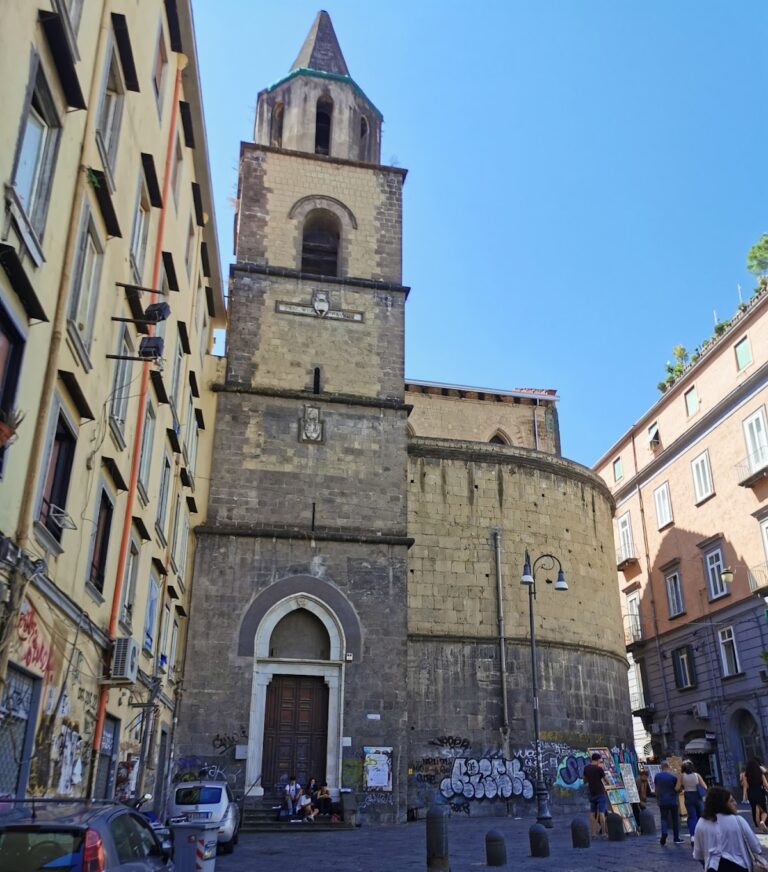
The new church was laid out in the opposite direction from San Michele Arcangelo a Morfisa. As a result, its apse, the polygonal termination of the main axis, faces the piazza. The basilica and monastery formed an extensive religious, artistic, educational, and cultural complex. The monastery also became the original seat of the University of Naples. Thomas Aquinas, the thirteenth-century Dominican theologian and philosopher, returned there to teach theology in 1272. Giordano Bruno, a later Dominican friar and philosopher, lived in the monastery, while Giovanni Pontano and Tommaso Campanella were among its students.
Thomas Aquinas and Dominican Memory
A tradition connected with Thomas Aquinas concerns a vision said to have occurred after Matins on 6 December 1273. According to the tradition, the sacristan Domenic of Caserta saw Aquinas levitating in prayer before an icon of the crucified Christ. Christ was said to have praised Aquinas’s writings, to which the theologian replied that he desired nothing but Christ. The story became part of the basilica’s Dominican memory and is associated with the crucifix now preserved in the Thomas Aquinas Room.
Renaissance Crisis and Baroque Transformation
Earthquakes and fires brought repeated rebuilding. Charles V was ceremonially received in the church in 1536, reinforcing its connections with the ruling elite. The fire of 1506 almost destroyed the Aragonese royal burials. During the seventeenth century, the church underwent major Baroque alterations. The original trussed roof was replaced in 1670 by a coffered and gilded ceiling, and the floor was completely remade by Domenico Antonio Vaccaro in 1732. Work on the floor continued into the eighteenth century.
The adjoining convent was also expanded and remodelled. Between 1668 and 1672, Tommaso Ruffo, Duke of Bagnara, commissioned the construction of large and small refectories on the site of the former infirmary. Later work followed the late-seventeenth-century rebuilding associated with Francesco Antonio Picchiatti. The historic library, regarded from the fifteenth century as one of Naples’ most important, was rebuilt as a room by Picchiatti in 1685. By the sixteenth century it held works by Giovanni Pontano, Xenophon, Aristotle, Ovid, Seneca, Cicero, and other authors.
Suppression, Restoration, and Heritage
During the French-dominated administration associated with Joachim Murat, the complex was assigned to public works from 1806 to 1815. The change damaged parts of the library and artistic heritage. Further disruption followed the suppression of religious orders. Between 1865 and 1885, the Dominicans again left the convent, whose buildings were used in succession as a gymnasium, school, refuge for beggars, and courthouse. Nineteenth-century restorations under Federico Travaglini sought to recover Gothic forms but substantially changed the church’s original spatial arrangement.
Pope Benedict XV raised the church to the rank of minor basilica in February 1921. A restoration in 1953 repaired damage caused by the 1943 bombing, restored the coffered ceiling, roofs, chapel balustrades, flooring, and eighteenth-century organ, and brought Pietro Cavallini’s frescoes back to light. The external piperno staircase and marble door were repaired in 1991. Piperno is a dark volcanic stone widely used in Naples. The convent was restored in 2012 in accordance with Picchiatti’s late-seventeenth-century rebuilding.
The original convent complex had three cloisters and extended as far as Via San Sebastiano, nearly reaching Santa Chiara. The seventeenth-century small cloister, known as the Cloister of the Statues, remains under the control of the religious complex. The former Cloister of Saint Thomas became a municipal gymnasium, while the Great Cloister, which once contained Giordano Bruno’s room, became part of Casanova secondary school. During the nineteenth century, the library collection was dispersed. Some books were lost, while others passed to university and national libraries.
Royal Burials and the Treasure
The sacristy contains 45 coffins with the embalmed remains of members of the Aragonese royal family. Among them are Ferdinand I of Naples, Ferdinand II of Naples, and Isabella of Aragon, Duchess of Milan. The room also contains the remains of Blessed Raymond of Capua, a former Master General of the Dominican Order, and Bishop Richard Luke Concanen, the first Catholic bishop of New York.
The Treasure Chamber was built in 1690 to preserve the hearts of Charles II of Naples, Alfonso V of Aragon, and Ferdinand II of Naples, together with important Dominican possessions. It remained closed to the public until 2000. In the late 1980s, clothing was removed from the Aragonese coffins and mummies, restored, and exhibited. Between 1984 and 1987, the Division of Paleopathology of the University of Pisa examined the tombs with Neapolitan heritage authorities. The examination identified three cases of cancer, two of syphilis, one of cirrhosis, and a rare case of hepatitis B with a smallpox-like eruption that had previously been mistaken for smallpox.
The complex also experienced repeated thefts and the removal of works to museums. Raphael’s Madonna of the Fish, once in the Crucifix Chapel, is now in the Prado Museum in Madrid. Titian’s Annunciation, commissioned for the Pinelli Chapel, is now in the Capodimonte Museum, as is Caravaggio’s Flagellation of Christ, formerly associated with the chapel of Our Lady or Zi’ Andrea. These transfers form part of the basilica’s artistic history.
Remains
Plan, Entrances, and Main Interior
The basilica is a large Angevin Gothic church substantially reshaped in the Baroque period. Its interior measures approximately 76 by 33 by 26.5 metres. A Latin-cross plan contains three naves, side chapels, a broad transept, and a polygonal apse. Twenty-seven chapels occupy the aisles, transepts, and areas near the apse. Their altars, tombs, heraldry, paintings, sculptures, floors, and frescoes preserve the long patronage of Neapolitan families including the Carafa, Brancaccio, Capece, Dentice, Spinelli, Tomacelli, Rota, Pinelli, Muscettola, and de’ Franchis.
The principal facade faces Piazza San Domenico Maggiore and stands opposite the obelisk of Saint Dominic. Its central street-level entrance, beneath a fifteenth-century Carafa balcony bearing the family heraldry, leads toward the Guevara of Bovino Chapel beneath the apse. A western staircase reaches the right transept through a Gothic-Renaissance portal from the middle of the fifteenth century. Commissioned for San Michele Arcangelo a Morfisa during the Aragonese period and associated with Alfonso I of Aragon, the staircase preserves a physical link with the earlier church.
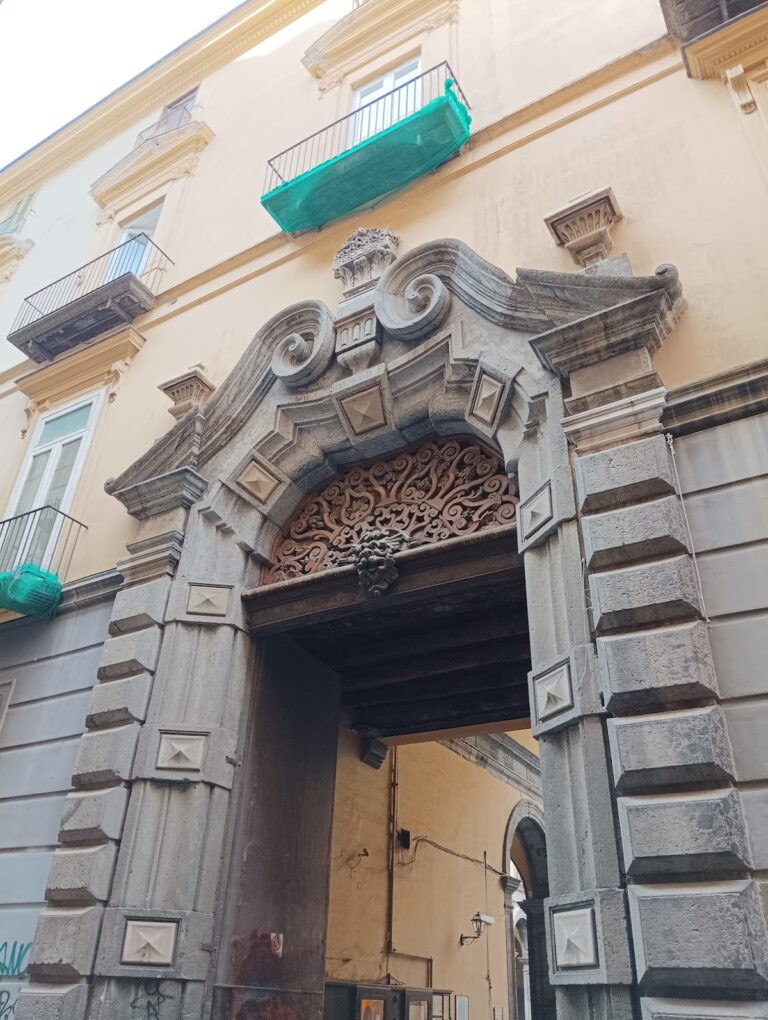
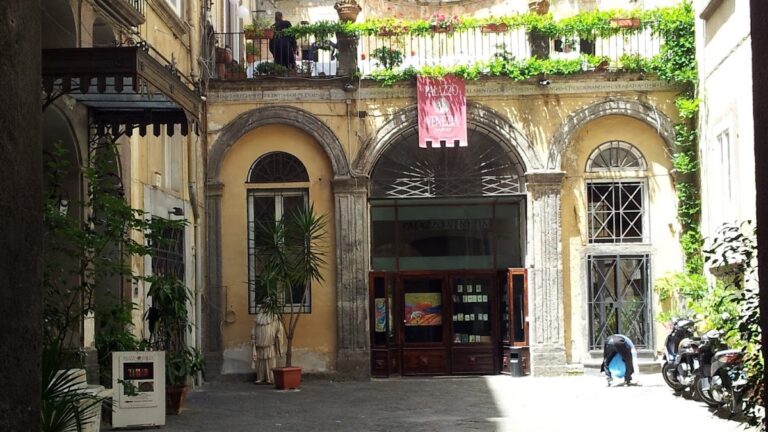
The main entrance is reached from a large courtyard on Vico San Domenico. A lunette over the outer arch contains The Virgin Offering the Dominican Scapular to Blessed Reginald, from the school of Pompeo Landulfo. An inscription on the inner arch records Charles II’s generosity toward the friars, while a marble statuette of the king stands in a courtyard niche. The courtyard also gives access to the Oratory of the Confraternity of the Most Blessed Sacrament. Its eighteenth-century entrance porch stands before the original pointed-arch Gothic marble portal and wooden door commissioned by Bartolomeo di Capua.
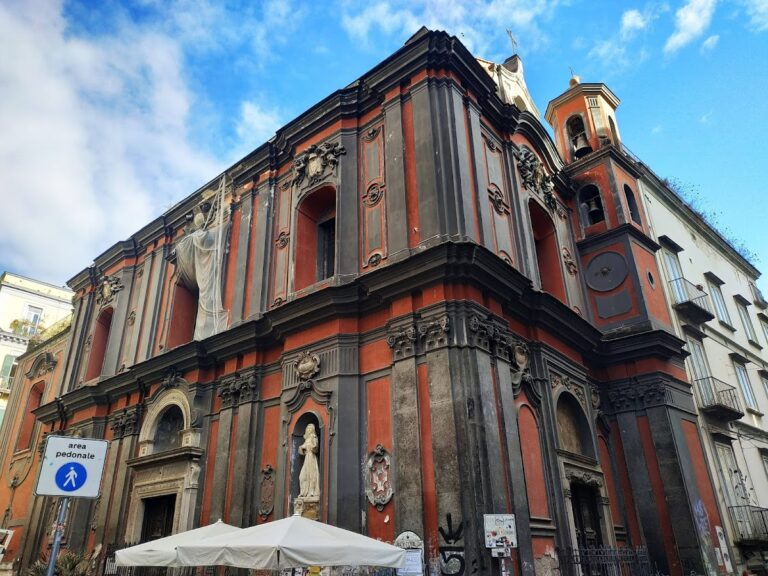
The facade of the oratory originally had three entrances. The two lateral openings were closed in the sixteenth century when the Carafa and Muscettola chapels were inserted into the counterfacade. A fourth entrance opens from Vico San Domenico into the left nave at the seventh chapel. An eighteenth-century bell tower rises beside the facade and next to the convent entrance. Inside, the Baroque coffered ceiling installed in 1670 is gilded and bears a Dominican coat of arms at the centre, with viceregal coats of arms at the corners. A mid-sixteenth-century pulpit stands at the fifth arch of the left nave.
Convent, Cloister, and Community Rooms
The adjoining convent has three levels. The ground floor contains the Cloister of the Statues and Thomas Aquinas’s teaching room. The first floor includes the library, refectory, Chapter Room, and Thomas Aquinas Room, while the upper levels contain the friars’ private rooms and a chapel used for some religious services.
Thomas Aquinas Rooms
The teaching room retains historical books, a valuable majolica-tiled floor, and a fresco by Michele Ragolia. Majolica is decorated tin-glazed pottery used here for architectural flooring. An inscription outside states that Aquinas received one ounce of gold each month for his lessons. The adjoining Cloister of the Statues contains four statues transferred from the church of San Sebastiano and leads to the monumental piperno staircase.
The Thomas Aquinas Room consists of two spaces used by Aquinas between 1272 and 1273 for conventual life, meetings with students, and liturgical studies. A monumental entrance contains a bust by Matteo Bottiglieri. After Aquinas left, the rooms were converted into a chapel and given a marble exterior portal. Above the altar is a thirteenth-century Crucifixion, traditionally connected with his prayer and vision. Restoration in 2017 and 2018 confirmed the panel’s refined quality, elegant linear style, and luminous colours. It is attributed to a Campanian or other southern Italian master influenced by eastern art and dated to the third quarter of the thirteenth century.
A reliquary beside the painting contains one of Aquinas’s bones, an upper-arm bone donated by Dominican friars from Toulouse, where he is buried. The adjoining room contains sacred furnishings, Aquinas’s desk and chair, historical books, and a handwritten page from one of his works.
Refectories and Chapter Room
The large and small refectories were built between 1668 and 1672. The large refectory has architectural perspective decoration by Arcangelo Guglielmelli, a Last Supper attributed to Domenico Antonio Vaccaro, and a Journey to Calvary attributed to a nineteenth-century artist. Antonio Rossi d’Aversa’s signed and dated 1727 Saint Thomas in Prayer before the Crucifix occupies the counterfacade.
The Chapter Room is among the best-preserved convent rooms. Built during Ruffo’s late-seventeenth-century expansion, it has stucco decoration by craftsmen associated with Cosimo Fanzago. Michele Ragolia painted the room around 1678 with a Calvary on the end wall, four Passion scenes and eight smaller scenes of the Mysteries of the Passion in the vault, and ten roundels showing putti carrying symbols of Christ’s martyrdom.
The upper levels preserve historical manuscripts, sixteenth-century parchment choir books, and paintings. Works include Mattia Preti’s 1656-1660 Saint John the Baptist Rebuking Herod and Beheading of Saint John the Baptist, a Magdalen by Cesare Fracanzano, and paintings by Francesco Solimena, Luca Giordano, and other seventeenth-century Neapolitan artists.
Right Aisle Chapels
Brancaccio and Capece Chapels
The first right-aisle chapel, dedicated to Saint Mary Magdalene and formerly owned by the Brancaccio Glivoli, contains a late-fourteenth-century fresco trace of the Madonna and Child. Fourteenth-century tombs commemorate Tommaso Brancaccio and Trani da Bartolomeo Brancaccio. Francesco Solimena’s 1730 Madonna and Child with Dominican Saints, a Saint Dominic by Giovanni Filippo Criscuolo, family heraldry, and an eighteenth-century wooden crucifix complete the chapel’s furnishings.
The Brancaccio Chapel, also called the Chapel of the Frescoes, was commissioned by Cardinal Landolfo Brancaccio around 1308. Pietro Cavallini painted its cycle, including the Stories of Saint John the Evangelist, a Crucifixion with the Virgin and Saint John, images of Saints Dominic and Peter Martyr, the Stories of Saint Andrew, and the Stories of Mary Magdalene. The cycle is a major example of Giottesque painting in Naples. The third chapel, originally dedicated to Saint George and held by the Capece family from 1549, contains an anonymous Crucifixion traditionally attributed to a member of that family, early-seventeenth-century tombs by Ludovico Righi, a statue of Corrado Capece by Girolamo d’Auria, and decoration with heraldry, military trophies, and weapons.
Chapels of Saint Charles and Saint Catherine
The fourth right-aisle chapel is now dedicated to Saint Charles Borromeo and was formerly dedicated to Saint Anthony Abbot. It contains a painting of the saint once mistakenly attributed to Giotto, Marco Pino’s 1564 Baptism of Christ, Teodoro d’Errico’s Ascension, and a Madonna of the Rosary Appearing to Saint Charles Borromeo and Saint Dominic by Filippo Vitale and Pacecco De Rosa. Mattia Preti’s Wedding at Cana and Meal in the House of Simon are also preserved there.
The fifth chapel, dedicated to Saint Catherine of Siena, has belonged to the Dentice delle Stelle since the fourteenth century. Its monuments include the fourteenth-century tombs of Dialta Firrao and Feliciana Gallucci, wives of Ludovico and Carlo Dentice, and the tomb slab of Carlo Dentice and Giovanna della Tolfa dated 1564. Dentice and Firrao heraldry and Matthias Stomer’s Adoration of the Shepherds add to the chapel’s furnishings.
Crucifix and Thomas Aquinas Chapels
The large Crucifix Chapel forms a separate interior space with a vestibule and two subsidiary chapels. Michele Ragolia painted its vault, while Wenzel Cobergher’s Resurrection is set into the right wall among Carafa tomb monuments. The left side contains the tomb of Francesca Carafa by Malvito and two Renaissance chapels with frescoes and funerary monuments. One of them contains a Nativity scene with statues made by Pietro Belverte during the first decade of the sixteenth century.
The chapel formerly held Raphael’s Madonna of the Fish, Colantonio’s Deposition, and the thirteenth-century Crucifixion now in the Thomas Aquinas Room. The Raphael and Colantonio paintings were transferred to museums, while the original crucifix was moved to protect and interpret it in its present setting. A photographic reproduction occupies the chapel altar.
The seventh right-aisle chapel is dedicated to Thomas Aquinas and has been patronized by the Aquinas family since the fourteenth century. Its seventeenth-century altar is attributed to Jacopo Lazzari and Antonio Galluccio. Luca Giordano’s Madonna and Child with Saint Thomas Aquinas, formerly on the altar, was stolen in 1975. Fourteenth- and sixteenth-century tombs and funerary monuments commemorate Joanna, Christopher, and Thomas Aquinas. A door at the front corner leads to the sacristy.
Left Aisle Chapels
Chapels of Our Lady, Saint John, and Saint Nicholas
The first left-aisle chapel, known as Our Lady or Zi’ Andrea, passed from the Spinelli family to the de’ Franchis family and was remodelled in Baroque form between 1637 and 1652 by Andrea Malasomma and Costantino Marasi. Corenzio’s vault frescoes are lost. Caravaggio’s Flagellation of Christ, commissioned by Tommaso de’ Franchis in 1607, was later moved to the Capodimonte Museum. Pietro Ceraso’s wooden Madonna of Zi’ Andrea replaced it in 1675. The chapel also contains the funerary monuments of Iacopo and Vincenzo de’ Franchis by Malasomma.
The second chapel, dedicated to Saint John the Evangelist and formerly belonging to the Carafa della Stadera branch, contains decoration dating from the sixteenth to the nineteenth centuries, low-relief busts of Saint John, Saint Dominic, and Saint Thomas, and paintings by Agostino Tesauro and Scipione Pulzone. Jacopo della Pila made the fifteenth-century tombs of Rinaldo Carafa and his son Antonio.
The third chapel, dedicated to Saint John the Baptist, contains Girolamo d’Auria’s statue of the saint and his monument to Bernardino Rota, made with Giovan Domenico d’Auria. Other features include a Madonna and Child associated with the school of Tino di Camaino, late-fifteenth-century tombs of Antonio Rota and Lucrezia Brancia, and a late-sixteenth-century monument to Alfonso Rota attributed to Giovanni Antonio Tenerello. The fourth chapel, dedicated to Saint Nicholas, contains a late-seventeenth-century painting of Saint Nicholas of Bari, engravings, and Gaetano Travone’s nineteenth-century funerary monument to Giovan Francesco d’Andrea.
Carafa and Tomacelli Chapels
The fifth left-aisle chapel, dedicated to Saint Bartholomew, has belonged to the Carafa della Spina family since the fourteenth century. Its seventeenth-century altar contains a Martyrdom of Saint Bartholomew attributed to Jusepe de Ribera. Monuments commemorate Alfonso and Maurizio Carafa, while the 1738 monument to Ettore Carafa was designed by Domenico Antonio Vaccaro and executed by Francesco Pagano. The chapel also contains Letizia Caracciolo’s mid-fourteenth-century tomb, family heraldry, eighteenth-century commemorative slabs, an anonymous late-sixteenth-century Martyrdom of Saint Lawrence, and two paintings attributed to Wenzel Cobergher.
The sixth chapel is dedicated to Saint Catherine of Alexandria and belongs to the Tomacelli family. It contains late-fifteenth- and early-sixteenth-century tombs, including Tommaso Malvito’s monument to Leonardo Tomacelli, as well as family heraldry, arms, a funerary slab decorated with skulls, and Giovanni Angelo D’Amato’s sixteenth-century Martyrdom of Saint Catherine. Cardinal Fabrizio Ruffo’s nineteenth-century tomb is also preserved there.
Chapel of Our Lady of the Snows
The final left-aisle chapel, dedicated to Our Lady of the Snows, contains Giovanni da Nola’s 1536 marble altar of Saint Mary of the Snows. A bronze bust of the poet Giovan Battista Marino, transferred there in 1813, stands with the 1553 tomb monuments of Bartolomeo and Girolamo Pepi.
Transepts and Presbytery
Right Transept and Former San Michele Church
The first chapel on the front wall of the right transept is dedicated to Saint Hyacinth. Giovanni Vincenzo da Forlì’s late-sixteenth-century altarpiece shows the Madonna appearing to Saint Hyacinth and is surrounded by panels depicting scenes from his life. Outside the chapel is the Dottonoroso altar, with a sixteenth-century relief of Saint Jerome in the desert.
The second front chapel incorporates the former Romanesque church of San Michele Arcangelo a Morfisa. It contains the sixteenth-century Rota family tomb group, the 1559 monument to Porzia Capece by Giovanni Domenico and Girolamo d’Auria, and the fourteenth-century Del Giudice monument. Within this former church are the chapels of Saint Bonito and Saint Dominic. The Saint Dominic Chapel retains Jacopo della Pila’s late-sixteenth-century tomb of Tommaso Brancaccio, fragments of fifteenth- and sixteenth-century tombs, a nineteenth-century maiolica floor, and the Quarantore ceremonial apparatus.
The Saint Bonito Chapel formerly belonged to Antonello Petrucci, secretary to Ferdinand I, whose family palace adjoins the chapel and basilica. After the barons’ conspiracy it passed to the Bonito family, who commissioned Giuliano Finelli’s statue of Saint Bonito for the high altar. Matteo Bottiglieri made the tomb of Alessandro Vicentini on the left wall.
Guardian Angel and Saint Dominic Soriano Chapels
The first chapel beside the apse, Saint Dominic Soriano, belonged to the Carafa della Stadera family from the fifteenth century. Its name comes from an eighteenth-century altarpiece depicting Saint Dominic Soriano. Two paintings by Luca Giordano show Thomas Aquinas and Vincent Ferrer, while Giovanni Cosenza painted the eighteenth-century frescoes.
The Guardian Angel Chapel, formerly dedicated to Thomas Aquinas, contains a late-sixteenth-century wooden altar statue of a guardian angel, frescoes by Michele Ragolia, an eighteenth-century maiolica floor, marble reliefs, and the remains of Saint Tarcisius. Outside the chapel, in the right corner of the transept, is Galeazzo Pandone’s 1514 tomb. A statue of the Virgin and Child by Giovanni da Nola stands above it, with the front of John of Anjou’s sarcophagus by Tino di Camaino higher still.
Left Transept Chapels
The first front chapel of the left transept is the Pinelli Chapel, purchased in 1545 by the Genoese banker Cosimo Pinelli. Its marble floor bears the family arms, and tombs commemorate Cosimo Pinelli and Giustiniana Pignatelli. Titian’s Annunciation, commissioned by Pinelli and installed shortly after 1557, was later transferred to the Capodimonte Museum.
Outside the chapel is the Saint Jerome altar, attributed to the circle of Tommaso Malvito and representing the surviving remains of the former Riccio Chapel. It incorporates an altar table with a relief of the resurrecting Christ, Michele Riccio’s 1515 funerary inscription, heraldry, a relief of Saint Jerome in the desert, and a lunette with the Annunciation. Nearby, the monumental tomb of Rainaldo Del Doce by Tommaso Malvito and Giovanni da Nola stands above a late-fifteenth- or early-sixteenth-century marble altarpiece and the fourteenth-century tomb slab of Philip of Anjou by Tino di Camaino.
The second front chapel is the Blanch Chapel, or Saint Vincent Chapel. Ownership passed from the Carafa family to the Spinelli family. The chapel contains Andrea Falcone’s tomb of Tommaso Blanch and a nineteenth-century painting of Saint Vincent.
The Rosary Chapel, beside the left side of the apse, was dedicated to the Virgin of the Rosary in 1692. Vincenzo Carafa acquired it in the eighteenth century and commissioned Carlo Vanvitelli’s restoration in 1779. Fedele Fischetti painted the 1788 altarpiece of the Madonna of the Rosary and the chapel frescoes. Andrea Vaccaro’s copy of Caravaggio’s Flagellation of Christ was displayed there for a period. A crypt beneath the chapel contains burials of members of the Carafa family and their relatives, including Ippolita Gonzaga, wife of Antonio Carafa, Duke of Mondragone.
Saint Stephen Chapel and Apse
The second chapel along the presbytery is dedicated to Saint Stephen, or the Immaculate Conception. Its furnishings include Roberto d’Oderisio’s fourteenth-century fresco of the Immaculate Conception, Paolo Finoglio’s seventeenth-century painting of the same subject, a sixteenth-century statue of Saint Stephen, Bernardino Moro’s tomb of Filippo Spinelli, and Giovanni Marco Vitale’s funerary monument to Carlo Spinelli.
Nicola Tagliacozzi Canale designed the apse area. Behind the high altar stands the Baroque organ case from 1715, made by Fabrizio Cimino. It occupies the area formerly containing the Aragonese royal tombs, which were almost destroyed in the fire of 1506, and replaced two earlier organs. Two large nineteenth-century frescoes by Michele De Napoli, Saint Thomas among the Doctors and Saint Dominic Disputing with the Heretics, replaced lost paintings by Michele Ragolia from 1680.
The wooden choir in the tribune dates from 1752 and was made by the Dominican Giuseppe Parete. Cosimo Fanzago made the high altar and marble balustrade in 1652. After the earthquake of 1688, Ferdinando de’ Ferdinandi, Giovan Battista Nauclerio, and Lorenzo Vaccaro adapted the area, with Vaccaro adding the two lateral putti in 1695. The crucifix is nineteenth-century, while other sculptural elements date mainly from the sixteenth century.
The present pipe organ was built in 1973 by the Ruffatti brothers’ firm using the 1715 Baroque case. It has electric action, an independent console with two 61-note manuals, and a concave-radial 32-note pedalboard. The decorated wooden case has three display fields, each with a principal-pipe tower and mitre mouths. Two fourteenth-century lions stand beside Fanzago’s balustrade. Near the left lion, three Virtues function as caryatids supporting a late-sixteenth-century candelabrum. These elements came from the dismantled funerary monument of Philip of Anjou by Tino di Camaino.
Guevara of Bovino Chapel
Two spiral staircases beside the balustrade descend to the Guevara of Bovino Chapel, also called the Succorpo, beneath the apse. Dating from around the end of the sixteenth century, it is reached through the central entrance facing Piazza San Domenico Maggiore.
Sacristy and Treasure Chamber
Sacristy
The sacristy is a large rectangular room decorated in eighteenth-century Baroque forms to designs by Giovan Battista Nauclerio. A sacristy is a room used to prepare and store objects needed for worship. The ceiling fresco by Francesco Solimena, The Triumph of Faith over Heresy through the Dominicans, occupies the upper space, while Fabrizio Santafede’s Annunciation, a marble floor, and eighteenth-century furnishings complete the interior. Around the gallery beneath the vault are the 45 coffins containing the embalmed royal and aristocratic remains.
Treasure Chamber
A door beside the high altar leads to the Treasure Chamber. Its collection includes royal clothing, processional objects, sacred silver, and Dominican relics, arranged in four sections within monumental eighteenth-century walnut cupboards: the Aragonese Arches, the Processions, the Treasure, and the Sacred Ornaments. The entrance door, a carved wooden work from the second half of the sixteenth century, is attributed to Cosimo Fanzago. Picchiatti decorated the cupboard doors, whose style corresponds to the terracotta-tiled floor made by Donato and Giuseppe Massa.
The Aragonese section contains fifteenth- and sixteenth-century clothing and accessories removed from royal coffins and mummies, restored, and displayed. Among the objects are Ferdinand I’s ivory, silk, and silver pillow embroidered with a black glove and the family motto juvat; Ferdinand II’s goatskin pillow and part of his sheath and dagger, which retain fire marks from 1506; and an ochre damask dress of Isabella Sforza of Aragon measuring 103 centimetres in length and 480 centimetres in width. The section also contains an ivory satin suit and gold-velvet hat associated with Peter of Aragon, a brown velvet suit attributed to Fernando Francesco d’Avalos, Maria of Aragon’s ivory taffeta and grosgrain dress with linen turban, and clothing and shoes of noble children.
The Processions section contains papier-mache, wooden, and silver-laminate busts of Dominican saints formerly carried in eighteenth- and nineteenth-century processions, including Saint Vincent Ferrer, Saint George, and Peter Martyr of Verona. Embroidered linen drapes made by Neapolitan embroiderers between 1669 and 1685 include scenes and allegories associated with Thomas Aquinas. Their silk-and-gold embroidery uses the punto pittura technique to create effects of light and shadow. Other drapes represent Benevolence, God’s Grace, Humility, and Peace Embracing Justice. Busts of Agnes of Rome, Raymond of Penyafort, and Louis Bertrand are also included.
The Treasure section holds Dominican liturgical vestments, copes, chasubles, altar frontals, mother-of-pearl ornaments, reliquaries, monstrances, and candelabra. A reliquary is a container for a relic, while a monstrance displays a consecrated host. Notable pieces include an eighteenth-century French brocaded lampas cope embroidered with silver and gold, a late-eighteenth-century peach tunic from the silk factories of San Leucio, an eighteenth-century altar frontal depicting the Virgin, Saint Dominic, and the Mysteries of the Rosary, and a reliquary finger of Saint Blaise.
The Sacred Ornaments section preserves objects that formerly decorated the basilica’s sacred spaces. They include eighteenth-century busts of Pope Pius V and Saint Dominic, a rock-crystal and gilt-bronze crucifix, wooden and silver-laminate vases with mother-of-pearl flowers, and nineteenth-century silver-copper candelabra.