Statua del Dio Nilo: an Ancient Roman Nile Sculpture in Naples

Site at a Glance
- Rating
- 4.4
- Popularity
- Low
- Country
- Italy
- Primary era
- Classical
- Eras represented
- Classical, Early Modern
- Civilizations
- Kingdom of Naples, Roman, Spanish
- Site type
- Civic
- Remains
- Monument
On this page12 sections
History
The Statua del Dio Nilo is an Ancient Roman marble sculpture in Naples, Italy, dating to the mid-second century AD, although a broader dating places it in the second or third century AD. It was probably erected in Neapolis, the ancient Greek name for Naples, by Alexandrian merchants or by the Egyptian community established there for commercial purposes. The monument honored the Nile as a divine source of prosperity and wealth.
The Alexandrian quarter
The Egyptian residents of Naples included travelers, merchants, and enslaved people from Alexandria. Their settlement occupied the area known as the Regio Nilensis, or Alexandrian quarter, and was associated with the street or district called the vicus Alexandrinus. The statue stood in the southwestern part of the ancient city, near the Plateia Inferior, an important residential area during the Roman period.
Local people called the Alexandrian community the “Nilesi,” and the sculpture eventually gave its name to the medieval administrative district known as the Seggio, or Sedile, of Nilo. A Seggio was both a Neapolitan district institution and the building where its representatives met. The district’s name was later corrupted to Nido.
Medieval rediscovery and changing interpretation
The statue was already visible by the twelfth century, when the first building of the Seggio di Nilo was constructed. It was moved elsewhere before the middle of the fourteenth century, possibly to the nearby monastery of Santa Maria Donnaromita. During construction of the second Seggio di Nilo, carried out between 1476 and 1507, the sculpture reappeared at the entrance to the present Via Paladino. Its rediscovery was described in historical works by Camillo Tutini, Giovanni Antonio Summonte, Ludovico de la Ville Sur-Yllon, and Bartolommeo Capasso.
Because the statue had lost its head, it was first interpreted as a female personification of Naples. The small figures around it were understood as children feeding at a mother’s breast, an image of the city nourishing its inhabitants. This interpretation gave the sculpture the name Corpo di Napoli, meaning “body of Naples,” and the same name was applied to the square where it stood.
In 1581, Angelo di Costanzo, writing under the pseudonym Marco Antonio Terminio, identified the figure as the Nile. The medieval district’s name probably originated with this earlier recognition, although its meaning was later largely forgotten.
Restoration and modern conservation
The old Seggio building was completely demolished in 1657, after which the sculpture was placed on a piperno pedestal. Piperno is a dark volcanic stone traditionally used in Naples and its surrounding region. At the initiative of families connected with the district, Bartolomeo Mori added a bearded male head, replaced the right arm, and supplied or restored the cornucopia, the heads of the crocodile and sphinx, and several small figures.
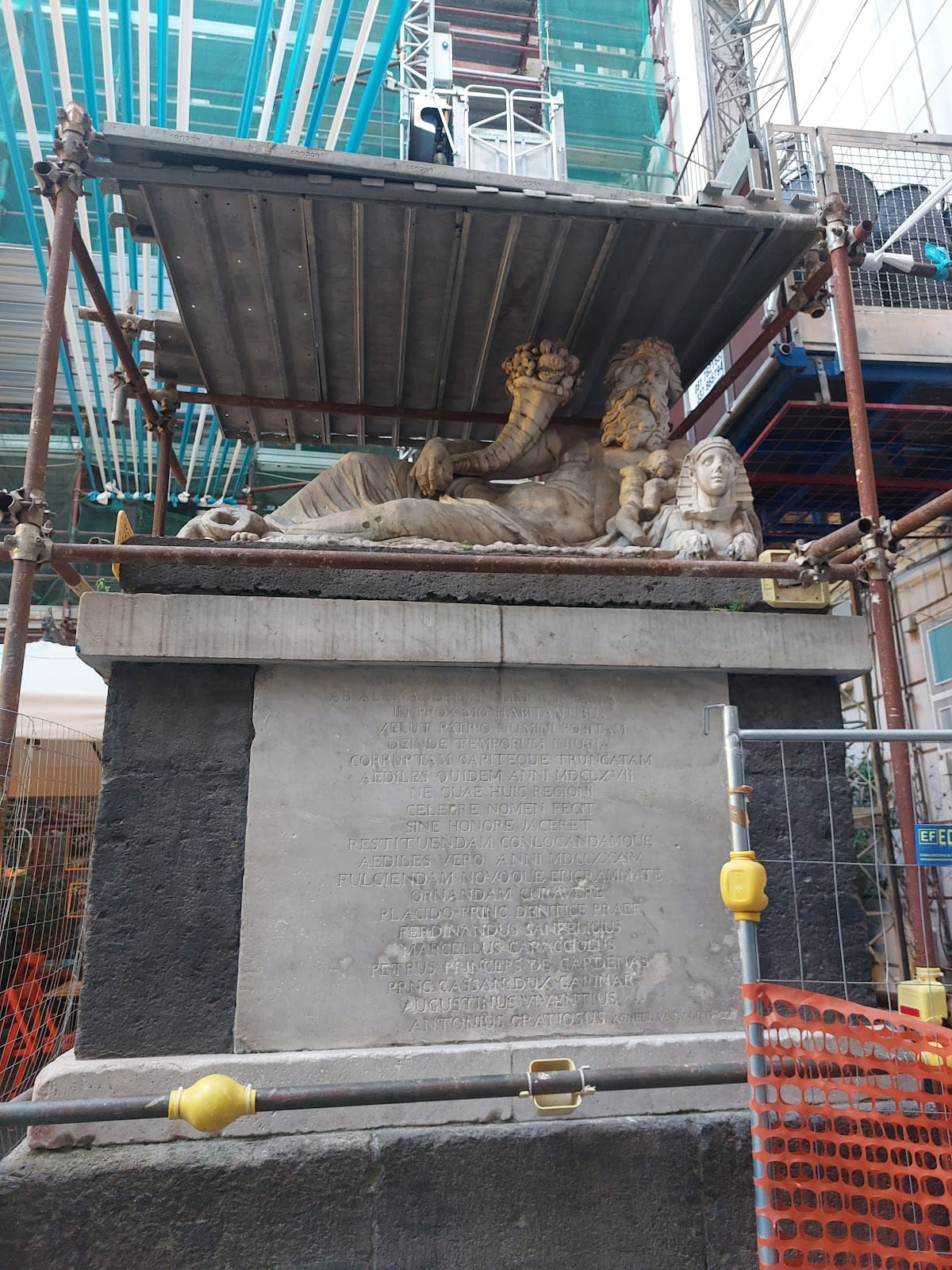
The first inscription commemorating the restoration was later lost, and the sculpture suffered further damage. In 1734, restoration sponsored by the Dentice and Caracciolo families and promoted by local figures including Ferdinando Sanfelice led to the Latin inscription still visible on the pedestal. The inscription recounts the statue’s history and restorations. Its reference to the 1657 intervention incorrectly gives the year as 1667, while Matteo Egizio later recorded the correct date.
Between the late eighteenth and early nineteenth centuries, Angelo Viva carried out extensive work on parts added by Mori. Viva described the sculpture as a mutilated torso and reconstructed almost all of its limbs and surrounding decorative elements. After the Second World War, two of the three lower putti and the sphinx’s head were stolen, probably for sale on the black market. The Carabinieri’s Command for the Protection of Cultural Heritage recovered the sphinx’s head in Austria in 2013, about sixty years after the theft.
The monument was restored in 1993 and again for most of 2014. The later intervention cleaned the sculpture and returned the recovered sphinx’s head. It was completed in November 2014 and presented to the city on 15 November. The Municipality of Naples owns the statue, which stands in Largo Corpo di Napoli, also called Piazzetta Nilo. The square and the adjoining quarter preserve the name derived from the monument.
Remains
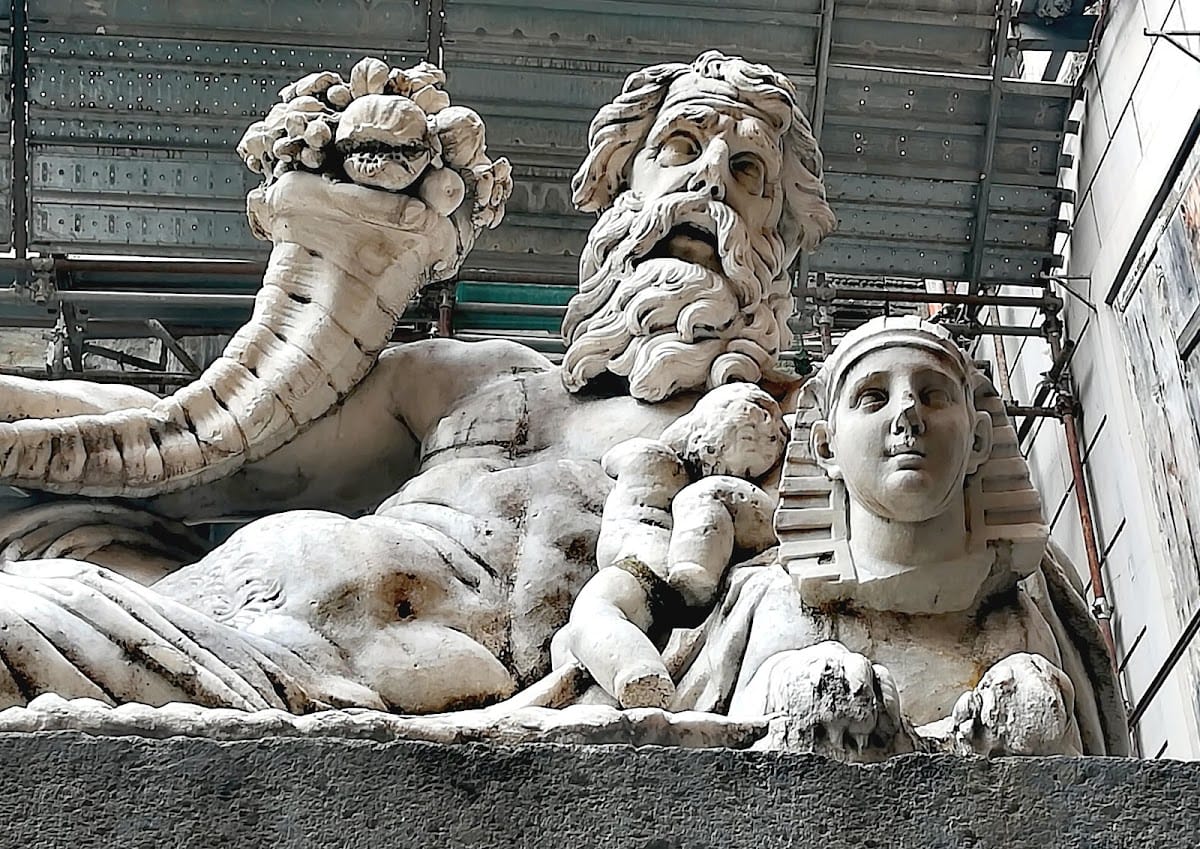
The monument is a marble group arranged on a wave-shaped base. It represents the Nile as a reclining, bearded, seminude male figure lying on waves, with a cornucopia in his right hand and his left arm resting on a sphinx. The ancient core includes the god’s torso, veiled lower limbs, left arm and shoulder, the wave-shaped plinth, and the bodies of the crocodile and sphinx. Much of the visible form consists of additions and reconstructions made during later restorations.
River god and associated creatures
The Nile figure
The reclining figure’s beard, exposed upper body, draped lower limbs, and cornucopia express the statue’s image of the Nile as a source of abundance. Its position on the wave-shaped plinth establishes the river setting, while the restored head and right arm contribute to the form seen today.
The sphinx and crocodile
The sphinx supports the god’s left arm. Its body belongs to the ancient sculpture, and its head is covered by a klaft, the striped headcloth traditionally associated with Egyptian royal and divine imagery. Near the god’s feet lies a crocodile with leonine feet. The crocodile’s head was identified with Ammut, an ancient Egyptian creature associated with the judgment of the dead and the devouring of condemned souls.
Putti and pedestal
The surviving putto
A single plump putto climbs toward the god’s chest and probably represents a tributary of the Nile. The original composition included three lower putti. Two were stolen during the postwar period, while the surviving figure remains part of the sculptural group.
The piperno pedestal
The sculpture stands on a piperno pedestal made in 1657. A marble plaque on its principal side carries the Latin inscription installed during the 1734 restoration, linking the present support with the monument’s long sequence of repairs.
Urban setting
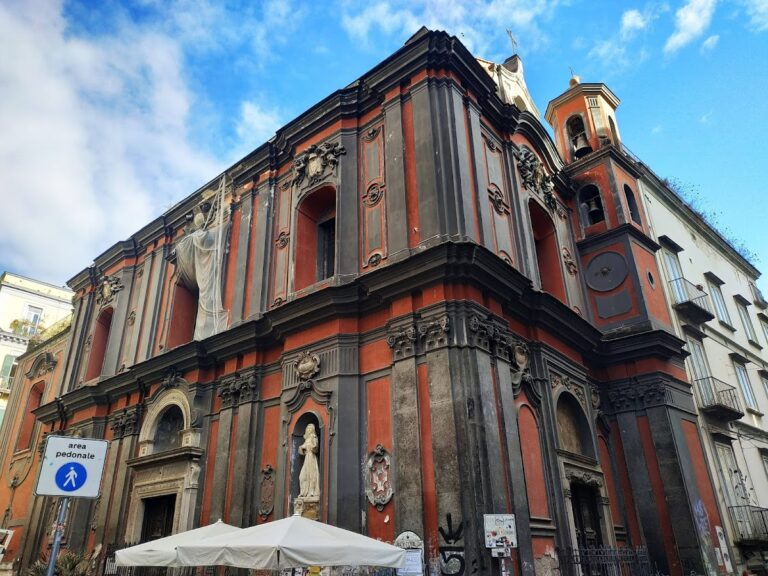
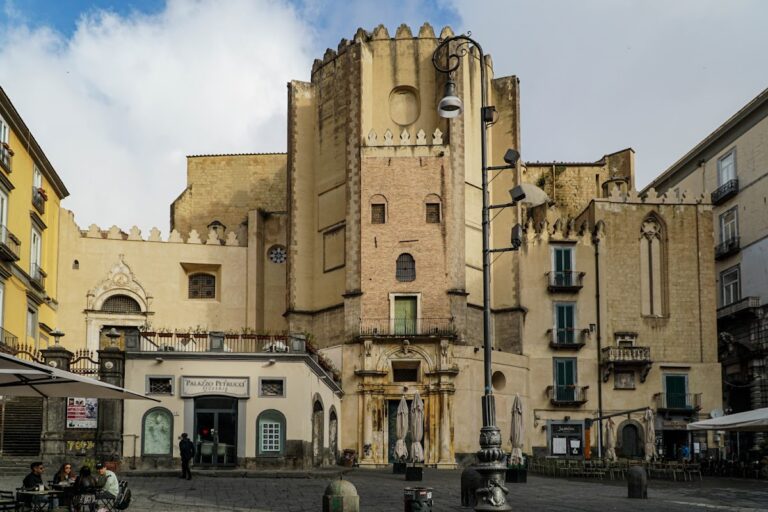
The statue is displayed at the beginning of Via Nilo in Largo Corpo di Napoli, within the area associated with the former Regio Nilensis. Santa Maria Assunta dei Pignatelli faces the monument, while the Palazzo del Panormita extends along the northern side of the square. The church of San Domenico Maggiore stands two blocks to the east along Via Benedetto Croce, part of the lower decumanus, a principal east-west street in a Roman city, commonly called Spaccanapoli.
The Naples sculpture and a higher-quality Ancient Roman version in the Vatican Museums are regarded as copies of an original from Alexandria in Egypt.