Santa Maria Zobenigo: A Venetian Baroque Church in Venice


Site at a Glance
- Rating
- 4.7
- Popularity
- Medium
- Country
- Italy
- Primary era
- Early Modern
- External website
- Open
- Eras represented
- Early Modern, Modern
- Civilizations
- Habsburg, Venetian
- Site type
- Religious
- Remains
- Church
On this page20 sections
History
Santa Maria Zobenigo, also called Santa Maria del Giglio, is a Roman Catholic church in Venice, Italy, rebuilt in the Venetian Baroque style between 1678 and 1683. Its origins reach back to the tenth century, when tradition attributes its foundation to the Jubanico family, a Slavic family associated with a palace in the area. The church became known for its unusual commemoration of Antonio Barbaro and his family, whose political and military careers shaped the rebuilding and its imagery.
Early foundations and medieval development
The older name Zobenigo developed from the name of the Jubanico family in the Venetian dialect. The dedication Santa Maria del Giglio, meaning Saint Mary of the Lily, refers to the flower traditionally associated with the Annunciation, the Christian episode in which the archangel Gabriel announces to Mary that she will bear Jesus. The original church was a three-aisled Byzantine basilica supported by family endowments.
Fire damaged the church in 966 and again in 1105, leading to rebuilding or substantial alteration. A further tradition holds that a wall begun at the church during the Hungarian siege of Venice around 899 extended toward Castello, then known as Olivolo. This claim remains a historical tradition rather than a certain account of the building’s development.
Santa Maria Zobenigo became a parish in the eleventh century and remained a collegiate church until 1807. Its jurisdiction extended over many neighboring churches, including San Moise, San Fantin, San Maurizio, San Benedetto, Sant’Angelo, San Vidal, San Samuele, San Gregorio, San Vio, Sant’Agnese, San Trovaso, San Barnaba, and San Raffaele.
The seventeenth-century rebuilding
The present church replaced the earlier structure during Venice’s war with Cyprus and a period when Venetian maritime power in the East was declining. Construction took place from 1678 to 1683, with Giuseppe Sardi associated with the rebuilding, the facade, and the side altars. Antonio Barbaro left 30,000 ducats in his will for the project and specified that the church should commemorate his political and military career as well as his family. The Venetian Senate and the chapter approved the plans, and Patriarch Giovanni Alberto Badoer consecrated the church in July 1700.
The celebratory program reflected Barbaro’s wishes. It presented his family and public achievements through images of cities, naval battles, military trophies, and allegorical figures rather than relying mainly on conventional saintly imagery. The commemoration was pointed in light of Barbaro’s dismissal for incompetence during the Cretan War, which was conducted under Francesco Morosini.
Napoleonic reforms and later status
Napoleonic reforms between 1807 and 1810 reduced the number of Venetian parishes from about 70 to slightly more than 30. Santa Maria del Giglio retained parish status and continued to exercise jurisdiction over San Vidal, San Maurizio, and San Fantin, although San Maurizio was suppressed in 1807 and San Fantin in 1810. The church was restored in 1833.
After a later period of abandonment, the church became a rector church in 1967, meaning that it was administered by a rector rather than functioning as an independent parish church. It is now part of the parish of San Moise and belongs to the Venetian Patriarchate, the Roman Catholic ecclesiastical jurisdiction headed by the patriarch of Venice. During the annual Salute festival on 21 November, a temporary bridge is built from the campo beside Santa Maria Zobenigo across the Grand Canal so processions can reach Santa Maria della Salute.
The facade attracted severe criticism from John Ruskin in The Stones of Venice, published in three volumes between 1851 and 1853. He condemned its predominantly secular glorification of the Barbaro family as “brazen atheism” and treated it as an extreme example of personal glorification in Venetian Baroque architecture.
Remains
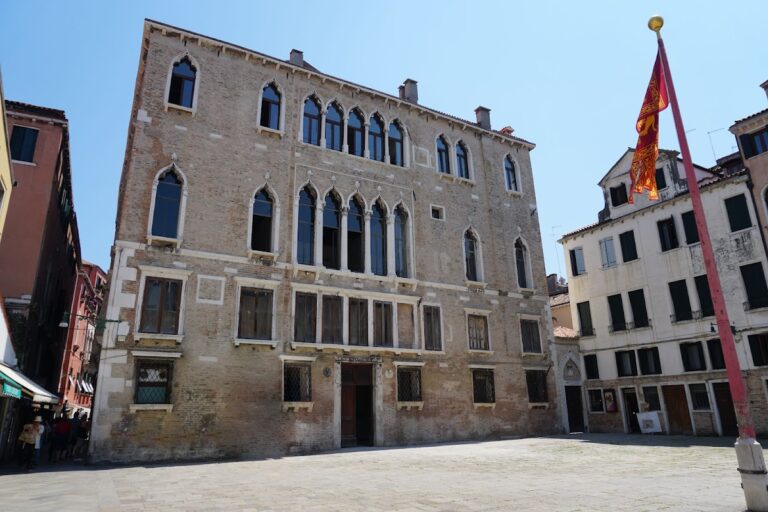
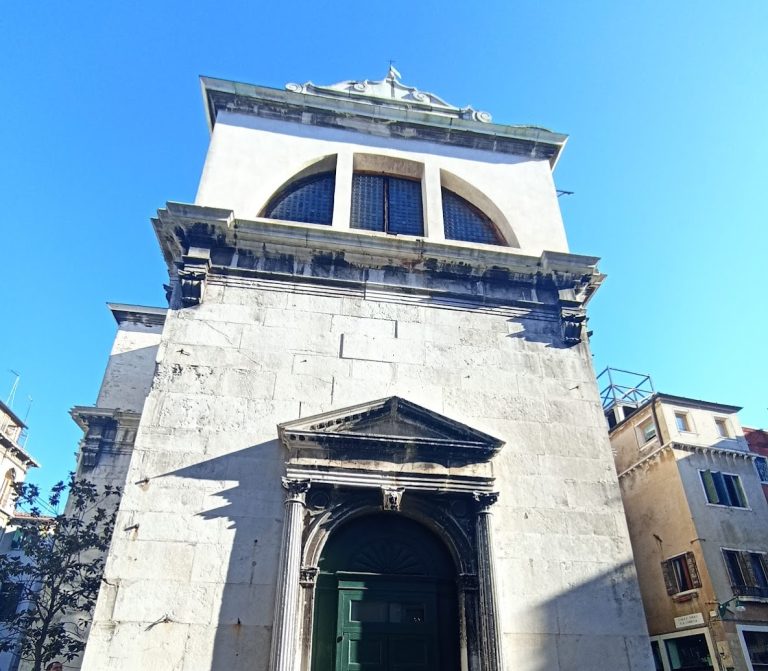
Santa Maria Zobenigo stands beside Campo Santa Maria Zobenigo, west of Piazza San Marco. The rebuilding retained the earlier east-west axis. The decorated facade faces a narrow street, while the comparatively plain side elevation faces the campo. The church is a single-nave Baroque building made principally of brick and marble. Inside, the compact nave has three relatively shallow chapels or altars on each side, and the rectangular apse is covered by a barrel vault.
Facade and commemorative sculpture
The facade has two tiers framed by paired fluted columns. The lower tier uses the Ionic order and the upper tier the Corinthian order, an arrangement that departs from the usual rules for superposed orders. An attic and a segmental pediment crown the composition. Its imagery is centered on Antonio Barbaro and the Barbaro family, creating a political and military memorial within the church’s architectural front.
Maps, battles, and military trophies
Relief maps of Zadar, Candia, Padua, Rome, Corfu, and Split occupy the lower plinths. Reliefs of naval battles appear on the corresponding upper bases, accompanied by trophies of drums, trumpets, flags, and cannon. Together these elements present the geographical and military dimensions of Barbaro’s public career.
Barbaro family statues
Niches in the lower tier contain statues of Antonio Barbaro’s brothers, Giovanni Maria, Marino, Francesco, and Carlo Barbaro. Each is shown in the clothing of his public office. The statues are probably attributed to Heinrich Meyring, also known as Enrico Merengo.
Antonio Barbaro’s monument
Above the entrance, Antonio Barbaro appears on his sarcophagus in a monument attributed to Josse de Corte. Allegorical figures of Honour, Virtue, Fame, and Wisdom flank the tomb. Higher on the facade, the Barbaro coat of arms is surrounded by further allegorical figures, putti, and winged figures of victory attributed to Tommaso Rues.
Nave, apse, and chapels
Nave and high altar
The nave ceiling carries a large painting by Antonio Zanchi. Three additional paintings by Zanchi, dated 1690 to 1696, show the Birth of the Virgin, the Coronation of the Virgin, and the Assumption of the Virgin. The high altar is flanked by Heinrich Meyring’s sculptural group of the Annunciation. Behind the altar in the sanctuary are paintings of the Evangelists by Jacopo Tintoretto. Former organ shutters also depict the Evangelists and include work attributed to Alessandro Vittoria.
Entrance paintings and side altars
Above the entrance are Giulio del Moro’s Last Supper and Giuseppe Porta’s Four Sibyls. Nearby are Antonio Zanchi’s Martyrdom of Saint Anthony, Consecration of the Church, and Venice in an Act of Atonement, together with several Marian paintings. The first altar on the right when approached from the presbytery contains Palma the Younger’s Visitation of Saint Elizabeth. The altar opposite contains Christ with Saints Francis of Paola and Justina, from the workshop of Jacopo Tintoretto, a work damaged during restoration. Other paintings are by Sebastiano Ricci, Palma the Younger, Johann Carl Loth, Francesco Solimena, and Andrea Schiavone.
Molin Chapel
The Molin Chapel, on the right side of the nave near the entrance, contains Peter Paul Rubens’s Madonna and Child with the Young Saint John the Baptist, identified as the only surviving painting by Rubens in Venice. Domenico Tintoretto painted the chapel’s ceiling image of the Madonna and Child. The chapel also contains a 1750 image of Saint Vincent Ferrer by Giovanni Battista Piazzetta and Giuseppe Angeli.
Stations of the Cross
Fourteen Stations of the Cross line the nave. Dated 1755 to 1756, the series represents episodes from Christ’s Passion and was produced by several artists, including Francesco Fontebasso, Francesco Zugno, Gianbattista Crosato, Gaspare Diziani, Jacopo Marieschi, and Domenico Maggiotto.
Sacristy and music
Sacristy painting
The sacristy contains Antonio Zanchi’s Abraham Teaching Astrology to the Egyptians, painted around 1665.
Mascioni organ
The Mascioni organ was built in 1913 and 1914. It has two manuals, a pedal, and thirteen stops, with pneumatic actions.
Bell towers
Earlier campanile
The former campanile, or bell tower, was a thirteenth-century structure. It was removed or collapsed in the late eighteenth century after becoming unstable.
Later bell structures
Reconstruction of the tower began in 1805 but stopped at approximately 8 metres, leaving an unfinished structure that later served commercial purposes. In 1823, a separate roof tower for three bells was built to the right of the choir on the initiative of the vicar of San Fantin.