Church of Our Lady (Klášterec nad Ohří): A Baroque-Rococo Pilgrimage Church


Site at a Glance
- Rating
- 4.6
- Popularity
- Very Low
- Country
- Czechia
- Primary era
- Early Modern
- External website
- Open
- Eras represented
- Early Modern, Modern
- Civilizations
- Habsburg, Holy Roman Empire, Kingdom of Bohemia
- Site type
- Religious
- Remains
- Church
On this page7 sections
History
The Church of Our Lady in Czechia is a Roman Catholic cemetery and pilgrimage church built between 1743 and 1760 in the Baroque-Rococo period. It is a filial church, meaning that it is subordinate to the parish church of the Holy Trinity rather than serving as the principal parish seat. The church belongs to the Litoměřice Diocese, the Czech ecclesiastical province, and the Krušnohorský Vicariate. It is also called the Church of Our Lady of Consolation, the Church of Our Lady of Protection, or the cemetery church.
The Marian cult and the cemetery chapel
The church stands on the site of a cemetery chapel dating from around 1500. Its later pilgrimage tradition developed around a Gothic wooden statue of the Virgin Mary, traditionally believed to possess miraculous powers. Around 1650 or 1652, the parish priest Daniel Heiden acquired the statue and a Marian image from the Augustinian monastery of Saint Thomas in Prague for 30 Imperial thalers. He initially placed them in the parish church of the Holy Trinity.
When the Holy Trinity church was demolished between 1665 and 1670 to make way for the present Baroque building, the statue was moved temporarily to a side altar in the Church of Saint Nicholas at Mikulovice. Devotees, especially people suffering from eye diseases, came to venerate it, and local tradition connected it with comfort and healing. Pope Clement IX granted indulgences, particularly for the feast of the Visitation of the Virgin Mary, which commemorates Mary’s visit to Elizabeth.
In 1683, after ecclesiastical and secular approval, the statue returned to Klášterec in a solemn procession and was placed in the cemetery chapel on an altar commissioned by Johann Egermann, the estate’s economic administrator. Several thousand people attended. A local tradition says that the statue began moving toward Klášterec during a Mass at Mikulovice after Egermann, who had an eye ailment, made a pilgrimage there.
Construction and later religious use
The growing pilgrimage cult made the cemetery chapel increasingly important as a devotional destination. Plans to demolish it and build a large church were made in 1712, but donations did not cover the proposed work. Instead, the chapel was extensively repaired and reconsecrated on 15 August 1714. A tower was added in 1725, and the first collection for the new church was organized.
The present church was built by Johann Christoph Kosch of Kadaň, using the Church of Saint John of Nepomuk in Prague’s New Town as its model. Vicar Wenceslas Kirchner of Deutsch Kralup consecrated it on 4 July 1750, although its towers were completed only in 1831 according to plans by Karl Siech. The building received the honorary title Our Lady of Consolation in 1764–1765. During that period, as many as 14,000 worshippers received the sacraments in Klášterec during the octave of the feast.
The church was renewed in 1825 and renovated again in 1967. It remains a functioning place of worship, and its pilgrimage tradition continues. The building is protected under the applicable heritage-protection system.
Remains
Plan and exterior
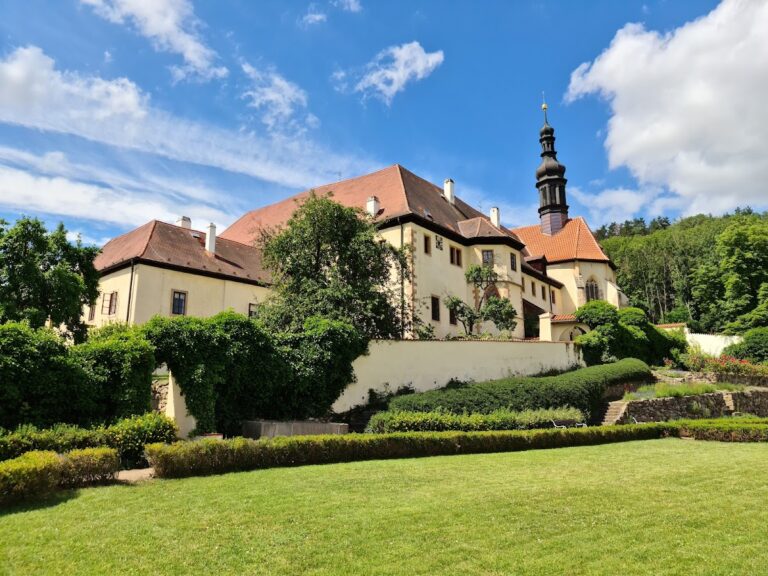
The cemetery church stands in the western or northwestern part of Klášterec nad Ohří and measures approximately 24.5 metres in length and 18 metres in width. Its altar faces southwest, while the main axis otherwise runs from south to north. The plan combines an elliptical presbytery, a choir gallery on the main axis, two rectangular side chapels on the transverse axis, and two sacristies placed diagonally. Two square towers stand obliquely at the facade.
The one-storey towers are divided by pilasters and niches and carry onion domes added in 1831. The principal portal has richly sculptural decoration. Stone, brick, and masonry form the building fabric. Inside, clustered pilasters support flat vaults over the nave, presbytery, and choir gallery, while the side chapels have barrel vaults.
Paintings and furnishings
Eighteenth-century ceiling frescoes show the Mysteries of the Rosary, the Miracles of the Virgin Mary, and the Birth of the Virgin Mary. They are attributed to Josef Hager of Přísečnice. The presbytery contains frescoes of illusionistic architecture, painted columns and structures that create the impression of architectural extensions, together with the four Evangelists and the four Fathers of the Church, major early Christian theologians influential in Christian doctrine and worship.
The principal altar and two side altars date from 1823 and were made by Andreas Friedrich of Chomutov. Their column-and-pilaster compositions use painted architectural effects. The side altars retain original statues of Saint Barbara and Saint Vincent, accompanied by angel sculptures. A Rococo, panelled side altar dedicated to Saint Anne has sculptures made by Karl Waitzmann of Kadaň around 1760. The church also contains an image of Saint Ottilia from the second half of the eighteenth century and Baroque carved pews dating from around 1700.
Above the principal altar, a Gothic wooden statue of the Virgin Mary, dated to about 1480–1490, hangs in a glass case. It is associated with the pilgrimage cult and is identified as having come from the Augustinian monastery in Prague. A Marian grace image, a devotional image believed to convey particular divine favor, dates from 1765 and is also connected with the church’s veneration.
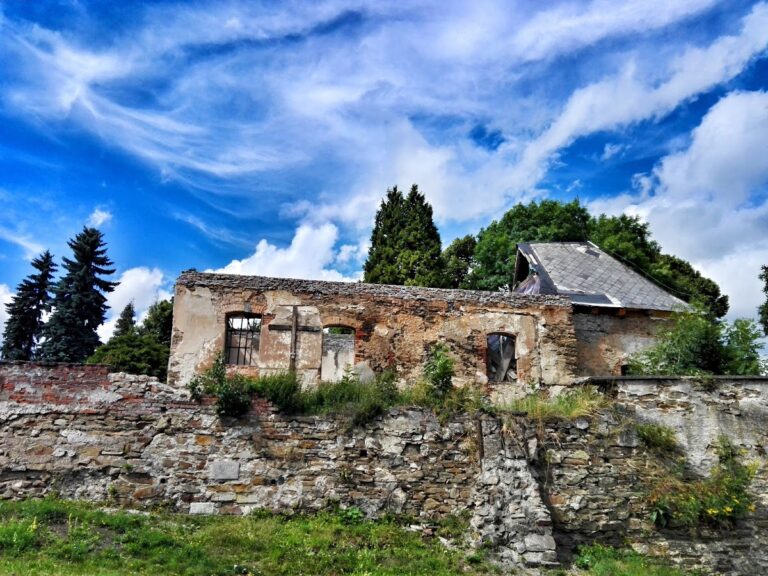
Rococo mortuary chapel
Beside the street, at the cemetery wall, stands an octagonal Rococo chapel with semicircular niches, corner pilasters, and a lantern. J. C. Kosch built it in 1764–1765, and it originally served as a mortuary chapel.