Church of the Holy Spirit: A Cistercian Church in Palermo


Site at a Glance
- Rating
- 4.4
- Popularity
- Very Low
- Country
- Italy
- Primary era
- Medieval
- Eras represented
- Medieval, Early Modern
- Civilizations
- Kingdom of Sicily, Norman, Spanish
- Site type
- Religious
- Remains
- Church
On this page15 sections
History
The Church of the Holy Spirit is a Roman Catholic church in Palermo, Italy, founded by Cistercian monks between 1173 and 1178 in the Anglo-Norman tradition. It formed part of a monastery outside Palermo’s walls, on the left bank of the Oreto River, and became associated with the beginning of the Sicilian Vespers.
Cistercian Foundation
Archbishop Walter of Palermo, known as Walter of the Mill, established the monastery and brought monks from the Calabrian Abbey of Sambucina. The community belonged to the Sambucina network connected to Clairvaux, one of the primary abbeys of the Cistercian order. Founded in the late eleventh century, the Cistercians followed a strict interpretation of Benedictine monastic practice. King William II of Sicily and his mother, Queen Margaret of Navarre and Sicily, supported the foundation and increased its property through substantial donations.
The church was consecrated in 1179. In 1196 the monastery incorporated the priory of Santa Maria of Altopiano in Calabria, and Alexander became its first recorded abbot. In 1232 the Cistercian General Chapter placed the monastery under the authority of Casamari.
The Sicilian Vespers
On 30 March 1282, at the hour of Vespers on Easter Monday, a popular uprising began in the square before the church. The revolt opposed Angevin rule, the government of the French Angevin dynasty in Sicily, and spread into the wider conflict known as the Sicilian Vespers. The church and monastery subsequently became known as Santo Spirito del Vespro, or the Church of the Vespers.
Commendam and Institutional Change
After the death of the last Cistercian abbot, Bonifacio di Bono, in 1443, the abbey was administered as a commendam, an arrangement that entrusted an abbey’s revenues and administration to a holder outside its resident monastic community. It was successively assigned to Gio Peralta, the royal chaplain Antonio Ferro, Cardinal Marco Barbo from 1468 to 1491, and Lorenzo Cibo de’ Mari from 1492 to 1503. The monastery was restored in 1469.
In 1516 the monastery was incorporated into Palermo’s Grande Ospedale. The church was assigned to the Order of Saint Augustine, while the former monastic property and associated feudal possessions passed to the hospital.
Olivetan Occupation
In 1573 Palermo’s senate assigned the complex to the Olivetan Congregation, a Benedictine reform community founded at Monte Oliveto. The transfer replaced the Olivetans’ establishment at Santa Maria dello Spasimo, which had to be evacuated because Palermo’s fortifications were expanding and conditions at the Kalsa site were unhealthy. The move also brought the painting known as the Spasimo di Sicilia and its monumental marble setting to Santo Spirito.
The painting was first displayed on the high altar and later transferred to the Chapel of the Blessed Sacrament. In 1661 it was ceded to Philip IV of Spain, known in Sicily as Philip III, through the mediation of the Sicilian viceroy Ferdinando d’Ayala, Count of Ayala, and Giovanni Dies. The transfer took place during disputes between the monastery’s abbot, Clement Staropoli, and the monks.
Abandonment and Survival
Between 1745 and 1747 the Olivetan community moved to the church of San Giorgio in Kemonia. The Santo Spirito complex was then effectively abandoned, while the former hospital and lazaretto functions had already ended after incorporation into the Grande Ospedale.
In 1782 Viceroy Domenico Caracciolo ordered the former monastery demolished to create a cemetery. A public cemetery was established by decree according to a design by Francesco di Alessandro. It became known as the Cemetery of Santo Spirito or Sant’Orsola Cemetery after the noble Company of Saint Ursula, which was entrusted with it. The monastic buildings were demolished in 1783, but the church remained.
Giuseppe Patricolo directed restoration work in 1882. The intervention removed additions made between the sixteenth and eighteenth centuries and reversed the church’s seventeenth-century Baroque alterations.
Remains
Basilica and Exterior Decoration
The church stands within Sant’Orsola Cemetery, north of the former monastic enclosure on the left bank of the Oreto River. It is a three-aisled, unvaulted basilica with three semicircular apses and a choir raised above the nave. The choir extends only slightly beyond the width of the nave. Its form combines Anglo-Norman, Arab-Norman, and Gothic elements.
Facade
The pointed-gable facade is not the original front of the church. The exterior is built with alternating blocks of tuff and lava, arranged to create polychrome geometric patterns. On the side elevations, lava inlay enriches the decoration of blind arcades, combining Arab-Norman and Gothic features.
North Side and Apses
The north side and apses display polychrome arches, interlaced blind arcades, ornamental disks, shell niches, and geometric and arabesque motifs. Some arches contain pointed windows, while the pointed windows of the apses are framed by a folded frieze.
Interior and Chapels
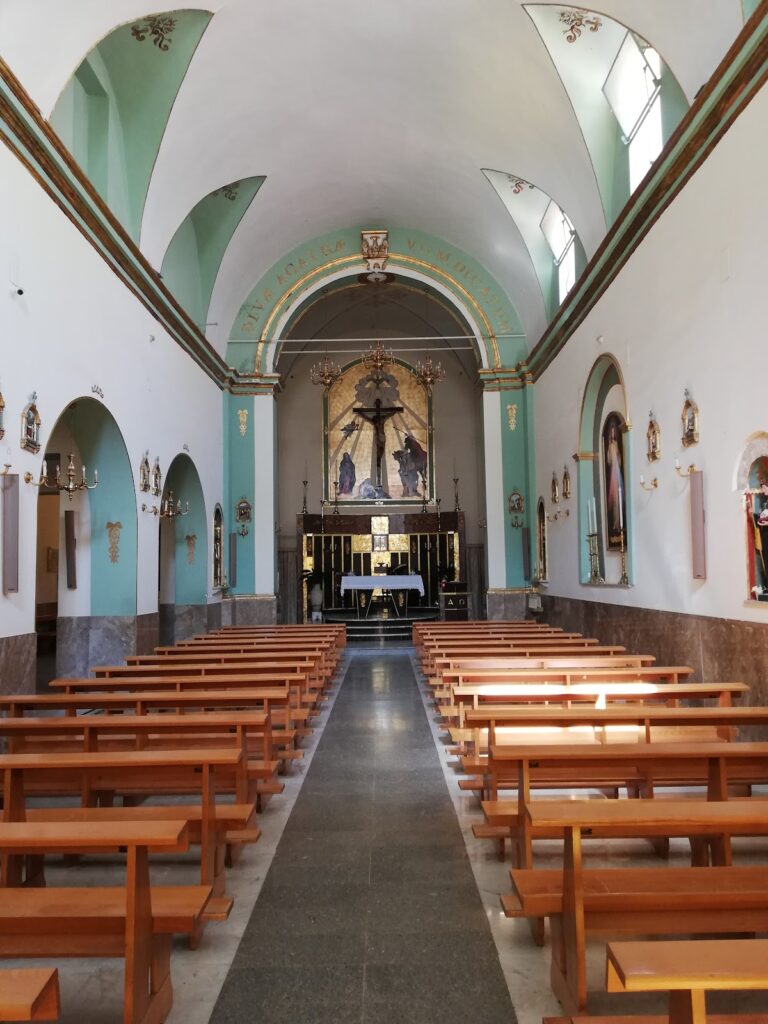
The interior is organized around six columns and eight arches. More detailed descriptions identify square piers in the choir, joined by pointed arches, and round columns in the nave. Traces of the original painted decoration survive on the wooden ceiling.
Main Choir Chapel
The main chapel, or large choir chapel, was made by Antonello Gagini, the major Sicilian Renaissance sculptor whose workshop produced marble altars and chapels associated with the church.
Chapel of Santa Maria del Riposo
In the right minor apse, the Chapel of Santa Maria del Riposo originated as the marble Ansaloni Chapel, produced by Antonello Gagini and his workshop in 1528. Its tabernacle and statue of Santa Maria del Riposo were among the elements later removed and relocated. Between 1745 and 1747, a copy of the statue was made for San Giorgio in Kemonia, while the original was transferred to the Regional Gallery of Sicily in Palazzo Abatellis.
Wooden Crucifix
A wooden crucifix attributed to the Master of the Trapani Polyptych dates from the first half of the fifteenth century.
Marble Altar of the Spasimo di Sicilia
The marble altar associated with the Spasimo di Sicilia was made by Antonello Gagini. It was dismantled in 1782 for transfer to the church of the Jesuit College on the Cassaro. After reassembly in the Chapel of Saint Aloysius Gonzaga, it lacked its six lateral roundels and displayed a marble image of Saint Aloysius Gonzaga by Ignazio Marabitti in place of Raphael’s painting.
From 1783 until the first decades of the twentieth century, the altar formed part of the monumental furnishing of the Chapel of Saint Aloysius Gonzaga in Santa Maria della Grotta al Cassaro.