Beselich Premonstratensian Canonesses’ Monastery: A Former Religious House in Germany


Site at a Glance
- Rating
- 4.8
- Popularity
- Very Low
- Country
- Germany
- Primary era
- Medieval
- External website
- Open
- Eras represented
- Medieval, Early Modern, Modern
- Civilizations
- German, Holy Roman Empire
- Site type
- Religious
- Remains
- Monastery
On this page14 sections
History
Beselich Premonstratensian Canonesses’ Monastery is a former women’s religious house in Germany, founded around 1170 by Arnstein Abbey on Beselicher Kopf in the present municipality of Beselich. Dedicated to the Blessed Virgin Mary and the Apostles Peter and Paul, it belonged to the Premonstratensian order, a Catholic community founded in the twelfth century whose houses combined religious life with pastoral ministry. The monastery formed part of the medieval religious landscape of the Diocese of Limburg and developed from a foundation established on the hill by Gottfried von Beselich.
Foundation under Arnstein Abbey
Gottfried von Beselich was a priest at the nearby St. Lubentius collegiate church in Dietkirchen. On Beselicher Kopf he established a church dedicated to Saint Giles, endowed it with a farm exempt from tithes, and bequeathed the foundation to Arnstein Abbey so that a monastery could be created there. Archbishop Hillin of Trier confirmed the donation in a charter of 1163. The donation itself was dated to the reign of King Conrad III and the pontificate of Pope Innocent II, between 1138 and 1143.
The monastery remained closely controlled by Arnstein. Its female superior, the Meisterin, could be elected by the community, but she had to consult the abbot of Arnstein and secure his approval for important decisions. An Arnstein prior, a male religious officer representing the mother abbey, lived at Beselich to conduct services and assist the women’s house. The 1163 charter designated the abbot of Arnstein as the monastery’s sole lord.
A wealthy noblewomen’s community
The community probably consisted almost entirely of women from the nobility. In 1298 the abbot introduced an admission fee of 30 marks in an attempt to prevent overcrowding. The monastery’s wealth grew through the dowries brought by noble sisters and through testamentary gifts made to secure commemorative masses on donors’ anniversaries of death.
Beselich acquired property, tithes, complete farms, and extensive vineyards at Aumenau on the Lahn. These holdings supported the religious community and helped establish the monastery as a wealthy institution. A fair held near the monastery is recorded from 1545, with indications that it may already have existed in the fourteenth century. It continued into the seventeenth century before disappearing.
Fire, rebuilding, and decline
The monastery’s decline became apparent in the middle of the fifteenth century after an attack reportedly burned the complex to the ground. A record placed at the parish house in Lahr in the Westerwald on 28 August 1487 identified Agnes Hube as the sole surviving sister. The possibility of turning Beselich into a men’s monastery was considered, but the institution was rebuilt and repopulated with sisters from the Premonstratensian canonesses’ monastery at Gummersbach.
The surviving record of the monastery’s heads begins with Jutta and Gisela, followed by Lukardis and two women named Sophie. One Sophie died on 11 September in an unknown year, while the other died on 12 October 1290. Hedwig led the house from 1290 to 1317, followed by Sophie from 1317 to 1329, Elisabeth von Elkershausen from 1329 to 1346, Benigna von Bachheim from 1346 to 1351, and Elisabeth von Bassenheim from 1351 to 1380. Later heads included Gertrudis von Weilburg, Lukardis von Allendorf, Alberadis, Demut von der Erlen, Katharina von Schwalbach, Agnes Hube, Margarete von Willensdorf, Isengart von Walderdorff, Gertrudis von Herschbach, Kunigunde von Rodheim, Anna von Heppenheft, and Anna von Brambach, who held office when the monastery was suppressed.
Suppression and secular transformations
During the sixteenth century, repeated attempts were made to reform Beselich according to Protestant teaching. The disputes that followed ended with the monastery’s suppression in 1568. The sisters’ recorded declaration expressed their refusal to abandon the Catholic faith, stating that they would rather be torn apart than be forced from it. Sophie von Runkel, Ida von Wied, and Demut Reichwein von Montabaur subsequently served as administrators, beginning in 1568, 1577, and 1587 respectively.
After the territorial ruler suppressed the monastery, the former buildings were converted into a state hospital in 1615. The surviving Beselicher Hofhaus belongs to this later phase. The property then became the subject of a dispute involving the House of Runkel, the House of Nassau-Hadamar, the Jesuits, and the Archbishop of Trier. The House of Runkel and the House of Nassau-Hadamar were territorial ruling dynasties in the region. Rome decided the dispute in favor of the Jesuits, whose position was strengthened by Count and later Prince Johann Ludwig of Nassau-Hadamar.
In 1637 Johann Ludwig transferred the Beselich estate to the Jesuits living in Hadamar. The Jesuits, a Catholic order associated with education, missionary work, and the Catholic Reformation, were promoting the re-Catholicization of the Hadamar territory. They did not restore Beselich as a monastery. Instead, they treated the complex as a source of building material for their residence in Hadamar.
Conflicts, especially with the Protestant-held lordship of Runkel, forced the Jesuits to sell Beselich back to the House of Nassau-Hadamar in 1656. By that time, usable materials had been removed from the complex, including the last bell, doors, roof beams, and stone. An additional large bell had earlier been taken by the House of Runkel to Schupbach, where it remained in the church tower until the First World War. The House of Nassau-Hadamar converted the former monastery into a family estate and later into an inheritable leasehold farm, an estate held under a hereditary lease rather than operated as a monastery. Its extensive possessions later passed to the Nassau Central Study Fund, a territorial fund supporting educational institutions.
Religious continuity and preservation
Religious activity returned to Beselicher Kopf in a new form in 1763, when the Franciscan hermit Leonhard, whose secular name was Georg Niederstraßen, established a hermitage and chapel beside the former monastery site. The chapel was blessed in 1767 under the name Maria Hilf and in honor of the Fourteen Holy Helpers, a group of saints traditionally invoked together in times of illness, danger, and hardship. This foundation continued the hill’s religious associations without restoring the medieval monastery.
The monastery ruins are protected as a historic monument and also receive wartime protection under the Hague Convention. The Association for the Preservation of the Beselich Monastery Ruins was founded on 10 January 1985 to maintain the site and took responsibility for the ruin plot through a long-term lease. The association was dissolved after a special meeting in May 2019. In July 2021, the municipality of Beselich concluded a long-term lease with the property owners, providing a new framework for the preservation of the ruins.
Remains
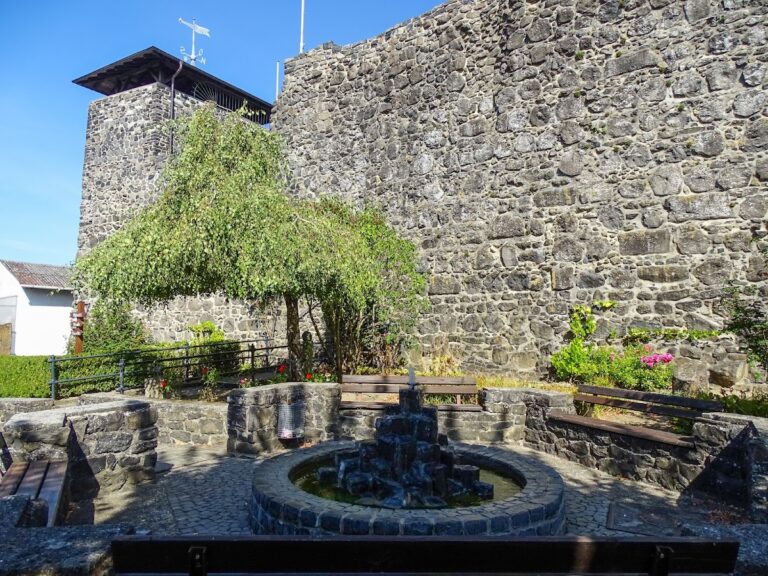
The remains stand on Beselicher Kopf, which rises to 296 metres and forms the highest elevation in the municipality of Beselich. The hill occupies a central position at the edge of the Limburg Basin. The former complex comprised a church, monastic buildings, and a monastery farm. The farm remains in agricultural use, while wall remains of the medieval church and the later Beselicher Hofhaus preserve different phases in the site’s history.
Medieval monastery and later farm
Monastery church
The medieval monastery church survives in wall fragments on Beselicher Kopf. It formed the principal sacred building of the Premonstratensian women’s house, which was dedicated to the Blessed Virgin Mary and the Apostles Peter and Paul. The church’s surviving fabric belongs to the medieval complex founded around 1170 and rebuilt after the destructive attack of the fifteenth century. Later dismantling affected the surviving structure, as the Jesuits removed doors, roof beams, stone, and other usable components for construction in Hadamar.
Beselicher Hofhaus
The Beselicher Hofhaus represents the estate’s later secular use. It belonged to the state-hospital phase created in 1615, after the monastery had been suppressed, and continued within the estate and leasehold arrangements that followed. The associated monastery farm remains in agricultural use, linking the surviving building to the productive lands that had supported the medieval community.
Pilgrimage buildings on Beselicher Kopf
Maria Hilf chapel
The Maria Hilf pilgrimage chapel stands directly beside the monastery ruins. It was established in connection with the hermitage created by Leonhard, or Georg Niederstraßen, in 1763, and received its blessing in 1767. Its dedication to Maria Hilf and the Fourteen Holy Helpers gave the hill a continuing Catholic religious function after the medieval canonesses’ community had ended.
Chapels of the Seven Sorrows
Seven small chapels dedicated to the Seven Sorrows of Mary line the pilgrimage path through the forest between Obertiefenbach and Beselich. Completed in 1877, they form part of the wider ensemble associated with the Maria Hilf pilgrimage chapel and extend the devotional landscape beyond the immediate area of the monastery ruins.
Material evidence and interpretation
The local-history room in Beselich-Obertiefenbach contains numerous exhibits relating to the former monastery and the work undertaken to preserve its ruins. Together with the surviving church walls, the Beselicher Hofhaus, the agricultural farm, and the pilgrimage buildings, these materials present the site as a layered landscape shaped by medieval religious life, early modern reuse, and later Catholic devotion.