Runkel Castle: A Medieval Hill Castle in Germany



Site at a Glance
- Rating
- 4.7
- Popularity
- Medium
- Country
- Germany
- Primary era
- Medieval
- External website
- Open
- Eras represented
- Medieval, Early Modern
- Civilizations
- Holy Roman Empire
- Site type
- Military
- Remains
- Castle
On this page11 sections
History
Runkel Castle is a ruined High Middle Ages hill castle in Germany, rising above the Lahn River at Runkel in Hesse. The Lords of Runkel built and developed the stronghold to secure a strategic river crossing and the route through the surrounding region. The castle was first mentioned in 1159, although it probably existed earlier. At that time, the Lahn was crossed by ferry, while the stone bridge was added only in the Late Middle Ages.
Origins and rival strongholds
The origin of the name Runkel remains uncertain. One tradition connects it with a Celtic expression meaning “rock mountain.” Two later legends associate the name with a knight held captive at Roncevaux in 778 or with the Roncaglia fields near Piacenza in 1136. The Roncevaux tradition also links the castle with imported vines and the red wine known as Runkeler Rote.
From about 1250, disputes over property and inheritance divided the ruling family. Siegfried V von Runkel expelled his cousin Heinrich from the castle in 1276. Heinrich then built Schadeck Castle on the opposite side of the Lahn as a rival stronghold. The connected lordships of Runkel and Westerburg were also separated during the late thirteenth century.
Expansion and the Wied-Runkel line
Dietrich III von Runkel enlarged his lordship in 1376 by acquiring the tithing districts of Schupbach and Aumenau. He also commissioned a newer castle beside the original stronghold. Later, Dietrich IV von Runkel acquired the County of Wied through his marriage to Anastasia von Isenburg-Wied. His descendants adopted the name Wied-Runkel, establishing the line that would govern the territory in subsequent centuries.
A stone bridge over the Lahn was commissioned in 1440 but was not completed until 1448. A dispute over toll and duty revenues delayed the work. In 1543, Count Johann IV von Wied-Runkel received Philipp Melanchthon at the castle. Melanchthon was a leading German Protestant reformer and a close associate of Martin Luther.
Runkel as an Upper County residence
In 1595, the County of Wied was divided between Wilhelm IV von Wied-Runkel and his nephew Johann Wilhelm von Wied-Runkel. Wilhelm received the Upper County of Wied, including Runkel and Dierdorf. Johann Wilhelm received the Lower County, including Wied, Braunsberg, and Isenburg. Runkel consequently became the center of the Upper County.
On 15 October 1634, during the Thirty Years War, a Central European conflict fought from 1618 to 1648, imperial troops commanded by Count Isolani captured and burned Runkel and its castle. The upper or main castle remained a ruin after the attack. The lower castle and several agricultural buildings were repaired and enlarged, and the comital residence moved from the citadel to the lower complex.
Principality and later succession
In 1692, Friedrich von Wied-Runkel transferred the Upper County of Wied, enlarged particularly by the addition of Isenburg, to his grandson Maximilian Heinrich von Wied-Runkel. The reunited territory became known as Wied-Runkel and was raised from a county to a principality in 1791.
In 1806, the Principality of Wied-Runkel was mediatized under the Treaty of the Confederation of the Rhine and incorporated into the Duchy of Nassau. Mediatization meant that a small state lost its direct sovereignty while being absorbed into a larger territorial state. The territories later came under Prussian rule. Karl Ludwig Friedrich Alexander von Wied, formerly a prince, became an administrator in the newly established Nassau district of Runkel.
The Wied-Runkel line ended in 1824 when Karl Ludwig Friedrich Alexander and his brother Friedrich Ludwig died without children. Their rights over Runkel and the castle passed to the Wied-Neuwied branch, first represented by Prince Johann Karl August von Wied and later by Wilhelm Hermann Karl von Wied. The Runkel lordship was dissolved in 1848.
Survival and protection
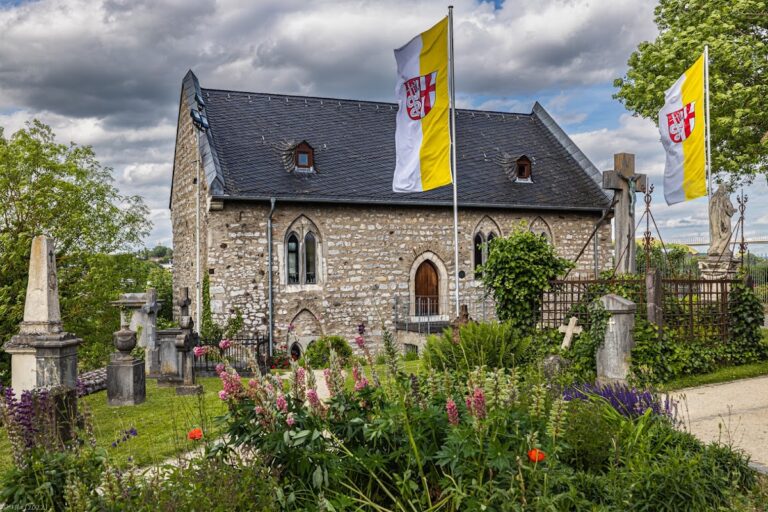
The lower castle now contains a museum, chapel, archive, and princely administrative rooms. Other parts remain residential or serve as agricultural storage. The upper castle survives as a ruin, with areas that can be walked and a main keep that can be climbed, while some portions remain inaccessible or are under reconstruction. Runkel Castle is protected as a regional architectural monument and has also received protection under the Hague Convention, which safeguards cultural property during armed conflict.
Remains
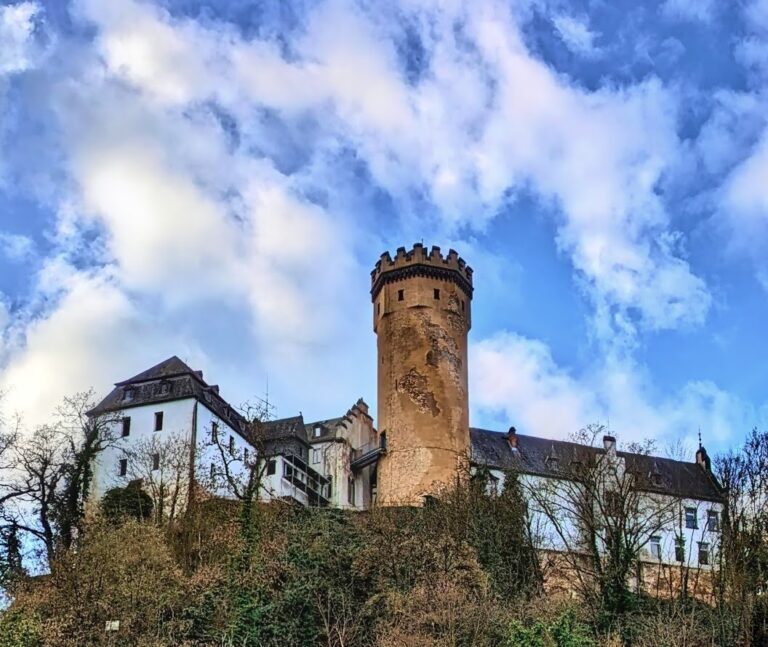
Runkel Castle occupies a rocky hill about 150 metres above sea level and approximately 35 to 40 metres above the Lahn valley. Built of stone and brick, the complex is divided into an upper or main castle on the highest ground and a lower castle to its south. The medieval bridge and the castle form a physically connected historical setting, while the surviving buildings preserve the contrast between the ruined upper stronghold and the more complete lower complex.
Upper castle and defensive buildings
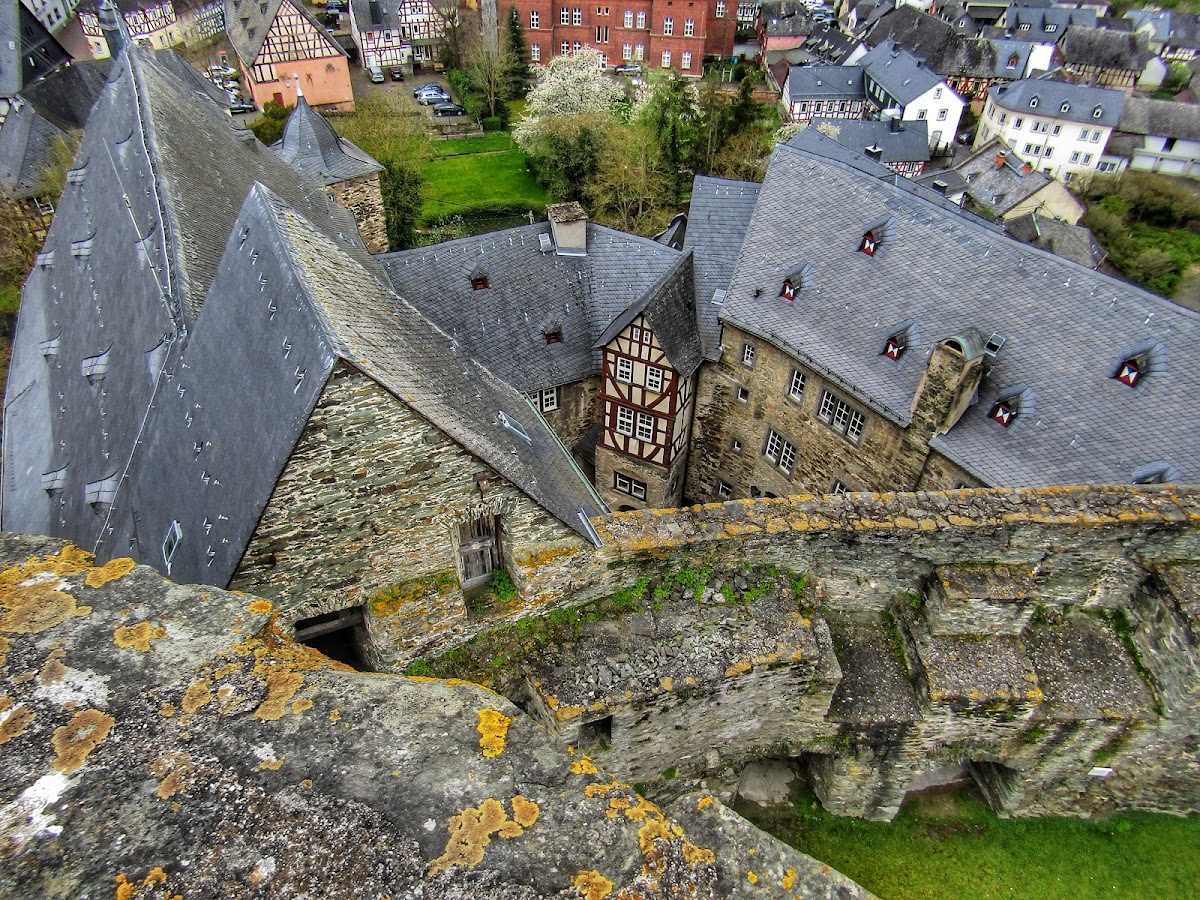
The upper castle stands opposite the medieval Lahn bridge. Its climbable keep, the principal defensive tower of a medieval German castle, rises about 31 metres above the lower-castle courtyard. Substantial ruins of the palas, the main residential or representational building, and other former residential structures surround it. Along the Lahn side, these remains form the appearance of a shield wall. The principal building tract is about 40 metres long and has a powerful defensive tower at each end. Both towers approach the keep in height and wall thickness, making Runkel an unusually rare castle type in which three towers could perform the role normally associated with a single principal tower.
Lower castle
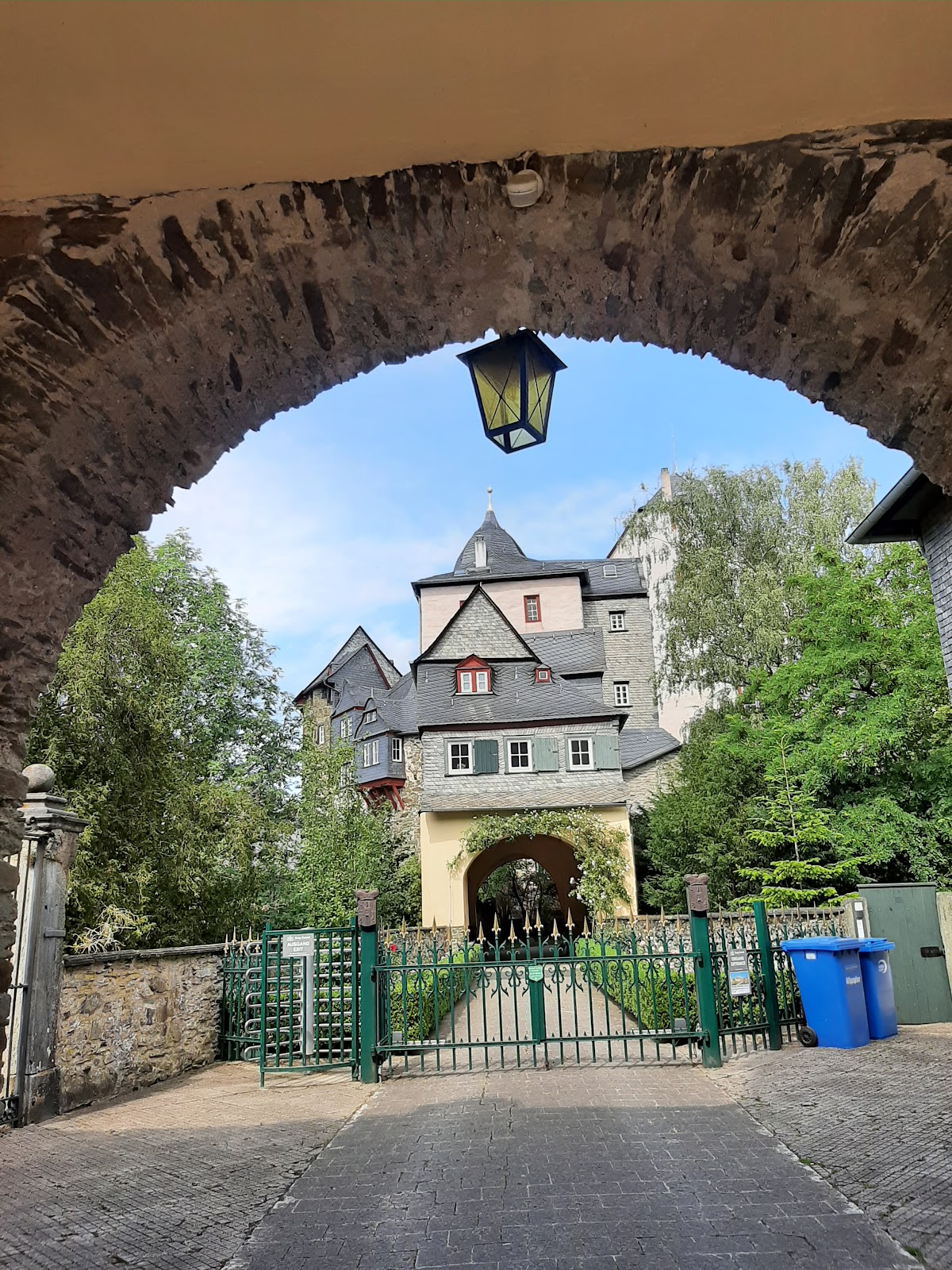
The lower castle was rebuilt and enlarged during the seventeenth and eighteenth centuries. Its two- and three-storey buildings are arranged in a U-shaped plan south of the upper castle, enclosing an inner courtyard. Unlike the upper castle, these buildings remain relatively well preserved and continue to be used. Their surviving form reflects the shift of the comital residence away from the ruined citadel after the destruction of 1634.
Agricultural buildings and forecourt
Former agricultural buildings occupy a lower forecourt enclosed by a circular perimeter wall. This area belongs to the lower complex, whose buildings were repaired and expanded after the seventeenth-century destruction. The continued use of parts of the lower castle for agricultural storage preserves the relationship between the residential and working areas of the post-medieval complex.
Hilltop setting
The castle’s position above the Lahn places the upper ruins, lower buildings, bridge, river valley, and surrounding settlement within one visible historical landscape. Views extend toward Runkel, the Lahn valley, the bridge, and Schadeck Castle on the opposite bank, the rival stronghold built after the thirteenth-century family dispute.