Borysohlibska Church in Vyshhorod: Orthodox Church and Medieval Shrine


Site at a Glance
- Rating
- 4.7
- Popularity
- Low
- Country
- Ukraine
- Primary era
- Modern
- Eras represented
- Medieval, Modern
- Civilizations
- Kievan Rus, Russian
- Site type
- Religious
- Remains
- Church
On this page11 sections
History
Borysohlibska Church in Vyshhorod is an Orthodox church in Ukraine whose history began with a cross-domed church built by the medieval polity of Kievan Rus in 1021. It was the first church dedicated to Saints Boris and Gleb, princes and Christian martyrs whose cult became important in the medieval Rus tradition.
Foundation and the veneration of Boris and Gleb
The church was established under Grand Prince Yaroslav the Wise beside the burial place of Boris and Gleb. A fire destroyed the earlier Church of Saint Basil in 1020, and the brothers’ bodies were discovered afterward. Miracles attributed to them prompted the construction of a small chapel. Yaroslav then ordered a larger church, described as having five domes.
The first wooden Borysohlibska Church was built in 1021. The transfer of the brothers’ bodies into it became associated with the beginning of their formal ecclesiastical veneration. The church therefore served both as a place of worship and as a shrine connected with the relics of the two princes.
Medieval stone churches
As the wooden building deteriorated, Prince Iziaslav Yaroslavich commissioned a single-domed stone church on the site. It was consecrated on 20 May 1072 in the presence of Metropolitan Georgy, the senior bishop of the Kyiv metropolitanate, along with other bishops and the Kyiv monastic community. The relics of Boris and Gleb were solemnly placed inside.
Prince Sviatoslav Yaroslavich later began a much larger stone church. Its walls were complete by the time of his death in 1076. Prince Vsevolod Yaroslavich continued the project, and the building was finished around 1080–1090. Its upper part subsequently collapsed and was restored by Prince Oleg Sviatoslavich. The rebuilt church was consecrated on 1 May 1115 in the presence of Grand Prince Vladimir Monomakh.
Destruction and later rebuilding
Chronicles mention the church repeatedly from its consecration until the Mongol invasion. Information about it then disappears, and it is believed to have been destroyed during Batu’s invasion of Kyiv in 1240. Batu was a Mongol ruler and military commander whose campaign reached Kyiv. The relics of Boris and Gleb were lost, while efforts to recover them in 1743, 1814, and 1816 did not succeed.
The territory of the ruined church later belonged to the Transfiguration Monastery of Mezhyhirya. In 1571, King Sigismund II Augustus transferred the monastery and its possessions to his Crown clerk E. Vysotsky. During the early seventeenth century, material from the medieval ruins was used to construct a Dominican church in Kyiv.
A wooden church was erected on the ancient site in 1614. Polish forces burned it in 1651, after which it was rebuilt. The building underwent another reconstruction in 1744. A small stone church designed by Konstantin Ton was then constructed on the site in 1861–1863. Ton was a nineteenth-century architect known for buildings in the Russian Empire.
War damage, excavation, and restoration
The nineteenth-century church survived until the middle of the Second World War. German troops used it as an observation post during their crossing of the Dnieper in the Lyutezh operation. Advancing Soviet forces destroyed the building, and intensive bombardment left fragments of its walls.
The ruins remained abandoned until the end of the 1980s. Excavations had begun in 1816, while archaeological work in 1951 completely exposed the foundations of the medieval church and established its architectural form. In 1991, the small stone church of 1861–1863 was restored from surviving design sketches. Borysohlibska Church is now an active Orthodox church in the diocese of the Orthodox Church of Ukraine, a regional ecclesiastical and pastoral jurisdiction.
Remains
The surviving site combines the fully exposed foundations and wall fragments of the medieval Borysohlibska Church with the restored small stone church built in the nineteenth century. The medieval building had a cross-domed plan, organized around a central crossing covered by a dome, with a narthex, or entrance vestibule, at the western end. It measured approximately 42 metres in length and 24 metres in width.
Medieval church remains
Foundations and walls
The medieval church was built of brick and ranked among the largest churches of pre-Mongol Rus. Its foundations are fully exposed, and fragments of its eleventh- to twelfth-century walls survive above them. Some of these fragments carry traces of projectile impacts from battles connected with the liberation of Kyiv during the Second World War.
Interior decoration and construction
The church’s facades were articulated with arched niches, and its roof was covered with lead. Inside, fresco paintings decorated the walls, while the floor was paved with glazed tiles. These features belonged to the medieval building associated with the veneration of Boris and Gleb.
Nineteenth-century church
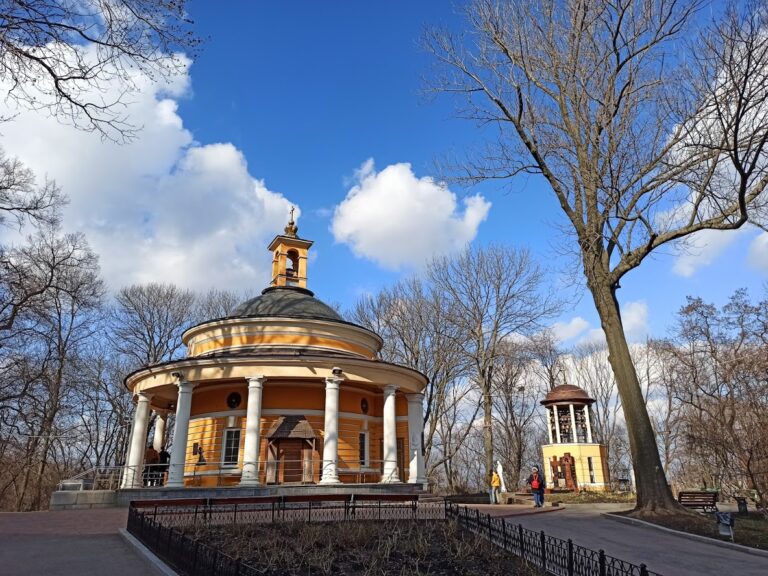
Restored stone building
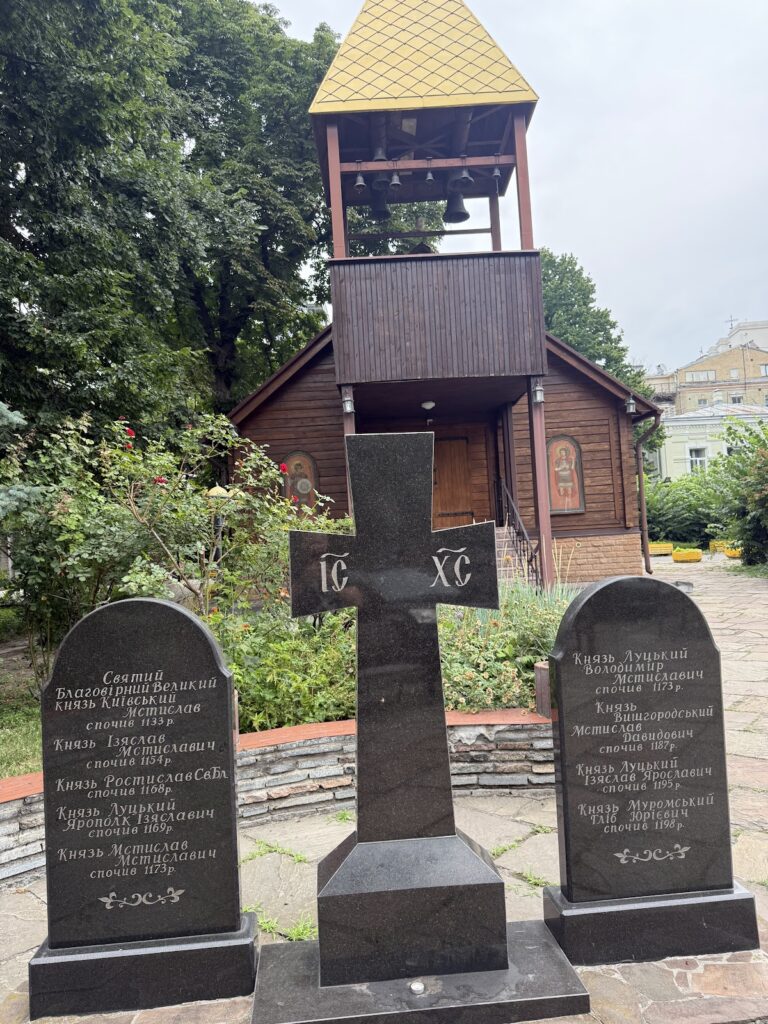
The small stone church designed by Konstantin Ton was built between 1861 and 1863. It was restored in 1991 using preserved sketches, and an iconostasis, the screen separating the sanctuary from the main worship space in an Eastern Christian church, is associated with the church.