Mezhyhirya Monastery: An Orthodox and Cossack Religious Center in Ukraine


Site at a Glance
- Rating
- 4.8
- Popularity
- High
- Country
- Ukraine
- Primary era
- Modern
- External website
- Open
- Eras represented
- Modern
- Civilizations
- Unclassified
- Site type
- Religious
- Remains
- Fortified Monastery
On this page13 sections
History
Mezhyhirya Monastery was an Orthodox monastery in Ukraine near Novi Petrivtsi, on the right bank of the Dnieper about 10 kilometers north of Vyshhorod. Traditionally founded by Greek monks who came from Byzantium with Michael, the first Metropolitan of Kyiv, it developed over many centuries from a male monastery into a female institution, and later returned to monastic use. Its origins are uncertain, but its history is closely connected with Orthodox religious life, the Zaporozhian Cossacks, and the political changes that reshaped the Kyiv region.
Early traditions and medieval history
One tradition places the monastery’s foundation around 988, although this early date has not been established by surviving evidence. Other traditions connect the site with a twelfth-century religious shrine and with Prince Andrey Bogolyubsky of the Vladimir-Suzdal lands. He is variously said to have built the stone White Savior Church in 1146 or 1161 and to have moved the monastery to its later location. The monastery was also known as the Savior-Transfiguration Monastery or White Savior, names associated with its principal church.
The earlier religious community was affected by the Mongol invasion and the destruction or devastation of Vyshhorod and the first monastery. Its monks dispersed before re-establishing the institution near a Dnieper crossing on the route from Chernihiv through Morovsk to Belgorod. The monastery is documented from the late fourteenth century, although 1520 is also given as the date of its first recorded mention. A tradition further holds that Ilya Muromets, a legendary warrior of East Slavic epic tradition, took monastic vows at Mezhyhirya. This association later contributed to the monastery’s esteem among the Cossacks.
Restoration and Orthodox autonomy
Crimean Tatars under Meñli I Giray attacked the monastery in 1482. Reconstruction began around 1520, when Orthodox clergy received privileges and land from Lithuanian and Polish rulers. The Kyiv voivode, a regional military and administrative governor, Andrey Nemirovich supported the restoration through the efforts of Mikhail Shcherbina. In 1523 the monastery was transferred to King Sigismund I of Poland and Grand Duke of Lithuania.
During the sixteenth century, the monastery repeatedly lost and recovered its property rights. Members of the Orthodox Ostrogski family served as patrons, while other nobles and officials contributed land and financial support. Mezhyhirya also became a center of resistance to efforts to bring Orthodox institutions under Uniate authority, a church structure that sought to unite Orthodox communities with the Catholic Church while retaining Eastern rites. This role was particularly associated with its leadership under I. Kopynsky in 1616.
The monastery held stauropegic status, meaning that it enjoyed a degree of administrative independence from local church authorities and was directly connected with a patriarchal authority. The initial grant is dated to 1609 or 1610. Peter I revoked this autonomy in 1703, but it was restored in 1710. The monastery’s institutional influence and possessions continued to expand, extending to settlements, estates, natural resources, agricultural holdings, and water rights on both banks of the Dnieper. It also collected transit and ferry duties and possessed vineyards.
The monastery of the Zaporozhian Cossacks
In the seventeenth century Mezhyhirya became a major religious center of the Zaporozhian Host, the military and political organization of the Zaporozhian Cossacks. The monastery was regarded as the Host’s military monastery. After Polish forces destroyed the Trakhtemyriv Monastery, retired and elderly Cossacks came to Mezhyhirya to spend their final years in prayer and penitence. The Zaporozhian Sich, a fortified Cossack center, supported the monastery financially and endowed it with land.
Mezhyhirya also became the principal military hospital of the Zaporozhian Cossacks. In 1683 the Sich council ordered that clergy for the Sich’s Intercession Cathedral should be supplied by the monastery. In 1687 the Cossacks again selected Mezhyhirya as their military hospital, and in 1691 nearby monasteries, including Lebedyn and Samara, were placed under its authority. The monastery’s military character was confirmed by the Cossacks in 1735. Many Cossacks took monastic vows in old age, reinforcing the institution’s role as a place of retirement, worship, and burial.
Hetman Bohdan Khmelnytsky, a seventeenth-century Ukrainian Cossack leader, became the monastery’s ktitor, or patron responsible for supporting a church or monastery, through a charter issued in 1656. The charter granted Vyshhorod, Novi Petrivtsi, Moshchun, and other settlements, together with estates and agricultural resources. Other grants involved land and water rights linked with Kharkivtsi, Popivtsi, Tsybli, and Vyiunishchi. By the late seventeenth century, under Hegumen Feodosiy Vaskovsky, Mezhyhirya was one of the largest and wealthiest monasteries in Ukraine.
The monastery’s historical importance is also reflected in the Mezhyhirya Chronicle, which covers events from 1608 to 1700 and was completed around the turn of the eighteenth century. Traditions identify Semen Paliy and Samiylo Samus as buried there. Other listed burials include the hetmans Ostap Gogol and Andrey Mohyla, the noblewoman Nemirovichova, and Yuriy Lyasota, who died in 1634. The monastery was later mentioned in Taras Shevchenko’s poem Chernets, written in the 1840s, and in Nikolai Gogol’s novel Taras Bulba, published in 1835.
Fires, rebuilding, and suppression
A fire in 1663 or 1676 destroyed the church and much of the complex. Reconstruction followed with assistance from Ivan Savelov, a monk who later became Patriarch Joachim of Moscow. Another major fire destroyed much of the monastery in 1717. In 1774 Petro Kalnyshevsky, the last Koshovyi Otaman, or senior leader, of the Zaporozhian Sich, financed the rebuilding of the Saints Peter and Paul Church. The Ukrainian architect Ivan Hryhorovych-Barskyi designed several buildings, including the brotherhood residence.
The abolition of the Zaporozhian Host by Catherine II in 1775 removed the political institution that had supported Mezhyhirya for generations. The monastery declined, and the imperial government closed it in 1786, confiscated its wealth, and transferred its remaining institutional establishment to the Taurida region. On the night before Catherine II’s planned visit to Kyiv in 1787, the monastery burned again. The circumstances remained unexplained, and the institution was finally dissolved.
Factory, Soviet demolition, and modern revival
Kaolin, a fine clay used to make porcelain and related ceramics, was discovered near the former monastery in 1796. The Mezhyhirya Faience Factory operated on the grounds from 1798 to 1884. Faience is a fired ceramic with a glazed surface. The factory produced crockery, ornamental vases, figurines, and other small objects, and by 1852 it had become the largest industrial complex in Kyiv. Former monastic buildings were adapted for industrial use alongside newly constructed facilities.
The monastery was revived in 1886 and converted into a women’s monastery in 1894. By the late nineteenth century it had been transferred to the authority of the Intercession Monastery in Kyiv. The Bolsheviks closed it during the 1920s, and the remaining buildings were dismantled in 1934 and 1935 after the site was selected for a suburban government residence following the transfer of the Ukrainian Soviet Socialist Republic’s capital from Kharkiv to Kyiv.
During the demolition, an underground library containing handwritten books was reportedly discovered. Later suggestions that it was the lost library of Yaroslav the Wise, an eleventh-century ruler of Kievan Rus traditionally associated with that library, remained speculative. A collection from the Zaporozhian period was considered more likely. Archaeological excavations between 1990 and 1994 investigated the claim but did not locate the alleged basement or manuscripts.
After the demolition, the site served government residences. Before the Second World War it housed Pavel Postyshev, Stanislav Kosior, and Nikita Khrushchev. During the German occupation it was occupied by Reichskommissar Erich Koch, and after the war Leonid Brezhnev and Volodymyr Shcherbytsky resided there. The residence was abandoned after the Chernobyl disaster because of the site’s proximity to the accident area, and it remained neglected until the early 2000s.
The Ukrainian Orthodox Church initiated a revival in 2011 and appointed Archimandrite Nikon Rusin as superior. A 2012 village plan allocated land for reconstruction, and a project based on archival drawings, photographs, and other historical material began before construction was halted by political circumstances. In 2015 the Mezhyhirya community built a chapel, consecrated by monks from Vydubychi Monastery, where services and prayers for the monastery’s restoration continued.
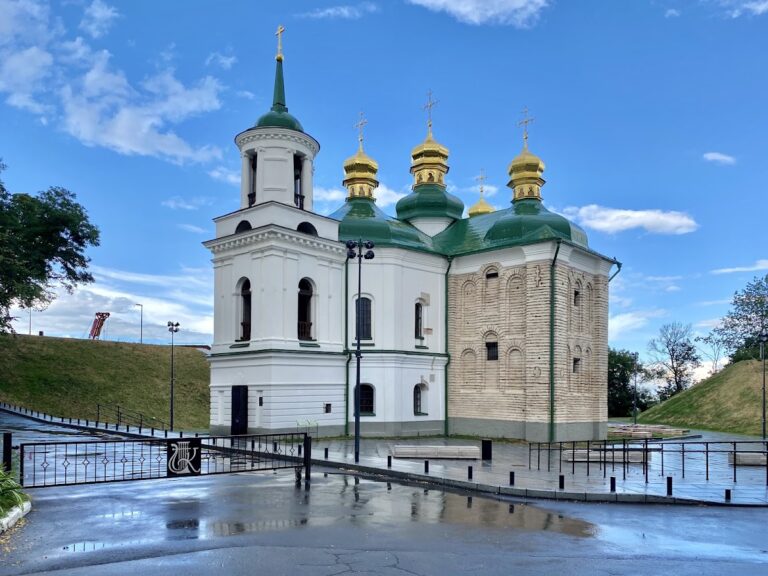
On 5 December 2019 the Orthodox Church of Ukraine approved the establishment and registration of the Mezhyhirya Savior-Transfiguration Monastery and appointed Hegumen Spiridon Matiashchuk as its superior. Metropolitan Epiphanius consecrated the newly built Savior-Transfiguration Church on 25 December 2020. On 2 February 2026 the synod appointed Hegumen Feofil Blishch as superior.
Remains
Setting and early sacred spaces
The monastery occupied the Mezhyhirya ravine and the surrounding hills on the Dnieper’s right bank, near the Kyiv Reservoir. Its grounds included a cave on a nearby hill and were associated with the locality known as “Volodymyr’s Oaks,” where ancient oak trees once grew. The setting included both the ravine and elevated ground, with the cave forming part of the early sacred landscape.
The earliest complex was associated with the White Savior Church. Traditions describe an initial wooden Transfiguration Church near Vyshhorod and a later stone church attributed to Andrey Bogolyubsky, although the precise sequence and dates remain uncertain. By 1555 the monastery contained four churches, including a cave church on Pekarnytsky Hill. The cave was large enough to contain a church, and parts of its interior were lined with brick and red stone slabs. An inscription inside gave the year 1700.
Seventeenth- and eighteenth-century buildings
Gate Church of Saints Peter and Paul
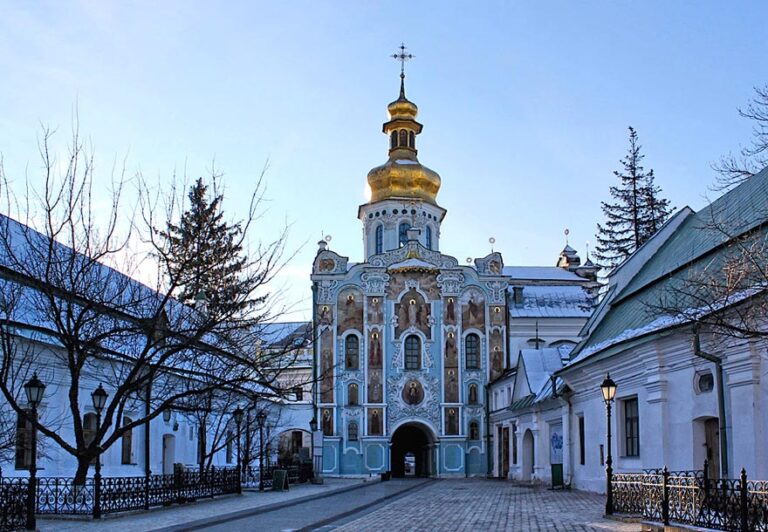
The Gate Church of Saints Peter and Paul was built in 1604 as part of the early seventeenth-century rebuilding campaign. In 1772 Petro Kalnyshevsky added a large gateway surmounted by the same church and a bell tower. The church was financed by Kalnyshevsky, whose support also extended to four other monastery buildings. The gateway, church, and bell tower were destroyed in the fire of 1787.
Transfiguration Cathedral and Saint Nicholas Refectory
The Saint Nicholas Refectory was built in 1609, while the Transfiguration Cathedral was constructed in 1611. These phases are also grouped within the period from 1609 to 1611, when older buildings were replaced by new structures. A later fire destroyed the wooden Transfiguration Cathedral and other buildings, after which the complex was rebuilt. The stone Transfiguration Church was financed by Patriarch Joachim of Moscow. By the late nineteenth century, it and the Saints Peter and Paul Church were the two churches remaining at the former monastery and factory site.
Hospital, brotherhood residence, and defensive complex
The monastery had a defensive character and possessed artillery for protection. Its principal group of buildings included a hospital, a brotherhood residence, a refectory, churches, and a large gate structure. An Annunciation Church was built near the hospital in 1678 with support from the Cossack community. In 1760 the complex contained two stone churches, the Transfiguration Church and the Church of the Holy Spirit, together with two wooden churches, the Church of the Mother of God and the Saint Nicholas Refectory.
Factory remains and surviving elements
After 1798 the former monastery buildings were adapted and rebuilt for the Mezhyhirya Faience Factory. Industrial facilities occupied the grounds, combining reused monastic structures with new factory buildings. The site therefore carried successive layers of religious and industrial construction before the Soviet demolition.
The historic monastic complex was almost entirely dismantled in 1934 and 1935. A water well survived as the only remaining element of the historic monastery. Archaeological excavations carried out from 1990 to 1994 examined the former grounds in connection with the reported underground library and basement. The modern revival has added a chapel consecrated in 2015 and the newly constructed Savior-Transfiguration Church, consecrated on 25 December 2020.