Church of the Tithes: Kyiv’s First Stone Church and Cathedral
Site at a Glance
- Popularity
- Very High
- Country
- Ukraine
- Primary era
- Medieval
- Eras represented
- Medieval, Early Modern, Modern
- Civilizations
- Kievan Rus, Polish–Lithuanian Commonwealth, Russian
- Site type
- Religious
- Remains
- Cathedral
On this page18 sections
History
The Church of the Tithes, also called the Church of the Dormition of the Virgin, was a medieval Orthodox cathedral on Old Kyiv Hill in Kyiv, Ukraine. Grand Prince Vladimir the Great built it between 989 and 996, when Kyiv was the center of Kyivan Rus, a medieval East Slavic polity. It is regarded as the polity’s first stone church and became a landmark within the city’s fortified center.
Foundation and royal cathedral
The church stood at a site traditionally identified as the place where the early Christian martyrs Theodore the Varangian and his son John were killed. At the laying of its cornerstone, Vladimir pledged a tithe, or one-tenth of his income and property, for the church. That contribution gave the building its popular name and helped support the metropolitan see, the church territory headed by a metropolitan. The church followed Orthodox Christianity under the ecclesiastical jurisdiction of Constantinople. Some chronicles date the beginning of construction to 990 or 991, while the building’s overall construction is dated to 989–996.
Greek and local builders worked on the church over six years. It was consecrated after construction and again in 1039 under Yaroslav the Wise, by Metropolitan Theopemptus, a senior Orthodox bishop. The reason for the later consecration is uncertain. It may have followed a Byzantine custom of renewing a church’s consecration annually, reflected questions about whether the proper rites had been observed, or related to changes in Kyiv’s church ties around 1037. A major fire in Kyiv in 1017 may have damaged the building and prompted repairs under Yaroslav, but a connection between that work and the 1039 ceremony remains disputed.
Royal burials and medieval damage
The church held relics attributed to Clement, a pope of Rome who was said to have been drowned at Chersonesus. It also became a burial place for the ruling family. Vladimir’s wife, the Byzantine princess Anna, and Vladimir himself were buried there after their deaths in 1011 and 1015. The remains of Princess Olga were brought from Vyshhorod. In 1044 Yaroslav arranged posthumous baptisms and burials there for Vladimir’s brothers Yaropolk and Oleg. Princes Izyaslav Yaroslavich and Rostislav Mstislavich were buried at the church in 1078 and 1093 respectively.
Repairs during the first third of the twelfth century included rebuilding the southwest corner and adding a large support in front of the western entrance. The work probably followed partial collapse after an earthquake. A further earthquake in 1230 may have left the church in poor condition. Troops led by Mstislav Andreyevich plundered it in 1169, and Rurik Rostislavich’s forces did so again in 1203. In 1240, during Batu Khan’s Mongol capture of Kyiv, the church was destroyed after serving as the city’s last refuge. It is uncertain whether the building collapsed under the weight of people sheltering on its vaults, was brought down by siege engines, or failed amid fire and structural weakness.
Ruins and early investigations
The church remained in ruins for nearly two centuries. A small wooden church dedicated to St Nicholas was later built among them, and stone from the site was reused in a Roman Catholic cathedral in Kyiv’s Podil district. In the 1630s, Metropolitan Peter Mohyla began excavations, and a small church dedicated to the Nativity of the Virgin was built over part of the medieval ruin. It housed an old Byzantine icon of St Nicholas, traditionally said to have been brought from Chersonesus by Vladimir. The small church was repaired in 1758 under the supervision of Nektaria Dolgorukaya, a nun of Floriv Monastery.
During his 1635 excavations, Mohyla found sarcophagi he identified as those of Vladimir and Anna. Vladimir’s skull was taken first to the Church of the Savior on Berestove and later to the Dormition Cathedral of the Kyiv Pechersk Lavra. A bone and jaw went to St Sophia’s Cathedral, while other remains were reburied. A later tradition held that Mohyla recovered princely remains hidden during the Mongol invasion, but that they disappeared again in the eighteenth century. Mohyla also left a bequest of one thousand gold coins for the church’s restoration.
Nineteenth-century rebuilding and archaeological work
In 1824 Metropolitan Eugene Bolkhovitinov ordered the medieval foundations cleared. Excavations by K. A. Lokhvitsky and N. E. Efimov revealed parts of the church plan, along with marble, mosaics, jasper and burials, including a sarcophagus attributed to Princess Olga. The unguarded excavation was looted. A replacement church designed by Vasily Stasov began construction in 1828 and was completed in 1842. Its construction removed the seventeenth-century chapel and about half of the medieval foundations. In 1837, several bricks from the old church were placed in the foundations of Kyiv University’s Red Building to express a connection with Vladimir’s educational legacy.
Modern investigations and recognition
Investigations from 1908 to 1914 examined the medieval church’s eastern apse and remains of two large late-tenth-century civic buildings nearby. Soviet authorities demolished the nineteenth-century church in 1928, and its remaining fabric was dismantled for brick by 1936. M. K. Karger led further excavations in 1938–1939.
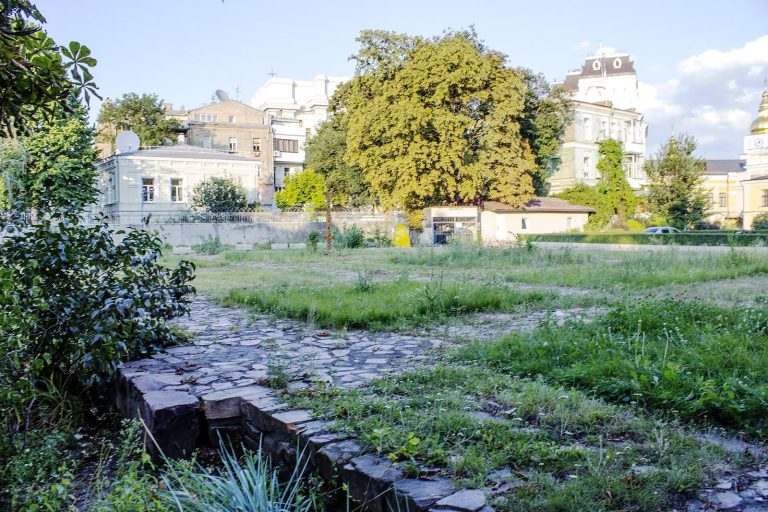
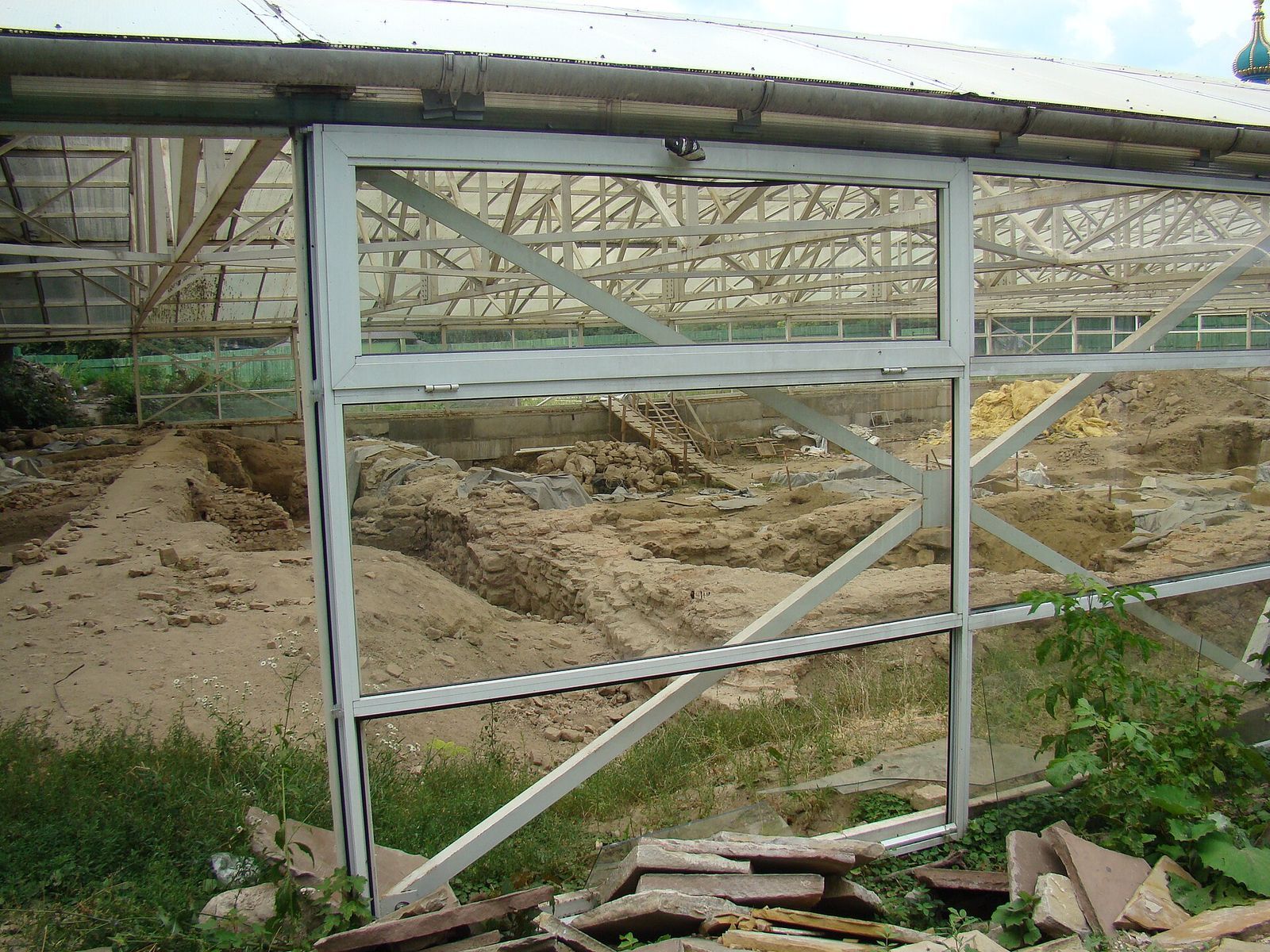
Archaeological work led by Hlib Ivakin from 2005 to 2011 opened previously unexcavated areas, clarified the foundation plan and identified building phases. The investigations also examined part of a defensive ditch and surviving wooden structures. A temporary Orthodox worship building erected near the ruins in 2006 was replaced by wooden and then stone structures; the stone building was dismantled in 2024. The church foundations and the wider archaeological area known as Volodymyr’s City are recognized as a monument of national significance in Ukraine. A museum devoted to the church was established in 2012.
Remains
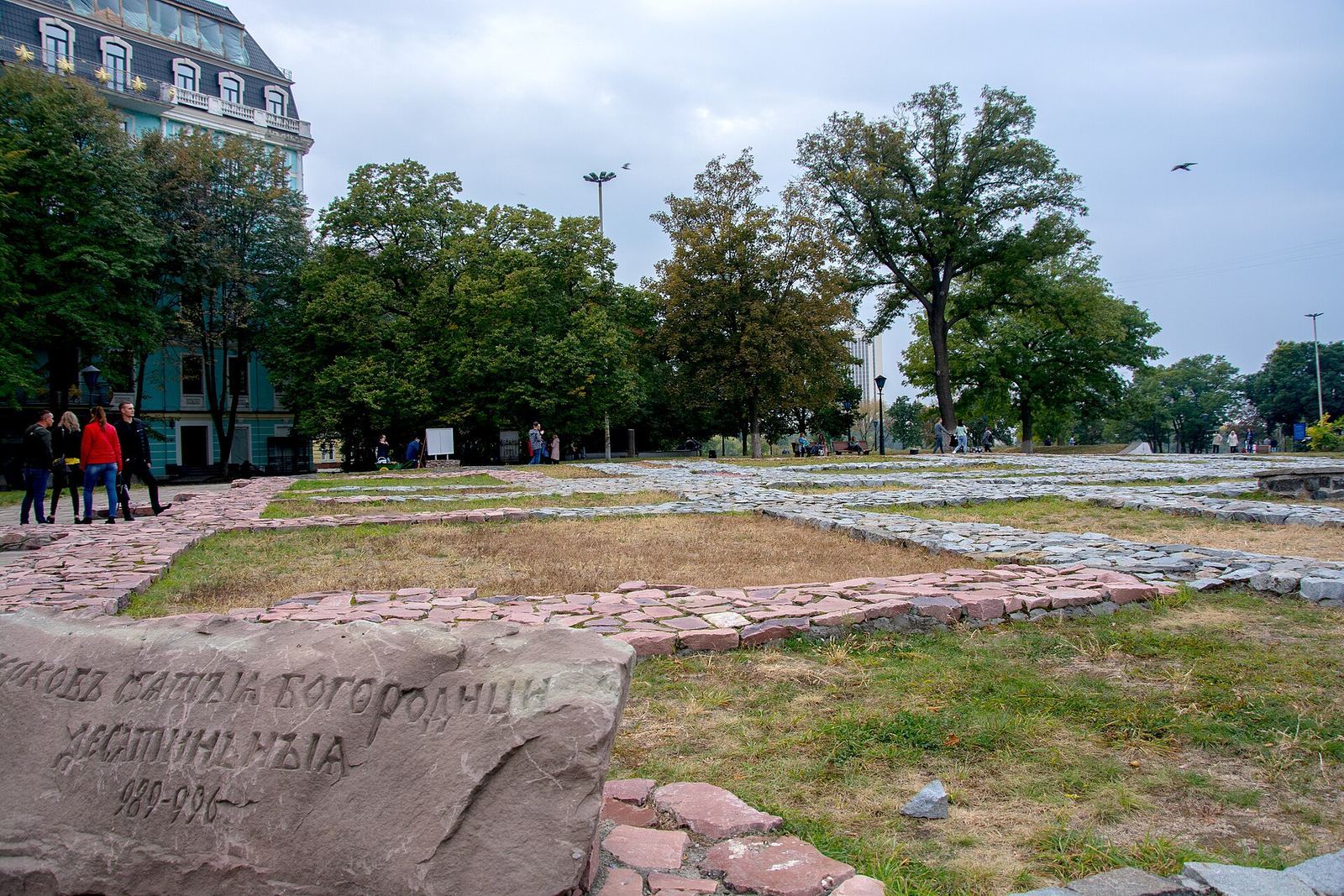
The church stood on Old Kyiv Hill within the fortified center, near the city gates and the old assembly and marketplace of Babin Torzhok. Its excavated foundations and building remains reveal a brick-and-masonry structure, though archaeological interpretations differ about its complete plan and appearance above ground.
The medieval church
Plan and construction
One reconstruction proposes a six-pillar church with three lengthwise spaces and a broad gallery, or passage alongside or around the building. Another places four supports within its central core. Both interpretations describe a cross-domed plan, with a dome above the central crossing. The foundations cannot settle the building’s full form, and proposed designs range from a centralized layout to a long, axial one. Its brickwork used recessed rows, with some courses set back from the wall face.
Decoration and western entrance
Mosaics, frescoes, carved marble and slate, and mosaic floors decorated the interior; some floor areas used glazed ceramic tiles. Marble was used extensively, leading to the description “marble church.” The building’s plan and surviving details have been linked to early Byzantine and Chersonesus traditions. Its form, brickwork, mosaic-floor technique, carved marble and Greek marks on some bricks point to builders from Constantinople. Cyrillic marks on bricks and glazed floor tiles indicate that southern Slavic builders, including Bulgarians, also took part.
Two large stone supports before the western entrance may have served as bases for bronze horses brought from Chersonesus. Copper statues of women may also have stood in front of the church; the name of the nearby marketplace may derive from these figures.
Marks and inscribed finds
Two late-tenth-century bricks bear marks scratched into their damp undersides. One carries letters that may be read as a syllable or a numeral, while another preserves a child’s footprint. Bricks found in 1907–1908 carry Vladimir’s trident symbols. A lead seal discovered in 1912 bears a two-pronged emblem and letters that may spell “Svyatoslav,” and another brick has a three-lobed interlaced mark.
Burials and nearby archaeological remains
Cemetery and settlement remains
Archaeological work in the surrounding area revealed a large tenth-century pagan cemetery and a concentration of richly furnished chamber graves associated with Scandinavian elites. Some have been proposed as burials of members of the Rurikid ruling lineage who died before the conversion of Rus. The wider excavated area also includes remains of princely residences, boyar houses, workshops and numerous ninth- and tenth-century burials. A portion of a princely stone residence lies about 60 metres northeast of the church foundations. A nearby building is thought to have served the church clergy and to have been built at the same time as the church.
Burials within the church
A wooden sarcophagus burial from the eleventh century contained the lower part of an iron sword in a wooden scabbard. Its silver fitting bears engraved ornament. The skeleton was laid with its head to the southwest.
Later church buildings and recovered fabric
Memorial church
The seventeenth-century memorial church occupied the southwest corner of the medieval ruin. Dedicated to the Nativity of the Virgin, it housed the Byzantine icon of St Nicholas associated by tradition with Vladimir’s journey from Chersonesus.
Nineteenth-century replacement
Stasov’s replacement was designed in a Russian-Byzantine style, rather than as a reproduction of the medieval church. Its iconostasis, an icon-bearing screen separating the sanctuary from the worship space, used copies of icons from St Petersburg’s Kazan Cathedral. The artist Vladimir Borovikovsky made the copies.
Excavated material
Surviving subsurface remains include foundations attributed to successive church buildings. Excavations have recovered fragments of medieval mosaics and frescoes, stone tombs and architectural components. Finds from the site are held by the National Museum of the History of Ukraine, the St Sophia reserve and the State Hermitage.