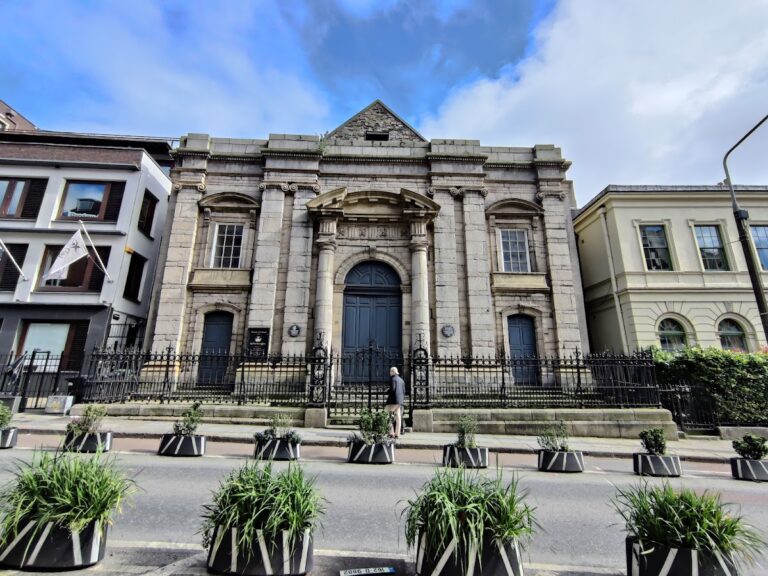
St Catherine’s Church, Dublin: A Church of Ireland Landmark in The Liberties


Site at a Glance
- Rating
- 4.6
- Popularity
- Very Low
- Country
- Ireland
- Primary era
- Early Modern
- External website
- Open
- Eras represented
- Early Modern, Modern
- Civilizations
- British, Irish
- Site type
- Religious
- Remains
- Church
On this page9 sections
History
St Catherine’s Church is a Church of Ireland church in Dublin, Ireland, whose present Palladian building was erected between 1760 and 1769. The church belongs to the Diocese of Dublin and Glendalough and follows a Low Church tradition, an Anglican approach associated with relatively restrained ceremony and formal ritual. It stands on Thomas Street in The Liberties, along the route of the medieval Slí Mhór, or Great Way, which ran westwards from Dublin.
Medieval origins and parish development
The origins of St Catherine’s are placed in 1185. In 1177, the parish of St James was recorded as belonging to the Augustinian Abbey of St Thomas, a religious house whose community followed the Rule of St Augustine. St Catherine’s served as a chapel-of-ease, a subordinate chapel established for parishioners who could not easily reach the principal parish church.
Population growth in Dublin’s western suburbs brought changes by the end of the thirteenth century. The parish of St James was divided, and St Catherine’s became an independent parish. Both parishes nevertheless remained subordinate to the Abbey of St Thomas until Henry VIII dissolved the abbey in 1539.
Reformation and changing congregations
After the abbey’s dissolution, the Crown appointed Sir John Brace as curate of St Catherine’s. Peter Ledwich, also recorded as Ledwidge or Lodowicke, succeeded him and was identified as vicar in 1551, followed by John Hande. Over the following century, St Catherine’s and St James’s passed to the Reformed Church. This change formed part of the Reformation under Henry VIII, which transferred Ireland’s established church away from Roman Catholic authority and brought the dissolution of religious houses, while Roman Catholic priests continued to serve much of the local population.
Roman Catholics obtained the use of a chapel in Dirty Lane, now Bridgefoot Street, towards the end of the seventeenth century. A separate St Catherine’s Church was later founded in Meath Street for the Catholic population. Within the Church of Ireland parish, a new organ designed and made by Renatus Harris, a prominent seventeenth-century English organ builder, was installed in 1697. The two Church of Ireland parishes were formally separated in 1710.
The eighteenth-century church
The present church was designed by the Dublin architect John Smyth and built from 1760 to 1769. Its foundation stone was laid in 1760, and it opened for worship in 1769. Joseph Jarratt was also paid for work on the building. The church was erected as Dublin’s western districts continued to develop and became a major Church of Ireland building in The Liberties.
Among the later clergy was James Whitelaw, rector from 1749 until his death in 1813. He was a historian and statistician who died from a fever contracted while visiting parishioners afflicted by illness. Another notable parishioner was William Mylne, the architect and engineer responsible for Dublin’s waterworks. A plaque inside the church commemorates him.
Execution, closure, and revival
In 1803, St Catherine’s was the site of Robert Emmet’s execution. Emmet was an Irish republican revolutionary whose uprising against British rule was suppressed that year. A plaque at the church commemorates the execution, while a separate memorial in the churchyard remembers participants in the 1803 Rising who were hanged, including people executed on Thomas Street.
The Protestant population of Dublin’s Liberties declined during the twentieth century. St Catherine’s closed in September 1966 and was deconsecrated in 1967. Worship moved to the former chapel-of-ease, the Church of St Victor, which was renamed St Catherine and James Church, Donore Avenue. Dublin Corporation subsequently held the building and used it for exhibitions and concerts, including performances by Christy Moore and the Chieftains. It fell out of use in the 1980s, when its interior was vandalised.
In 1990, Dublin Corporation offered the church for sale as part of an inner-city development plan. The Anglican City Outreach for Renewal and Evangelism group, known as CORE, undertook its refurbishment in 1993. The interior was largely restored by the end of 1998, and the church was reconsecrated in early November that year. It has served as an active place of worship for CORE since then. Eoghan Heaslip became minister in 2017. John Percy Phair, another later rector, subsequently became Bishop of Ossory.
Remains
St Catherine’s survives as a Palladian galleried church, with its principal façade facing Thomas Street and its churchyard and former cemetery behind it. Palladian architecture uses symmetry, ordered proportions, and classical elements such as columns, pilasters, and pediments. The galleried form, in which raised galleries provide additional interior seating, was common in Dublin from the late seventeenth century.
Thomas Street façade
The Thomas Street façade is built of mountain granite. Four Doric semi-columns occupy its centre and support a pediment, while coupled pilasters mark the two extremities. A spire was intended for the design but was never completed because insufficient funds were available. The restrained classical arrangement gives the exterior its characteristic Palladian appearance.
Interior and crypt
The church’s interior retains the arrangement of a galleried place of worship. It was restored in 1877 by the architects Curdy and Mitchell. During the following decade, James Franklin Fuller reordered the interior and replaced the old box pews with open pews. Fuller was a nineteenth-century architect known for ecclesiastical restoration and reordering.
The crypt contains the remains of several Earls of Meath. Christopher Plunkett, 2nd Earl of Fingall, was buried in the church in August 1649 after being fatally wounded at the Battle of Rathmines. He was an Irish aristocrat and military participant who died from those wounds. The interior also contains the plaque commemorating Robert Emmet’s execution and the plaque to William Mylne.
Churchyard and burial ground
The churchyard and cemetery behind the church date originally from 1552. Burials ended there in 1894, after which the former burial ground became a small public park. A plot was provided by the Protestant Orphan Society, a charitable institution supporting Protestant orphans, for the burial of orphans. The grounds also contain memorials connected with the 1803 Rising, including the commemoration of those hanged after the rebellion.