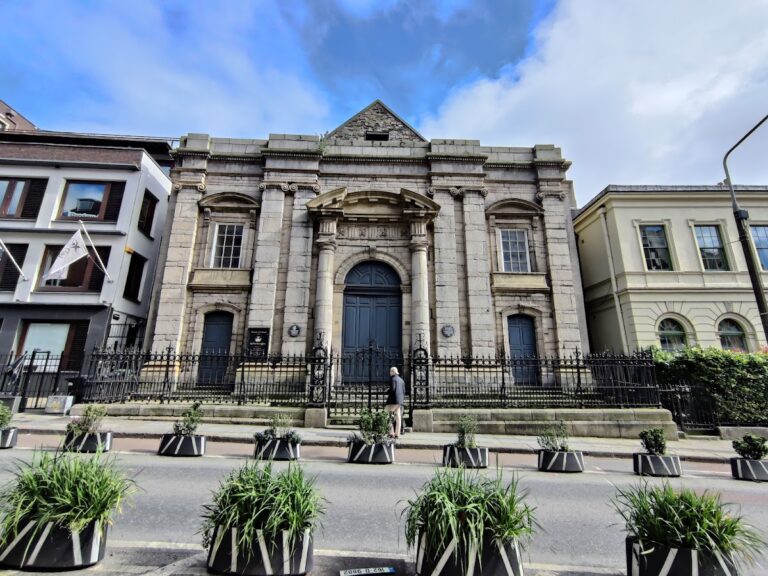
St. Michan’s Church: A Viking-Era Parish Church in Dublin


Site at a Glance
- Rating
- 4.7
- Popularity
- Medium
- Country
- Ireland
- Primary era
- Early Modern
- External website
- Open
- Eras represented
- Early Modern, Modern
- Civilizations
- British, Irish
- Site type
- Religious
- Remains
- Church
On this page10 sections
History
St. Michan’s Church is a Church of Ireland parish church in Dublin, Ireland, standing on the site of a Christian chapel founded in 1095 during the Norse Kingdom of Dublin. The Norse Kingdom was a medieval polity centered on Dublin and established by Scandinavian settlers and rulers. Dedicated to St. Michan, an early Christian saint traditionally associated with Ireland, the church is now part of the Diocese of Dublin and Glendalough, in the Province of Dublin and the Christ Church parish.
From medieval chapel to parish church
St. Michan’s operated as a Catholic church until the Reformation, the sixteenth-century transformation that changed the religious and institutional status of many Irish churches. The present building was largely reconstructed in 1686 under the architect William Robinson. It has served Church of Ireland parishioners in Dublin for more than 300 years and is described as the only surviving parish church north of the River Liffey founded on a Viking-era site, as well as the oldest parish church in that part of the city.
The church grounds later acquired additional parish buildings. An almshouse was built around 1720 and subsequently used as church offices. Renovation followed around 1825, with further alterations in 1865, including the addition of a two-storey vestry on the northern side of the church.
Burial vaults and later events
The vaults made St. Michan’s a public attraction from the Victorian period. Numerous mummified human remains, most dating from the seventeenth to nineteenth centuries, were preserved there. They include Henry and John Sheares, participants in the 1798 rebellion, an Irish uprising against British rule, as well as people associated with the title Earl of Leitrim. A nun described as about 400 years old, a tall body popularly believed to be a crusader, and a body with its feet and right hand severed also became associated with the vaults.
In July 1996, vandals entered one of the five burial vaults, removed bodies from their coffins, and started a fire using rags and paraffin. The vault was destroyed, while water used to extinguish the fire damaged the remains. The disturbed bodies were later reinterred during a church service, and the four undamaged vaults remained open while the destroyed vault was permanently closed.
On 23 and 24 February 2019, an intruder entered the crypt, decapitated the mummy popularly called the Crusader, and stole its head along with another skull. The nun’s remains, other bodies and coffins, and the family vault of mathematician William Rowan Hamilton were disturbed. Gardaí recovered the stolen remains in early March. After restoration work and improved security, the crypt reopened on 9 July 2019. Brian Bridgeman received a 28-month prison sentence in July 2019 after pleading guilty to burglary and criminal damage, including damage to two dead bodies.
On 11 June 2024, an intruder deliberately set fire to the crypt. The fire and the water used to prevent it spreading to the church destroyed or damaged beyond repair five mummified remains, including the Crusader. In February 2025, Cristian Topiter received a six-year prison sentence after pleading guilty to arson. Conservation work was continuing and public access to the crypt remained suspended as of March 2025.
Remains
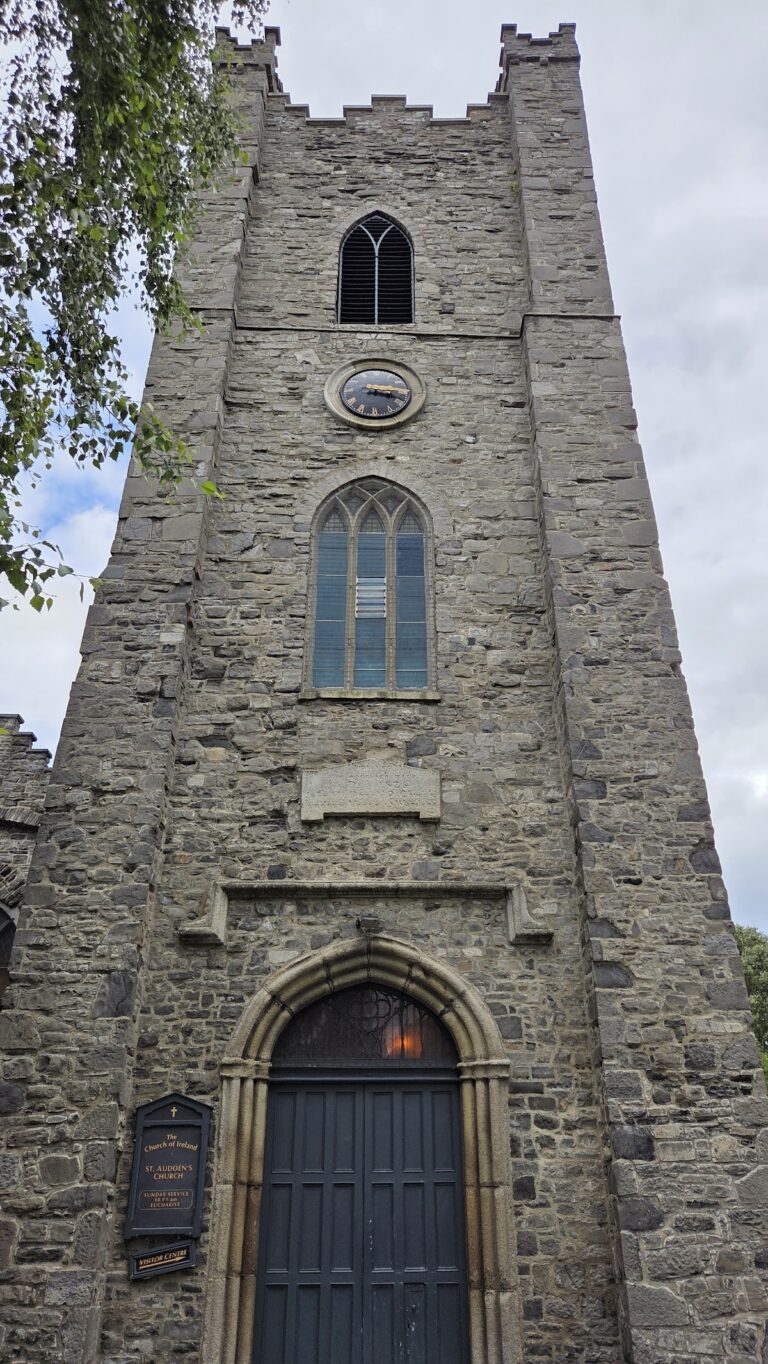
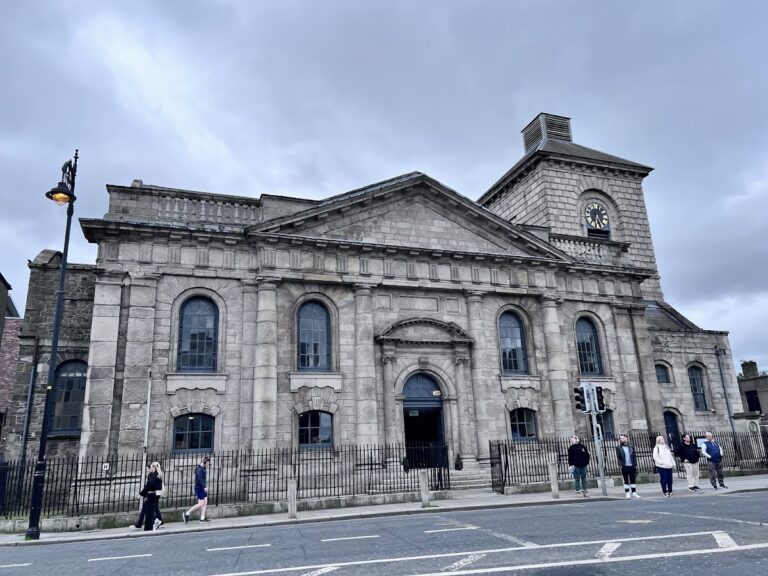
St. Michan’s has a modest exterior and an interior containing fine woodwork and partly historic furnishings. The surviving church largely reflects the 1686 reconstruction. Its tower has post-Gothic forms, and the architectural historian Harold G. Leask concluded that it was built with the present church rather than retained from a medieval predecessor. The church stands on Church Street on the north side of the River Liffey, which divides Dublin into northern and southern areas.
Church buildings and furnishings
Almshouse and vestry
The former almshouse, built on the church grounds around 1720, survives as a building later adapted for church offices. The church’s two-storey vestry stands on its northern side and belongs to the nineteenth-century alterations made after the renovation around 1825 and the further work of 1865.
Historic organ
The church contains a pipe organ that combines an eighteenth-century case with a twentieth-century instrument. Jean-Baptiste Cuvilliés, a French craftsman, made the ornate case between 1723 and 1725. Evans and Barr of Belfast built the present organ around 1940, retaining the historic case and fitting a three-manual pneumatic console into the space formerly occupied by narrower eighteenth-century keyboards. The Swell division has a slider soundboard with separate pneumatic subaction, while the Great and Choir divisions use non-slider windchests.
The Organ Trophy, a carved wooden panel showing seventeen musical instruments, was installed on the front of the gallery in 1724. A long-standing Dublin tradition holds that George Frideric Handel practised on the organ before the first performance of Messiah in Dublin in 1742. The earliest published account, from 1852, said that the tradition had long been preserved in Dublin, but its accuracy remains unconfirmed.
Crypt and cemetery
Burial vaults
The crypt contains five burial vaults with limestone walls. Their very dry air is associated with the natural preservation and mummification of the bodies. The remains dried and contracted into a leathery condition without artificial preservation. The vaults contain bodies and coffins from several periods, including the remains associated with the Sheares brothers, the Earls of Leitrim, the nun, and the figure popularly identified as a crusader.
Cemetery markers
The adjoining cemetery contains several grave markers dating from the mid-seventeenth century, adding surviving evidence of the burial ground’s use alongside the church.