Christ Church Cathedral, Dublin: A Medieval Cathedral of Ireland


Site at a Glance
- Rating
- 4.5
- Popularity
- High
- Country
- Ireland
- Primary era
- Medieval
- External website
- Open
- Eras represented
- Medieval, Modern
- Civilizations
- Norman
- Site type
- Religious
- Remains
- Cathedral
On this page18 sections
History
Christ Church Cathedral, formally the Cathedral of the Holy Trinity, is a medieval cathedral in Dublin, Ireland, founded by the Hiberno-Norse king Sitric Silkenbeard in the early eleventh century, probably after 1028 and traditionally dated to 1038. It is the older of Dublin’s two medieval cathedrals and serves the united dioceses of Dublin and Glendalough within the Church of Ireland, the Anglican church in Ireland.
Foundation and the Early Diocese
The first bishop of the new Dublin diocese was Dúnán, also known as Donat. The small diocese lay within the much larger Diocese of Glendalough and was initially answerable to Canterbury rather than to the Irish church hierarchy. The first church stood on high ground above the Viking settlement at Wood Quay. Sitric endowed it with the lands of Baldoyle, Raheny, and Portrane to support its maintenance.
Christ Church was one of only two churches serving the Viking city. Of four reputed early Celtic Christian churches around Dublin, only the church dedicated to St Martin of Tours stood within the city walls. The cathedral was initially served by secular clergy. Under the second bishop of Dublin, Benedictine monks were introduced, and in 1163 Laurence O’Toole, the second archbishop of Dublin, reorganized the institution as the Priory of the Holy Trinity under the reformed Augustinian Rule of the Canons of Arrouaise. Augustinian canons were clergy living in a community under the Rule of St Augustine, while the Canons of Arrouaise followed a reformed version of that rule.
Laurence O’Toole followed the rule himself, and the priory remained under an Augustinian prior until its dissolution in 1541. It became one of Ireland’s wealthiest religious houses, holding more than 10,000 acres of property in County Dublin. Its lands included farms at Grangegorman, Glasnevin, and Clonken, now known as Deansgrange.
Stone Rebuilding and Medieval Expansion
In the 1180s, Strongbow, the historical name of Richard de Clare, 2nd Earl of Pembroke, and other Anglo-Norman magnates financed the replacement of the wooden church in stone. The rebuilding created a choir, choir aisles, transepts, a crypt, and chapels dedicated to St Edmund, St Mary, and St Lô. A chapel to St Laurence O’Toole followed in the thirteenth century, while much of the nave was built during the 1230s.
Henry II attended the cathedral’s Christmas service in 1171. According to the cathedral tradition, it was his first reception of Holy Communion after the murder of Thomas Becket by Henry’s knights at Canterbury in 1170. Between 1349 and 1362, John de St Paul, Archbishop of Dublin, carried out a major extension that added a “long choir,” lengthening the earlier choir by approximately 10 metres. By 1358, part of the nave was being used for secular purposes, and St Paul installed an organ. His work was later destroyed during the nineteenth-century rebuilding, although he was buried beneath the high altar.
In 1300, Richard de Ferings, Archbishop of Dublin, established the Pacis Compositio, the medieval agreement regulating the relationship between Christ Church and St Patrick’s Cathedral. It recognized both as cathedrals but gave Christ Church formal precedence as the diocese’s mother and senior cathedral. The agreement assigned the archbishop’s consecration and enthronement normally to Christ Church, required the annual consecration of diocesan chrism there, and provided for the alternating burial of deceased archbishops unless they directed otherwise. Christ Church also retained the cross, mitre, and ring of each deceased archbishop, while the two cathedrals were to act as one and share their liberties equally.
In 1480, the judge William Sutton left all his lands and silver to Christ Church. The cathedral was also the purported site of the 1487 coronation of Lambert Simnel, a boy pretender who claimed to be King Edward VI of England in an unsuccessful attempt to depose Henry VII. A choir school was founded in 1493.
Dissolution and Religious Change
Henry VIII’s Royal Warrant of 12 December 1539 dissolved the Priory of the Holy Trinity. Its prior and canons became secular clergy who formed the dean and chapter of Christ Church. The last prior, Robert Paynswick or Penswick, became the first dean, and the conversion was completed between 1540 and 1542 with a chapter of eight clergy.
The Reformation was the sixteenth-century religious and institutional transformation that transferred Ireland’s established church structures from Roman Catholic control to the Church of Ireland under the English crown. Under Edward VI, Christ Church received additional staff and annual royal support for its choir school. St Patrick’s Cathedral was formally suppressed, and on 25 April 1547 its silver, jewels, and ornaments were transferred to Christ Church. Mary I and James I later increased the cathedral’s endowment. English replaced Latin in sung worship in 1551, and the Bible was first read in English in Ireland in 1560.
In 1562, the nave foundations, which rested on peat, slipped. The south wall and arched stone roof collapsed, while the north wall survived in a visibly leaning position. Much of the fallen material was levelled and covered by new flooring, completed in 1871.
Public Institutions and Later Worship
During the seventeenth century, Parliament and the law courts met in buildings beside Christ Church. James II presided over a state opening of Parliament there before Parliament moved to Chichester House at Hoggen Green, now College Green, and the courts moved to the Four Courts.
After arriving in Ireland in 1690 to fight for his throne, James II temporarily restored Roman Catholic worship at Christ Church and attended High Mass in the cathedral. The choir later participated in the first performance of George Frideric Handel’s Messiah in 1742.
Victorian Reconstruction and Modern Cathedral Life
Christ Church remained in poor condition through much of the nineteenth century and was declared unsafe. The architect Matthew Price undertook limited work between 1829 and 1831. In 1869, during the disestablishment of the Church of Ireland, the possibility of transferring the building to Roman Catholics was seriously considered.
George Edmund Street extensively renovated and rebuilt the cathedral and Synod Hall between 1871 and 1878, with major financial support from the whiskey distiller Henry Roe of Mount Anville. The intervention prevented the badly decayed building from collapsing, but it also produced a mixture of medieval fabric and Victorian reconstruction that can be difficult to distinguish. Further restoration, notably extensive work on the roofs and masonry, took place in 1980–1982. The crypt was renovated in the early 2000s.
Since the Reformation, Christ Church has been the cathedral of the Church of Ireland’s Archbishop of Dublin in law and practice. The Roman Catholic Archbishop of Dublin uses St Mary’s on Marlborough Street as a pro-cathedral, a church temporarily serving as a cathedral when the formally claimed cathedral is unavailable or belongs to another denomination, although the Holy See has regarded Christ Church as the rightful Roman Catholic cathedral of the archdiocese.
Christ Church remains the worship centre of the united dioceses of Dublin and Glendalough. It hosts ordinations of priests, consecrations of bishops, and the annual Citizenship Service. In 1971, the Church of Ireland created the Christ Church Cathedral Group of Parishes, bringing the cathedral together with the parishes of St Andrew’s, St Werburgh’s, All Saints at Grangegorman, St Michan’s, St Paul, and St Mary.
Since 1872, operational oversight has been provided by a board of nine clergy and nine lay members. The dean and chapter, with the consent of the Archbishop of Dublin, govern the cathedral. The chapter includes the dean, precentor, chancellor, treasurer, the archdeacons of Dublin and Glendalough, and twelve canons, eight from Dublin and four from Glendalough.
The cathedral has a long musical tradition, including a cathedral choir and a girls’ choir. John de St Paul installed an organ in the fourteenth century. The present organ was built in 1984 by Kenneth Jones and Associates of Bray and was overhauled and slightly enlarged in 2003–2004.
The heart of Laurence O’Toole was stolen from the cathedral on 3 March 2012. Irish police recovered it in Phoenix Park in April 2018.
Remains
Church Fabric and Medieval Layout
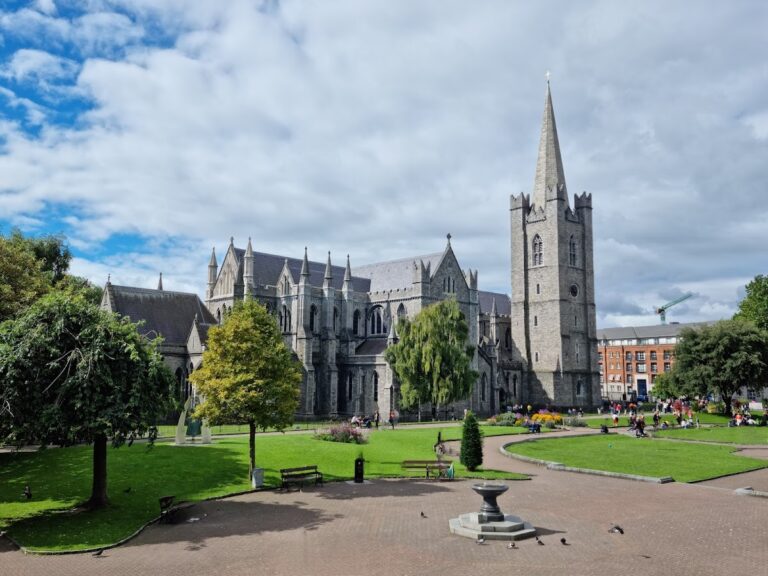
Christ Church has a Romanesque and Gothic character and follows the basilican plan of a church organized around a central nave with supporting aisles. Its medieval setting has been substantially altered by road construction and the demolition of the older residential quarter around Wood Quay, which separated the cathedral from the former pattern of small streets and buildings and left it visually isolated behind newer civic offices.
Stone Church and Nave
The original eleventh-century church was wooden. The late-twelfth-century stone rebuilding included the choir, choir aisles, transepts, crypt, and chapels of St Edmund, St Mary, and St Lô. The thirteenth-century nave was influenced by the English western school of Gothic architecture and was built with Somerset oolite, a limestone from Dundry, by craftsmen from Somerset. The surviving north wall largely dates from about 1230 and still leans as a result of the collapse of 1562.
Choir, Chapter House, and Baptistry
The great fourteenth-century choir was demolished during Street’s restoration. A new eastern end and choir were built over the original medieval crypt, and Street added a new chapter house. The former north porch was removed and replaced by a baptistry occupying a chapel along the cathedral’s north wall. Stained-glass images of Irish patron saints surround it, including St Cormac, St Anne, St Mary, St Finbar, St Cuthbert, St Edmund, St Patrick, St Laurence O’Toole, St Bridget, and St George defeating the dragon.
Behind the altar area, the chapter house contains cathedral offices, meeting rooms, and other facilities. Near the south Romanesque portal stands a ruined chapter house associated with the former priory of the Canons of Arrouaise.
Crypt and Preserved Objects
Built in 1172–1173, the crypt extends for 63.4 metres beneath the nave and choir. Heavy, roughly cut stone pillars support the weight of the cathedral and its main tower. It is the largest cathedral crypt in Britain and Ireland. The space contains historic cathedral books and altar goods, medieval tiles, and a tabernacle and candlesticks associated with the brief restoration of Roman Catholic worship under James II.
Secular Carvings and Medieval Stocks
Two carved statues in the crypt stood outside Dublin’s medieval Tholsel until the late eighteenth century and are regarded as Ireland’s oldest known secular carvings. The crypt also contains stocks made in 1670 for punishing offenders before the Court of the Dean’s Liberty. Originally placed in Christ Church Place, they were moved into the crypt in 1870.
The Cat and Rat
A mummified cat and rat are preserved in the crypt. They were found trapped behind the organ in 1860 while apparently pursuing one another, and the cathedral’s unusually dry air preserved their remains.
Tombs, Portals, and the Synod Hall
Strongbow’s Tomb
The nave contains a tomb traditionally identified as that of Strongbow, Richard de Clare, 2nd Earl of Pembroke. The monument was smashed when the nave roof collapsed in 1562. The present tomb is a replacement brought from Drogheda and is not considered to be Strongbow’s actual grave. A smaller adjacent effigy has sloping shoulders and may represent a woman, although its chain mail may instead indicate a child.
From the sixteenth to the eighteenth centuries, the Strongbow tomb served as a venue for legal agreements. The heart of Laurence O’Toole was kept separately in the cathedral.
South Portal and Interior Furnishings
A twelfth-century portal survives on the south side of the transept. Inside, Gothic arches rise to approximately 25 metres. The cathedral also contains a medieval brass lectern and a nineteenth-century copy of it, while the pulpit is surrounded by sculptures of the four Evangelists carved by Thomas Earp.
Bridge and Synod Hall
At the west end, a fully integrated covered stone bridge connects the cathedral with the former Synod Hall. Street built the hall on the site of St Michael’s, a prebendal church of Christ Church, and incorporated that church’s surviving tower. The hall formerly hosted general and diocesan synods for Dublin, Glendalough, and Kildare and now houses the Dublinia exhibition.
Tower and Bells
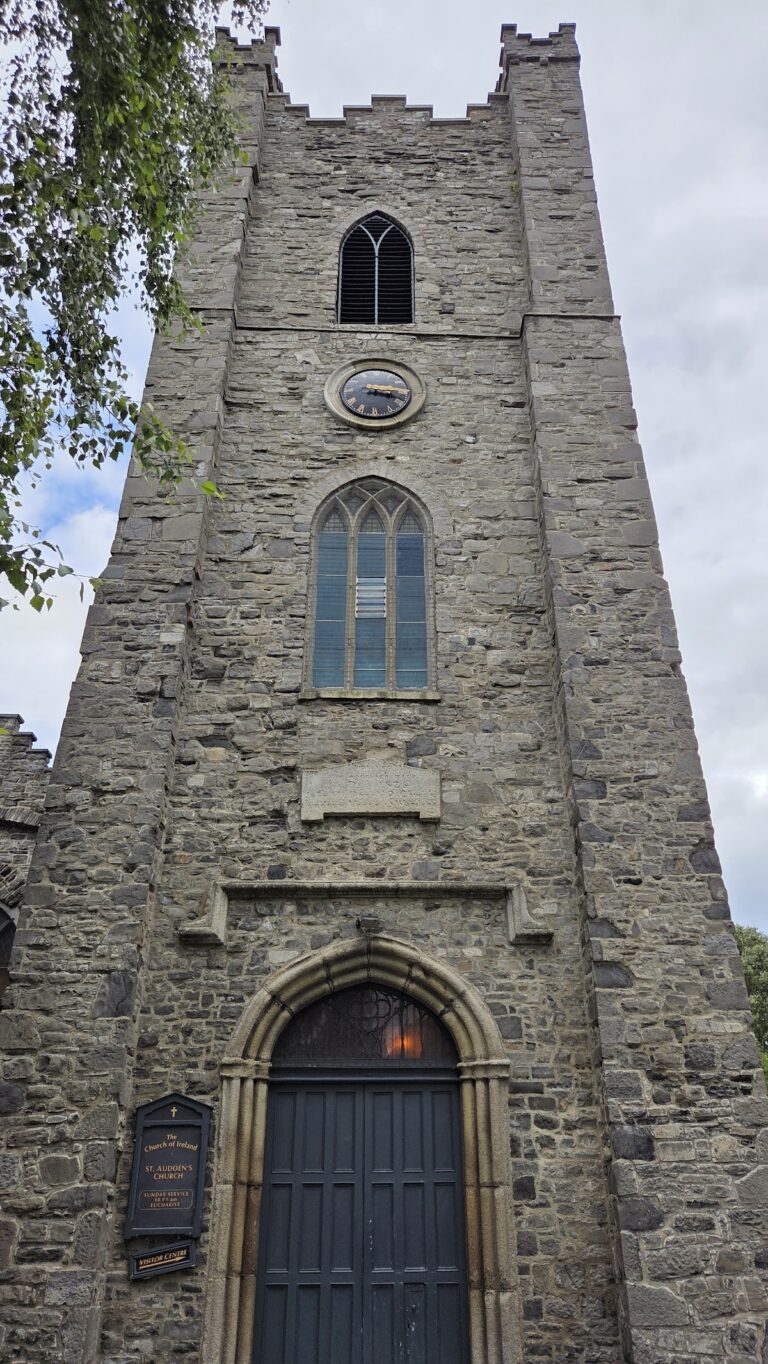
Christ Church probably had at least one ringing bell from its foundation, and three large bells were recorded in the tower by 1440. An accidental gunpowder explosion on a nearby quay on 11 March 1597 damaged the tower and cracked the bells, as well as damaging the tower of St Audoen’s Church.
Six bells cast from cannon metal were installed in 1670. Abel Rudhall recast them and increased the number to eight in 1738. Several were recast by John Murphy of Dublin in the 1840s, and the ring was gradually recast and increased to twelve by John J. Murphy in the 1860s and 1870s. The tenor bell was recast in 1979.
Seven additional bells were installed in 1999, producing twenty bells in total, nineteen swinging bells and one chiming bell. The ring provides combinations for twelve-, fourteen-, and sixteen-bell peals, including twelve-bell combinations in B, C-sharp, and F-sharp. At the time of its augmentation, it was the second sixteen-bell full-circle peal in the world.