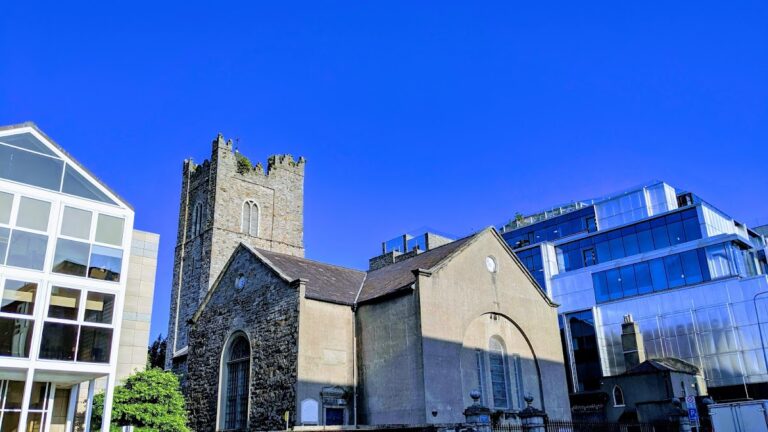
St. Werburgh’s Church, Dublin: A Church of Ireland Parish Church


Site at a Glance
- Rating
- 5
- Popularity
- Very Low
- Country
- Ireland
- Primary era
- Early Modern
- External website
- Open
- Eras represented
- Early Modern, Modern
- Civilizations
- British, Irish
- Site type
- Religious
- Remains
- Church
On this page14 sections
History
St. Werburgh’s Church, Dublin, in Ireland, is a Church of Ireland parish church whose parish was founded by Anglo-Norman settlers from Bristol in 1178. The present building, an example of Italianate classical architecture, was constructed in the early eighteenth century and completed after a destructive fire in 1759. Its history is closely connected with Dublin Castle and with the religious, civic, and musical life of central Dublin.
Medieval parish origins
The parish was established shortly after the Anglo-Normans, Norman rulers and settlers who gained control in parts of Ireland after the late twelfth-century invasion, arrived in Dublin. It was dedicated to St. Werburgh, an Anglo-Saxon abbess associated with Ely and regarded as the patron saint of Chester. Before that dedication, the area had been associated with St. Martin of Tours, whose church stood near the southern end of present-day Werburgh Street.
St. Werburgh’s was especially frequented by settlers from Bristol. Its medieval church contained chapels dedicated to Our Lady, St. Martin, and St. Catherine. From the period of Archbishop Henry de Loundres, who died in 1228, the parish was appropriated to the chancellor of St. Patrick’s Cathedral. A major fire in 1311 destroyed the church and affected much of Dublin, after which the building was reconstructed.
Parish reorganization and civic connections
In 1559, the nearby parish of St. Mary del Dam on Dame Street was suppressed and incorporated into St. Werburgh’s. The enlarged parish included Dublin Castle, and its boundaries later corresponded with those of the civil parish, a territorial administrative unit distinct from an ecclesiastical parish. During the seventeenth century, St. Werburgh’s disputed its boundaries with the parish of St. John the Evangelist on Fishamble Street. The disagreements concerned houses liable for parish rates, particularly properties in Copper Alley and near Essex Gate and Essex Bridge.
The parish was served by several notable clergy. James Ussher was appointed to the church in 1607 and later became Primate of the Church of Ireland, the senior bishop of that church. Edward Wetenhall served as curate, a clergyman working under the authority of a parish priest or rector, before becoming Bishop of Kilmore. Patrick Delany, a clergyman and friend of Jonathan Swift, became rector in 1730.
The eighteenth-century rebuilding
By the end of the seventeenth century, the medieval church required replacement. An Irish Parliament act of 1715 appointed commissioners to organize a new building, and Colonel Thomas Burgh, Surveyor-General of Public Buildings and Member of Parliament for Naas, was entrusted with its construction. The new church was sufficiently complete for worship in 1719, at a cost of £8,000.
An accidental fire in November 1754 severely damaged the building, leaving only the stonework and bells. The church was restored and reopened in 1759, and much of the present interior dates from this rebuilding. Joseph Jarratt is associated with the later work, while the eighteenth-century interior was designed by John Smith, also recorded as John Smyth. Smith also designed an upper gallery for pupils of the parish school.
St. Werburgh’s acquired a particular connection with the British Lord Lieutenant, the Crown’s chief representative in Ireland before the establishment of the Irish state, and his household. A viceregal pew, reserved for the Lord Lieutenant or another representative of the Crown, was installed in 1767. The church’s pew register recorded many prominent figures in eighteenth-century Dublin.
Music and later parish history
Music formed an important part of the church’s history. Philip Hoey, a former clergyman of the parish, left money for the purchase of an organ. The parish acquired an instrument made by Millars of College Street, which was installed and publicly performed in June 1768.
On 3 May 1787, the church hosted a commemoration of George Frideric Handel. Handel had used the church organ to rehearse Messiah, which later premiered at the Great Music Hall on Fishamble Street. The composer and pianist John Field was baptized at St. Werburgh’s on 5 September 1782. His grandfather, also named John Field, was a professional organist who played the church organ.
In 1877, St. Werburgh’s parish was united with that of St. John the Evangelist. The interior was then remodelled, with additions by the architect William Welland. The churchyard had been used for several centuries, and twenty-seven burial vaults were located beneath the church. Those buried there included Nicholas Sutton, Attorney General for Ireland, in 1478; Peter Palmer, a justice of the Irish Court of Common Pleas, in 1621; Robert Sibthorp, Bishop of Limerick, in 1649; William Hilton and his wife, Anne Ussher, in 1651; and the historian Sir James Ware in 1666.
Lord Edward Fitzgerald, commander-in-chief of the United Irishmen, was buried in a church vault on 5 June 1798. Major Sirr, who captured Fitzgerald, was buried in the churchyard in 1841. Parish deeds dating from 1317 to 1662 preserve evidence about property owners in the area. The Royal Irish Academy catalogued the collection between 1916 and 1919.
Remains
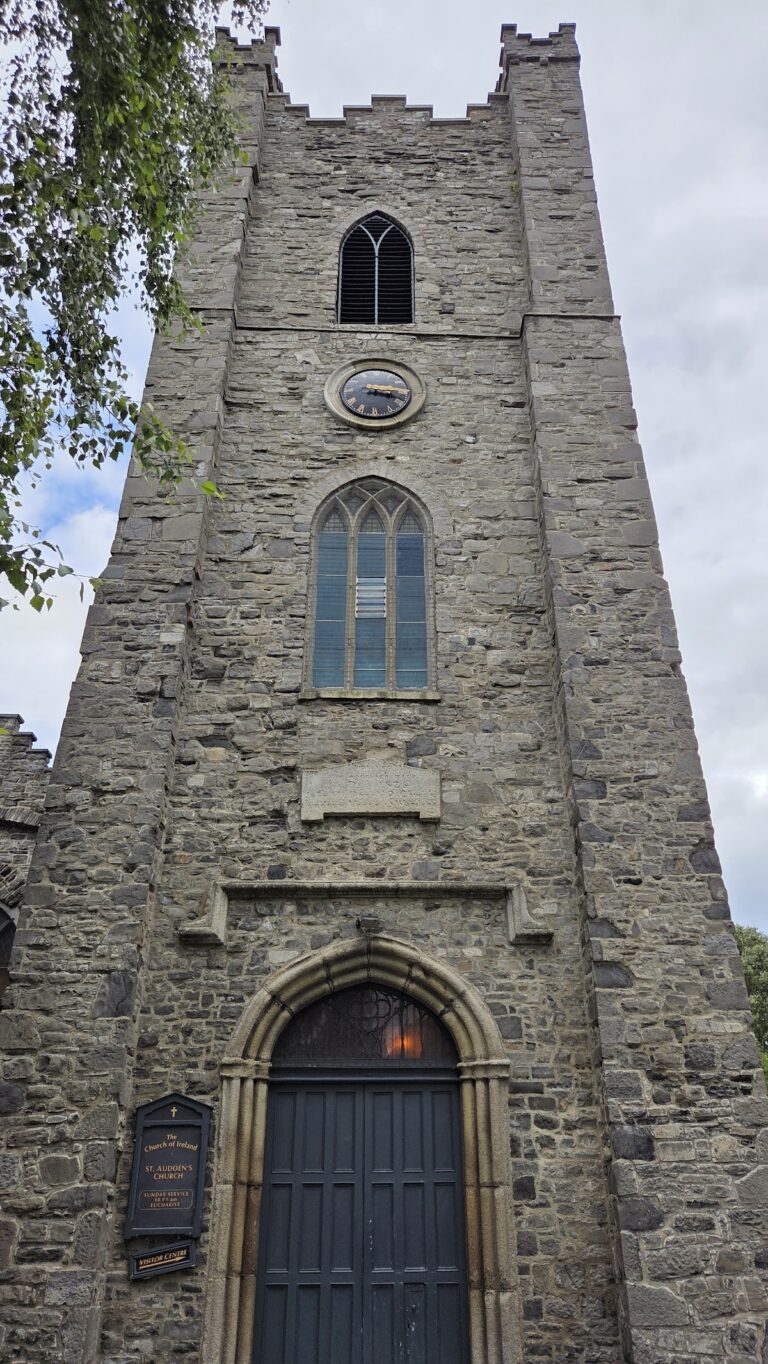
St. Werburgh’s occupies a site on Werburgh Street near Dublin Castle. The present church is an Italianate classical building whose interior measures approximately 80 feet (24.4 metres) in length and 52 feet (15.8 metres) in width. The churchyard lies beside the building, while twenty-seven burial vaults extend beneath it. Surviving elements also include the eighteenth-century organ, later organ fittings, the former bellows-pumping space, and Dublin’s oldest surviving fire appliances.
Church building and interior
Interior and galleries
The church was built under Thomas Burgh in 1719 and completed after the fire of 1754 in 1759. Its interior belongs substantially to the eighteenth-century rebuilding and follows classical forms influenced by Italian architectural models. John Smith, also known as John Smyth, designed the interior and an upper gallery for pupils of the parish school. Later remodelling in 1877 introduced additions by William Welland.
Tower and spire
A tower and spire were added after the main church had been constructed. The spire was removed around 1810 because it overlooked the yard of Dublin Castle and was considered a security risk. The architect Francis Johnston offered to make the tower safe, but the offer was rejected. The tower itself was dismantled in 1836.
Fire appliances
The 1754 fire left the church’s stonework and bells. Afterward, fire engines were stored in the church porch. The building now preserves Dublin’s oldest surviving fire appliances, linking a practical feature of its later use with the event that shaped its present interior.
Organ
Instrument and case
The organ was originally built by the eighteenth-century Dublin organ builder Ferdinand Weber. Around 1870, Telford and Telford restored it within the case of the earlier instrument. It has two manuals, keyboards operated by the hands, and pedals operated by the feet. The instrument has mechanical action, fifteen stops, and one additional stop prepared for but never installed.
Pipes and surviving mechanism
The gilded front pipes and some internal pipes date from the eighteenth century. The manuals have a normal compass of 56 notes, while the pedals have 25 notes and reflect a transitional mid-nineteenth-century design. The organ was electrified in the 1960s, but the former bellows-pumping space survives and contains historical graffiti.
Churchyard and burial vaults
The churchyard beside St. Werburgh’s and the twenty-seven vaults beneath the building preserve the physical setting of the parish’s long burial history. The interments include civic officials, judges, bishops, an historian, Lord Edward Fitzgerald, and Major Sirr, whose burials connect the churchyard and vaults with Dublin’s religious, legal, political, and military history.