Church of St. Thomas: A Baroque Parish Church in Brno, Czechia


Site at a Glance
- Rating
- 4.7
- Popularity
- Low
- Country
- Czechia
- Primary era
- Early Modern
- External website
- Open
- Eras represented
- Medieval, Early Modern
- Civilizations
- Holy Roman Empire, Margraviate of Moravia
- Site type
- Religious
- Remains
- Church
On this page17 sections
History
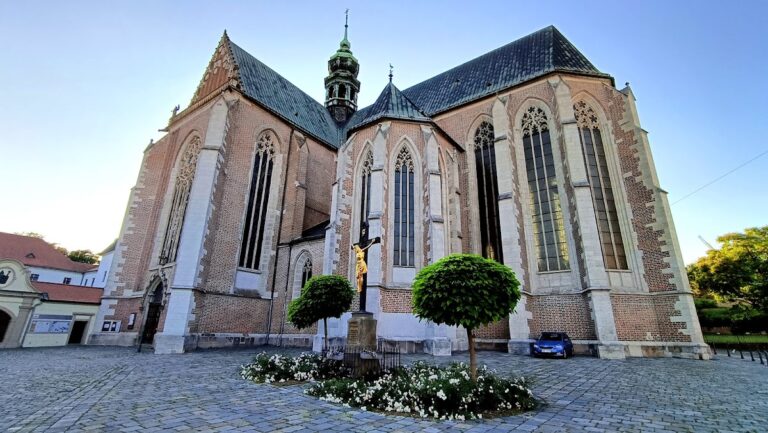
The Church of St. Thomas is a Roman Catholic parish church in Brno, Czechia, originating in a fourteenth-century Augustinian monastery. Dedicated also to the Annunciation of the Virgin Mary, it was founded on 2 February 1350 by John Henry, Margrave of Moravia, as a planned burial place for his family. His brother, Charles IV, King of Bohemia and Holy Roman Emperor, actively supported the foundation.
Foundation and Gothic construction
Construction began in 1353. The Prague Parler workshop, associated with a prominent Central European family of medieval architects, builders, and sculptors, was invited to design a three-nave basilica. The monastery was intended to accommodate 42 Augustinian monks and was planned as a major religious foundation within the Holy Roman Empire, the central European political realm that lasted until 1806.
The church was consecrated in 1356 by Jan Očko of Vlašim, Bishop of Olomouc, in the presence of Charles IV. The building was probably still incomplete, with foundations and unplastered brickwork concentrated in the presbytery and choir. Charles IV presented the monastery with the Madonna of St. Thomas, an icon that remained associated with the church until the monastery was dissolved.
The scale of the work exceeded John Henry’s financial resources. Between 1366 and 1368, Charles IV paid for construction from revenues from the silver mines at Kutná Hora. John Henry died in 1375 and was buried in the presbytery. Work resumed in 1381 with financial support from his son Jobst, and the Parler workshop was no longer involved. Jobst and his brother Prokop donated the church bell in 1393, and construction was completed in 1397. Jobst died in 1410 and was buried before the main altar beneath a red-marble slab.
War, fire, and rebuilding
The monastery suffered severe damage during the Hussite Wars, religious and political conflicts that affected the Bohemian lands, during the siege of Brno in 1428. Further destruction followed during the Bohemian War of 1467 to 1468, after which fortification walls were built around the monastery in 1468. A major fire damaged the complex in 1500, and repairs continued until 1591.
Repairs to one of the monastery chapels were financed in 1631 by Franz Graf von Magnis auf Straßnitz. On 16 July 1641, strong winds tore away the church roof. The north tower collapsed two years later, and the monastery was badly damaged again during the Swedish siege of Brno in 1645.
Baroque transformation
With the support of Emperor Leopold I, the church was rebuilt in Baroque form between 1661 and 1668 under Giovanni Battista Erna. The Baroque style, known for movement, theatrical spatial effects, and rich ornament, reshaped the medieval building while retaining its earlier ground plan. The monastery and prelature, the residence and administrative complex of a senior ecclesiastical office, were extensively rebuilt between 1732 and 1752. The Marian Chapel and Chapel of the Holy Cross were rebuilt from 1731 under Moritz Grimm.
Moritz Grimm remodeled the presbytery between 1749 and 1752, completing the church’s later Baroque transformation. In 1784, Joseph II’s secularization of church property dissolved the monastery. The monks moved to the former Cistercian convent in Old Brno, and the church thereafter functioned as a parish church.
Later religious and cultural history
The Church of St. Thomas remains associated with the Order of Saint Augustine and the Roman Catholic parish of St. Thomas in Brno. It is a parish church in the Diocese of Brno and is legally protected as a cultural monument. John Henry and Jobst are buried in the church, while John Henry’s second consort, Margaret of Opava, is traditionally also considered to have been buried there. The architect Adolf Loos was baptized in the church on 1 January 1871.
Remains
The church stands on the southern side of Moravian Square in Brno. Its present building is a Baroque, three-nave church with an east-facing altar and two shallow chapels incorporated into the expanded nave structure. Beneath the later decoration, its arrangement preserves the ground plan of the earlier Gothic Augustinian monastery church.
Facade, tower, and medieval features
Western facade
The monumental western facade received its sculptural decoration between 1674 and 1676 from Jan van der Furth. Statues of Nicholas of Tolentino, Augustine of Hippo, the Apostle Thomas, Saint Monica, and Saint Giles appear on the facade, together with an Annunciation group showing the Virgin Mary and the Archangel Gabriel. The Annunciation represents the Christian event in which Gabriel announces to Mary that she will bear Jesus.
Southern tower and bell
Jan Matyáš Matern enlarged the southern tower in 1702. The church also retains the large bell cast in 1393 by the Viennese master Johannes of Eistett. With a diameter of 205 centimetres and an approximate weight of 7.5 tonnes, it is the largest and oldest surviving bell in Brno.
Prelature portal
The former prelature portal carries statues of John Henry and his son Jobst by Josef Leonard Weber. Jobst is depicted as King of the Romans, the title given to the elected German king, often before an imperial coronation.
Presbytery and interior furnishings
Main altar
The Baroque presbytery was remodeled between 1749 and 1752. Its main altar includes Franz Anton Maulbertsch’s painting The Revelation of Christ to the Apostles. Josef Winterhalder the Elder designed the altar’s sculptural decoration in 1762 to 1764 together with Jakub Scherz. Scherz also created two side altars in the presbytery, which contain paintings by Tadeáš Rotter.
Side altars and organ
Most of the other predominantly black-and-gold side altars date from the late seventeenth century. Their production involved Ferdinand Pfaundler, Baltasar Frobel, and Jan van der Furth. Martin Antonín Lublinský painted the image for the Guardian Angel altar and a painting of Saint Augustine copied from a work by Peter Paul Rubens in the Church of St. Thomas in Prague. Jan Jiří Heinsch painted the titular image for the altar of Saint Wilgefortis. The organ case was commissioned from the workshop of Antonín Riga, while F. Pfaundler made the pulpit, whose paintings are attributed to Jan Křtitel Spiess.
Chapels, altar, and burials
Our Lady of Sorrows Chapel
A side chapel dedicated to Our Lady of Sorrows contains a polychrome Gothic stone Pietà attributed to Jindřich Parler, a stonemason and builder who worked for Jobst. A Pietà is a devotional image of the Virgin Mary mourning over the dead Christ, while polychrome describes a sculpture finished in several colors.
Marian Chapel and left nave altar
At the head of the left nave stands a Baroque altar with a Gothic crucifix and angels by Jan J. Schauberger. The altar conceals the original entrance to the Marian Chapel. Until the monastery was dissolved, that chapel housed the Madonna of St. Thomas on a silver altar. The icon was later transferred to the basilica in Old Brno.
Crypt and tomb
A crypt or tomb directly in front of the main altar contains the remains of Jobst. John Henry’s burial lies in the presbytery, reflecting the church’s original role as the intended burial place of the ruling family that founded the monastery.