St. Jakobus (Abenberg): A Roman Catholic Parish Church in Germany


Site at a Glance
- Rating
- 4.6
- Popularity
- Very Low
- Country
- Germany
- Primary era
- Medieval
- External website
- Open
- Eras represented
- Medieval, Early Modern, Modern
- Civilizations
- German, Holy Roman Empire
- Site type
- Religious
- Remains
- Church
On this page14 sections
History
St. Jakobus is a Roman Catholic parish church in Abenberg, Germany, dedicated to Saint James the Elder, one of the Twelve Apostles of Jesus. Most of the church was constructed between 1057 and 1075 in the Romanesque period, and Bishop Gundekar II of Eichstätt consecrated it around 1070. The church stands in the center of Abenberg’s old town and remains part of the Roth-Schwabach deanery in the Diocese of Eichstätt.
Medieval Parish History
A chapel dedicated to Saint James was first mentioned around 1150. The parish had initially been a subsidiary of the Catholic parish of Pfaffenhofen, but Abenberg was recognized as an independent parish in 1296. Together with the parish of Spalt, it was regarded as a stronghold of Catholicism.
The church developed through several medieval and early modern building phases. Its tower was erected between 1294 and 1300, while the present choir dates from the late fifteenth century. The nave was extended westward in two stages, first between 1624 and 1627 and again between 1854 and 1857. The tower received its present form in 1769.
Later History and Memorials
St. Jakobus is protected as a historic monument. The green area north of the church occupies the site of the former cemetery. At its northern entrance stands a stone memorial to those killed or missing in the First World War. The memorial is decorated with a sculpture of Saint George made in 1923 by the sculptor Hench Roth. In autumn 2022, the Catholic community of the wider municipality of Abenberg comprised approximately 2,800 members.
Remains
The church stands on a hill in the western part of Abenberg’s town center. It is built from sandstone ashlar and consists of a nave with a gabled roof, a choir set back from the nave and closed on three sides, and a side tower attached to the northeast. The nave is approximately 30 metres long and 15 metres wide, while the square tower has sides of about eight metres.
Romanesque Fabric and Exterior
North Nave Wall
The eastern part of the original north nave wall survives. Its Romanesque round-arch frieze reflects the heavy masonry and rounded arches associated with that medieval style. The wall also preserves remains of a Romanesque portal with two columns.
Tower and West Front
The tower has a tent roof with a lantern and a curved Welsch hood, a domed tower roof often combined with a lantern. A metal cross on a finial ball crowns the roof. Clamp holes in the lower part of the tower indicate that it originally served a defensive purpose.
The main portal is set in the west gable and has a dark-stained wooden double door. Six windows are arranged above it: a central round window at the lowest level, paired double windows above, and a single plain window at the top.
Interior Architecture
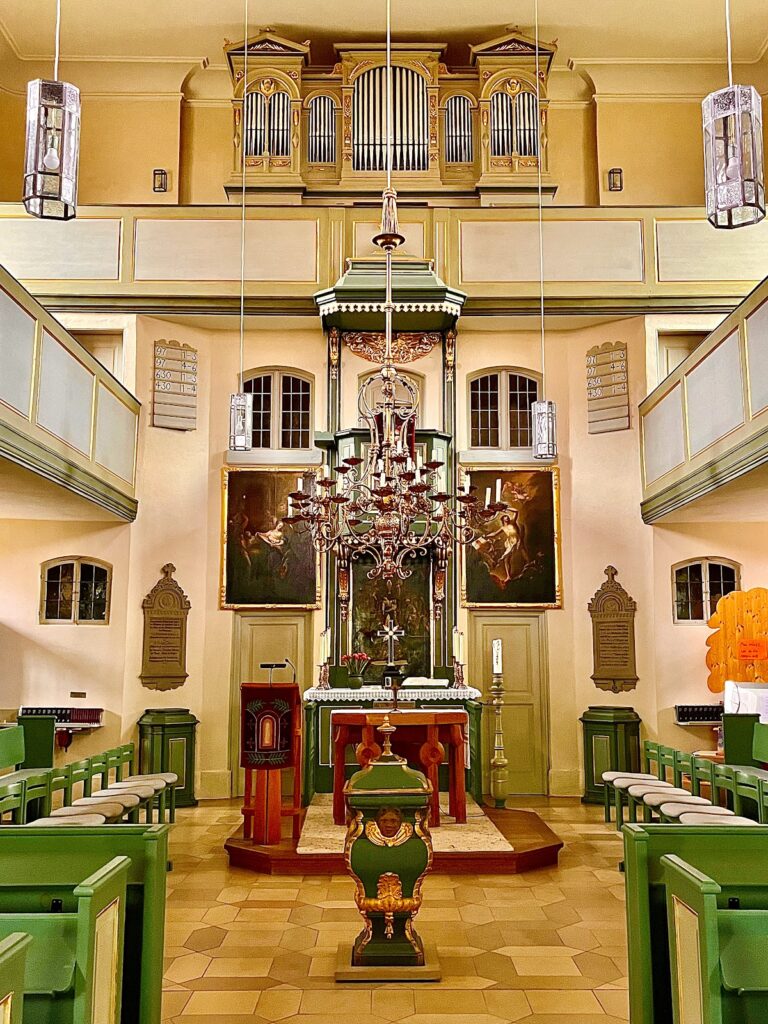
Inside, St. Jakobus is arranged as a hall church, with a single broad interior formed by wall piers and covered by a barrel vault with lunettes. The choir has a flat coffered ceiling divided into recessed decorative panels. Differently coloured surfaces emphasize the triangular spaces between the piers and the vault, with a small number of simple ornaments.
Recessed wall piers with pilasters create two side chapels. At the rear of the nave, a west gallery occupies a round niche. Its slightly curved wooden balustrade projects into the nave and carries three round medallions. Musical angels appear on the outer medallions, while the central medallion shows Saint Cecilia playing a portative organ, a small portable pipe organ.
Rows of wooden pews line the nave around a central aisle and provide seating for approximately 300 people. South of the choir stands a pulpit with a hexagonal basket and a projecting decorated sounding board. A crucifix hangs above the triumphal arch. Simple cylindrical lights are suspended from the nave ceiling.
Altars and Sacred Art
High Altar
The high altar is a carved, partly painted and gilded winged altarpiece, an altar with hinged wings that can display different arrangements of images. Its earliest elements probably date from the fifteenth century, while substantial additions were transferred from the Upper Parish Church in Ingolstadt in the early 1920s.
The central shrine contains a Madonna and Child from around 1470, a Baroque figure of Saint James, and Saint Stilla, a local saint associated with the Abenberg area. The wings contain high-relief scenes from the life of Mary.
Side Altars and Sculptures
The right side altar displays the Baroque Abenberg wax Christ Child, known as the Abenberg Fatschenkindl. A Fatschenkindl is a devotional figure of the infant Jesus represented as a swaddled child. Above the sacristy door stands a sculpture of Saint Anne with the Virgin Mary and the Christ Child, dated around 1470.
Other furnishings include a Madonna, Saint Sebastian as a protector against plague, and figures of Wendelin, Isidore, and Ottilie, agricultural patron saints whose sculptures belong to the Lower Bavarian Hiernle artistic tradition.
Choir Paintings
Three paintings from Marienburg Monastery hang on the north wall of the choir. They depict the Presentation of Jesus in the Temple, dated around 1680 and probably painted by Kilian Stauffer, the Marriage of Mary and Joseph, and the Friendship of Christ, dated 1734.
Memorials, Fresco, and Music
The church contains memorial monuments to officials of the Abenberg administrative office. These include the Seckendorff heraldic stone at the right of the choir arch, dated 1498; a Baroque memorial stone for a child of the administrator Alois Freiherr von Riedheim; an epitaph for Johann Michael Strauß and his wife Clara at the north portal, dated 1703; and an epitaph for Freiherr von Ebingen at the south portal, dated 1765. An epitaph is a memorial monument or inscription commemorating a deceased person. Memorial plaques also commemorate Prelate Klein, who died in 1927, and Abenberg’s dead of the Second World War.
A surviving wall fresco from around 1597 depicts the baptism of Jesus by John the Baptist. It has been restored in accordance with historic-monument requirements. The west gallery houses an organ built in 1997 by Orgelbau Sandtner as opus 243. The instrument has 25 stops, two manuals, and a pedal, with a case dominated by two projecting pipe towers. Its listed couplers and playing aids are II/I, I/P, II/P, Organo Pleno, and toe levers for the bassoon and trumpet.
Bells
Three bells belong to the church. The oldest was cast around 1300 and is more than 700 years old, while the youngest bears the casting date 1750. All three probably came from Nuremberg.