Dreifaltigkeitskloster Derman: A Fortified Orthodox Monastery in Ukraine


Site at a Glance
- Rating
- 4.6
- Popularity
- Low
- Country
- Ukraine
- Primary era
- Early Modern
- External website
- Open
- Eras represented
- Medieval, Early Modern, Modern
- Civilizations
- Grand Duchy of Lithuania, Polish–Lithuanian Commonwealth, Russian
- Site type
- Religious
- Remains
- Fortified Monastery
On this page16 sections
History
Dreifaltigkeitskloster Derman is a fortified Orthodox monastery in Ukraine, in the village of Derman’ Druha, traditionally founded in 1428 and attributed to Vasyl Ostrogski. The monastery developed within the religious and intellectual life of Volhynia, and its buildings preserve evidence of the Gothic architectural character widely used in the region during the period.
Foundation and Ostrogski patronage
The monastery was established as a male community, and monks from Mount Athos, a major Orthodox monastic center in northern Greece, reportedly came at the founder’s request. Its first abbot was Isaac Boryskovich. The Ostrogski princes subsequently maintained the community at their own expense. The Ostrogski family was a powerful Ruthenian princely house that supported Orthodox institutions, education, and printing across the Polish-Lithuanian Commonwealth.
From 1602, the monastery followed a coenobitic rule, meaning that the monks lived communally under a shared rule, and it was permitted to employ lay workers. The monks studied Greek, Latin, and Church Slavonic and produced translations. The Ostrogski patrons intended Derman to become an intellectual center of Orthodoxy in the Polish-Lithuanian Commonwealth.
Printing and opposition to the Union of Brest
During the late sixteenth and first half of the seventeenth centuries, Derman became one of the centers of opposition to the Union of Brest. This agreement brought parts of the Orthodox hierarchy in the Polish-Lithuanian Commonwealth into communion with the Roman Catholic Church while allowing them to retain the Byzantine rite. The resulting Greek Catholic communities were commonly served by the Basilian monastic order.
Konstanty Ostrogski endowed the monastery with a printing press in 1602, and Derman became for a time a center of Ruthenian book production. Ivan Fedorov, a pioneer of printing, administered the monastery in 1574 and 1575. In 1603, Damian Nalewajko directed the press and was later ordained a priest at Derman. He was the brother of Severin Nalewajko, the leader of a Cossack uprising.
Meletius Smotrytsky served as archimandrite, a senior monastic superior, from 1625 to 1633. His tenure covered both the period before and the period after his conversion to the Union. Other Greek Catholic leaders associated with Derman included Methodius Terletsky, Cyprian Zhokhovsky, George Winnicki, Felician Filip Volodkovich, Maximilian Ryłło, Theodosius Rostocki, and Theodosius Goyzhevsky. Metropolitan Josyf Velamin Rutsky died at the monastery on 5 February 1637.
Greek Catholic administration
After the death of the last male Ostrogski heir and the conversion of the family’s descendants to Catholicism, patronage passed to the Zasławski princes. Anna Aloysa Chodkiewicz and Aleksander Zasławski promoted the monastery’s union with the Greek Catholic Church. The transition is dated to 1635, while the monastery’s adoption of the Union of Brest is also recorded in 1637.
Derman remained associated with leading figures of the Greek Catholic Church, including Archimandrite Theodosius Goyzhevsky. The monastery’s changing allegiance reflected the religious contest between Orthodox and Greek Catholic institutions in the region. In 1821, the Russian government removed the monastery from the Basilians and transferred it to Orthodox monks from Ostroh. An imperial decree of 21 November 1821 ordered the Greek Catholic monastery to be placed under Orthodox clergy and directed that the Basilian monks, together with Goyzhevsky, be transferred elsewhere.
In 1873, the Monastery of the Epiphany in Kremenets was attached to Derman. Two churches were also erected in the complex during the nineteenth century: the church of Saint Innocent of Irkutsk, consecrated in 1850, and the church of Saint Theodore Ostrogski, consecrated in 1873.
Education, evacuation, and interwar life
A church teachers’ seminary operated at Derman until 1920. It was later followed by a diocesan girls’ school, which became a Ukrainian private gymnasium in the early 1930s. During the interwar period, the monastery belonged to the Volhynian Diocese of the Polish Autocephalous Orthodox Church. It retained most of its property, although one building was confiscated by the Lutsk educational authorities and converted into a school.
The monks supported themselves mainly through farming, with smaller income from donations and fees for occasional services and sacraments. In 1915, they evacuated the monastery and took most of its valuable furnishings with them, including the archives of the Ostrogski and Zasławski families and the library. The collections eventually reached Saint Petersburg and Moscow, where they became dispersed.
Soviet closure and restoration of monastic life
After the Second World War, when Volhynia became part of the Soviet Union, Derman came under the jurisdiction of the Russian Orthodox Church. In 1949, Bishop Pankracy of Volhynia and Rivne converted the male monastery into a women’s monastery and brought nuns from the monastery at Zymne.
The women’s community lasted for eleven years. Soviet authorities closed the monastery in 1960 and forced the nuns to move to the monastery at Korets. The complex was then converted into a school and boarding institution for children with intellectual disabilities. One church was used as a room for drying laundry.
Monastic activity resumed on 24 December 1991, after Ukraine regained independence. The Holy Synod of the Ukrainian Orthodox Church confirmed the restoration at the request of Bishop Irenaeus of Rivne. The community has since functioned as a women’s monastery under the Ukrainian Orthodox Church of the Moscow Patriarchate. Abbess Veronica Zoshchuk, born on 2 January 1958, leads the monastery, and the nuns undertook repairs to the dilapidated buildings after the reopening. The complex received national architectural-monument status through a resolution of 24 August 1963.
Remains
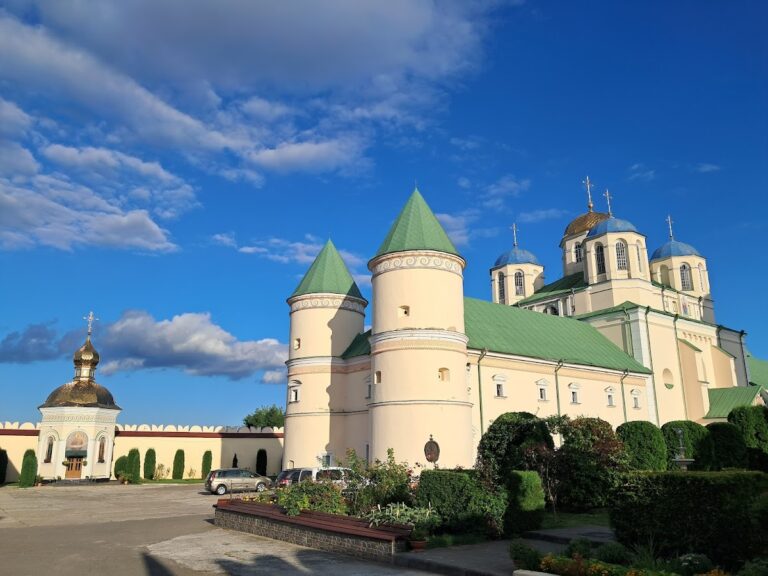
Dreifaltigkeitskloster Derman survives as a fortified complex organized around churches, residential and service buildings, and a defensive perimeter. Its structures preserve elements of an earlier Gothic character, while later work introduced Eastern Baroque forms and nineteenth-century additions. The complex includes a gate belfry, the central Holy Trinity Church, a refectory wing with a church, additional churches, monastic housing, and economic buildings.
Defensive perimeter and entrance
Gate belfry
The entrance is marked by a five-tiered gate belfry. Fragments of loopholes, narrow defensive openings, survive in the tower and indicate its earlier military function. The building acquired its role as a belfry in the first half of the nineteenth century, when a fifth level was added. This level has tall pointed-arch windows, with three on each of the principal and opposite facades and two on each side facade.
After the addition, the tower reached 30 metres at its highest point and could be seen from many kilometres away. Its combination of defensive evidence and later bell-tower use reflects the changing purposes of the monastery’s entrance structure.
Churches and central monastic buildings
Holy Trinity Church
The stone Holy Trinity Church was begun in 1602 at the center of the monastery, along the defensive perimeter and on the site of an earlier wooden monastic area. It is a relatively small, three-part, single-domed building with a rectangular plan measuring 25 by 17 metres and a vestibule. The church is described as a rare, possibly unique, stone building of its typological kind and as an example of Eastern Baroque architecture.
Its exterior includes a tall octagonal dome drum, the raised structure between the dome and the building below it, with windows. Paired pilasters of the Tuscan order, a simplified classical form with plain columns and capitals, appear on the north-eastern and south-western facades. Other features include a semicircular window, tall window arches, a broad frieze between moulded cornices, and triangular gables above the pitched roof.
Refectory church
The church of Saint Theodore Ostrogski occupied the second floor of the building containing the refectory. Together with Holy Trinity Church, it formed a center of monastic life. The building belongs to the group of structures that organized worship and communal activity within the fortified enclosure.
Southern church wing
A wing containing a heated church stands in the southern part of the complex beside the defensive wall and incorporates elements of an earlier structure. Its plan is T-shaped. The central section has a broken-line decorative gable and a semicircular dormer window, while the second level has window hoods and Tuscan-order pilasters.
Nineteenth-century churches
The complex also contains the church of Saint Innocent of Irkutsk, consecrated in 1850, and the church of Saint Theodore Ostrogski, consecrated in 1873. These buildings belong to the nineteenth-century expansion of the monastery, when additional worship spaces were added to the existing group of structures.
Residential and economic buildings
The monastery included a multi-story belfry, three residential buildings, and a guest area for a bishop within one of the residential buildings. Eight service buildings, a water mill, and an apiary supported the economic life of the community. Together, these structures formed the practical infrastructure of a monastery whose members relied mainly on farming during the interwar period.
Well and venerated icons
A large well survives within the women’s monastery. A local tradition holds that an underground passage once led from it toward the south-eastern side of the hill. The entrance is now sealed, although the well could still be entered freely in the early 1960s.
The monastery particularly venerates a copy of the Kazan Icon of the Mother of God, the icon of Saint Theodore Ostrogski, and the icon of Saint Panteleimon. The community regards all three as miraculous, linking the surviving complex with its continuing religious life.