San Fruttuoso Abbey: A Medieval Monastic and Coastal Complex in Italy


Site at a Glance
- Rating
- 4.6
- Popularity
- Medium
- Country
- Italy
- Primary era
- Medieval
- External website
- Open
- Eras represented
- Medieval, Early Modern
- Civilizations
- Genoese, Holy Roman Empire
- Site type
- Religious
- Remains
- Monastery
On this page15 sections
History
San Fruttuoso Abbey is a Catholic parish church in Italy, located at Capodimonte within the municipality of Camogli, Liguria. The medieval complex, which includes Romanesque elements, is dedicated to Saint Fructuosus of Tarragona, a third-century Christian bishop and martyr from the ancient city now known as Tarragona in northeastern Spain. Tradition places the origins of the settlement in the eighth century, while the present abbey is generally dated to the middle of the ninth century.
Origins and Benedictine expansion
According to tradition, Prospero, bishop of Tarragona, fled the Arab invasion of the Iberian Peninsula and brought the relics of Saint Fructuosus with him. He is said to have established a small place of worship for the relics at San Fruttuoso. An earlier religious building stood partway up the slope at the location now called Chiesa Vecchia. The present abbey was rebuilt between the late tenth and early eleventh centuries, probably through the initiative of Adelaide of Burgundy, the widow of Emperor Otto I.
During the eleventh century, the complex passed to the Benedictines, a Western Christian monastic order that followed the Rule of Saint Benedict. The monks expanded the abbey during the twelfth century, adding an upper floor and constructing the upper cloister. These changes established the monastery’s principal medieval form and strengthened its role as a religious community connected with the cult of Saint Fructuosus.
Doria patronage and coastal defenses
The Genoese Doria family sponsored major additions during the thirteenth century. These included the wing facing the sea and a funerary area for members of the family. The Benedictine monks granted the Dorias a burial place inside the abbey, creating an enduring connection between the monastery and one of Genoa’s leading families.
In the sixteenth century, Andrea Doria, a prominent Genoese admiral and statesman, commissioned the almost complete rebuilding of the upper cloister. The abbey’s exposed coastal position also led to stronger defenses. The Senate of Genoa erected the Torretta in 1561, and the Torre Doria followed in 1562 to protect the settlement and its water source from attacks by Barbary corsairs. The Torre Doria was built under a right of patronage granted to Andrea Doria by Pope Julius III in 1551. His heirs, Giovanni, Andrea, and Pagano, later gave the tower its name. During the seventeenth century, Abbot Orazio Spinola altered its appearance by commissioning a new roof.
Decline, restoration, and later interpretation
After a period of decline, the monastic community abandoned the abbey. Parts of the complex were adapted for residential use, and by the seventeenth century some rooms had also served as a sheep barn. Camillo Doria restored the abbey in 1730 and returned the church to liturgical use. A flood damaged several buildings in 1915, followed by restoration by the Italian state in 1933.
Modern conservation reshaped understanding of the site. Restoration during the 1990s exposed earlier Romanesque structures in the monastic complex, and a museum devoted to the abbey’s history was subsequently established. Between 1985 and 2017, the Fondo Ambiente Italiano, an Italian heritage organization that conserves and manages culturally important properties, carried out a comprehensive renovation of the buildings. In 1983, Frank and Orietta Pogson Doria Pamphilj donated the abbey, its dependencies, and its land to the organization, which has overseen their conservation. The complex also has Italian cultural-property status under a declaration dated 1986.
San Fruttuoso Abbey has also entered modern cultural history through its use as a film location. In 1951, scenes for Il diavolo in convento, directed by Nunzio Malasomma, were filmed partly inside the church.
Remains
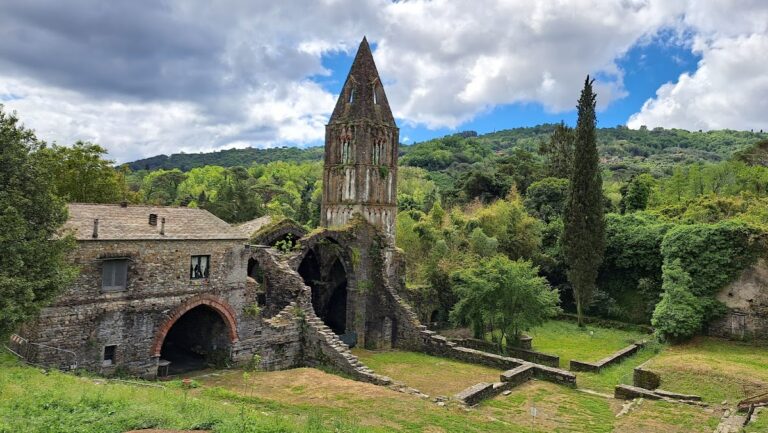
The complex stands in a secluded bay within the terrestrial and marine area of Monte di Portofino. Its surviving elements include the abbey church, monastic buildings, upper and lower cloisters, the sea-facing wing, two defensive towers, and the remains of the earlier building at Chiesa Vecchia. Together, these structures preserve the religious, funerary, domestic, and defensive functions that accumulated around the medieval settlement.
Church and earliest religious spaces
Monastic church
The medieval church, known as the monastic church, is entered through the former sacristy, a room created when the building was raised in the sixteenth century. Its interior is divided into a front section, probably used as the monks’ choir, and a rear section. An apsidal room serves as a chapel. The plaster or stucco surfaces and pavement date from the tenth century, while a rear crypt was added in the thirteenth century. The crypt was probably intended for abbots or members of the Doria family and is approximately contemporary with the underground family tomb.
The public church was formed by raising the medieval building after the monks had left the abbey. Its high altar contains a small silver reliquary holding relics associated with the martyrs Fructuosus, Augurius, and Eulogius. The apse is built partly against or into the rock. Above the church is a Middle Byzantine-style dome decorated with seventeen small arches made from local mountain stone. An octagonal bell tower and slate roofs complete the structure’s distinctive Ligurian appearance.
Sancta sanctorum
The lower part of the complex contains the sancta sanctorum, a very small room regarded as the oldest nucleus of the settlement. It was believed to have been used to preserve and venerate relics. The room therefore links the surviving fabric of the abbey with the foundation tradition centered on Saint Fructuosus.
Cloisters and funerary buildings
Upper cloister and sea-facing loggia
The upper cloister was constructed in the twelfth century and almost entirely rebuilt in the sixteenth century under Andrea Doria’s patronage. It contains cross vaults, Romanesque capitals, and columns of varied provenance. The complex also preserves a sea-facing Romanesque loggia, an open-sided gallery added during the medieval development of the abbey.
Doria family tomb
The lower level of the cloister contains the Doria family tomb. Seven Doria burials date from 1275 to 1305, and the enclosure also includes two other tombs and a Roman sarcophagus whose occupants are unidentified. The burials are arranged in rows along three sides of the room. Individual or paired masonry chests, mostly bearing inscriptions, stand beneath pointed-arch tomb recesses supported by small marble columns and covered with gabled roofs. Alternating bands of white marble and gray stone create the characteristic Ligurian two-color design.
Defensive towers
Torre Doria
The Torre Doria was erected in August 1562 beside the steep stairway linking the abbey with the fishing settlement. It is a square watchtower attributed to the architect Giovanni Ponzello. Its defensive equipment included three bronze cannon, one bombard, and thirty-three muskets and arquebuses. The armament cost 2,687 gold scudi. The tower bears the Doria coat of arms and an imperial eagle on two façades, with further decoration on its cornices and brackets.
Torretta
The Torretta occupies the rocky promontory west of the bay. Built by the Senate of the Republic of Genoa in 1561, it has a truncated-pyramidal form, two large and two small loopholes, accommodation for up to eight soldiers, and two small-caliber cannon. Its construction cost 940 lire. Alongside the Torre Doria, it preserves the sixteenth-century effort to defend the settlement and its water supply from corsair attacks.
Archaeological and underwater remains
The museum displays table ceramics found in a deposit within the monastery. The vessels came from different geographical areas and were used by the Benedictine monks during the thirteenth and fourteenth centuries. A small reliquary preserves relics associated with the abbey’s cult of Saint Fructuosus. In the bay, the underwater statue known as the Christ of the Abyss was installed on the seabed in 1954 at a depth of 17 metres and restored during the 1990s.
Nearby sites