St. Foillan: Aachen’s Gothic City Parish Church


Site at a Glance
- Rating
- 4.5
- Popularity
- Low
- Country
- Germany
- Primary era
- Modern
- External website
- Open
- Eras represented
- Medieval, Modern
- Civilizations
- German, Holy Roman Empire
- Site type
- Religious
- Remains
- Church
On this page10 sections
History
St. Foillan is a Roman Catholic city parish church in Aachen, Germany, whose present building derives from a Gothic church consecrated in 1482. Dedicated to Saint Foillan, an early medieval Christian missionary and bishop associated with the evangelization of western Europe, it is described as the only church in the German-speaking world to bear his patronage. This dedication has been regarded as an indication that Christian mission in the Aachen area came from the west.
Origins beside the Minster
After Aachen Minster was erected around AD 800, the empire’s privileged classes and the canons of the Marienstift worshipped there. Ordinary citizens had to use other churches, creating the need for a separate parish church. A church dedicated to St. Foillan was built on the site of the present church around 1180, but that earlier structure no longer survives.
The Gothic parish church
The enlargement of the Minster’s side aisle in 1414 brought it very close to St. Foillan. Aachen’s citizens then sought a larger parish church, and a three-aisled Gothic replacement was built and consecrated in 1482. The position of the neighboring Minster shaped the new building’s form. A west tower would have stood too close to it, so St. Foillan’s tower was placed unusually on the south side.
The church later became associated with several episodes in Aachen’s religious and cultural history. The Dominican friar Johann Tetzel, known for preaching indulgences in the early sixteenth century, preached at St. Foillan in 1507. In 1520, when the Habsburg emperor Charles V was crowned, the leading German Renaissance artist Albrecht Dürer drew St. Foillan together with Aachen’s town hall and cathedral. In 1848, St. Foillan hosted the first May devotion held in a parish church.
Fire, destruction, and reconstruction
Repeated fires severely damaged the church over the centuries. A bombing raid on the Tuesday after Easter in 1944 almost completely destroyed it. Aachen architect and cathedral master builder Leo Hugot rebuilt St. Foillan between 1956 and 1958. The reconstruction integrated surviving Gothic elements into a new interior organized by modern piers and covered by a cast folding ceiling. The sacristy was not rebuilt, and the design was modeled on the Jacobin Church in Toulouse.
Parish and organ history
Following a comprehensive parish reform, St. Foillan became part of the Roman Catholic parish association Franziska von Aachen in central Aachen. The association takes its name from Franziska Schervier, a nineteenth-century Catholic religious founder from Aachen, and is supported by the Franciscan Sisters of the Poor, the congregation associated with her charitable work. Its other communities include St. Adalbert, St. Andreas, Holy Cross, St. Mary, St. Peter, the youth church kafarna:um, and the Neue Gemeinde Zeitfenster.
After a New Year’s Eve fire in 2010, the historic Klais organ was moved from Aachen’s St. Nicholas church, which had become a city church, to St. Foillan. It was fully restored and installed in its new setting in 2012. The instrument has been protected as a historic monument since 1988 because of its importance as a historic sound monument of late Romanticism.
Remains
Church fabric and surviving Gothic elements
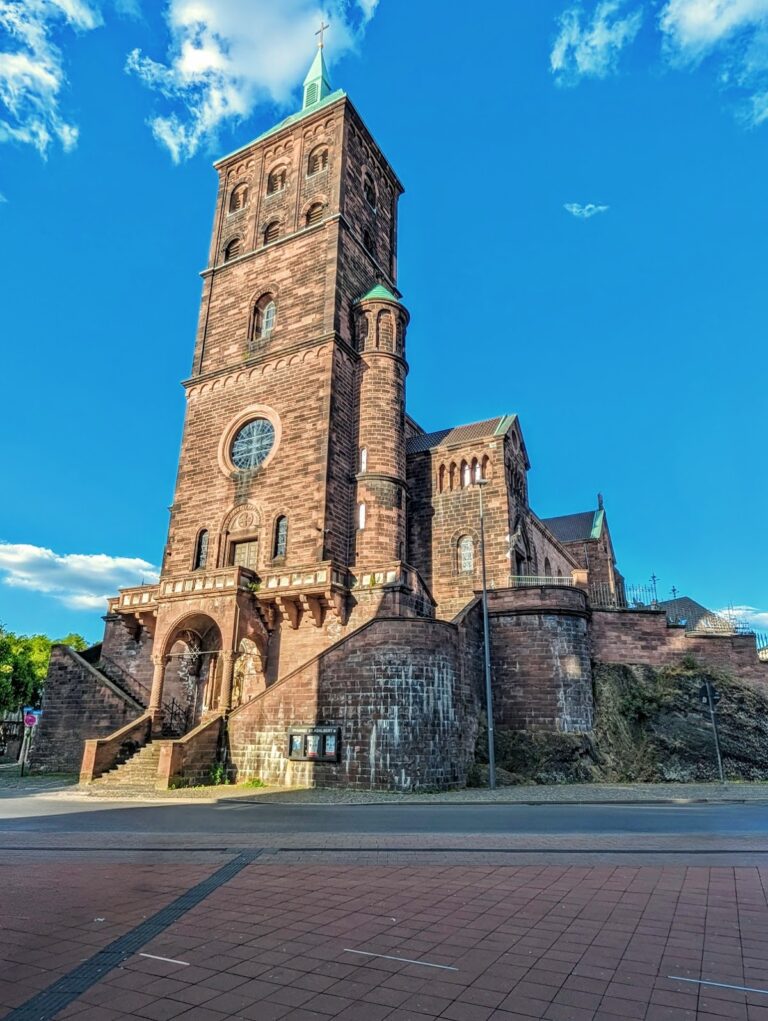
St. Foillan stands in Aachen’s pedestrian zone, separated from Aachen Cathedral by only a narrow lane. Parts of the Gothic church consecrated in 1482 remain, including sections of the choir, portions of the facade, and several other areas. Most of the facade and the tower date from 1888 or later. The present interior combines these earlier elements with Leo Hugot’s postwar reconstruction of 1956 to 1958, including its modern pier structure and cast folding ceiling.
Choir furnishings and stained glass
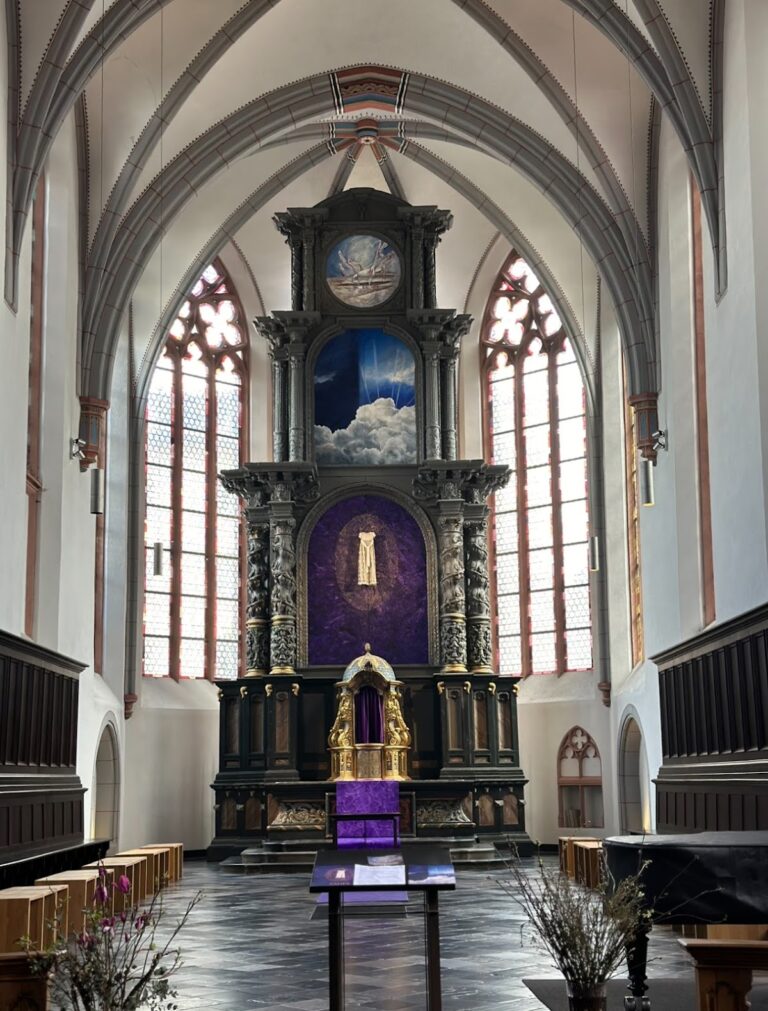
The choir is centered on a blue-stone altar made by Klaus Iserlohe in 1962. Its surrounding relief presents 32 scenes from salvation history. Above it hangs a large enamel-coated bronze cross by Egino Weinert, also made in 1962. Scenes of the Crucifixion appear on its front, while the reverse depicts the Lamb of God. Weinert also designed the octagonal tabernacle, an altar superstructure used to reserve consecrated Eucharistic elements. Its exterior enamel work shows scenes from the life of Jesus.
Three large central choir windows, created by Wilhelm Buschulte in 1958, depict scenes from the Revelation of John. The large west window uses color to express the theme “Salvation in History,” showing Creation, the Incarnation of God, and the completion of history at the end of time. Iserlohe’s blue-stone ambo, made in 1966, has reliefs of the coming of the word of God to humanity and the Seven Sorrows of Mary.
Iserlohe also created the baptismal font and Easter candle holder in 1968. The ensemble combines bronze and blue stone with imagery associated with baptism, including water, the Red Sea, the Jordan, the Tree of Life, light, the pillar of fire, the solar disk, and the primordial serpent.
Paintings and devotional sculpture
The church contains numerous paintings, including two large early sacred works by August von Brandis. One, painted in 1901 and 1902, depicts the Wedding at Cana as a cheerful scene inspired by southern European art. The other shows the Entombment of Christ. The Easter candle is placed symbolically before this painting, expressing the transition from Christ’s entombment to the Resurrection.
Abraham Campenhout’s Madonna and Child, painted in 1649, is also displayed. Campenhout was a pupil of Peter Paul Rubens. The church contains a Black Madonna, a copy of a painting dating from around 1700 whose original is exhibited in Brno.
In an altar in the southern side aisle stands the wooden Beautiful Madonna, a 2.15-meter-high sculpture dating from 1410. It exemplifies the Late Gothic Beautiful Style, recognized for graceful figures, flowing drapery, and gentle, idealized faces. Its original polychromy was removed after the 1979 Parler exhibition in Cologne. Irene Rothweiler created a painted wall hanging in 1984, and the newly crowned Madonna was inaugurated with it.
A wooden sixteenth-century figure of the scourged Jesus wearing the Crown of Thorns represents the Ecce Homo, a devotional image presenting Christ before his crucifixion. The Stations of the Cross, made in 1987, contain 16 stations rather than the customary 14. Their sequence ends with the Resurrection instead of the Entombment, and the stations are casts of works in Kilian’s Crypt at the Neumünster in Würzburg.
Organs
From 1979 to 2010, St. Foillan housed an organ built specifically for the church by Willi Peter of Cologne. It was re-voiced in 1998 and enlarged by two stops. Its slider chests had electric key and stop actions, with couplers II/I, I/P, and II/P, as well as three free combinations. The instrument was later dismantled and sold to Poland.
The restored Klais organ was built in 1913 by the Bonn firm Klais for the provost church of Kornelimünster as Opus 502. It was placed in a historic case from 1763 designed by Johann Joseph Couven. Leo Hugot moved it to St. Nicholas church in 1963, where it received a painted facade by Franz Pauli. At St. Foillan, the instrument has 32 stops on two manuals and pedal, fully pneumatic action, and pneumatic cone chests. Its couplers are II/I, Super II/I extended to g4, Sub II/I, I/P, II/P, and Super II/P. A register crescendo, fixed piano, mezzo-forte, forte, and tutti combinations, and one free combination support its operation. The swell division’s compass was extended to g4 for the super-octave coupler.