San Giacomo di Rialto: Venice’s Market Church


Site at a Glance
- Rating
- 4.5
- Popularity
- Low
- Country
- Italy
- Primary era
- Medieval
- Eras represented
- Medieval, Early Modern
- Civilizations
- Venetian
- Site type
- Religious
- Remains
- Church
On this page14 sections
History
San Giacomo di Rialto is a Roman Catholic church in Venice, Italy, whose present building generally dates from the twelfth century and whose history is closely tied to the Rialto market. It stands in the San Polo district within the Patriarchate of Venice, the Roman Catholic jurisdiction headed by the Patriarch of Venice. The addition “di Rialto” distinguishes it from San Giacomo dell’Orio in Santa Croce, while Venetians commonly call the small church San Giacometo.
Tradition and medieval origins
Tradition regards San Giacomo di Rialto as Venice’s oldest church and places its foundation or consecration on 25 March 421, the traditional date assigned to the foundation of Venice. One legend tells that a carpenter named Candioto, or Eutinopo, vowed to build a church dedicated to Saint James the Apostle after surviving a serious fire. Another version says that an earlier church dedicated to the Annunciation was destroyed because the replacement was dedicated to Saint James.
The 421 date remains a tradition rather than an archaeologically secure foundation date. A donation document from 1097 describes the land beneath the church without mentioning a church, and the first certain written reference dates from May 1152. The present structure is generally assigned to the twelfth century, although its exact construction date is uncertain. Its foundations may incorporate elements from the early settlement traditionally associated with 421.
San Giacomo was solemnly consecrated by Pope Alexander III on 25 July 1177. A plaque on the façade records the event and grants a plenary indulgence, meaning the remission of the temporal consequences of sins whose guilt has already been forgiven in Catholic theology.
The church and the Rialto market
The church’s history developed alongside the commercial life of the Rialto. Money changers, lenders, and later bankers operated in front of it under official supervision. Local tradition identifies the area as the setting of Venice’s earliest business transactions, and the first state bank is said to have opened there in the fifteenth century. Bills of exchange were also associated with the market.
Merchants and craft associations maintained altars dedicated to different saints. Traders swore to conduct business honestly in the church and sought penance after deceiving customers. San Giacomo housed the Scuola degli Oresi, a Venetian confraternity of goldsmiths and related metalworkers whose workshops were in the neighboring Sotoportego dei Oresi and whose members were buried in the church. The building was also associated with the Garbeladori and Ligadori. Saint Anthony Abbot was the patron of the Scuola degli Oresi.
Fire, restoration, and later use
San Giacomo survived the major fire that devastated the Rialto commercial area in 1513 and 1514, although it suffered limited damage. Natale Regia, a wealthy citizen appointed priest of the church in 1503, initiated the renewal connected with the restoration of 1531. After his death in 1532, the city authorities and the Patriarch disputed the appointment of his successor. Pope Clement VII settled the matter by ordering that the priest should be appointed by the doge and should be a native Venetian.
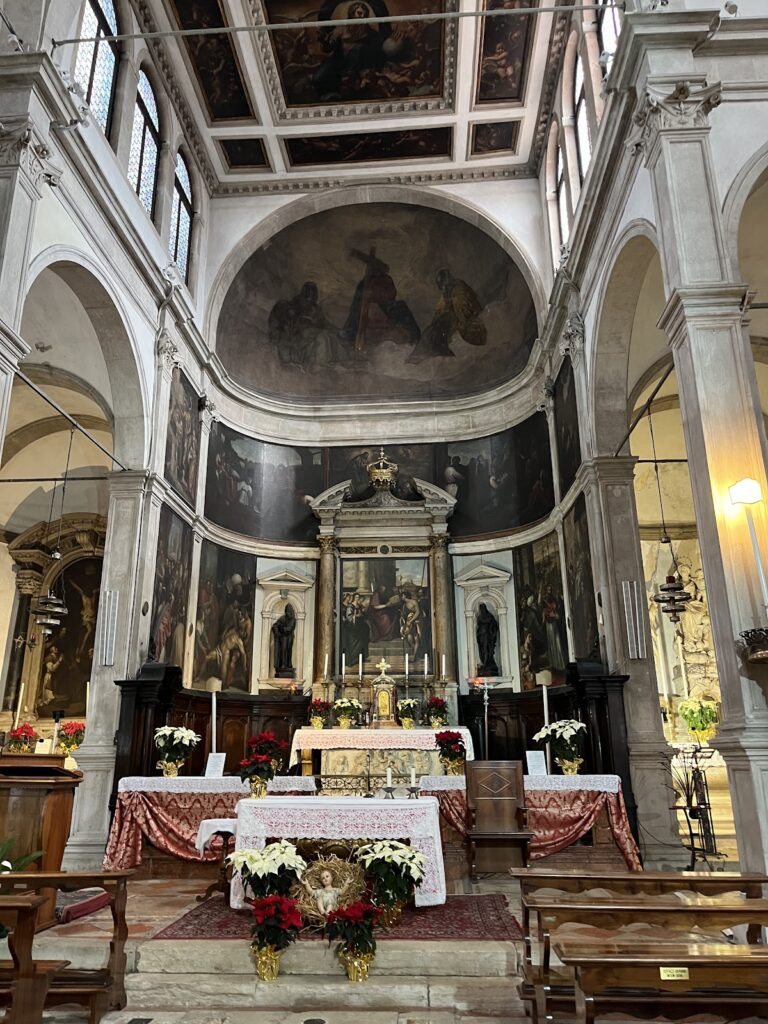
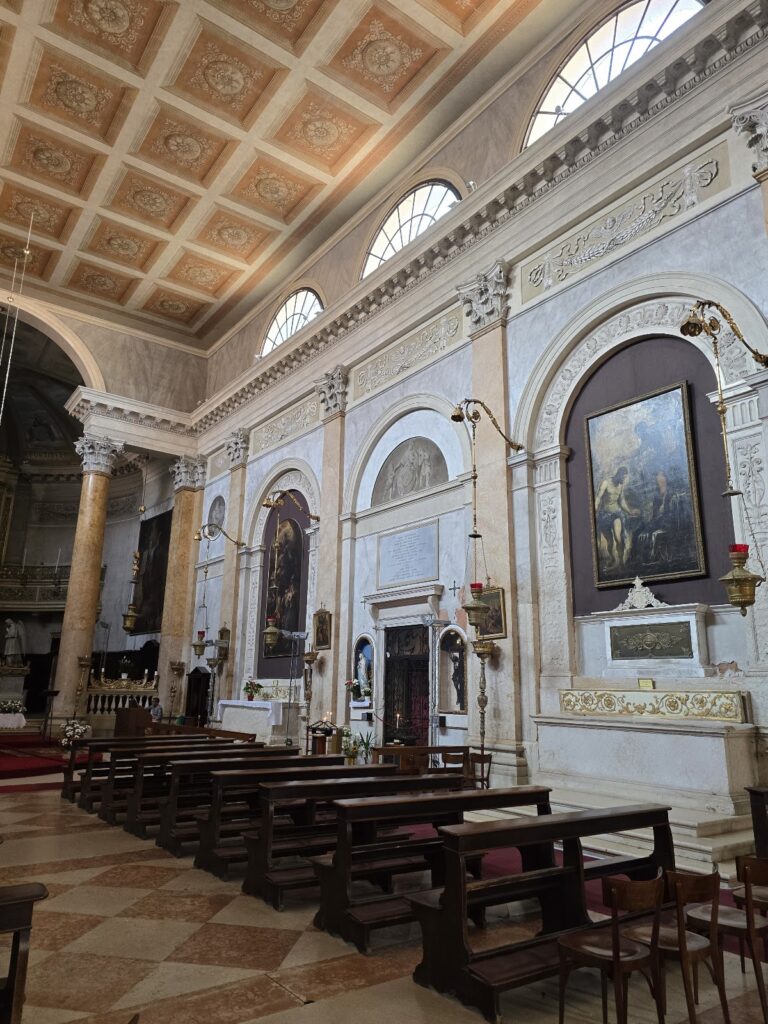
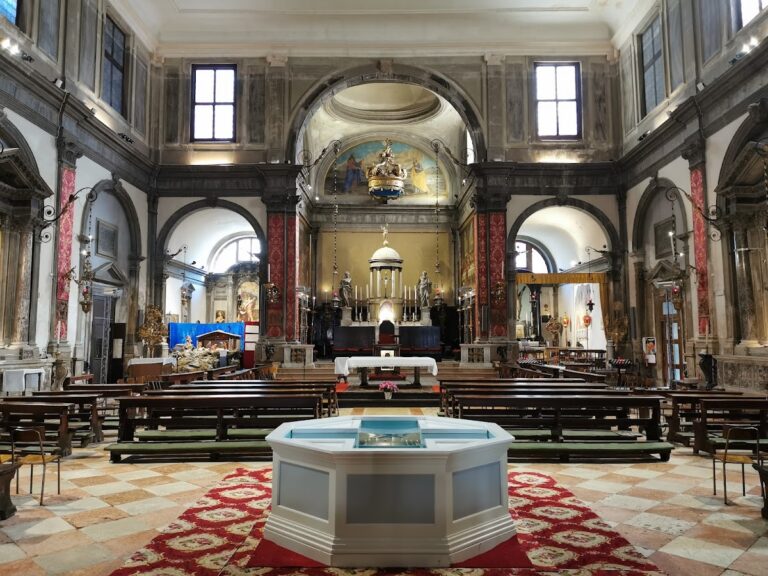
A further restoration took place between 1599 and 1601, or began in 1601, on the orders of Doge Marino Grimani. The work improved interior lighting, introduced several heavy Baroque altars, and raised the floor to reduce flooding in one of Venice’s lowest areas. The intervention may also have transformed an earlier Latin-cross arrangement, with a longer main arm and shorter cross arm, into the present Greek-cross plan, in which four broadly equal arms meet beneath a central dome.
In 1571, German merchants celebrated the Holy League’s naval victory over the Ottoman fleet at the Battle of Lepanto for three days. They commissioned a commemorative Mass from Andrea Gabrieli, a Venetian composer and organist associated with the city’s civic and religious life. Gabrieli directed the performance from a temporary stage erected in front of the church.
San Giacomo is now a rectory, a church served by a rector while dependent on a larger parish, under San Silvestro. It remains open for worship and is also used for concerts. The gallery inside the façade was removed in 1933, while the campanile was consolidated and restored in the modern period.
Remains
San Giacomo di Rialto forms the eastern side of the square that once held the Rialto produce market. The Rialto Bridge and fish market are nearby, and market stalls formerly stood directly before the church. The surviving building combines a compact Greek-cross layout with attached structures, including a narthex, or entrance vestibule, and an apsidal chapel. These additions can make the plan appear basilican. Three chapels occupy the apsidal area, while a centrally placed dome rises above three equal-width naves.
Church interior and structure
Plan and surviving columns
Large windows on the free sides bring light into the small interior. The right side adjoins secular buildings. The interior has Renaissance characteristics and contains several substantial Baroque altars. Six ancient Greek-marble columns with Veneto-Byzantine capitals survive inside and are identified as remains of the eleventh-century church. The church’s later rebuilding preserved its basic form, which influenced Venetian parish churches during the fifteenth and sixteenth centuries.
Artworks and bells
The interior contains a statue of Saint James by Alessandro Vittoria dated 1602 and a statue of Saint Anthony Abbot by Girolamo Campagna on the altar of the Scuola degli Oresi. An Annunciation painting by Marco Vecellio is also associated with the church. The campanile carries three small bells named Grande, Mezana, and Piccola. They were cast in 1900 by the Premiata Fonderia De Poli of Vittorio Veneto and came from another Venetian church. Their notes are Do4, Re4, and Mi4 respectively.
Façade, clock, and portico
Bell structure and clock
The modest façade reflects Byzantine artistic influence and is dominated by a low, wall-like campanile a vela, a bell structure built above the building rather than as a separate tower. The present campanile is Romanesque in style and was built in 1749 after the earlier bell tower was destroyed in the Rialto fire. Beneath the bells is a Gothic relief of the Virgin and Child from the beginning of the sixteenth century.
The façade clock was made in 1410 and restored or remade in 1749. It was repaired and returned to its position in the early twentieth century. Its dial uses twenty-four hours marked with Roman numerals and has a single hand shaped like a sun ray. The clock displayed Italian hours, in which the historical day began after sunset, and was installed for merchants working in the market. By modern standards, its system was regarded as inaccurate or impractical.
Wooden Gothic portico
A surviving medieval wooden Gothic portico shelters the entrance. Its wooden architrave rests on five columns with Gothic capitals, and the structure is one of the very few intact wooden Gothic church porticos remaining in Venice. It was restored in 1958. The portico also provided covered shelter for travelers, who could spend the night beneath it.
One column carries carved outlines of a fish and an oyster. These images are associated with minimum-size standards for fish sold in the market, intended to protect reproduction. A corner column has an asymmetrical capital supporting the wooden barbacane, a projecting structural support or corbel-like feature.
Inscriptions and the market square
Merchant inscriptions
A twelfth-century Latin inscription arranged in the form of a cross is carved on the exterior wall of the apse. It calls for fair laws around the temple, accurate weights, and honest agreements among merchants. A second inscription on the cross above it asks Christ to make the cross a true source of salvation for the place. Together, the texts connect the church’s exterior to the ethical and commercial life of the market.
Fountain and Gobbo di Rialto
A small public fountain stands in the square before the church. At the far end is the sixteenth-century granite statue known as the Gobbo di Rialto. The kneeling figure supports a pedestal from which laws were formerly read. Citizens could also post satirical verses criticizing nobles on the pedestal, giving the square a civic and political use alongside its commercial and religious functions.