San Bartolomeo: A Historic Roman Catholic Church in Venice


Site at a Glance
- Rating
- 4.5
- Popularity
- Very Low
- Country
- Italy
- Primary era
- Early Modern
- Eras represented
- Medieval, Early Modern, Modern
- Civilizations
- Habsburg, Venetian
- Site type
- Religious
- Remains
- Church
On this page22 sections
History
San Bartolomeo is a Roman Catholic, Latin-rite church in Venice, Italy, in the San Marco district near the Rialto Bridge. Tradition places its foundation around 840, although the church first appears in surviving documentary records in 1083. Dedicated initially to Saint Demetrius of Thessaloniki, an early Christian martyr and military saint, it bore the dedication to Saint Bartholomew, one of the Twelve Apostles, by 1170. Its long history reflects the religious, commercial, and artistic life of the Rialto.
Medieval Parish and Merchant Community
After 1170, San Bartolomeo was rebuilt as a three-aisled church with an entrance on the north side. Its medieval bell tower was constructed during the same period. Although it served as a parish church from an early date, its pastoral and sacramental rights were acquired gradually and were probably established by the middle of the thirteenth century.
The church’s jurisdiction became the subject of a dispute with neighboring San Salvador. Pope Lucius III temporarily placed San Bartolomeo under the canons of San Salvador, but Pope Innocent III later returned it to the secular clergy. The dispute ended in 1299, when an agreement defined the parish boundaries and divided the tithes, or ecclesiastical payments traditionally drawn from local income and produce.
From the thirteenth century, German-speaking merchants based at the nearby Fondaco dei Tedeschi used San Bartolomeo, particularly for baptisms and burials. Their connection brought the church substantial endowments and helped establish it as a religious center for the German community in Venice. The School of Saint Matthias, also called the School of the Merchants, was founded there in 1247. The German School of Saint Mary of the Rosary is recorded from 1380.
Ecclesiastical Jurisdiction and Religious Associations
In 1342, Pope John XXII assigned San Bartolomeo to the Patriarchate of Grado, a senior ecclesiastical jurisdiction governing Venetian churches, and affiliated it with San Silvestro. When Grado was abolished in 1451, its authority and the right to appoint San Bartolomeo’s parish priest passed to the newly established Patriarchate of Venice. The affiliation with San Silvestro continued, along with its associated obligations and payments.
San Bartolomeo hosted sixteen craft schools and devotional confraternities, organized religious associations often linked to professional groups, charitable work, or particular altars. The School of the Crucifix, also known as the Pious Association of Prisoners, moved to the church in the seventeenth century. The church was also regarded as receptive to reformist ideas during the sixteenth century.
Until 1807, San Bartolomeo was a collegiate church administered by a chapter of four titular priests, two deacons, two subdeacons, and four acolytes. Together they managed parish property and income. Most of the church’s religious associations disappeared after the Napoleonic measures of 1810. During the same period of administrative reorganization, the parish was suppressed and its territory was incorporated into San Salvador. San Bartolomeo became a subordinate church, described as filial or vicarial.
Rebuilding from the Seventeenth Century
A major rebuilding began in 1623, when the church was enlarged according to a classical Latin-cross plan. A Latin-cross plan has a long central axis crossed by a shorter transept. Further extensive rebuilding began in 1723, probably under Giovanni Antonio Scalfarotto, and produced the building’s present form. Several side altars and the musical choir were remodeled during the eighteenth century, and Gaetano Callido built a new organ in 1775.
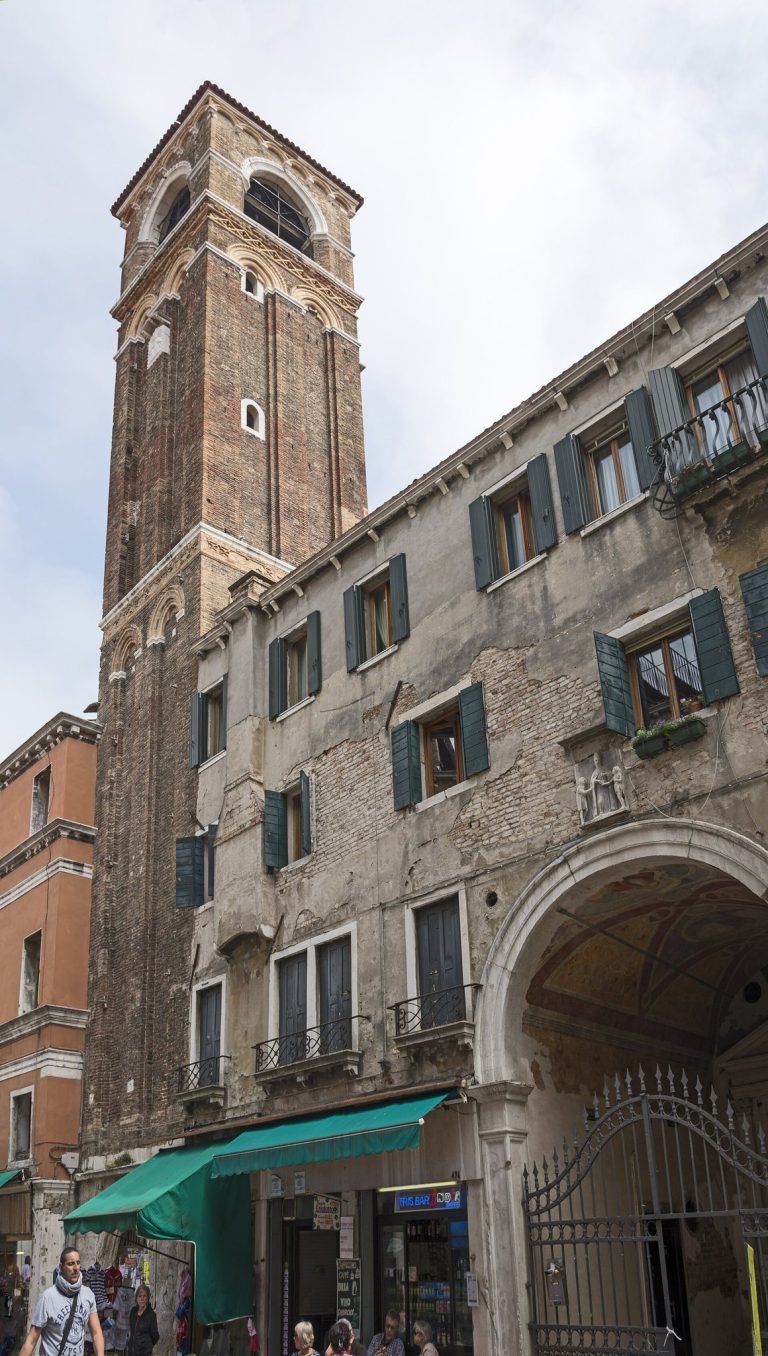
The medieval bell tower was damaged by the earthquake of 1688 and threatened with collapse. Giovanni Scalfarotto directed its replacement between 1747 and 1754. Bernardino Maccarucci reorganized the high altar and the area reserved for the Blessed Sacrament between 1764 and 1770. An octagonal dome over the crossing was completed between 1801 and 1805.
Closure and Later Use
After decades of neglect, San Bartolomeo was closed and deconsecrated in the 1980s. Restoration followed, after which the building was used first as an art gallery and later as a concert venue. It has also been identified as a rectoral church within the parish of Santissimo Salvatore. At times, parts of the building have remained closed because of their conservation condition.
Remains
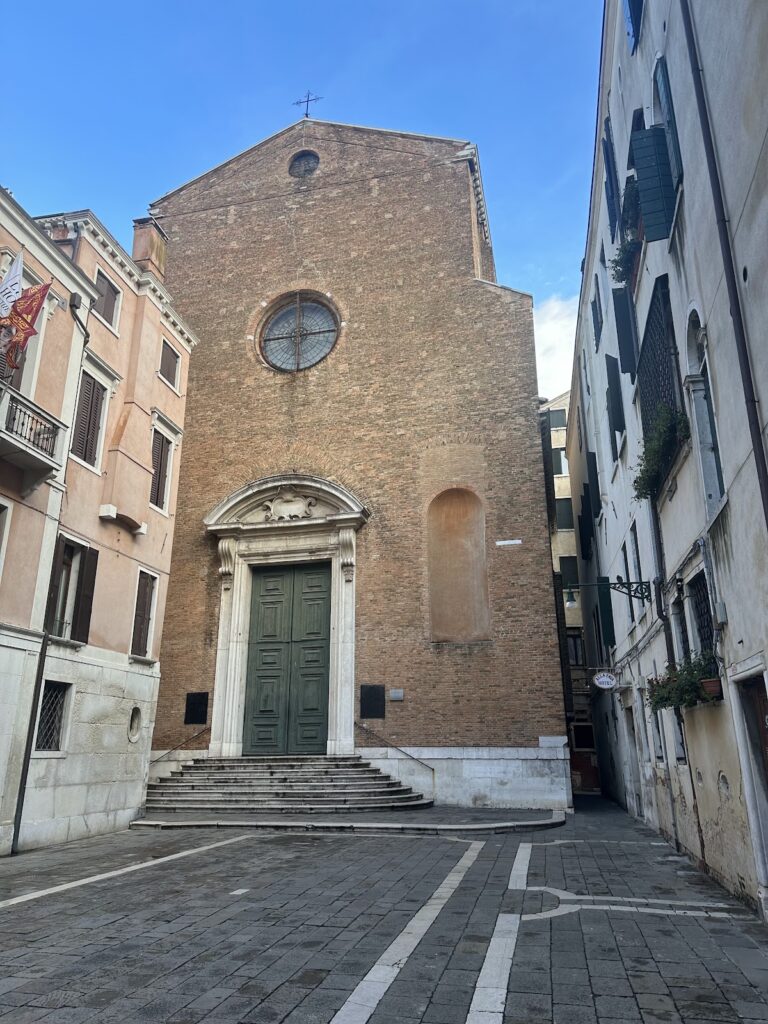
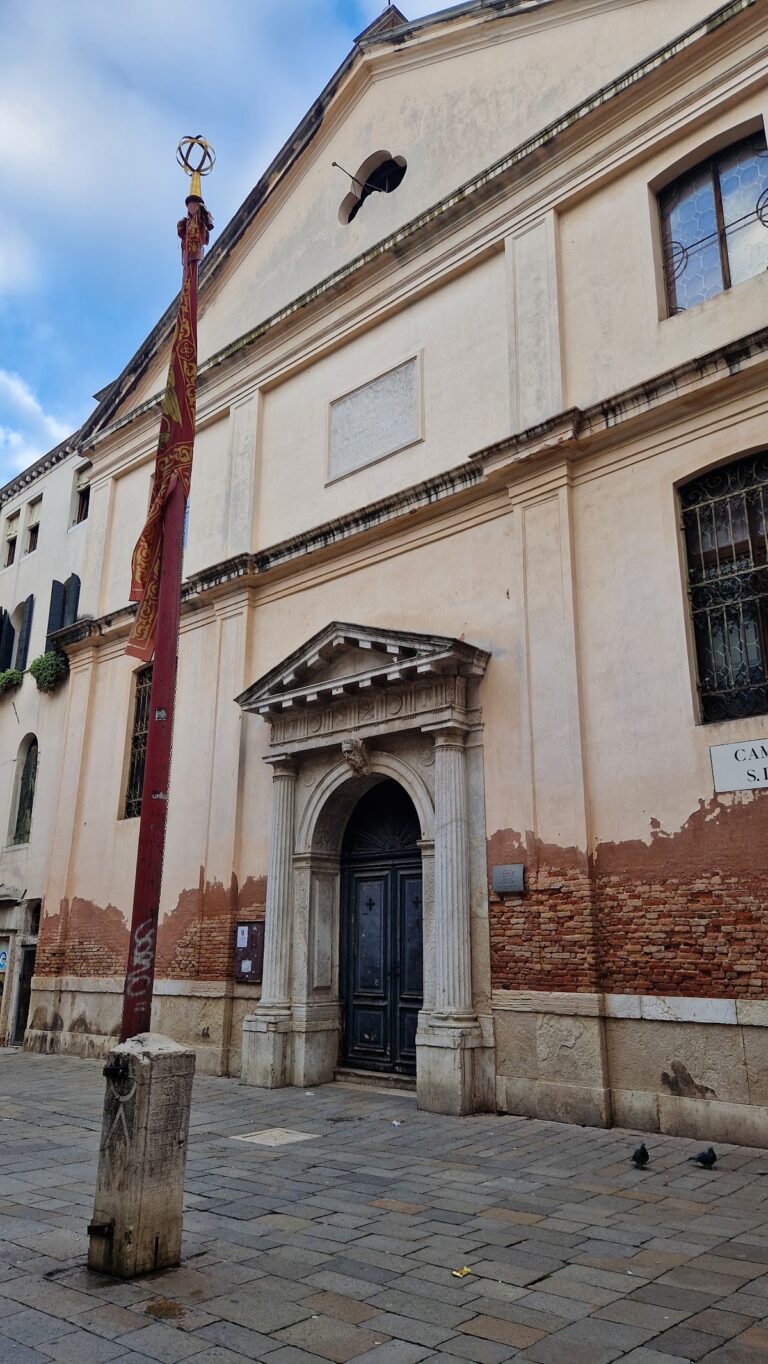
San Bartolomeo is almost completely enclosed by the shops, houses, and palaces of the dense Rialto urban fabric. The visible exterior is concentrated around the simple main facade, the side entrance on Salizada Pio X, the apse, and the bell tower. Inside, the later Latin-cross arrangement has a principal nave, side aisles, transept, three apsidal chapels, and an octagonal dome over the crossing.
Exterior and Bell Tower
Main and Side Entrances
The main facade faces Ramo dei Bombaseri and is largely undecorated. A statue of Saint Bartholomew stands above the principal portal. The side portal facing Salizada Pio X has a stone frame and a broken pediment, with an older statue of Saint Bartholomew in the niche above the entrance. The door leaves appear contemporary with this early-modern portal.
Campanile
The campanile, or bell tower, rises approximately 50 metres and contains manually operated bells. Built between 1747 and 1754, it is crowned by an onion-shaped dome resting on an octagonal drum. Its design was modeled on the dome of the campanile at the nearby church of Santi Apostoli, which was designed by Tirali. The monumental base contains a mascaron, a sculpted ornamental face, above the doorway, attributed to Antonio Gai.
Interior Structure
Nave, Aisles, and Crossing
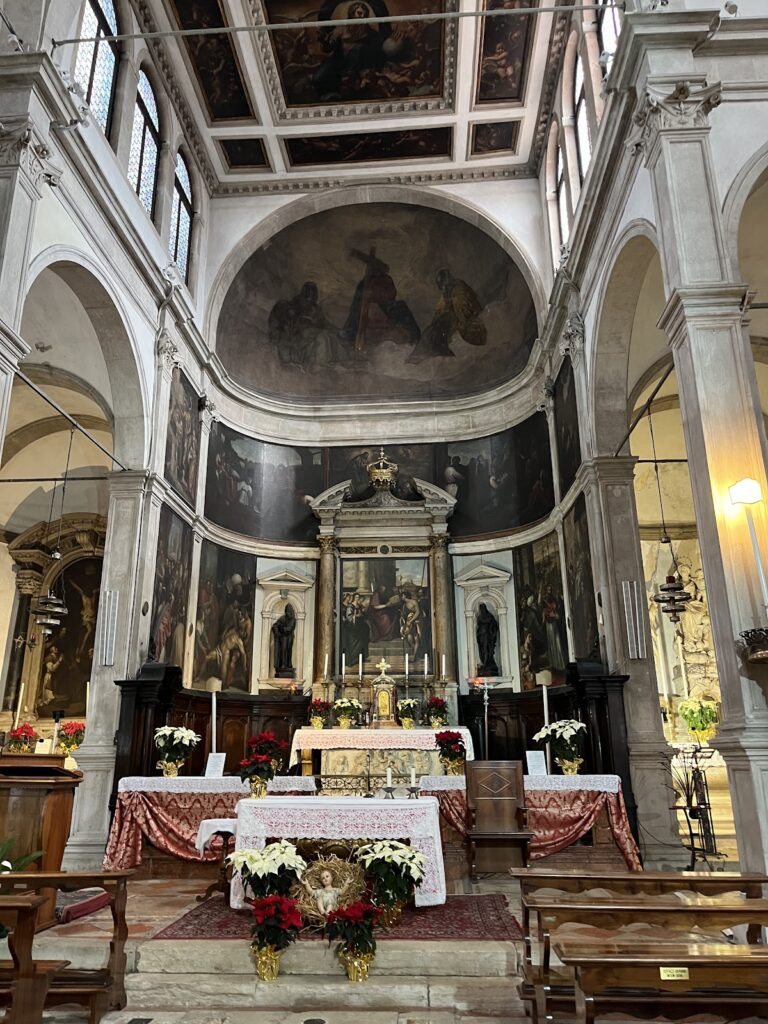
The medieval church had three aisles, while the later rebuilding created the present principal nave and side aisles. Piers with Corinthian half-columns divide the aisles. The main nave is covered by a barrel vault with lunettes, curved openings or painted sections formed within a vault, while the side aisles have flat ceilings. An octagonal dome crowns the crossing, and three apsidal chapels terminate in straight walls.
High Altar
The high-altar complex includes an altar, a tabernacle for reserving consecrated Eucharistic elements, and an arrangement associated with Bernardino Maccarucci. Sculptures of Faith and Hope stand behind it and are attributed to Enrico Merengo, also known as Heinrich Meyring. Behind the tabernacle is Palma the Younger’s Martyrdom of Saint Bartholomew, enclosed by an elaborate stucco frame. Large canvases on the side walls show Saint Bartholomew Baptizing the Kings of Armenia and Saint Bartholomew Struck, also by Palma the Younger. Michelangelo Morlaiter painted the grisaille works, monochrome images in shades of gray that imitate sculpture.
Transept and Sacristy
The two ends of the transept contain large canvases. Palma the Younger painted Punishment of the Serpents, while Sante Peranda painted Gathering of the Manna. A door to the sacristy stands below Peranda’s painting.
Chapels and Side Altars
Left Chapel
The left chapel contains Antonio Balestra’s Ecstasy of Saint Francis Xavier and Pietro Malombra’s Crucifix of the Pious Association of Prisoners. Its altarpiece is Lattanzio Querena’s Saint Philomena between Two Female Saints, dated 1837.
Right Chapel
The right chapel contains an Annunciation by Johann Rottenhammer, a Visitation by Sante Peranda, and another Annunciation by Michelangelo Morlaiter. Frescoes by Morlaiter and Peranda are associated with the right rear chapel.
Altars on the Left
On the left side, the altar of Saint Nicholas holds Pietro Moro’s Saint Demetrius among Saints, recalling the church’s original dedication. Above the side door is Pietro Vecchia’s Dormition of the Virgin. The altar of Saint Matthias contains a monumental Saint Matthias by Leonardo Corona.
Altars on the Right
The Baroque Crucifix altar includes a sculptural ensemble recently reattributed to Andrea Pozzo. The three-dimensional crucifix, formerly attributed to Brustolon, is now attributed to Francesco Terrilli, while the two grieving figures beside it are by Enrico Merengo. The All Saints altar has Lattanzio Querena’s Ecstasy of Saint Francis Xavier, dated 1816. At the altar of Saint Michael, also called the altar of Our Lady of Sorrows, is Pietro Novelli’s Saint Michael, dated 1798. A small lower niche contains a statue of Our Lady of Sorrows formerly associated with street devotion.
German Community and Major Works
Meeting Hall
The sacristy leads to the meeting hall of the German community, known as the Scoletta. Its decoration includes a series of canvases depicting the Life of the Virgin.
Dürer’s Rosary Madonna
Albrecht Dürer painted the Feast of the Rosary, also called the Rosary Madonna, for San Bartolomeo in 1506. Christopher Fugger, a German merchant who was buried in the church, placed the commission. Fugger’s tomb originally stood above the altar of the Rosary Confraternity. The painting is now held by the National Gallery in Prague.
Organ Shutters
Sebastiano del Piombo painted the organ shutters between 1510 and 1511. Saints Bartholomew and Sebastian appear on their exterior, while Saints Sebald and Louis of Toulouse appear on the interior. The shutters once belonged to the church’s organ, which is now lost, and are preserved in the Gallerie dell’Accademia in Venice.