Palazzo Dolfin Manin: A Palace on Venice’s Grand Canal
Site at a Glance
- Country
- Italy
- Primary era
- Early Modern
- Eras represented
- Early Modern, Modern
- Civilizations
- Habsburg, Venetian
- Site type
- Domestic
- Remains
- Palace
On this page12 sections
History
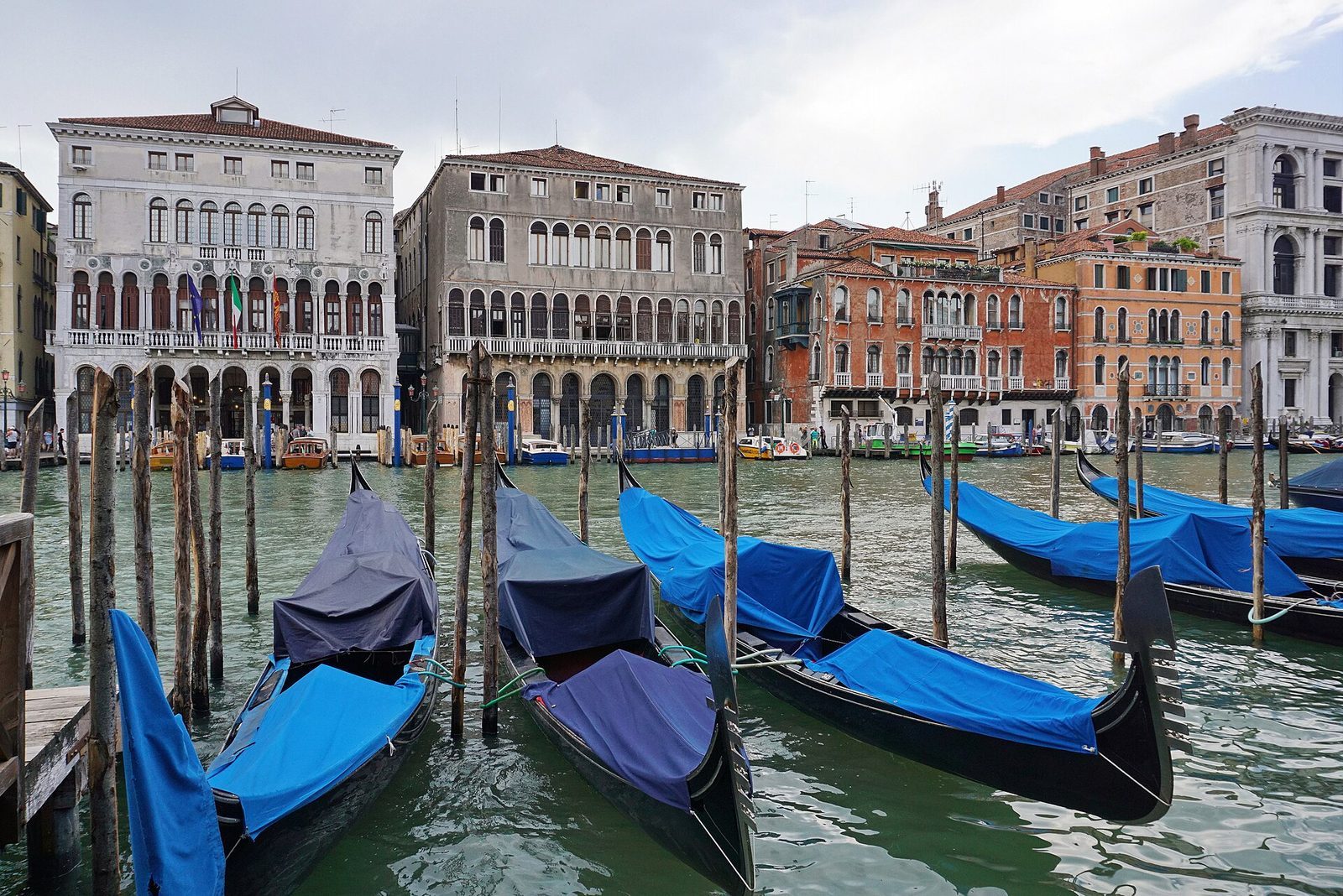
Palazzo Dolfin Manin is a palace on the Grand Canal in Venice, Italy, in the San Marco district. Begun in 1536 for the Dolfin family, it later became the home of Ludovico Manin, the last doge, or elected head, of the Venetian Republic.
Construction for the Dolfin family
Zuane Dolfin commissioned the palace after returning from public service. A Venetian patrician and follower of Doge Andrea Gritti, he was a procurator of St Mark, a senior official associated with the administration of St Mark’s Basilica and its institutions. In 1529 he served as a senior military administrator in the field, and in 1532 he became Verona’s chief civic magistrate. The new residence replaced two medieval houses that had formed the family’s earlier home.
The project met resistance from neighboring families, including the Bembo, Dandolo, and Da Molin. Venice’s governing bodies required a public passage through the building. Construction began in 1536, and the palace was largely complete when Zuane died in 1547.
Changing ownership and the Manin family
During the seventeenth century, the Dolfin family first rented out the palace and then sold it in stages. Among its later owners were members of the Pesaro, Venier, Dolce, and Correggio families. In 1651, amid Venice’s conflict with the Ottoman Empire over Crete, the Manin family purchased admission to the Golden Book, the official register of Venice’s patrician families.
By the early eighteenth century, the Manins used the palace’s principal formal upper floor, known as the piano nobile, as their main residence. In 1787, Ludovico Manin and his brother Pietro purchased the entire building, which was then in poor condition. From 1787 to 1801, the architect Gianantonio Selva carried out a major restructuring. A proposed radical redesign of the façade was abandoned after public opposition to changing Jacopo Sansovino’s work.
Ludovico Manin and the end of the Republic
Ludovico Manin lived in the palace from 1789 to 1797. On 12 May 1797, faced with Napoleon’s ultimatum, he accepted the French demands and abdicated. The Venetian Republic ceased to exist by the end of that year, and its territories were divided between France and Austria. Manin remained in the palace in seclusion until his death there on 24 October 1802. Venetians regarded him with contempt.
Bank ownership and later changes
From 1801, the palace served as the Manin family’s official residence, giving rise to its double name. The family library grew in 1810 with the addition of the Basadonna collection, but the library and furnishings were later dispersed as the family’s fortunes declined. The Manins owned the palace until 1867, when it passed to the Banca Nazionale del Regno. Its successor, the Bank of Italy, has its Venetian branch in the building.
After the bank acquired the palace, nearby streets were widened and canals filled. The lane immediately to the north was widened and renamed in honor of Giuseppe Mazzini. Interior redecoration in 1911 resulted in the loss of some late eighteenth-century furnishings. Partial restoration in 1968–1971 removed some decoration from the bank’s period of ownership, and further restoration followed in 2002.
Remains
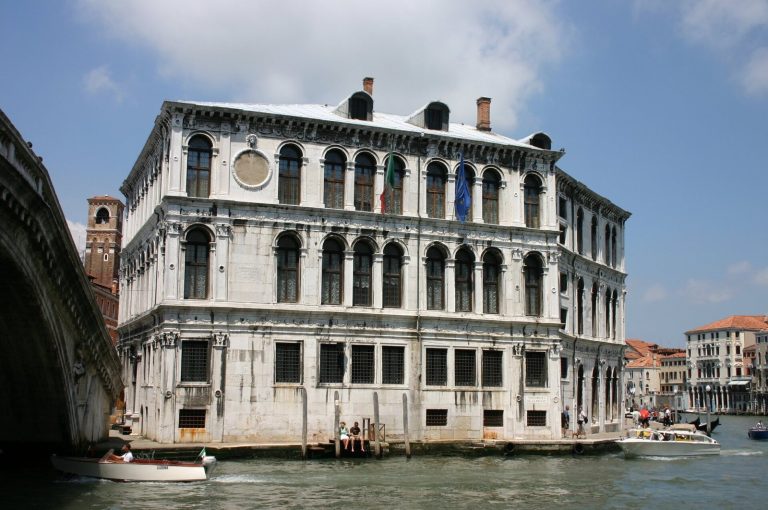
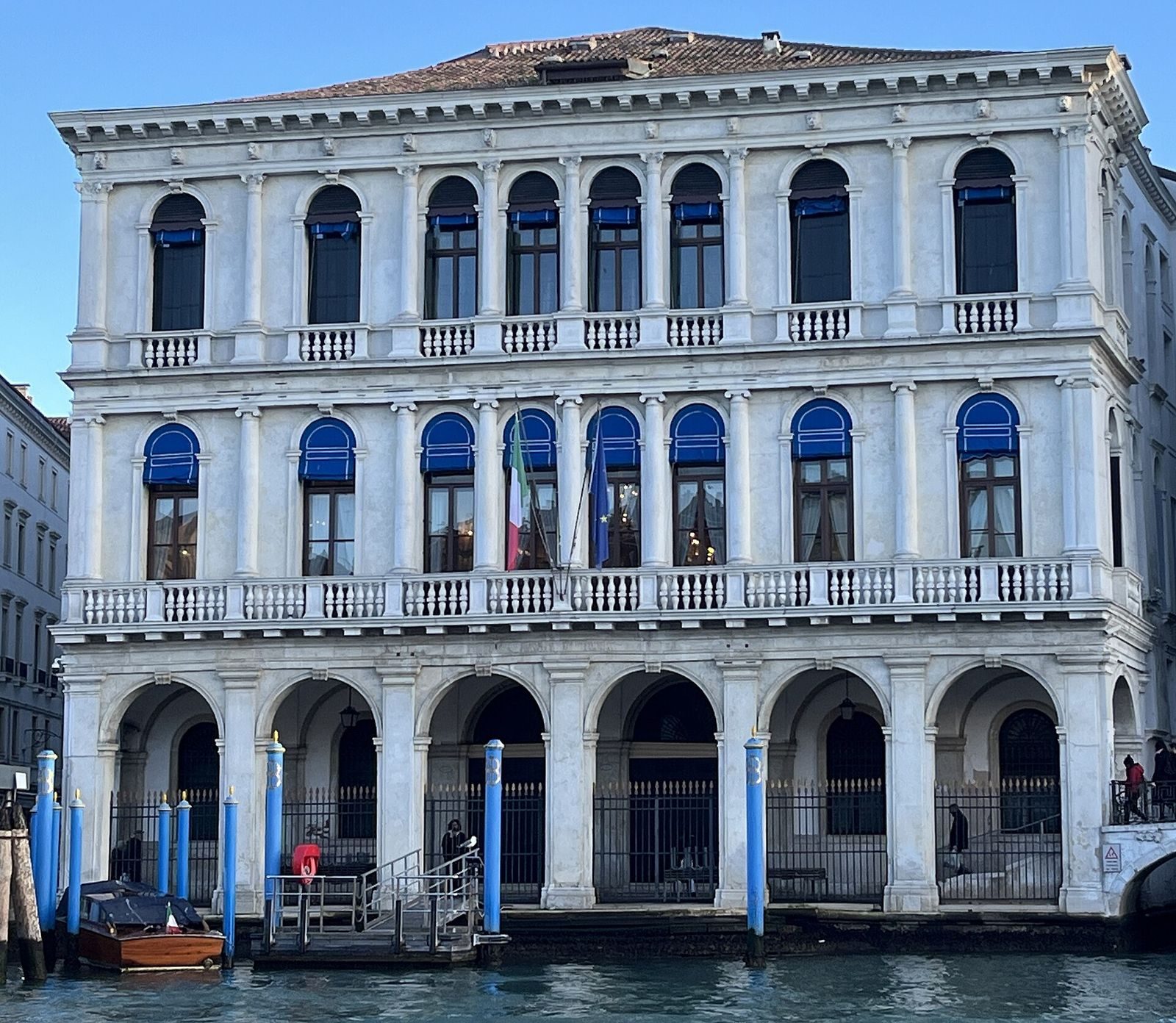
The palace has a trapezoidal plan and a Renaissance façade of white Istrian stone facing the Grand Canal. Its internal arrangement was later altered during Selva’s Neoclassical restructuring.
Plan and entrance
The original plan included a square courtyard reached from Rio dei Coffaneri. Selva removed the courtyard and replaced the entrance stair with a large, more elaborate Neoclassical staircase. The entrance faces the Grand Canal. At ground level, six round arches carried on seven pilasters form a passage designed for pedestrians.
Grand Canal façade
Jacopo Sansovino’s façade was built between 1538 and 1547 and continues along the sides of the palace. Its symmetrical arrangement places the upper-story windows above the ground-floor arches. Ionic columns, a classical order distinguished by its capitals, or attached half-columns mark the piano nobile; Corinthian columns, another classical order distinguished by its capitals, mark the floor above. Shallow rectangular supports, called pilasters, carry the ground-floor arches. The central section has two four-light mullioned windows, each divided into four vertical sections by supports, with no intervening wall spaces between the windows. A broad roof overhang, edged with small tooth-like blocks called dentils, crowns the façade.
Interior paintings and decoration
Reception-room paintings
Giambattista Tiepolo painted a cycle of Roman-history scenes for the reception room between 1725 and 1730. The paintings are now dispersed among museums. The Metropolitan Museum of Art in New York holds The Battle of Vercellae and The Conquest of Carthage. The Kunsthistorisches Museum in Vienna has The Death of Consul L. J. Brutus in a Duel with Aruns and Hannibal Recognizes the Head of His Brother Hasdrubal. Five works are at the Hermitage in St Petersburg: Quintus Fabius Maximus before the Senate of Carthage, Mucius Scaevola before Porsenna, The Triumph of Marius, The Triumph of Manius Curius Dentatus, and The Dictatorship Offered to Cincinnatus. The Hermitage also holds Coriolanus at the Gates of Rome, a series of ten canvases made for the principal room.
Ceiling and wedding works
Tiepolo’s ceiling painting The Triumph of Virtue and Nobility over Ignorance, made around 1740–1750, measures 320 by 392 centimeters and is now at the Norton Simon Museum in Pasadena. Other interior works by Tiepolo date to 1747 and were created for Ludovico Manin’s marriage to Elisabetta Grimani the following year.
Surviving painted and stucco decoration
Some ceiling paintings and stucco ornament remain in an alcove on the principal upper floor and in rooms on the floor above. They were made under Selva’s direction by Pierantonio Novelli, Jacopo Guarana, Costantino Cedini, Pietro Moro, and Giuseppe Bernardino Bison.