San Giovanni Elemosinario: A Renaissance Church in Venice’s Rialto Market
Site at a Glance
- Rating
- 4.1
- Popularity
- Very Low
- Country
- Italy
- Primary era
- Early Modern
- External website
- Open
- Eras represented
- Medieval, Early Modern
- Civilizations
- Venetian
- Site type
- Religious
- Remains
- Church
On this page20 sections
History
San Giovanni Elemosinario is a Roman Catholic church in Venice, Italy, rebuilt in Renaissance style between 1527 and 1529 after the destruction of the Rialto fire. Located in the San Polo district beside the Rialto market, it is dedicated to Saint John the Almsgiver, a seventh-century patriarch of Alexandria remembered for charitable aid to the poor. In Venice, the church is commonly called San Zuane de Rialto.
Medieval Foundation and Parish History
Tradition places the foundation of San Giovanni Elemosinario in 966, while the church is documented by the eleventh century. A document from 1051 describes it as ancient, and the collapse of its bell tower was recorded in 1071. By the end of the eleventh century, the church had become a parish during a reorganization of Venetian ecclesiastical administration.
The building was reconstructed in 1167 and again in the fifteenth century. Its parish administration changed repeatedly during the later Middle Ages. In 1391, the church was reduced to a commenda, an ecclesiastical benefice whose administration or revenues were assigned to a commendatory holder, and placed under the chapter of San Pietro di Castello. A papal privilege in 1440 assigned its revenues to the College of the Twelve Poor of Christ, based at the cathedral.
Disputes between the college and the parish community resulted in the church’s transfer to ducal jurisdiction in 1487, under the primicerius, a senior clerical official, of San Marco. The Patriarch of Venice assumed authority over the parish during the second half of the sixteenth century. The church also served as a meeting place for merchant confraternities and guild schools, religious or occupational associations that could commission and maintain artworks. Grain merchants, couriers, poultry sellers, and textile workers competed to adorn the building.
Fire and Renaissance Reconstruction
On 10 January 1514, a fire devastated the Rialto district, destroying numerous buildings, shops, and large quantities of merchandise. San Giovanni Elemosinario was completely destroyed. The reconstruction of the district, including the church, was entrusted to Antonio Abbondi, known as Scarpagnino, a Venetian Renaissance architect and builder.
The church was rebuilt from 1527 to 1529, with the wider building phase continuing until about 1531 during the early rule of Doge Andrea Gritti, the elected head of the Venetian Republic. Its decoration developed progressively through commissions to leading sixteenth-century artists, including Titian, Jacopo Palma the Younger, and Giovanni Antonio de’ Sacchis, known as Il Pordenone. Gritti commissioned Il Pordenone to paint frescoes for the dome.
The chronology of the decoration also preserves a challenge to a traditional story associated with Giorgio Vasari. The painting of Saints Catherine, Sebastian and Roch is dated approximately 1530 to 1535, earlier than Titian’s Saint John the Almsgiver. This sequence conflicts with the story that Titian and Il Pordenone competed after Titian left Venice for Bologna, with Il Pordenone’s commission intended to challenge Titian’s altarpiece.
Later Parish and Conservation History
A 1705 census recorded a hatter’s family living within the church. One member, Giambattista Pittoni, later became a prominent Venetian painter. The parish itself was abolished by the Napoleonic decrees of 1807, and from 1808 San Giovanni Elemosinario became a filial church of the parish of San Silvestro I Papa.
Severe deterioration, including damp and fungal growth, led to the church’s closure in 1982. The paintings were removed and placed in the supervisory authorities’ depot at San Gregorio. Restoration enabled the church to reopen on 1 March 2001, while the badly damaged Heraclius Carrying the Cross to Jerusalem returned after separate restoration on 1 February 2002. San Giovanni Elemosinario is currently an active filial church and forms part of the Chorus Venezia association. Its traditional foundation is associated with Saint John the Almsgiver, whose relics are now in San Giovanni Battista in Bragora.
Remains
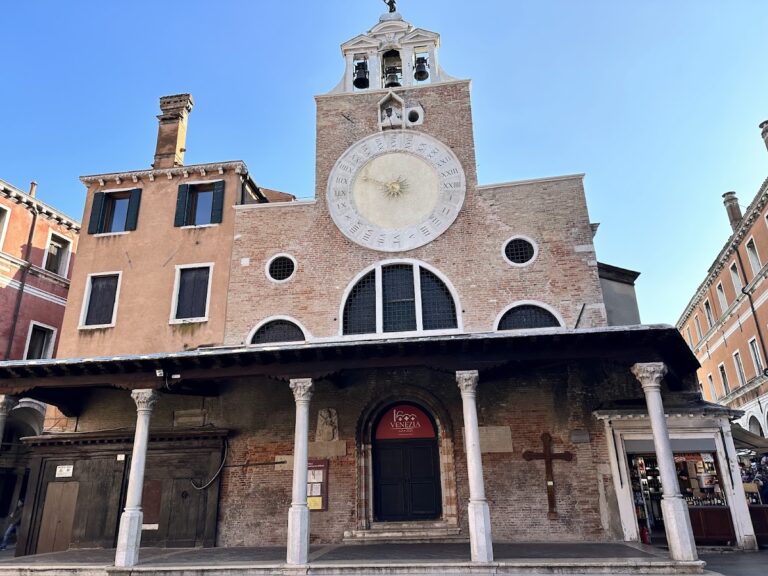
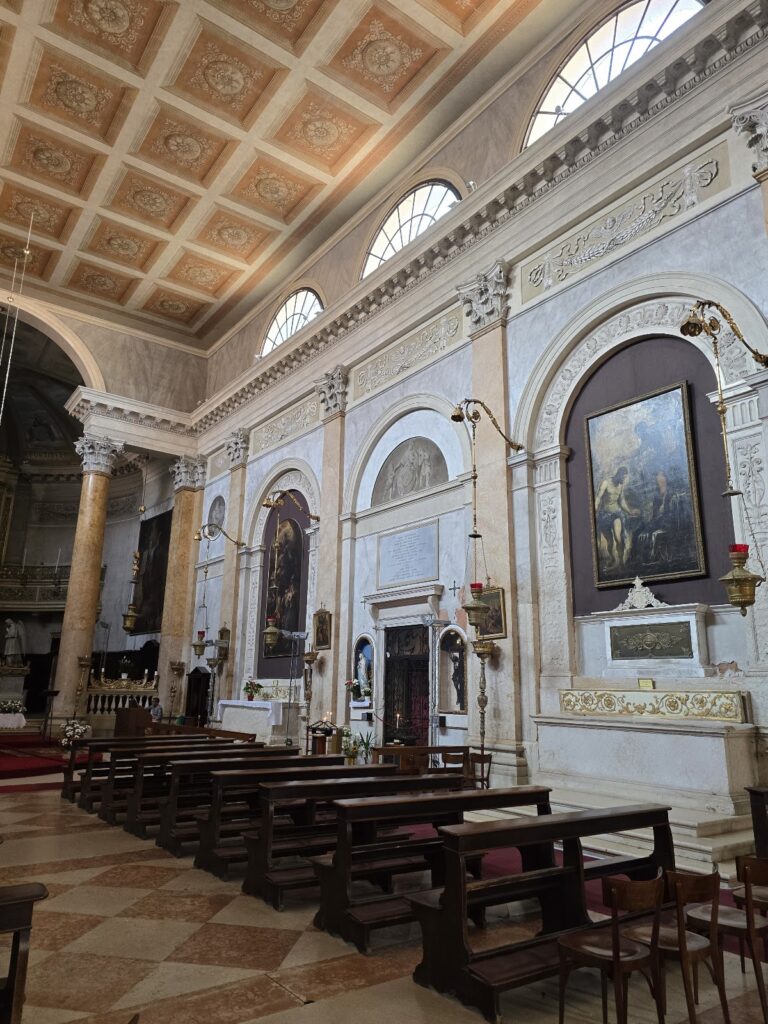
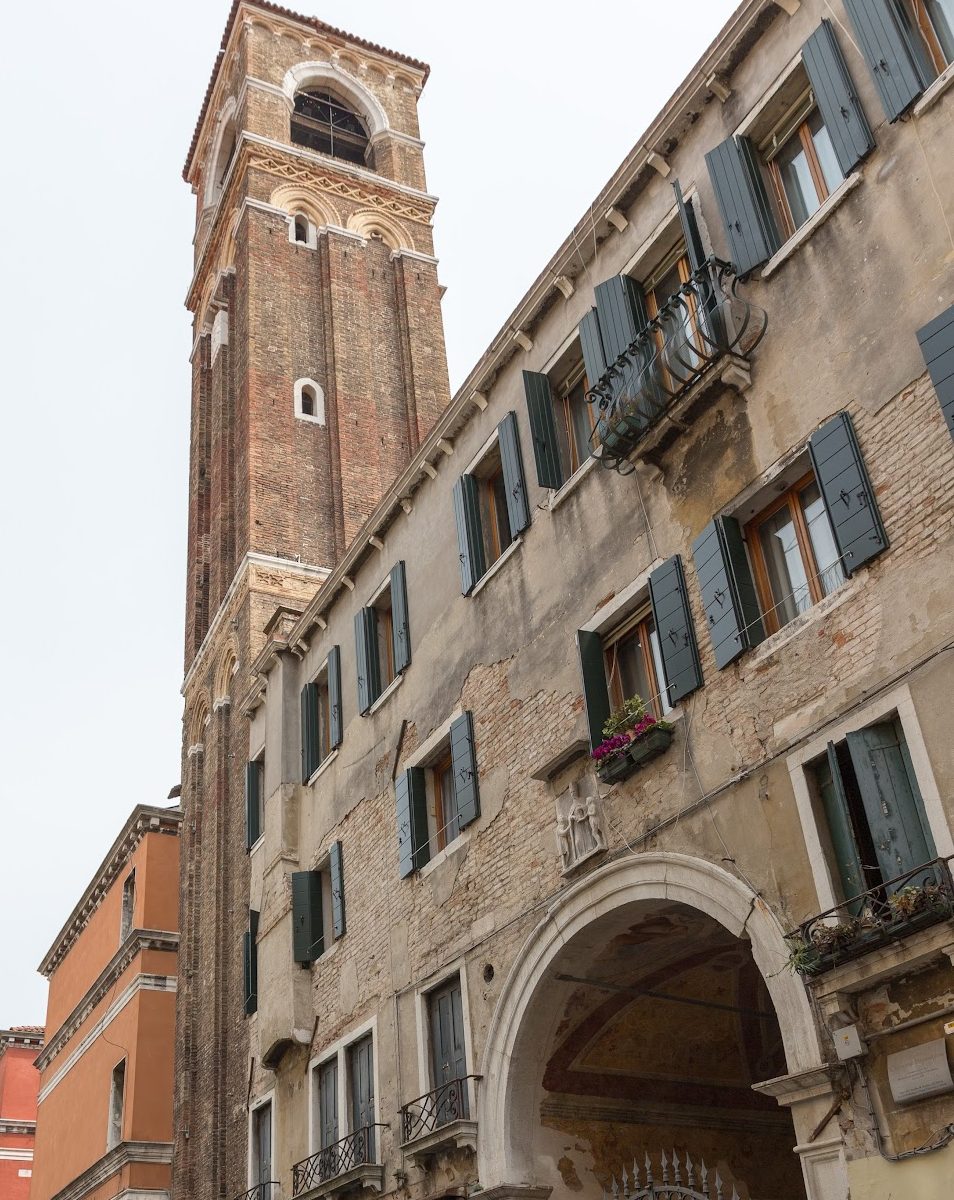
San Giovanni Elemosinario is a Renaissance brick church inserted into the dense, uniform housing beside the Ruga Rialto. Its outer form is difficult to distinguish from the surrounding buildings. The entrance is approached from the canal through an arched portal with an iron gate, and the arrangement allowed adjoining or nearby commercial premises and spaces for market stalls. Inside, a Greek-cross plan, with four arms of approximately equal length, is inscribed within a square. Three naves, barrel vaults, and a central dome organize the interior.
Exterior and Bell Tower
Church Plan and Presbytery
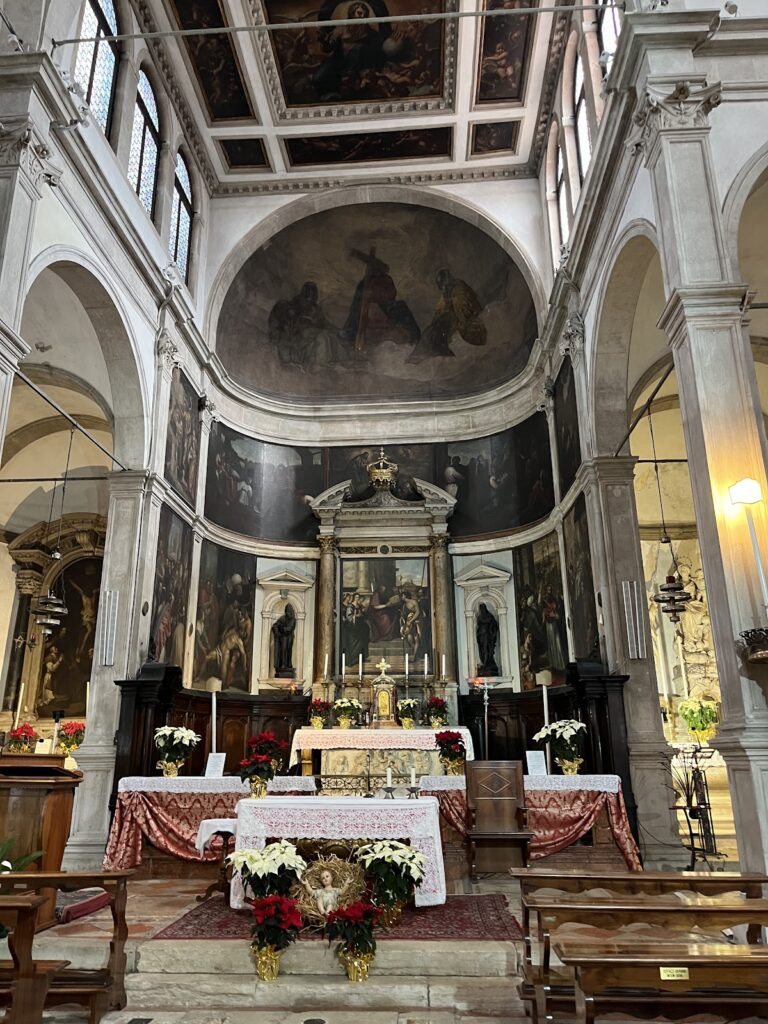
The central dome rests on pendentives, curved triangular supports that allow a circular or polygonal dome to rise above a square space, carried by four piers. The presbytery stands five steps above the rest of the church, providing additional height for the crypt. Stairs descend to the crypt from inside the altar, while two chapels flank the presbytery.
Bell Tower
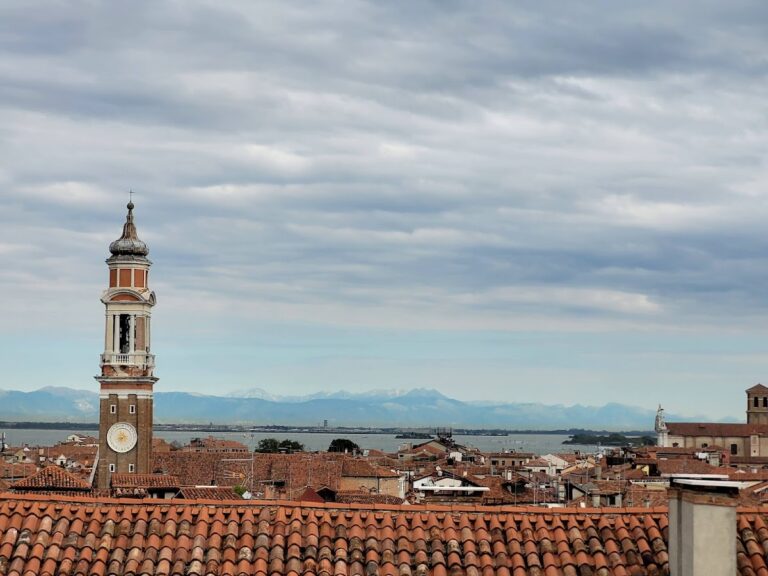
The church’s bell tower, or campanile, is 41 metres high. After its collapse in 1071, it collapsed again in 1361, was rebuilt between 1398 and 1410, and was later altered by Abbondi during the Renaissance reconstruction. It was originally crowned by a dome with four pinnacles. Its present top is a hipped roof covered with curved tiles, and the bells are operated manually.
Chapels and High Altar
Right Chapel
The right chapel contains Il Pordenone’s Saints Catherine, Sebastian and Roch, dated approximately 1530 to 1535. On the wall is Palma the Younger’s Martyrdom of Saint Catherine, dated 1595, while the lunette above contains Saint Roch Healing the Plague-Stricken, dated 1590.
Left Chapel
The left chapel contains a fifteenth-century marble Pietà, flanked by small statues of Saint John the Almsgiver and Saint Francis of Assisi. Palma the Younger’s Heraclius Carrying the Cross to Jerusalem, dated 1590, occupies the chapel wall.
High Altar
The high altar was built in 1633 for the Casteletti, the guild of lottery officials. It contains Titian’s Saint John the Almsgiver, painted approximately between 1545 and 1550. The work underwent restoration in 1989 and 1990, when nineteenth- and twentieth-century overpainting and varnish were removed, before it was returned to the church. Above the altar is Leonardo Corona’s Resurrection of Christ.
Dome and Wall Paintings
Dome Decoration
Restoration in 1993 uncovered frescoes by Il Pordenone. The centre of the dome contains The Eternal Father Blessing, a sculpture by an unknown Venetian artist. The vault bears Angels in Glory, Dancing on Clouds, the drum contains Doctors of the Church, and the pendentives display the Evangelists, dated 1531. The dome also carries the coat of arms of Doge Andrea Gritti.
Presbytery Walls
Leonardo Corona’s Crucifixion of Christ occupies the right wall, with Moses Bringing Water from the Rock in the lunette above. On the left wall is Antonio Vassilacchi’s Washing of the Feet, while Corona’s Prayer in the Garden of Gethsemane fills the lunette above.
Transepts, Facade, and Organ
Right Transept
The right transept contains Corona’s large Gathering of Manna, Saint Andrew Raised on the Cross, and The Investiture of Saint Nicholas of Bari in the lunette above. Its altar has Luigi Zandomeneghi’s neoclassical Virgin and Putto, dated 1834.
Left Transept
Above the side portal in the left transept is a former organ front. Its paintings show Saint John the Almsgiver, Parish Priest Gianmaria Carnovali Blessing Doge Leonardo Donà, and Saint Mark by M. Vecellio, identified as Titian’s son. The altar contains an anonymous Venetian painter’s Dormition of Saint Joseph, flanked by Corona’s Annunciation and Archangel Gabriel.
Facade Interior
The interior wall of the facade displays Carlo Ridolfi’s Adoration of the Magi, dated 1642. The lunette above contains Domenico Tintoretto’s The Eternal Father in Glory with Doge Marino Grimani, Dogaressa Morosina Morosini, and Members of the Poultry Sellers’ Guild. A dogaressa was the doge’s wife or consort.
Organ
The church’s Nacchini organ dates from 1749. It has one manual with eleven stops and was modernized in the late nineteenth century.