Zuiderkerk (Enkhuizen): A Late Gothic Hall Church in the Netherlands


Site at a Glance
- Rating
- 4.5
- Popularity
- Low
- Country
- Netherlands
- Primary era
- Medieval
- External website
- Open
- Eras represented
- Medieval, Early Modern, Modern
- Civilizations
- Habsburg, Holy Roman Empire
- Site type
- Religious
- Remains
- Church
On this page10 sections
History
Foundation and Catholic origins
The Zuiderkerk (Enkhuizen) is a late Gothic church in Enkhuizen, Netherlands, built in the Brick Gothic tradition as a replacement for the church of Oostdorp. That settlement stood outside the Westfriese Omringdijk and was destroyed or inundated during the flood of 1421. In 1422, the inhabitants of Enkhuizen received permission from John III, Duke of Bavaria, to demolish the old church and construct a new one within the dike.
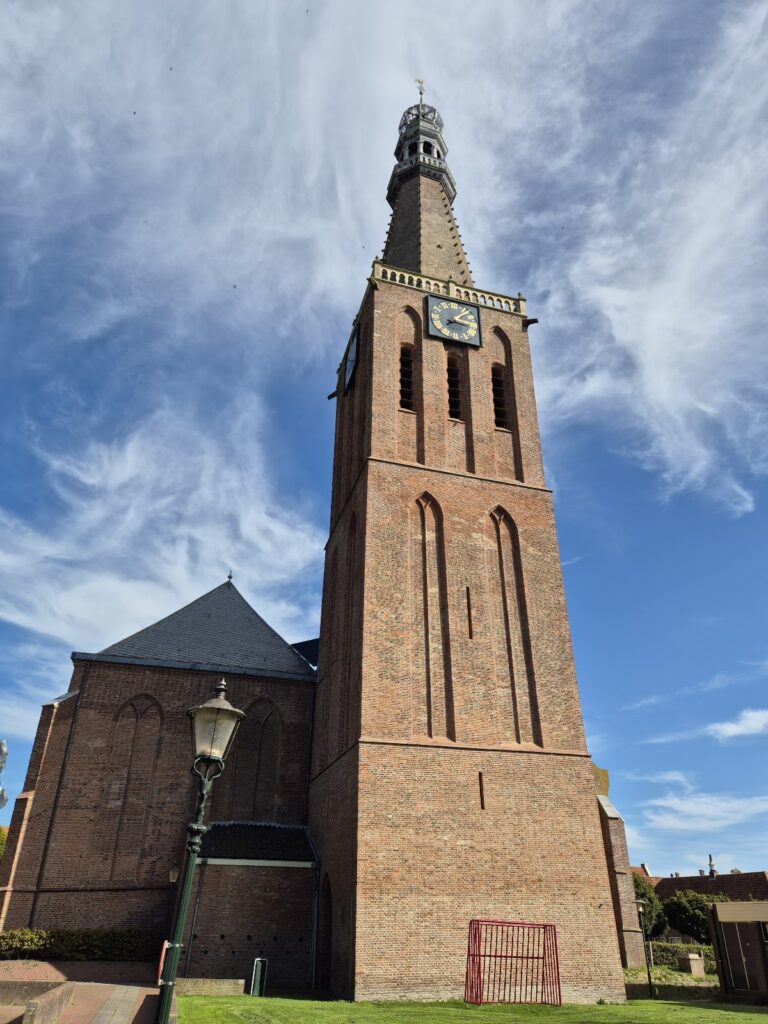
Construction began in 1422 or 1423, traditionally on a substantially raised area of reed land. The church was largely complete by 1458, while the upper part of its approximately 75-metre tower was finished in 1524. Dedicated to Pancras of Rome, an early Christian martyr and saint, it originally served the Roman Catholic community.
Reformation and later changes
The church passed to Protestant control during the Reformation, the sixteenth-century movement that established Protestant churches in western Europe and transferred many Catholic churches to them. Cornelis Cooltuyn became pastor in 1555. Known as the “father of the Dutch Reformation,” he left Enkhuizen for Alkmaar in 1557 after his orthodoxy was questioned.
By 1595, the tower leaned approximately six or seven feet and had to be straightened. Biblical scenes painted on the vaults in 1484 were covered with whitewash or paint in 1609 after the church became Protestant. The vault paintings and several wall paintings were uncovered again during the twentieth century.
Restoration and continuing worship
The tower is owned by the municipality of Enkhuizen and was restored in 1992. The church underwent a major restoration from 2001 to 2004, partly in response to damage caused by the deathwatch beetle. Part of the interior was reorganized in 2013 and 2014. The changes were designed to be reversible, and the renewed arrangement entered use in February 2014. The Zuiderkerk continues to serve the Enkhuizen congregation of the Protestant Church in the Netherlands. It has been a Rijksmonument, a protected national monument in the Netherlands, since 1966, under monument number 15268.
Remains
Church structure and interior
The Zuiderkerk is a two-aisled hall church, a form in which the central nave and side aisles are approximately equal in height. Its late Gothic design follows the Brick Gothic tradition, which uses brick instead of, or together with, cut stone. A chapel projects from the north side, and two parallel gabled roofs cover the building. Wooden barrel vaults span the aisles and are structurally connected to the parallel roof frames. The church stands inside the dike on raised ground, with walls whose height was comparable to the depth of the foundations, indicating the substantial preparation of the building site.
The northward-projecting Chapel of the Cross was enclosed by a glass wall during the 2013 and 2014 reorganization. An inserted structure created a foyer, nursery, and kitchen on the ground floor, two meeting rooms above, and a separate upper-level room for the cantorate. Bricks from a formerly blocked passage were placed beneath the floor so that the intervention could later be reversed. The baptismal screen around the pulpit was made smaller and moved slightly backward, opening access from the front to the baptismal enclosure and pulpit.
Painted vaults and organ
The wooden vaults carry biblical scenes painted in 1484. Later layers of whitewash or paint concealed them in 1609, and the paintings were revealed again in the twentieth century along with wall paintings. The organ is a hybrid instrument assembled from components dating from several periods. Its surviving pipes and registers include a 4-foot Octave and an 8-foot Holfluit attributed to Jan van Covelens, as well as a nearly equally old 2-foot Gemshorn attributed to Hendrick Niehoff. Another old 4-foot flute survives, although its maker is unknown.
Antonius Henricus added a Rückpositiv, a separate organ division placed behind the player, in 1593, and the instrument was extensively altered in 1621. The case dates from that year. The organ was examined by Jan Pietersz and Philips, with Jan Pietersz identified as the renowned organist Jan Pieterszoon Sweelinck, who also played it. Several registers from that period remain. Johannes Duyschot added the existing three-register free pedal in 1688. Eighteenth-century furnishings include a sailcloth curtain painting behind the organ and side wings made by Pieter de Nicolo in 1737, replacing the original shutters.
Heinrich Hermann Freytag rebuilt the organ extensively in 1799. He replaced the earlier Rückpositiv with a larger one, widened the lower case of the main section, and installed new keyboards. These changes gave the instrument an Empire-style appearance that contrasts with the older main case. The present pitch, approximately A = 450 Hz, also dates from this period. Flentrop restored the organ between 1988 and 1990, using its 1799 state as the basis and reconstructing the missing Mixtuur and Scherp stops of the main section.
Further major maintenance in 2023 returned the great octave of the 3-foot Nasard, which had previously been recovered from the Mennonite meeting house in Wormerveer, and introduced Neidhardt 1729 temperament. The organ now has 21 stops on two manuals and pedal, with mechanical action. The main-work stops are largely sixteenth-century, while those in the Rückpositiv date from 1799.
Western tower and timekeeping
Bells and carillon
The massive western tower has a wooden octagonal upper structure and a domed roof. Two bells hang in its bell chamber. The larger C bell was cast by Geert van Wou in 1509 for the Westerkerk. Its inscription gives the bell the name Salvator and asks that its sound please the Lord. It was moved to the Zuiderkerk in 1653 and is connected to the carillon. The smaller A bell was cast by Pieter and François Hemony in 1648. Its inscription invokes the Lord’s blessing and praise. It served as a fire bell until 1936 and is not connected to the carillon.
The octagonal section contains a carillon, a set of tuned bells operated from a keyboard or automatic mechanism. It originally consisted of 52 bells made by François and Pieter Hemony. Bells were later added and replaced, and 54 are currently present, with approximately 20 dating from before 1800. The instrument uses seventeenth-century meantone temperament, a historical tuning system associated with Renaissance and Baroque keyboard and bell instruments. It transposes upward by a whole tone, so the sounding D is connected to C on the keyboard.
The first playing bells were installed in the octagonal tower windows in 1524. Several bells from the earlier warning or prelude system, cast by Geert van Wou, are now outside the Zuiderkerk, including two in the Drommedaris carillon and others in later bell installations. A. H. van Bergen of Heiligerlee rebuilt the carillon in 1936 on the model of the carillon at St. Rumbold’s Cathedral in Mechelen. The bells were rearranged in rows, and the earlier connection between the keyboard and clappers was replaced by rocker levers.
During the 1936 rebuilding, the large Geert van Wou bourdon of 1523, which had also served as a fire bell, was removed because it was considered dangerous and was broken into pieces. Petit & Fritsen rehung the corroded mechanism in 1971. The 1992 tower restoration reinstated the original arrangement, added a keyboard room in the octagon, and connected the clappers to the keyboard with aligned rocker levers. The lost bourdon was replaced as an hour bell by a bell sounding A. The hand-playing mechanism later received further improvements, including a new keyboard in December 2013.
Clock room
Lower in the tower, the clock room retains the clock and striking mechanisms together with a playing drum dating from the sixteenth or seventeenth century. Its maker is unknown. The drum was converted from a fixed-note system to sliding notes in 1909, and it is the part that remains in use.
Until 1936, weights drove the clock and striking mechanisms. An electric motor and a synchronous electric clock with striking mechanisms made by Addicks of Amsterdam were installed that year. Since 1992, modern computer controls have operated the clock and striking functions. Minute hands were added to the dials in 1936, whose numerals include an unusual Q in place of 5. The heaviest lead weight formerly used for the playing drum weighed approximately 600 kilograms. It was hidden beneath the tower floor during the Second World War and later rolled into sheet lead for repairing the roof of the Koepoort. The bells were not requisitioned during the war, although bronze bearing blocks from the disused tower clock disappeared.