Santa Maria Formosa: A Historic Parish Church in Venice


Site at a Glance
- Rating
- 4.6
- Popularity
- Medium
- Country
- Italy
- Primary era
- Early Modern
- External website
- Open
- Eras represented
- Medieval, Early Modern, Modern
- Civilizations
- Habsburg, Italian, Venetian
- Site type
- Religious
- Remains
- Church
On this page23 sections
History
Santa Maria Formosa is a Roman Catholic church in Venice, Italy, in the Castello district near the boundary with San Marco. Traditionally founded in 639 by Saint Magnus, bishop of Oderzo, it developed into a collegiate and mother church and was rebuilt in the Renaissance by Mauro Codussi, whose work combined an earlier Greek-cross conception with a Latin-cross plan. The church belongs to the Patriarchate of Venice and remains a parish church dedicated to the Purification of Mary.
Traditional foundation and medieval history
Tradition says that the Virgin appeared to Saint Magnus and directed him to the site. The patrician Tribuno family financed the foundation. This story also explains the name Formosa, referring to the Virgin’s beautiful or splendid appearance. The earliest surviving written evidence for the church, however, dates from 1060. The earlier building was renovated in 864 and repaired after a fire in 1106.
Santa Maria Formosa had an important place in the religious organization of medieval Venice. From at least the thirteenth century, it was a collegiate church, meaning that a chapter of clergy served it, and a mother church with authority over affiliated churches. San Lio and Santa Marina were among the churches connected with it. The church was also associated with the Casseleri and fruit sellers, Venetian guilds that operated as religious and charitable associations.
On the Feast of the Purification of Mary, the doge traditionally visited Santa Maria Formosa to commemorate the liberation of twelve girls abducted by Narentian pirates. The rescue was attributed to the Casseleri guild. The annual observance gave rise to the Festa delle Marie, a Venetian festival derived from the medieval commemoration of the rescued brides. Antonio Molinari’s surviving ceiling painting in the presbytery later preserved this subject in visual form.
Codussi’s rebuilding and the Cappello façades
By 1492 the church had decayed, and Mauro Codussi began its reconstruction. Codussi was a Renaissance architect active in Venice whose work introduced central Italian Renaissance principles into Venetian church design. He adapted the new structure to the existing foundations and partly retained the earlier Greek-cross arrangement. He died in 1504 before the work was complete. Unidentified builders finished the exterior, while the dome may have been added by his son Domenico according to his father’s design.
The Cappello family financed the two principal façades. The canal-facing elevation was built in 1542 in memory of Admiral Vincenzo Cappello, who had died the previous year. Its signed funerary monument was made by Domenico di Pietro Grazioli. The façade facing the square was completed in 1604 and decorated with images of the Cappello family.
Earthquake repairs and institutional change
An earthquake caused extensive damage that led to a major restoration financed by the merchant Turin, or Turrino, Tonon. The work strengthened the façades, altered the structure of the dome, decorated the nave and transept ceilings, and added two large funerary monuments for the Tonon family. The earthquake is probably identified with the 1624 Argenta earthquake. A further earthquake in 1688 required repairs to the dome.
The church’s collegiate status ended in 1807 during the Napoleonic suppressions, which abolished collegiate titles and reorganized Venetian parishes. San Lio and Santa Marina were incorporated into the parish administration of Santa Maria Formosa. From that year, the parish priest has been appointed by the patriarch of Venice.
Nineteenth- and twentieth-century alterations
During the first half of the nineteenth century, parish priest Bartolomeo Cecchini removed the Tonon monuments from the main chapel. Their surviving busts were placed on the transept walls. Cecchini also opened four additional windows in the octagonal structure supporting the dome.
On the night of 9 August 1916, an Austrian bombardment caused a fire that stripped the presbytery, right transept, and nave of their roofs. The organ and ceiling paintings were destroyed, with Antonio Molinari’s work surviving. Giovanni Scolari directed a restoration in 1926, during which the drum of the dome was also removed. The church now forms part of the Chorus Venezia association. Campo Santa Maria Formosa, one of Venice’s largest squares, occupies an island bounded by the canals of Santa Maria Formosa, Pestrin, San Giovanni Laterano, and Mondo Novo.
Remains
Santa Maria Formosa combines a Renaissance exterior with a church plan that preserves elements of an earlier Greek-cross conception. The building is principally of brick and has a central dome, a Latin-cross arrangement, three aisles, a transept, a presbytery, and three semicircular apses. Two smaller chapels flank the presbytery on each side, while larger chapels open from the side aisles. Inside, light arcades divide the spaces. The main nave is twice the width of the side aisles and has a vault. Each aisle is divided into three bays, each covered by a small dome, and the chapels are separated by two-part arcades.
Façades and campanile
Canal-facing façade
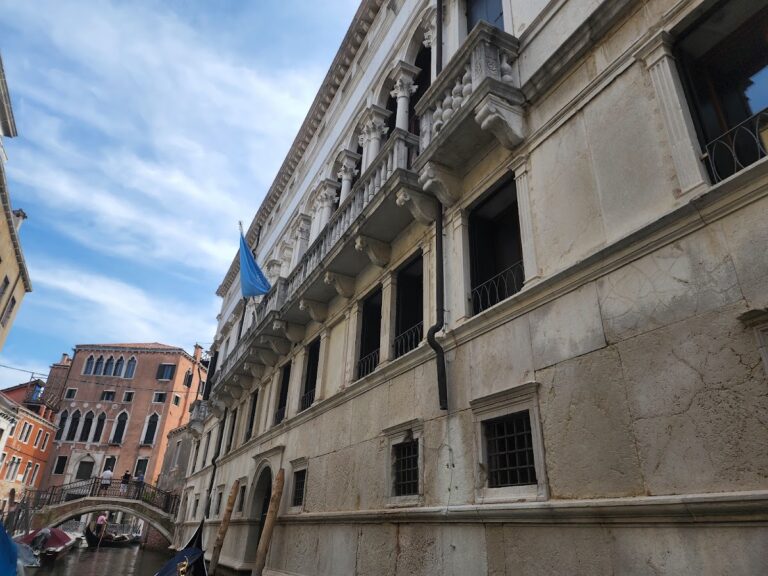
The canal-facing façade, completed in 1542, is a three-part Renaissance composition. Paired Corinthian half-columns on high bases divide its surface, while a high entablature supports a large pediment fitted with vase-shaped ornaments and the Cappello coat of arms. Ionic columns at the portal support the funerary monument of Vincenzo Cappello. The admiral is shown standing with a command staff above an elaborate urn, and medallions on the bases depict weapons and armor. Domenico di Pietro Grazioli signed the monument.
Square-facing façade
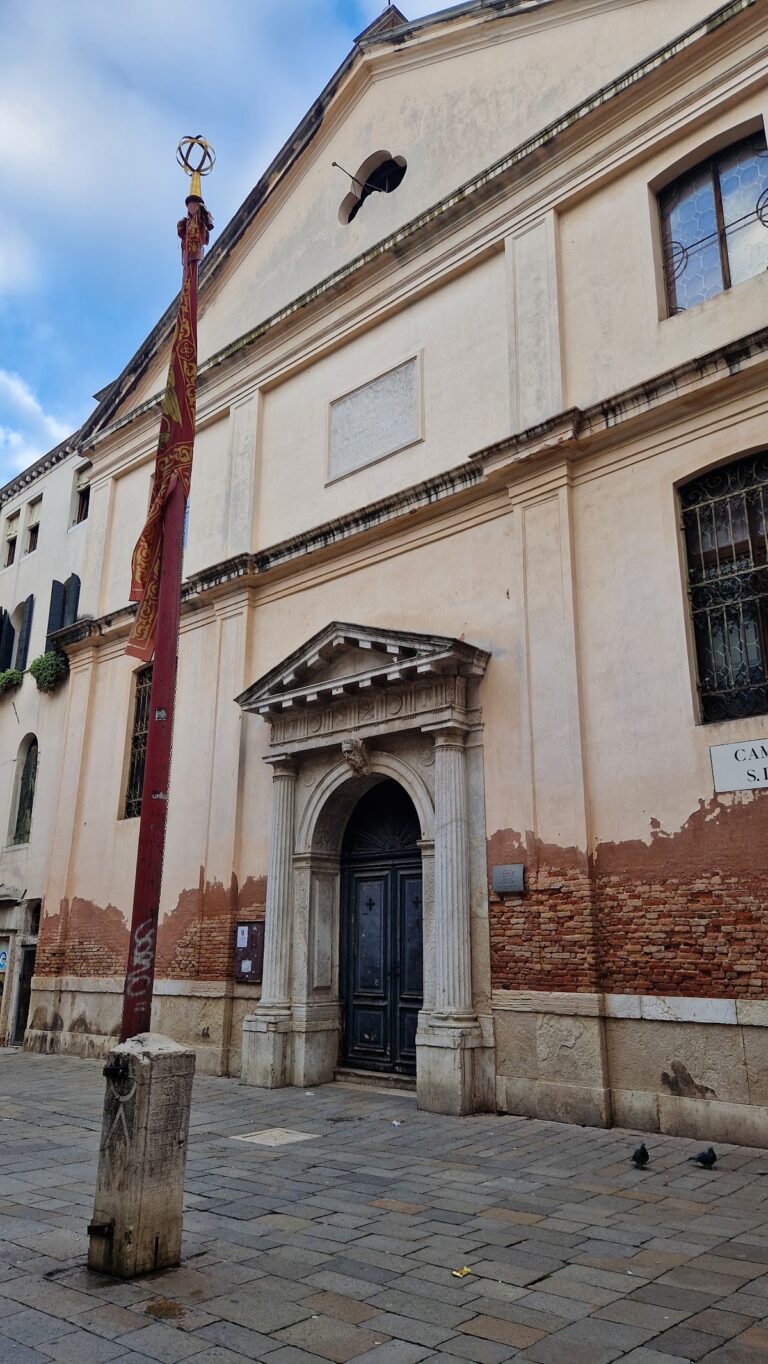
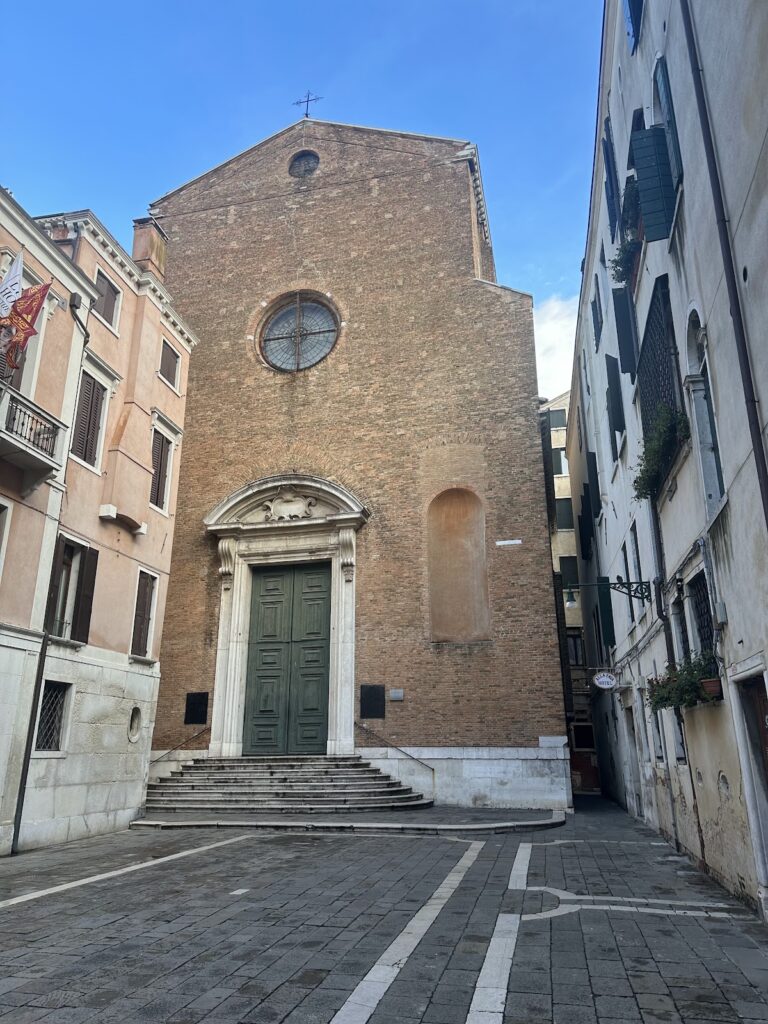
The façade facing the square was completed in 1604 as a two-level Baroque composition. Ionic pilasters and blind arches organize the lower level. Corinthian supports, a pediment, trabeated wings, and curved convex screens shape the upper level. A statue of the Virgin and four Virtues crown the elevation. The central portal has a broken pediment and a bust of a Cappello, while two further family busts stand above the lateral sections.
Freestanding bell tower
The Baroque campanile, or freestanding bell tower, stands separately from the church. Small former guild buildings of the fruit sellers and Casseleri occupy the space between the tower and the church. The priest Francesco Zucconi designed the campanile. Construction began in 1611 and ended in 1688, producing a tower approximately 40 metres high.
Rusticated courses mark the lower stages, above which is a plastered section with clock faces on all four sides. The belfry has balustraded windows and masks in its keystones. Curved pediments and complex drums lead to an octagonal drum, a balustrade, and an octagonal pinnacle crowned by cherubs supporting a cross. A grotesque sculpted mascaron above the entrance was traditionally believed to keep the devil from entering and ringing the bells. Its comic character expressed a Venetian attitude toward that belief, while John Ruskin strongly criticized the sculpture.
Nave chapels and paintings
Baptistery and first chapel
A sixteenth-century baptistery stands near the beginning of the nave. Above it is the Circumcision of Jesus, a work influenced by Giovanni Bellini and attributed to Vincenzo Catena.
The first chapel contains Bartolomeo Vivarini’s signed and dated 1473 triptych. Its three panels show the Virgin of Mercy, the Meeting of Joachim and Anne, and the Birth of the Virgin. The work was probably made for the high altar of the earlier church and is now mounted on a Baroque altar. The chapel also contains a Father Eternal and Angels by Lazzaro Bastiani and a small relief of the Dead Christ. The triptych originally had a gilded Gothic frame, later replaced by the surviving marble frame.
Second chapel and nave wall
The second chapel contains Jacopo Negretti, known as Palma the Younger’s, Madonna in Pietà and Saint Francis of Assisi. The painting hangs above a Baroque altar with a richly carved marble frontal. Above a two-light window, meaning a window divided into two openings by a central support, on the right wall is Leandro Bassano’s Last Supper from the early seventeenth century.
Saint Barbara altar
A large Baroque altar holds Palma the Elder’s early-sixteenth-century polyptych, a multi-panel altarpiece, of Saint Barbara and the Saints. Saint Barbara occupies the center. Saint Sebastian and Saint Anthony Abbot appear below her, Saint John the Baptist and Saint Vincent Ferrer above them, and a Pietà crowns the arrangement. Giuseppe Torretti made the eighteenth-century marble frontal, which depicts the Martyrdom of Saint Barbara. In 1719 Torretti also supplied the polyptych with a marble frame, replacing an earlier wooden one.
Presbytery and patronal chapels
Apse and high altar
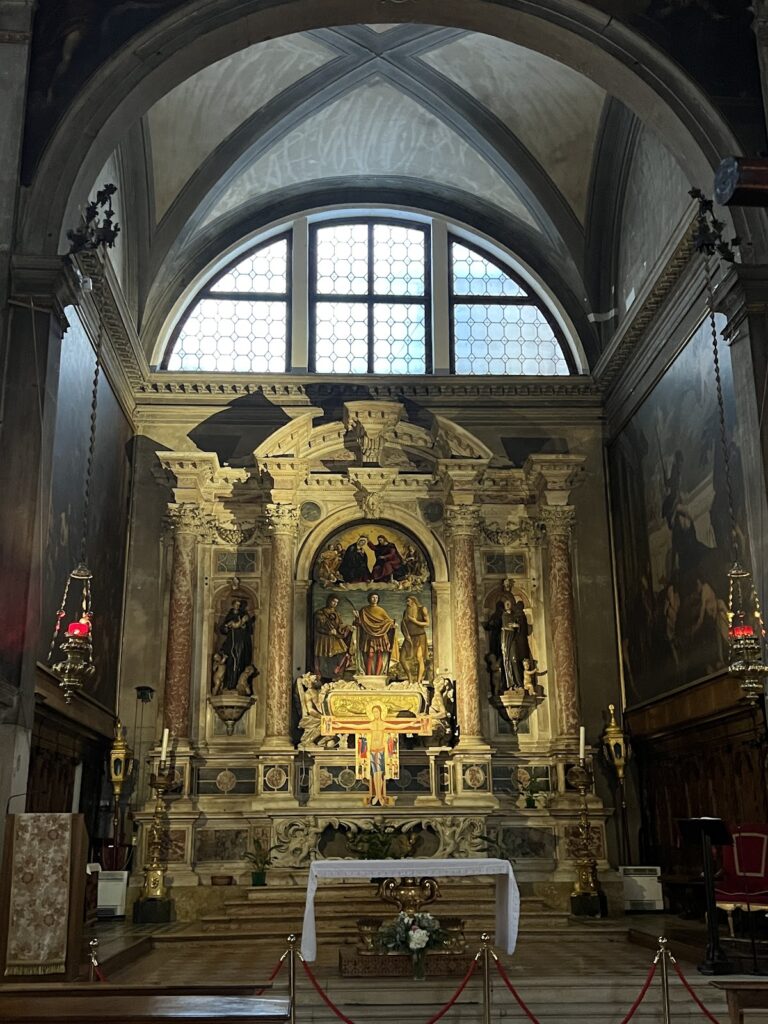
The apse has a substantial arrangement of Corinthian columns alternating with niches and windows. It contains three statues by Girolamo Campagna, Saint Sebastian, Saint Francis, and Saint Lawrence Giustiniani, dating from the late sixteenth or early seventeenth century. The statues were transferred from former fruit sellers’ altars and a nearby chapel.
A display case within the arch leading to the presbytery contains sacred furnishings and finely worked goldsmiths’ objects dating from the seventeenth to the nineteenth centuries. The ambons at the presbytery entrance are modern reconstructions. Two Renaissance Donà funerary urns face one another in the walls. The detached triumphal-arch high altar is partly the result of twentieth-century restoration, and its present marble tabernacle replaced an earlier one in the eighteenth century. The two seventeenth-century statues beside it came from the demolished church of Santa Marina.
On the rear wall of the presbytery is Giulia Lama’s 1710 altarpiece, The Virgin with Saints Mark and Magnus, also known as Allegory of the Church. The ceiling retains Antonio Molinari’s late-seventeenth-century Presentation to the Doge of the Brides Rescued from the Narentian Pirates. It is the only one of the large ceiling paintings to survive the 1916 bombardment.
Former Grimani chapel
The former Grimani patronal chapel was rebuilt at the end of the sixteenth century for Antonio Grimani, then bishop of Torcello. Its coffered apse basin has mosaics based on designs by Palma the Younger. The central scene is the Marriage of Mary and Joseph, surrounded by Prophets and Sibyls. Corinthian columns in multicolored marble frame the rear wall, which carries seventeenth-century statues of Saint Matthew and Saint James by an anonymous sculptor. The altar contains an anonymous sixteenth-century Madonna of Childbirth.
Chapel of the Blessed Sacrament
The chapel of the Blessed Sacrament contains a richly worked marble ciborium transferred from the church of Sant’Agnese. It includes a late-sixteenth-century Christ the Redeemer by Giulio del Moro with adoring angels. Other paintings show the Trinity; Tobias and the Angel; the Nativity of Mary; the Presentation of Jesus in the Temple; Christ mourned by Mary Magdalene and Saint John; Mary Magdalene Anointing Christ’s Feet in the House of Simon; Saint Anthony; the Sorrowful Virgin; Saint Jerome; and Saint Marina.
Transepts, side chapels, and counterfacade
Tonon memorials and later paintings
The transept walls display busts of Bartolomeo Tononi, Antonio Tononi, and Turrino Tononi. They are the surviving portions of the two large seventeenth-century Tonon monuments formerly installed in the main chapel. The bust of Antonio Tononi is associated with Giovanni Comin and Domenico Rossi, while Turrino Tononi’s bust was made by Comin.
Above a two-light window hangs Baldassare d’Anna’s early-seventeenth-century Approval of the Order of the Most Holy Trinity, or Ransom of the Slaves. Nearby is a nineteenth-century copy by Lattanzio Querena of a Virgin and Child by Sassoferrato.
Chapels toward the transept
The first chapel toward the transept contains Antonio Ermolao Paoletti’s triptych of approximately 1890, showing Saint Aloysius Gonzaga, Saint Simeon Showing Jesus, and Saint Anthony of Padua.
The second chapel formerly belonged to the fruit sellers’ guild. Its altarpiece, painted by Lattanzio Querena around 1830, represents the Sacred Heart of Mary, Saint Alphonsus Liguori, and Saint Aloysius Gonzaga. An anonymous sixteenth-century Venetian painting of the Capture of Christ in the Garden and Saint Marcellinus hangs on the left wall.
Madonna of Consolation and organ gallery
The altar left of the entrance holds the Madonna of Consolation, also called the Madonna of Lepanto, a Veneto-Cretan icon attributed to Nicolaus Safuris. Tradition says that the icon was on the galley of Sebastiano Venier during the Battle of Lepanto in 1571. Venier’s heirs later donated it to the church.
In the counterfacade, the organ stands above a marble choir gallery with polychrome inlay supported by four Ionic columns. The original organ was destroyed in the 1916 bombardment and replaced in the twentieth century. Nearby is Vincenzo Cappello’s tomb slab, decorated with the Lion of Saint Mark, the Cappello arms, and a naval battle scene.
Oratory
The oratory occupies the first floor above the sacristy. Its collection includes Madonnas and Child by Giandomenico Tiepolo, Giambettino Cignaroli, and Sassoferrato, together with Saint Peter the Apostle by Paolo Pagani.