Santa Maria della Fava, Venice: An Eighteenth-Century Baroque Church


Site at a Glance
- Rating
- 4.5
- Popularity
- Low
- Country
- Italy
- Primary era
- Early Modern
- External website
- Open
- Eras represented
- Early Modern
- Civilizations
- Venetian
- Site type
- Religious
- Remains
- Church
On this page17 sections
History
Santa Maria della Fava is an eighteenth-century Baroque Roman Catholic church in Venice, Italy, rebuilt for the Oratorians on the site of an earlier chapel. It stands in the Castello district near San Lio, Campo San Bartolomeo, and Rialto, and belongs to the Patriarchate of Venice. The present building reflects a long devotional history centered on an image of the Madonna of Consolation.
The Chapel of the Madonna of Consolation
The church originated with a devotional image displayed on a street wall near the homes of the Amadi family in the San Lio area. The image gained a reputation for miraculous powers, which the Venetian patriarch Maffeo Gherardi confirmed in 1480. On 10 November that year, Gherardi authorized Luigi Amadi and other patricians to build a chapel to house and protect it. He also appointed the descendants of the Amadi family as the image’s perpetual curators.
The chapel was completed around 1500. Although it was formally dedicated to Santa Maria della Consolazione, it became commonly known as Santa Maria della Fava, after the nearby bridge and campo. Several explanations have been proposed for the name, including bean cakes sold by a local bakery, the unloading of bean sacks from nearby barges, and an association with the Fava family of Ferrara.
Growth of the Sanctuary
Devotion to the image increased during the sixteenth century. On 2 July 1572, the chapel received permission to reserve the Eucharist in its tabernacle. On 12 May 1573, it was solemnly consecrated under the dedications of Santa Maria della Consolazione and the Visitation of Saint Elizabeth.
In 1622, Pope Gregory XV granted a plenary indulgence, the remission of punishment associated with forgiven sins under conditions established by the Catholic Church, to those who visited the chapel on the feast of the Visitation. During the seventeenth century, responsibility for the chapel shifted between the Procurators of Saint Mark and the Congregation of the Oratory of Saint Philip Neri. The Procurators held jurisdiction in 1662, before the chapel passed later in the century to the Oratorians, a Catholic community organized around communal religious and pastoral life rather than monastic vows.
The Eighteenth-Century Rebuilding
In 1701, the Oratorians obtained the doge’s permission to build a new church. The patriarch Gianalberto Badoer consecrated its cornerstone on 5 August 1705, and construction began according to designs by Antonio Gaspari. His plan drew on Roman architectural traditions and proposed an oval interior, a dome on a drum, and gently rounded interior corners.
The Oratorians rejected the proposed high dome over the nave and the campanili, or bell towers, intended to flank the façade. Work stopped in 1715, although the first Mass in the new building was celebrated on 11 December of that year. Side altars were added in 1725, probably following designs by Domenico Rossi. The original chapel was demolished in 1736 while worship continued in the new church, and its outline was marked in the pavement to retain the memory of the earlier sanctuary.
Giorgio Massari completed the church between 1750 and 1753, largely continuing Gaspari’s conception. He finished the apse, presbytery, dome, altars, and vaulting. The completed church was consecrated on 1 April 1753.
Relics and Later Religious Administration
The new church received relics rescued from Candia, the Venetian name for Crete, after the island was conquered by the Ottoman Empire. They included two fragments of the Cross of Christ, hairs attributed to the Virgin Mary, and a foot attributed to Saint Mamas, an early Christian martyr. The authenticity of the cross fragments was established by a fire test. In 1690, Doge Francesco Morosini gave the relics to his relative Regina Giustinian Morosini, who presented them to the church. Morosini gave the church a relic from Christ’s Crown of Thorns in 1693.
After the fall of the Venetian Republic in 1797, Napoleonic edicts suppressed the Oratorian congregation. The community was restored in 1821, but the Oratorians left Venice in 1912. On 16 June that year, the church and oratory passed to the Redemptorists, members of a Catholic congregation founded for pastoral and missionary work, especially among poorer communities. They continue to serve the church, particularly its Filipino congregation.
Remains
Exterior and Site Form
Façade
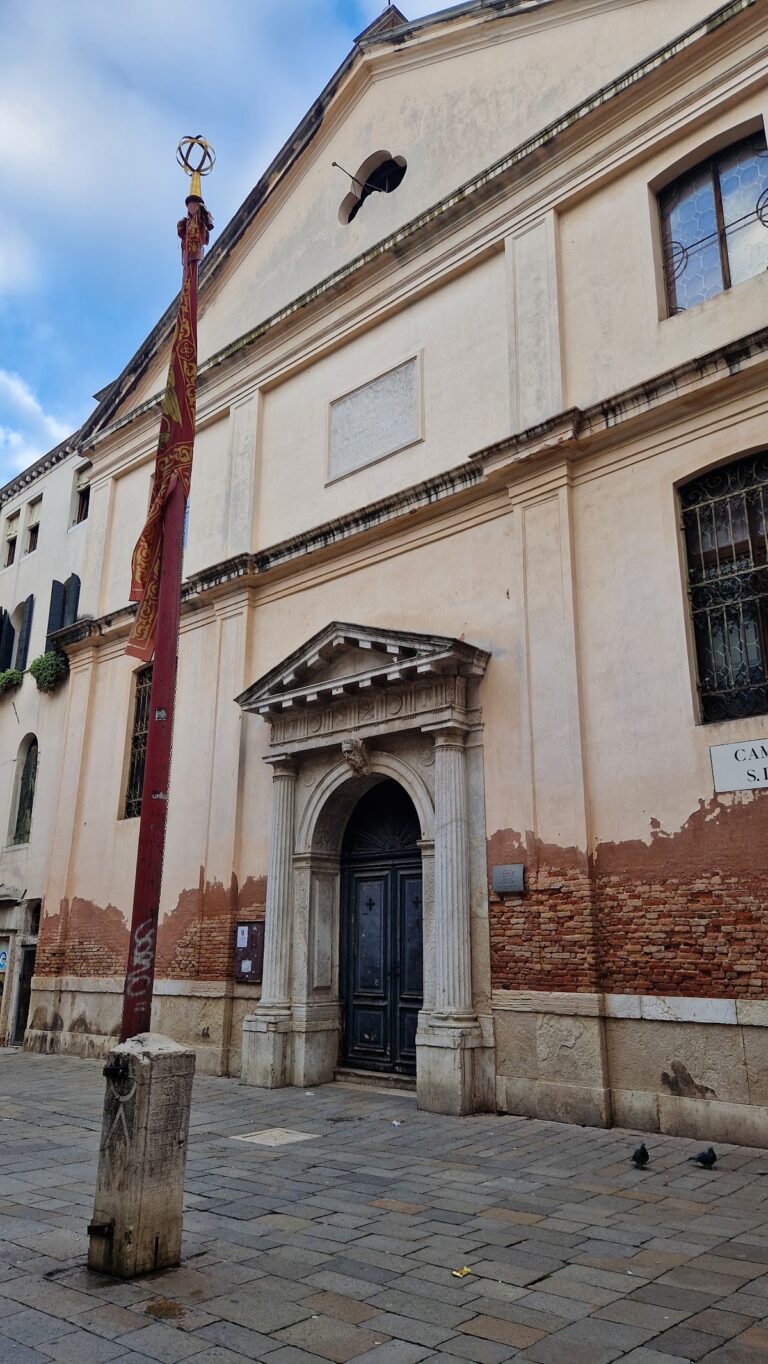
Santa Maria della Fava is a Baroque brick building with a single nave. Its principal façade faces west toward Campo della Fava and remains unfinished. A large doorway is crowned by a Baroque marble pediment bearing a shell motif associated with the Virgin Mary. Two broad semicircular niches flank the entrance and remain undecorated, contributing to the incomplete character of the exterior.
Bell Towers
Two tall bell towers stand beside the apse. They also remain unfinished, reflecting the unresolved development of the church’s exterior. Their position beside the apse forms part of the building’s intended external composition, even though the planned architectural work was not brought to completion.
Interior Architecture
Nave and Chapels
The interior is organized around a single nave covered by a barrel vault, a continuous semicircular ceiling, with lunettes, the crescent-shaped spaces formed where openings meet the vault. Three chapels open on each side of the nave. They are linked to one another and separated by wall sections carrying Corinthian pilasters. Eight statues of saints and Evangelists along the nave were carved by Giuseppe Bernardi, who was also probably responsible for reliefs showing episodes from the life of Saint Philip Neri.
Apse and High Altar
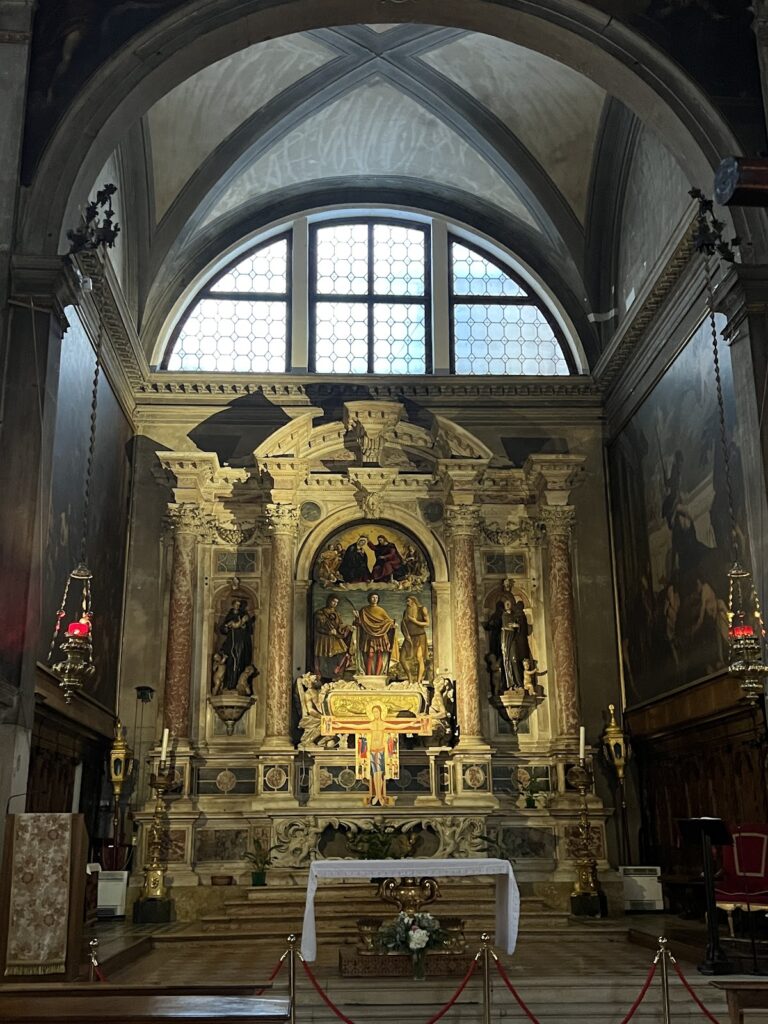
The rectangular-plan apse forms the terminal space behind the main altar and is covered by a domed vault. Its Baroque high altar contains a 1738 painting with biblical scenes and Eucharistic imagery, set within a frame of gilded copper and silver. The tabernacle, the container for consecrated Eucharistic elements, is decorated with small pieces of marble and flanked by two stone angels carved by Giovanni Maria Morlaiter.
Organ and Choir Gallery
A pipe organ installed in 1754 stands against the rear wall above the raised choir gallery. Pietro Nacchini built the instrument, whose organ front is enclosed in a wooden case with gilded decoration.
Nave Altars and Paintings
Altars on the First Side
The first nave altar contains Giovanni Battista Tiepolo’s Education of Mary, painted in 1732. It depicts Saint Anne with the young Virgin Mary and Saint Joachim. The second altar bears the dedication of Santa Maria della Fava, the name by which the church is now known. Its altar table carries a small fifteenth-century oil painting of Santa Maria della Consolazione by an unknown artist, while the altar also contains Jacopo Amigoni’s Visitation, painted in 1743.
The third altar on this side contains Giambettino Cignaroli’s Madonna and Child with Blessed Gregory Barbarigo, painted in 1761.
Altars on the Opposite Side
The first altar on the opposite side contains Jacopo Amigoni’s Madonna and Child with Saint Francis de Sales, also painted in 1743. The second holds Giovanni Battista Piazzetta’s Vision of Saint Philip Neri, also known as The Apparition of the Virgin to Saint Philip Neri. A related dating places the painting in 1726.
The third altar contains Gregorio Lazzarini’s Crucified Christ between the Virgin Mary, Saint John, and Mary Magdalene. Together with the paintings on the other altars, these works preserve the church’s connection with the late Baroque and eighteenth-century Venetian artistic world.
Footprint of the Earlier Chapel
Marble slabs in the pavement mark the footprint of the former Santa Maria della Consolazione chapel. The marked outline preserves the position of the structure demolished in 1736 and provides a physical reminder of the sanctuary that preceded the present church.