San Zulian: A Renaissance Church in Venice


Site at a Glance
- Rating
- 4.6
- Popularity
- Low
- Country
- Italy
- Primary era
- Early Modern
- External website
- Open
- Eras represented
- Medieval, Early Modern
- Civilizations
- Venetian
- Site type
- Religious
- Remains
- Church
On this page23 sections
History
San Zulian, formally the Church of Saint Julian the Martyr, is a Roman Catholic church in Venice, Italy, rebuilt in the Renaissance after a medieval history and dedicated to Saint Julian. It stands in the San Marco district, on the campo of the same name near the Mercerie, and belongs to the Patriarchate of Venice.
Medieval origins and jurisdiction
The church was probably founded before the eleventh century amid devotion to Eastern saints in the Upper Adriatic. Tradition places its foundation around 829, while the chronicle of Doge Andrea Dandolo, written in the mid-fourteenth century, gives the year 832. The first certain documentary evidence dates from 1061. Saint Julian was traditionally regarded as a Christian martyr associated with Basilissa, and the pair were said to have suffered martyrdom in the Thebaid between 302 and 304.
By the early twelfth century, San Zulian was subject to the special jurisdiction of the Basilica of San Marco and its primicerius, an ecclesiastical official, rather than to the Diocese of Castello. This separate arrangement continued after the Patriarchate of Venice was established in 1451. It ended in 1804, when the Marcian jurisdiction was suppressed and the chapters of San Marco and San Pietro di Castello were united.
The parish probably existed by the eleventh century, although its exact foundation is unknown. At the initiative of Doge Michele Steno and with the involvement of Pope Innocent VII, the parish benefice was divided by the early fifteenth century among seven capitular positions: a parish priest, four titular priests, a deacon, and a subdeacon.
Fire and medieval rebuilding
A major Venetian fire destroyed or severely damaged the church, after which it was rebuilt. The medieval reconstruction probably created a three-aisled building with a pointed bell tower crowned by a pyramidal roof. Jacopo de’ Barbari’s map of the early sixteenth century records this appearance. The medieval church was also associated with the patronage of the Balbi family during the dogeship of Pietro Centranico.
Renaissance reconstruction
By the mid-sixteenth century, the medieval building was in danger of collapse. In 1553, the Senate of the Venetian Republic authorized Tommaso Rangone of Ravenna, a physician and scholar, to rebuild the façade at his own expense and to place his funerary monument there. When the old roof collapsed during the work, the project expanded into a reconstruction of the entire church.
Rangone contributed substantially to the rebuilding in return for burial inside the new church. Jacopo Sansovino designed the façade, and Alessandro Vittoria completed it after Sansovino’s death in 1570. The reconstructed church was consecrated on 8 July 1580 by Giulio Superchio, bishop of Caorle. A bequest from Girolamo Vignola helped complete the ceiling.
The Chapel of the Blessed Sacrament was built between 1578 and 1583 under the patronage of its confraternity, a formally organized religious association. Its altar was supported by the confraternity of comb-makers, or peteneri, whose connection with the relics of Saint Paul the First Hermit was recorded on a gilded urn dated 1667. Paul of Thebes, also called Paul the First Hermit, was regarded in Christian tradition as an early desert ascetic and was also considered the protector of lantern-makers, or feraleri.
The Chapel of Saint John the Evangelist and Saint Charles Borromeo was assigned to Giuseppe Negroni during Patriarch Priuli’s pastoral visitation in 1593 and later became known as the Negroni Chapel. A confraternity established around its altar received relics of Saint Charles Borromeo in 1612. The saint was venerated there as a protector against plague.
Later alterations and ecclesiastical changes
The high altar was rebuilt in the seventeenth century, probably under the direction of Giuseppe Sardi, and completed in 1666. The earlier bell tower was demolished in 1775, and a replacement was built together with the lateral sacristies.
Napoleon’s decree of 5 June 1805 began the suppression and reorganization of Venetian parishes and religious institutions. San Giuliano parish was suppressed in 1807 and incorporated into Santissimo Salvatore, after which the church became filial. In 1810 it became a rectoral church, meaning that it was governed by a rector rather than serving as the independent seat of a parish. In 1967 it returned, with rectoral status, to the parish of Santissimo Salvatore. It is now an active rectoral church within the parish of Santissimo Salvatore and Santo Stefano.
San Zulian preserves relics associated with Saints Germanus the Martyr, Florian, and Paul of Thebes. Its paintings, sculpture, inscriptions, chapels, and furnishings bring together a substantial artistic program from the sixteenth and seventeenth centuries.
Remains
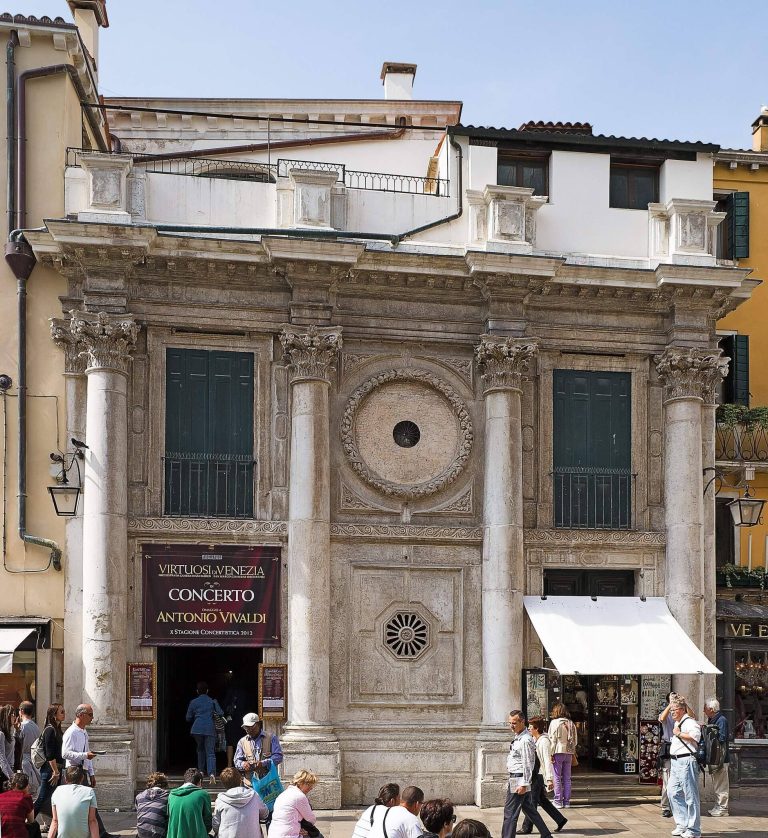
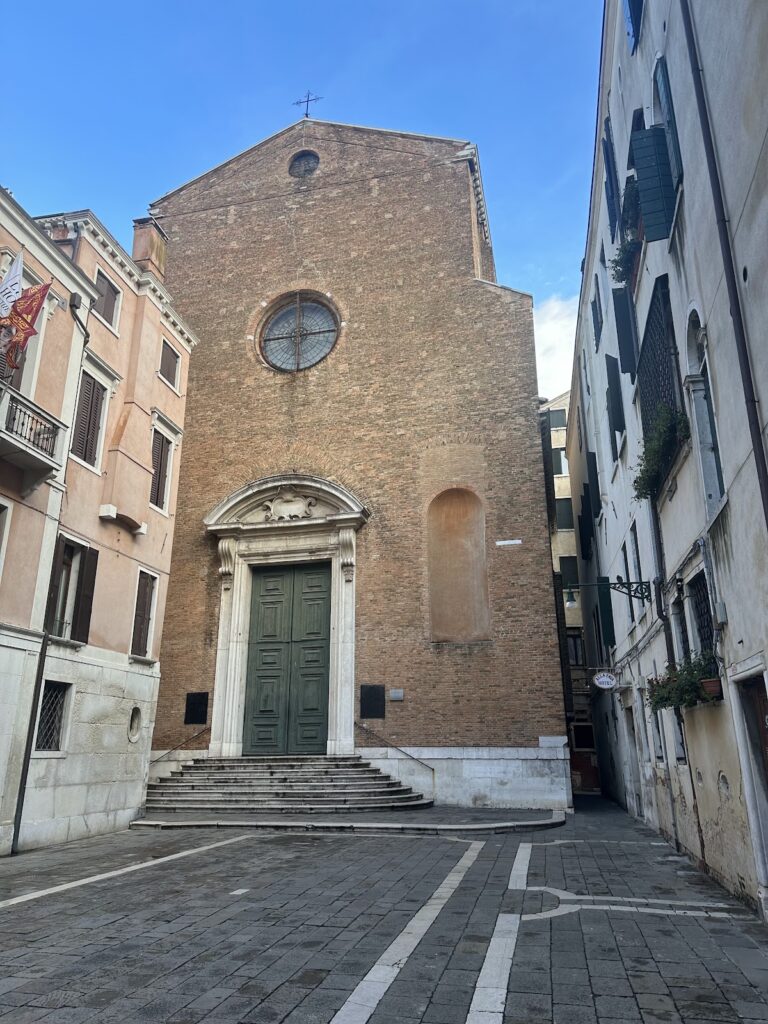
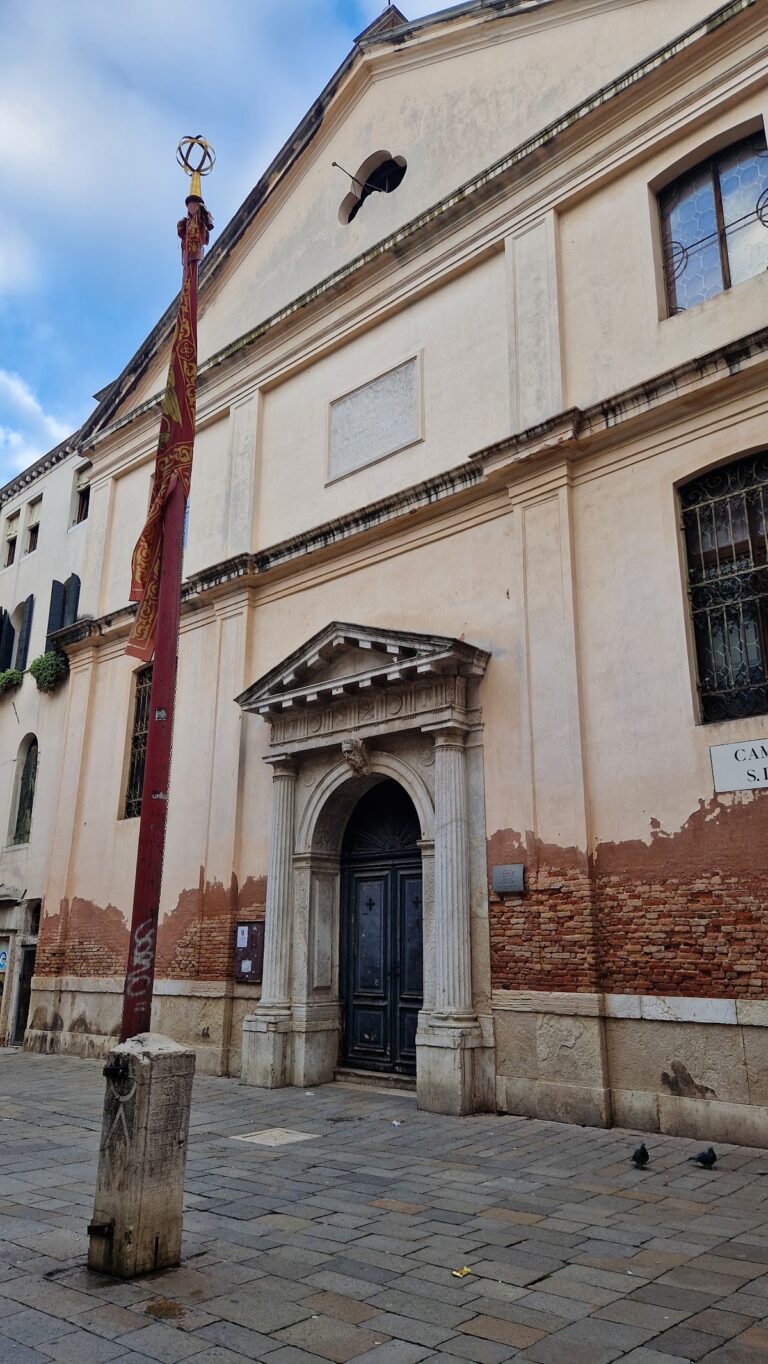
San Zulian is a Renaissance church built principally of brick, with a white façade of Istrian stone from Rovigno. The present interior has a single, nearly square nave in place of the three aisles probably belonging to the medieval church. A rectangular presbytery, the area around the principal altar reserved for the clergy, is covered by a cross vault and flanked by two small chapels. Two rows of similar windows light the nave, separated by a gilded wooden cornice dated 1587.
Façade and bell tower
Rangone’s commemorative façade
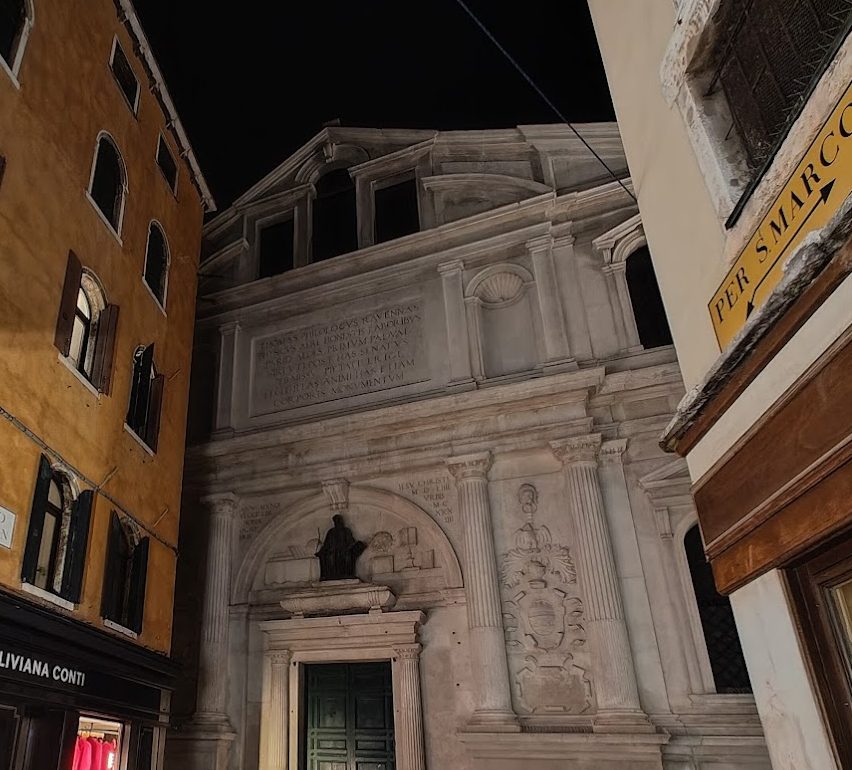
The façade was executed in two stages, beginning in 1553–1554 and continuing after 1566, in a collaboration associated with Jacopo Sansovino and Alessandro Vittoria. Its commemorative composition is arranged in two classical orders. The projecting center resembles a triumphal arch, with an entablature supported by paired columns on high bases and closed by an arch. A Latin memorial inscription occupies the upper part.
Tommaso Rangone’s bronze funerary monument dominates the main portal. He is shown seated on a funeral urn and wearing a doctoral robe. Completed by Alessandro Vittoria in 1570, the monument includes a globe, a horoscope displaying Rangone’s birth date of 18 August 1493 and the sign of Leo, and a book bearing the inscription DEUS HIQ.
Rangone is represented with sarsaparilla and guaiacum, New World plants that he used in treating syphilis and yellow fever. Reliefs also portray the world as it was understood at the time of his death. Three inscriptions contribute to the monument’s program: a Latin text giving biographical and legal information, a Greek text praising Rangone’s cultural achievements, and a Hebrew text recalling the possibility of realizing on earth the divine intention that a person might live to 120 years.
The later bell tower
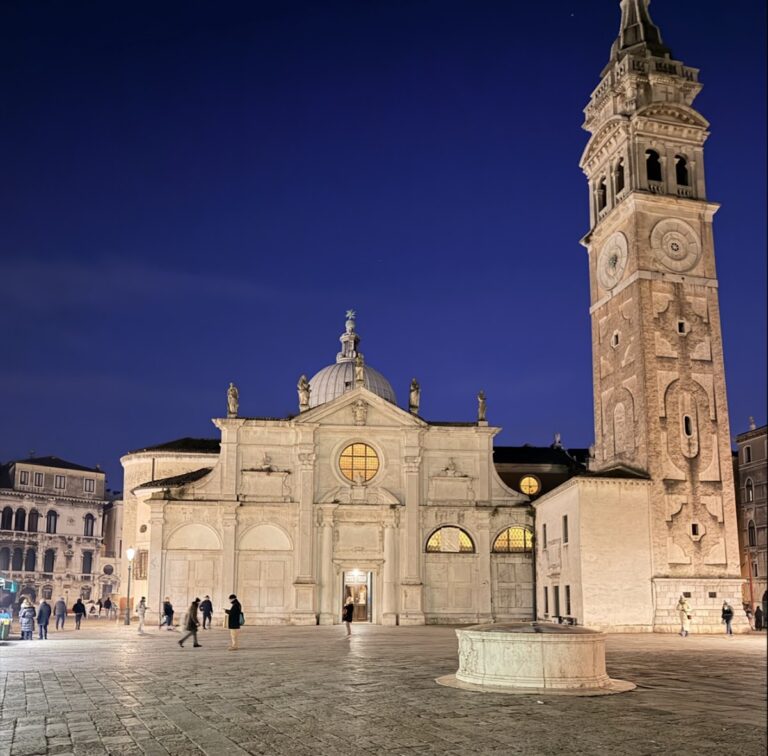
The present bell tower was built after the earlier tower was demolished in 1775. It rises directly from the church roof, an arrangement described as unique among Venetian bell towers. The earlier tower shown by Jacopo de’ Barbari probably had a pyramidal spire and four finials.
Presbytery and high altar
High altar and principal paintings
The main chapel is illuminated by a large thermal window, a semicircular-headed window. Its mid-seventeenth-century high altar, probably designed by Giuseppe Sardi, contains Girolamo da Santacroce’s signed altarpiece, The Coronation of the Virgin among Saints Julian, Florian, and Paul of Thebes. The painting belonged to the former medieval church and was documented by 1544.
An urn beneath the altarpiece contains relics of Saint Paul of Thebes, formerly arranged within a mannequin. Beneath the altar mensa are the relics of Saint Germanus the Martyr, brought from the Roman catacombs. Two seventeenth-century polychrome wooden statues of Saints Anthony and Francis stand in the side aedicules.
Choir stalls and Julian paintings
Walnut-root choir stalls from the early eighteenth century line the sides of the presbytery. Above them hang two large canvases by Antonio Zanchi, both dated 1674: The Martyrdom of Saint Julian on the right and The Passion of Saint Julian and His Companions on the left. Jacopo Palma the Younger’s Annunciation occupies the spandrels of the arch facing the nave.
Side chapels
Chapel of the Blessed Sacrament
The Chapel of the Blessed Sacrament contains an altar designed by Giovanni Antonio Rusconi and Girolamo Campagna’s sculptural Deposition, with a small figure of God the Father above the group. On the left is Jacopo Palma the Younger’s Arrest of Christ. Leonardo Corona’s Fall of the Manna occupies the upper-right lunette, while Paolo Veronese’s Last Supper, produced with workshop participation, is below it. Ottaviano Ridolfi executed the chapel’s stucco decoration.
Negroni Chapel
The Negroni Chapel is dedicated to Saint John the Evangelist and Saint Charles Borromeo. Giuseppe Negroni’s coat of arms appears on the keystone of the vault. Its paintings include Saint Charles Borromeo freeing a possessed person, attributed to the circle of Palma the Younger or to the Vicentino, and The Attempted Assassination of Saint Charles Borromeo, attributed to Odoardo Fialetti.
Jacopo Palma the Younger’s altarpiece depicts Saint John the Evangelist between Saint Joseph and Saint Anthony Abbot. A devotional roundel shows Saint Cajetan of Thiene and is attributed to Giovanni Battista Giacomello.
Nave altars and paintings
Passion cycle and former central doorway
The nave contains four principal side altars, two on each side, together with numerous canvases by artists of the Venetian school. A Passion cycle occupies the upper register, beginning with Leonardo Corona’s Entry into Jerusalem above the Negroni Chapel and continuing clockwise to Resurrection above the Chapel of the Blessed Sacrament. Other scenes include Giovanni Fiammingo’s Washing of the Feet and Agony in the Garden, Leonardo Corona’s Christ before Caiaphas, Flagellation, Crowning with Thorns, and Christ Condemned, Palma the Younger’s Ecce Homo, and Meeting with Veronica.
A former central doorway in the nave was closed to encourage devotion to Carlo Dolci’s The Sorrowful Virgin. Its richly decorated surround bears an inscription commemorating Girolamo Vignola, while Leandro Bassano’s Saint Jerome Penitent crowns the opening. Vignola’s simple tomb, covered by a black marble slab, stands at its base.
Altar of the Assumption
The altar of the Assumption belonged to the guild of mercers, or merciai, an occupational association. It contains Palma the Younger’s signed Assumption, dated 1583–1584. Alessandro Vittoria’s sculptural decoration includes the reliefs Glory of Saint Catherine, Nativity of the Virgin, and Martyrdom of Saint Daniel, together with statues of Saint Catherine of Alexandria and the prophet Daniel.
Altar of Saint James
The altar of Saint James the Apostle was established from 1573 by the guild of second-hand dealers, or strazzaroli. It passed to the devotional confraternity of the Sorrowful Virgin in 1855. Its sixteenth-century architectural frame contains Paolo Veronese’s Saint James between Saint Mark and Saint Jerome.
Two paintings by Odoardo Fialetti near the altar depict the saint’s miracles, Saint James Frees Hermogenes and Saint James and the Magician Hermogenes. On the opposite side are Sante Peranda’s Saint Roch Cures the Plague-Stricken and Saint Roch in Prison.
Altars by Campiello San Zulian
The side entrance facing Campiello San Zulian is flanked by two further altars. The former altar of the local small guild of Saints Roch and Nicholas, authorized in 1478 by the Council of Ten, now contains Boccaccio Boccaccino’s Madonna Enthroned with Four Saints, painted around 1510 and formerly associated with the guild of the Visitation, or the Valtellinesi. A twentieth-century Madonna and Child enclosed in a metal riza stands beneath it.
The other altar formerly belonged to Saint Roch and contains Vincenzo Guarana’s Heart of Jesus in Glory with Saints Roch, Sebastian, and Luigi Gonzaga. The nearby upper register includes further Passion scenes, among them Meeting with Veronica.
Ceiling, choir loft, and organ
Gilded coffered ceiling
The richly carved gilded wooden ceiling is divided into nine recessed panels, or coffers. Its large central cruciform panel contains Palma the Younger’s Glory of Saint Julian. The other eight panels contain allegorical figures of the theological and cardinal virtues together with Humility: Charity, Temperance, Prudence, Faith, Humility, Hope, Justice, and Fortitude.
The oval paintings are attributed to Leonardo Corona, while the rectangular panels appear to be by an anonymous collaborator of Corona or Palma. The central image is generally dated to 1588–1589, and the wooden ceiling itself is associated with Francesco Smeraldi and dated to 1579. Alessandro Vittoria is associated with the church’s stucco work.
Choir loft and organ
The counter-facade contains a substantial choir loft by Francesco Smeraldi and a Corinthian-style organ case holding Gaetano Callido’s organ, opus 12, dated 1764. Two holy-water basins occupy niches at the base of the loft. Its rear is decorated with Andrea Vicentino’s God the Father among Acclaiming Angels.