St. James’s Church: A Gothic Pilgrimage Church in Rothenburg ob der Tauber


Site at a Glance
- Rating
- 4.2
- Popularity
- Medium
- Country
- Germany
- Primary era
- Medieval
- External website
- Open
- Eras represented
- Medieval, Early Modern, Modern
- Civilizations
- Holy Roman Empire
- Site type
- Religious
- Remains
- Church
On this page12 sections
History
St. James’s Church is a Gothic parish church in Rothenburg ob der Tauber, Germany, built principally between the fourteenth and fifteenth centuries on a medieval pilgrimage route to Santiago de Compostela. Originally Roman Catholic, it is now an Evangelical-Lutheran parish church of the Evangelical-Lutheran Church in Bavaria and is dedicated to St. James the Greater, the apostle traditionally associated with the pilgrimage to Santiago.
Medieval construction
Rothenburg’s first parish church was a Romanesque building erected in 1270. Construction of the present church began in 1311 with the chancel, the eastern part containing the principal altar and clergy’s liturgical space. The east chancel was completed in 1322. After a pause in building, the nave rose between 1373 and 1436 on the site of the earlier Romanesque nave. The work followed designs by the Nuremberg masters Heinrich and Hans Staudigl and Konrad Eschenbach.
The western choir and Holy Blood Chapel were added between 1453 and 1471, bringing the principal medieval construction phase to completion. The church itself was completed in 1484 and consecrated in 1485 by the Bishop of Würzburg as a Roman Catholic church.
Altarpieces and religious change
The church’s furnishings developed alongside its late medieval architecture. The Twelve Apostles Altar was made in 1466, with paintings by Friedrich Herlin and sculptural work probably from the Ulm school under the influence of Hans Multscher. Its wooden corpus was made by the joiner Hans Waidenlich, and its design followed the altar at St. George’s Church in Nördlingen, probably created according to a design by Nikolaus Eseler the Elder.
The Holy Blood Altarpiece was commissioned by Rothenburg’s city council from Erhart Harschner in 1499. Tilman Riemenschneider, a leading late Gothic German wood sculptor and carver active in Würzburg, received the contract for the sculptural work on 15 April 1501. The shrine and reliquary cross were installed in the west choir on 8 May 1502, and the figures were completed by January 1505.
During the Peasants’ War of 1525, the insurgent peasants’ articles were read aloud in the church’s west choir by their leader Florian Geyer. Rothenburg adopted the Reformation in 1544, a sixteenth-century religious movement that led many churches in German territories to Protestant worship and organization. St. James’s subsequently became Lutheran.
After the Reformation, the Twelve Apostles Altar remained closed for an extended period, which probably helped preserve its interior. In 1582, Martin Greulich painted Passion scenes over its Catholic-looking images, while leaving the backgrounds of the two central panels untouched, including one depicting Rothenburg’s marketplace. The original paintings were restored in 1922.
Restoration and continuing use
A restoration supervised by the historian Carl Alexander Heideloff took place in 1852. More than a century later, comprehensive repairs and conservation were carried out from 2005 to 2011. The work began with the roof of the northern tower and was completed for celebrations marking the church’s 700th anniversary.
Remains
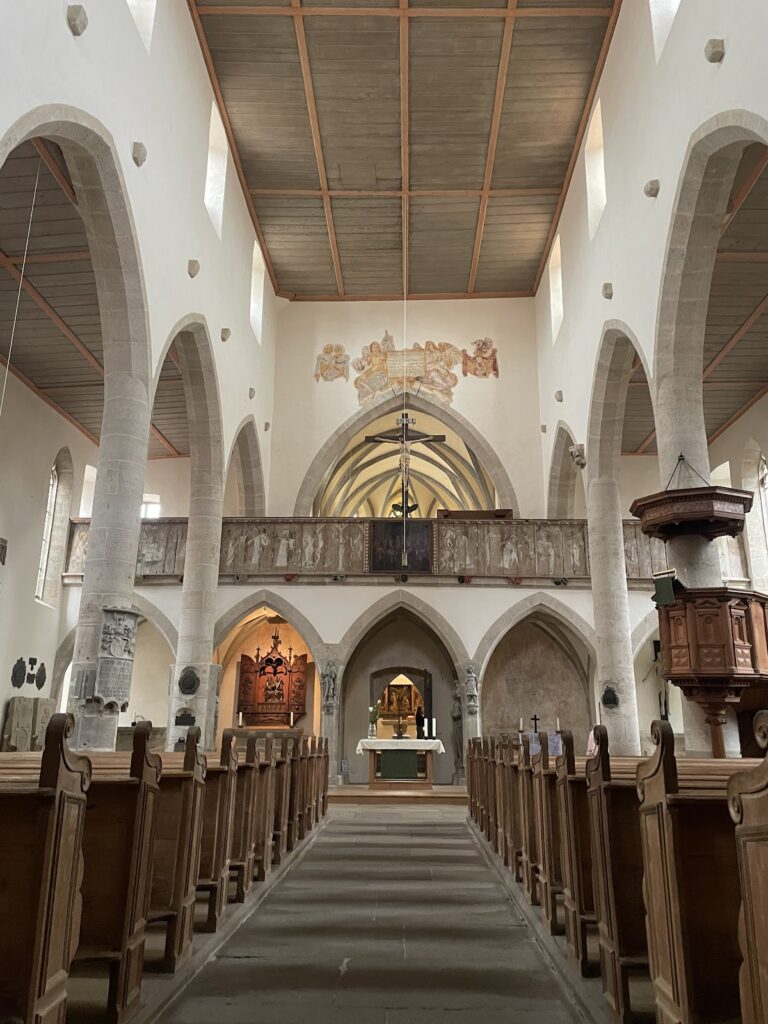
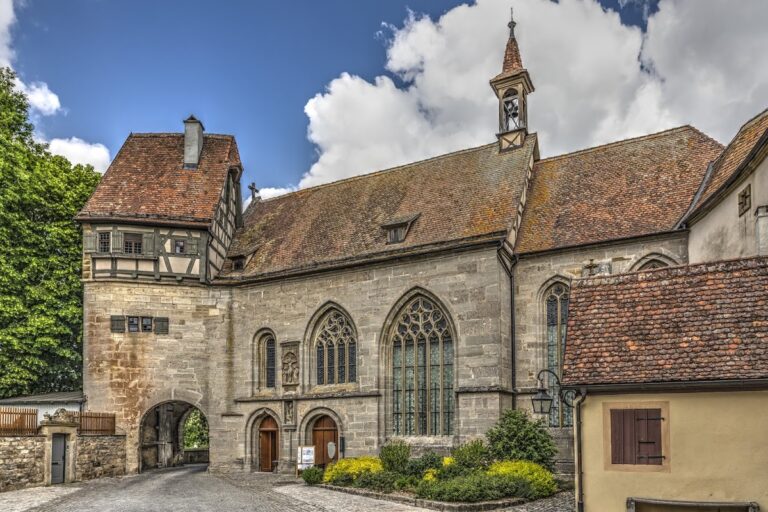
St. James’s Church is a three-nave Gothic basilica, meaning that its central nave rises above lower side aisles. Two towers of unequal height stand beside the chancel. The south tower reaches 55.2 metres and the north tower 57.7 metres, while the exterior has a comparatively plain appearance. At the west, the choir and Holy Blood Chapel extend across a street on a supporting arcade.
Towers and exterior sculpture
A local legend tells of a master builder and his apprentice competing to construct the higher tower. When the master’s south tower proved lower, he is said to have thrown himself from it, followed by his dog. A dog sculpture on the south tower is associated with this story.
Near the south tower, a sculptural group represents Christ praying in the Garden of Olives. It includes sleeping disciples, hunters, and an angel holding a chalice. The work was produced in two phases, dated to 1450 to 1460 and approximately 1500, and was restored around 1900.
Chancel and medieval glass
The tracery windows of the east chancel contain medieval stained-glass paintings. The oldest panels date from about 1350, while further sections date from about 1400. The left window presents scenes from the life of the Virgin Mary, the central window depicts Christ’s life and Passion, and the right window concerns Christ’s work of redemption and the sacraments.
Late Gothic altars
Twelve Apostles Altar
The Twelve Apostles Altar stands in the east chancel as a late Gothic winged altar, an altarpiece with side panels that open and close. Its carved central group shows the Crucifixion and saints, while painted wings, a predella beneath the main scenes, and paintings on the outer sides and back complete the structure. The principal figures include Christ on the cross and Saints Elizabeth, James, Mary, John the Evangelist, Leonard, and Anthony the Abbot. The back bears a view of Rothenburg dated 1466, described as the oldest depiction of the city, together with rare scenes of pilgrims connected with the legend of St. James and the Way of St. James.
Holy Blood Altarpiece
The Holy Blood Altarpiece stands on the western gallery. Riemenschneider carved it between 1500 and 1505 for a Holy Blood relic. Its scenes show Christ’s entry into Jerusalem on the heraldic right wing, the Last Supper in the shrine, and Christ praying on the Mount of Olives on the heraldic left wing.
A rock-crystal capsule, set in a reliquary cross dating from about 1270, holds the relic. A reliquary is a container made to preserve or display a religious relic. The relic is traditionally understood as a drop spilled from the chalice during the Last Supper that became Christ’s blood through transubstantiation.
The altarpiece has monochrome finishing, an openwork shrine, and finely carved reliefs. It was designed as a permanent, unchanging display, and its wings have no decoration on their weekday sides. Its lighting arrangement was innovative for its time. Judas occupies the central position rather than Jesus, and the two figures have notably similar facial features. The Judas figure can be removed, revealing the apostle John the Evangelist behind it, asleep with his head resting on his arms. When Judas is in place, he covers the gap between the shrine’s two relief blocks.
Other furnishings and music
Other furnishings include the Louis of Toulouse Altar, made by Tilman Riemenschneider with wings attributed to Jakob Mülholzer, and the Coronation of the Virgin Altar, whose sculptures come from several centuries, including the Riemenschneider school. A Neo-Gothic pulpit dates from 1854.
The great organ was built by Rieger Orgelbau of Vorarlberg in 1968. It has 69 stops, 108 ranks, and approximately 5,500 pipes, arranged behind two prospect facades. A four-manual main console stands at the front and a two-manual secondary console at the rear. Its playing action is mechanical and its stop action electric. The 2021 renovation and cleaning by Orgelbau Sandtner and Orgelbau Friedrich added a Heuss combination system and electric couplers alongside the mechanical couplers. The instrument also includes swell pedals for the Swell and Choir divisions, a carillon, and a cymbal star.
Bell peal
The two towers contain a six-bell peal. All six bells were cast locally in 1626 and 1627 by the Lorraine itinerant bell-founders Petrus Bulevilius and Caspar Delson.