St. Wolfgang: The Shepherds’ Church in Rothenburg ob der Tauber
Site at a Glance
- Rating
- 4.7
- Popularity
- Very Low
- Country
- Germany
- Primary era
- Medieval
- External website
- Open
- Eras represented
- Medieval, Early Modern
- Civilizations
- Holy Roman Empire
- Site type
- Religious
- Remains
- Fortified Church
On this page10 sections
History
St. Wolfgang is a late Gothic fortified church in Rothenburg ob der Tauber, Germany, built by the Shepherds’ Brotherhood between 1475 and 1493. Dedicated to Wolfgang of Regensburg, a tenth-century bishop and saint, it served as a place of worship for shepherds and reflected the importance of wool trading and sheep husbandry to the medieval town. The building is also known as the Shepherds’ Church.
The Shepherds’ Brotherhood
The brotherhood established the church as a religious centre for the shepherding community. Its members venerated St. Wolfgang as the protector of flocks, while St. Wendelin was regarded as the patron of shepherds and of their brotherhood. The church therefore combined the spiritual life of the shepherds with the occupational identity that had helped shape Rothenburg’s medieval economy.
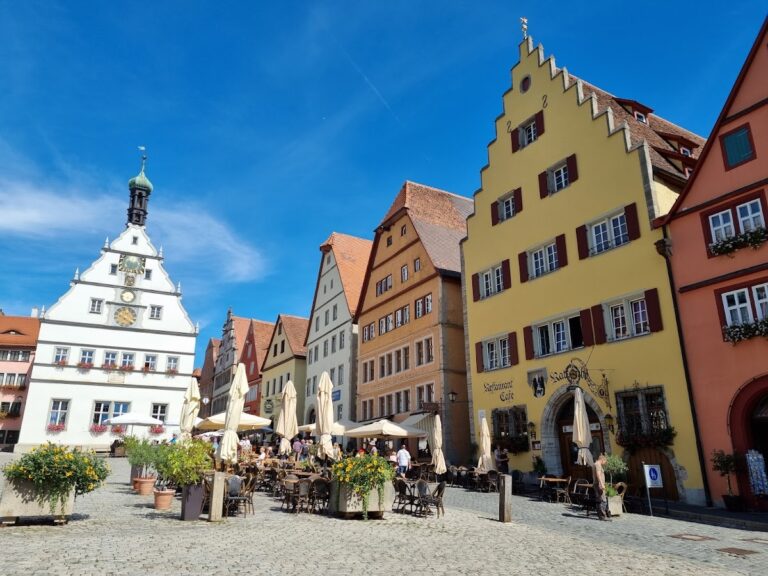
The brotherhood held an annual thanksgiving service on the Tuesday after St. Bartholomew’s Day. After worship, the shepherds gathered at the Lamb Inn on the market square to eat and dance. This custom provided a yearly meeting point for religious observance and communal celebration.
Living traditions and protection
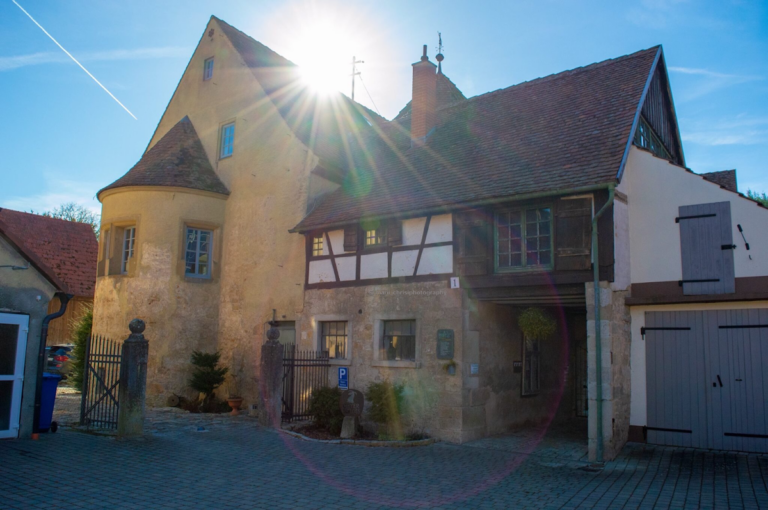
The Shepherds’ Dance tradition began in 1911 and has continued with performances several times a year. In 1986, a museum exhibition associated with the church opened in an adjoining structure. It presents objects connected with the dance and with sheep husbandry in Rothenburg, extending the church’s relationship with the town’s shepherding heritage into the modern period.
St. Wolfgang is now a protected Evangelical Lutheran church. It is listed as a protected architectural monument in the Bavarian Monument List under number D-5-71-193-341.
Remains
Fortified setting and exterior
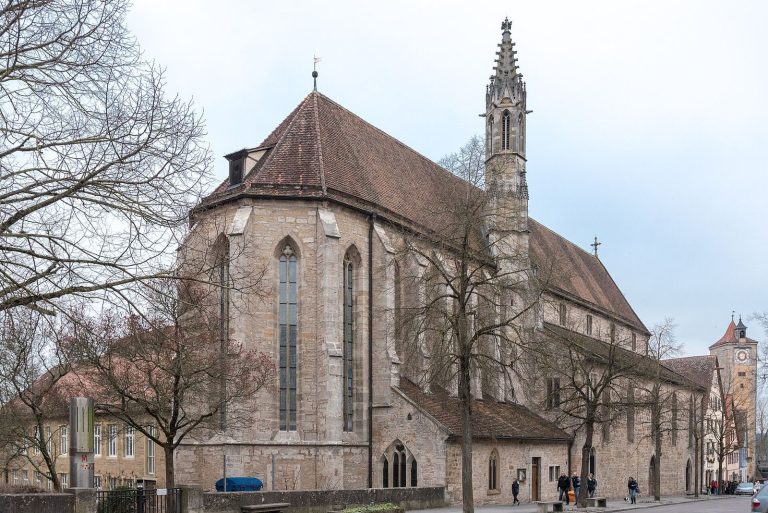
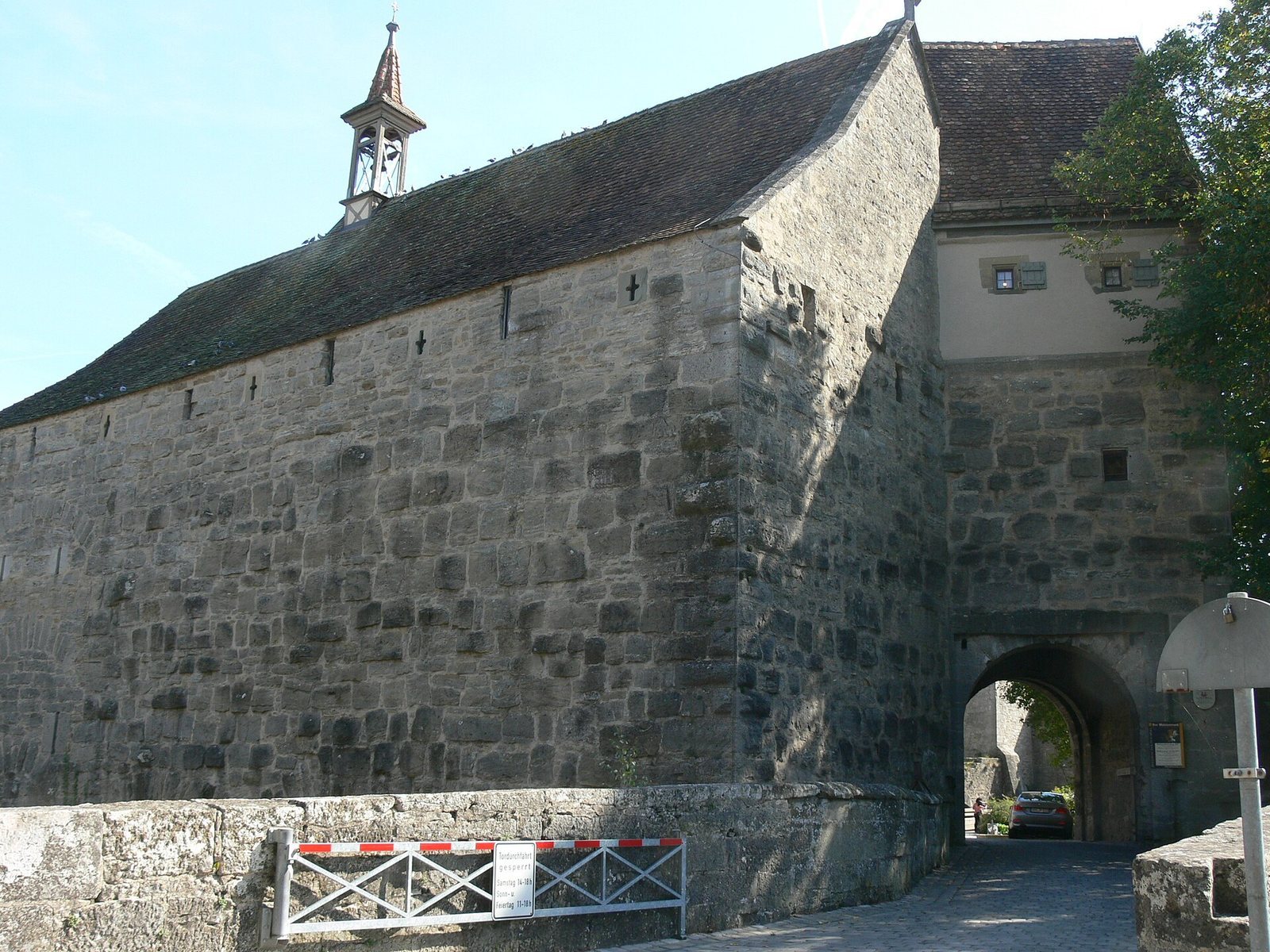
The church stands behind Klingentor at the Klingentorbastei, beside the Klingenturm. It was built above the bastion’s casemates, vaulted fortified chambers used for defensive positions or storage. A nearby arch provides a route towards the Tauber River. Together, the church and its setting form a building whose religious purpose is closely integrated with the town’s defensive works.
St. Wolfgang’s exterior has the heavy appearance of a fortification. Thick walls, loopholes, and a parapet wall with firing openings give the late Gothic church a defensive character. The building is an ashlar hall church, constructed from carefully cut stone blocks. Its nave and narrower choir are supported by buttresses, and the choir ends in a distinctive five-eighths polygonal termination, an east end formed from five sides of an imagined octagon.
Nave and choir
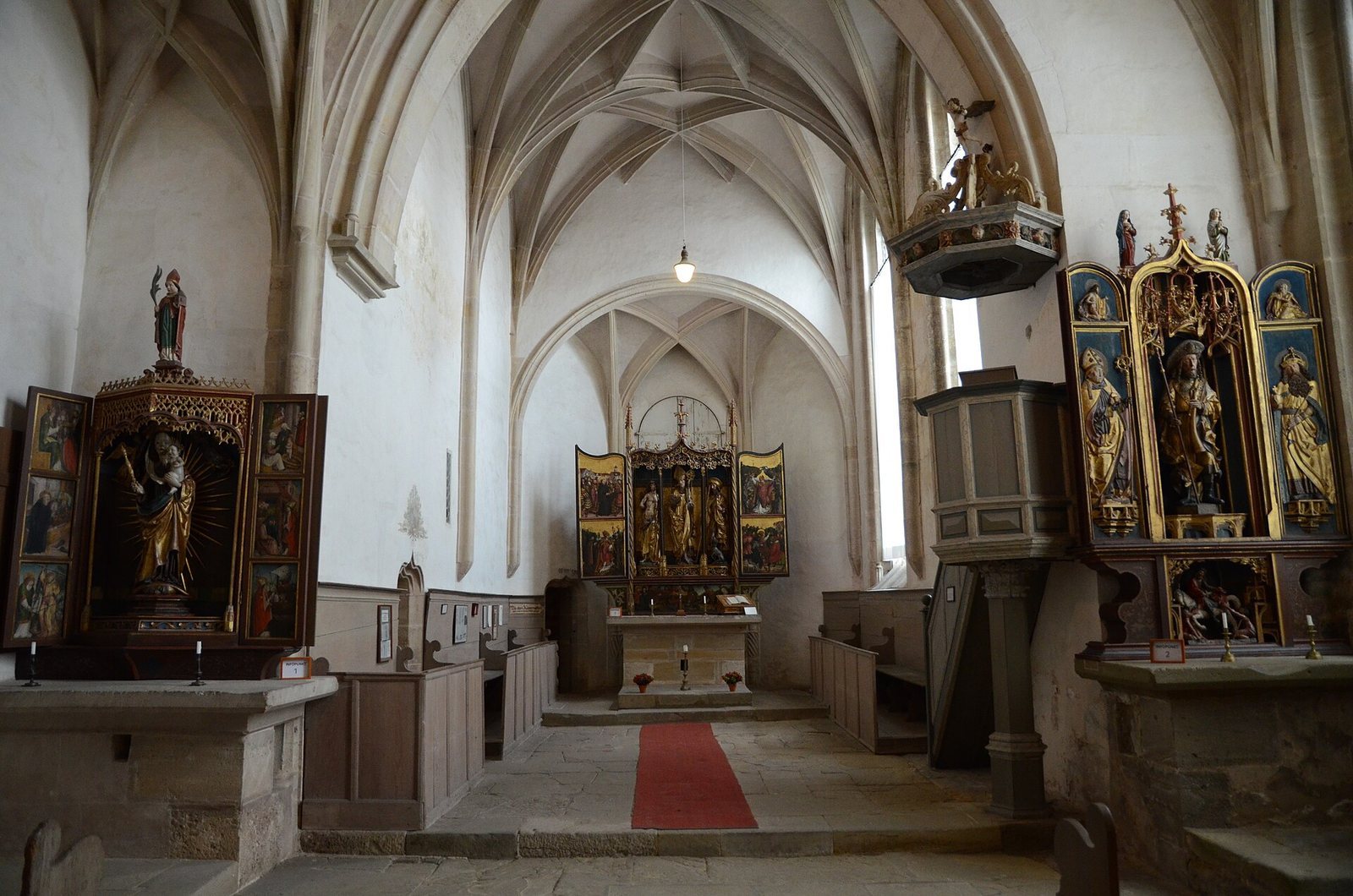
The nave is covered by a gabled roof. At its eastern end, a square roof turret rises above the building and houses a small church bell. Inside, the three bays of the nave have star vaults, a form of Gothic ribbed ceiling whose ribs create a star pattern. The two bays of the choir have net vaults, another ribbed form in which the intersecting ribs create a mesh-like design.
Sculpture and wall decoration
Between the two portals in the south wall of the nave, a niche contains a seated image of St. Wolfgang. Above it is a relief of the Crucifixion group. These features place the church’s patron and the central Christian scene of the Crucifixion directly within the exterior approach to the building.
High altar
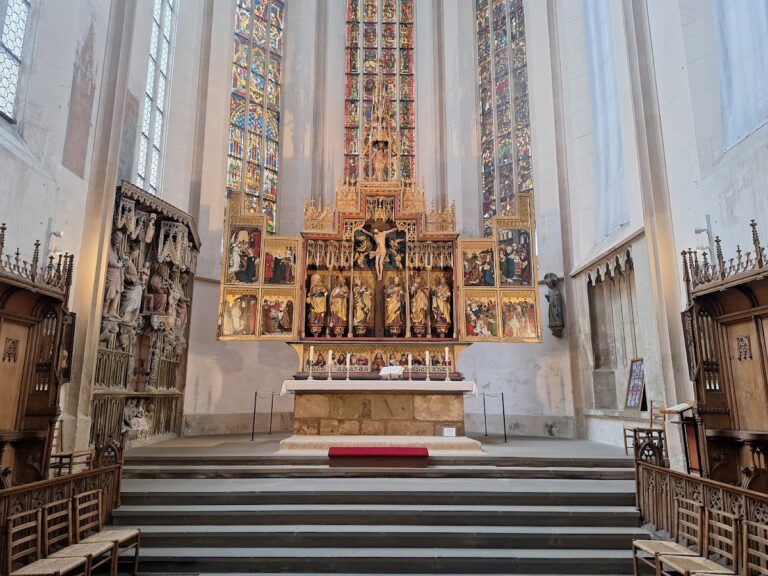
The choir contains a winged high altar made in 1514. A winged altarpiece has a central section with hinged painted or sculpted wings that can be opened or closed. Its central wooden figures show Wolfgang as a bishop, flanked by Sebastian and Rochus of Montpellier, saints commonly associated with protection against plague. Four paintings on the wings present episodes from Wolfgang’s life.
The lower section of the altar, called the predella, is richly figured. Its relief includes Jesus carrying the Cross, his captors, John, the two Marys, and Veronica. The paintings and reliefs are attributed to Wilhelm Ziegler.
Side altars
The north side contains the Marian altar, another winged altarpiece. Its central image shows the Madonna holding the Christ Child within a radiant aureole, while the wings depict episodes from the life of Mary.
Opposite it stands the altar dedicated to St. Wendelin. The saint carries a shepherd’s staff and a shepherd’s horn, but wears the shell-shaped hat associated with a pilgrim to Santiago. The Shepherds’ Brotherhood donated the altar, and its coat of arms appears at Wendelin’s feet. Two other saints flank the central figure, while additional images represent St. Nicholas and the Holy Roman Emperor Henry II, a medieval emperor and saint. The predella contains a relief of St. Martin on horseback sharing his cloak with a beggar.
Later interior features
A pulpit and a gallery were added in the second half of the seventeenth century. The church has survived to the present in its historic form, together with the adjoining Shepherds’ Dance Museum and the architectural features that connect its religious, communal, and defensive functions.