Burg Seldeneck: A Medieval Hill Castle in Germany


Site at a Glance
- Rating
- 4.8
- Popularity
- Very Low
- Country
- Germany
- Primary era
- Medieval
- Eras represented
- Medieval
- Civilizations
- Holy Roman Empire, Kingdom of Bohemia
- Site type
- Military
- Remains
- Castle
On this page8 sections
History
Burg Seldeneck is a thirteenth-century hill castle in Germany, near the Seldeneck hamlet in Blumweiler. Probably founded as a fief of John the Blind, King of Bohemia, it later became a jointly owned castle and a possession connected with the Burgraves of Nuremberg and the Imperial City of Rothenburg ob der Tauber.
Foundation and shared ownership
The castle was first named in 1265 and mentioned again in 1300. Since the ministerialis Heinrich I, a dependent noble official serving administrative or military functions, was not associated with Seldeneck until the middle of the thirteenth century, the fortress probably did not originate earlier. Its founder was probably the father of Götz, or Gottfried, von Hohenlohe, during Gottfried’s period.
Gottfried installed a branch of the Nordenberg family as castle men, retainers responsible for service and defense. This branch later adopted the name Seldeneck. It received shares in the castle, sold additional shares to Conrad and Arnold von Savensheim, the sons of Erkinger, and transferred another share to Kraft II. Seldeneck consequently became a ganerbenburg, a castle in which several families or lords held separate shares and rights.
The castle belonged to the Oberamt Mergentheim, a higher-level territorial administrative district. Its associated Adelgersmühle mill was first mentioned in 1341 but no longer survives. The family branch seated at Seldeneck died out in the male line in 1583. It was not the same family as the Barons of Seldeneck, a separate line created in 1777 for the children of the morganatic marriage between Margrave Wilhelm Ludwig of Baden-Durlach and Wilhelmine Christine Schortmann. In such a marriage, the spouse and children did not receive the higher partner’s dynastic or inheritance rights.
Transfer to Nuremberg and destruction
On 24 July 1344, Conrad von Seinsheim of Willanzheim sold all his rights in Seldeneck to Burgraves John II and Albrecht of Nuremberg. The transfer included land, serfs, associated villages and village shares, and hunting rights. Conrad had previously acquired the relevant portions from Götz von Hohenlohe and probably sold them to settle debts connected with an imperial ban imposed on him in April 1344. An imperial ban was a formal outlawry that removed legal protection and required others to enforce the sentence.
On the same day, Luppold von Seldeneck sold his share of the fortress to the two burgraves and was permitted to remain there as bailiff. Kraft von Gattenhofen was mentioned in 1347, while Ullrich Mörder and Eberwein von Seldeneck were named in 1368, probably as castle men. In 1379, Frederick V pledged Seldeneck together with the villages of Bernheim, possibly Burgbernheim, and Bergel. Cunz von Kirchberg served as bailiff in 1393, and his successor Adam von Kirchberg formally renounced his claims in 1414, by which time the castle had already been destroyed.
In the summer of 1404, ownership passed from Frederick I, Burgrave of Nuremberg, to the Imperial City of Rothenburg ob der Tauber. This was a city directly subject to the Holy Roman Emperor rather than to a local territorial lord. In 1407, Rothenburg joined the Marbach League in support of the deposed Wenceslaus of Luxembourg against King Rupert. Rupert responded by placing Rothenburg under an imperial ban and appointing the Burgraves of Nuremberg and Johann I von Egloffstein, Bishop of Würzburg, to enforce it. Rothenburg was not captured, but many surrounding castles were destroyed, and Seldeneck appears to have been destroyed during this campaign. Rothenburg’s chronicles nevertheless continued to record officials at the castle in 1418. The ruins were repaired in 1985.
Remains
Spur setting and defenses
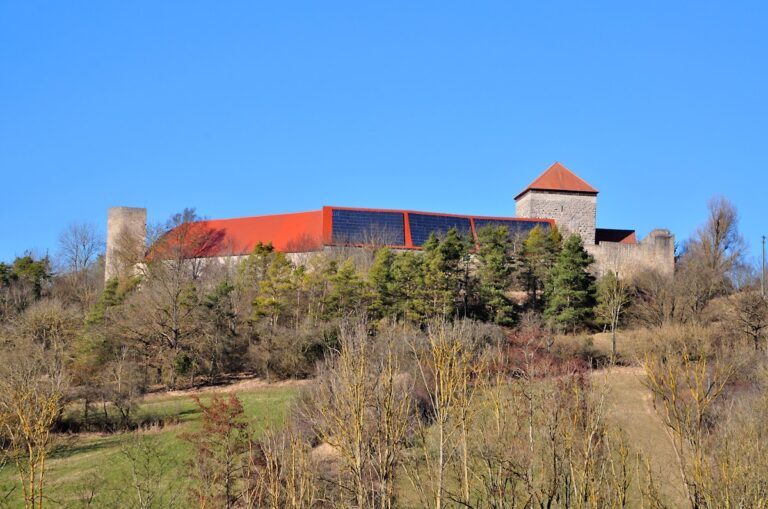
The ruin stands at about 392 metres above sea level on the tip of a valley spur near the Seldeneck hamlet in Blumweiler, at the eastern edge of Creglingen’s territory and close to the Baden-Württemberg-Bavaria border. The spur was shaped by the steep ravine of the short Ansbach and the Tauber River, with steep drops on three sides, including toward the Tauber Valley. The castle was therefore a spur castle. A moat protected its western side, facing the present hamlet. The hamlet probably functioned as an outwork, while individually preserved wall sections still allow the former course of the castle walls to be traced roughly.
Surviving building fragments
Building with loopholes
A long section of a building survives with loopholes, probably at ground-floor level, and an arched window on the first floor. On the interior side, bearing ledges for the higher floors remain clearly visible. These features preserve evidence of the building’s vertical arrangement and defensive function within the castle.
Pointed-arch window fragment
Nearby lies a broken-off building component containing the remains of two pointed-arch windows. It may have belonged to the palas, the principal residential or representative building of a medieval castle, or to a castle chapel. A wall section extending at a right angle from the longer building fragment has been partly restored, and additional wall sections and overgrown remains can still be discerned.
After the destruction of the castle, its other parts were robbed for stone. The castle hill later became wooded, restricting the view toward the Tauber Valley. During the Middle Ages, Rothenburg ob der Tauber could be seen from the castle.
Nearby sites