Franciscan Abbey, Rothenburg ob der Tauber: A Medieval Mendicant Church in Germany


Site at a Glance
- Rating
- 4.5
- Popularity
- Very Low
- Country
- Germany
- Primary era
- Medieval
- External website
- Open
- Eras represented
- Medieval
- Civilizations
- Holy Roman Empire
- Site type
- Religious
- Remains
- Church
On this page13 sections
History
Franciscan Abbey, Rothenburg ob der Tauber, is a former Franciscan friary and church in Germany, founded in 1281 and developed as an early High Gothic mendicant foundation. The friary was dedicated to the Virgin Mary and belonged to the Upper German, or Strasbourg, Franciscan province known as Argentina. Its church is now an Evangelical Lutheran parish church and is regarded as the oldest church in Rothenburg.
Foundation and medieval development
Hermann von Hornburg, Rothenburg’s Schultheiß, a municipal official with judicial and administrative authority, founded the friary with other supporters. He was later described as its first and principal founder. Franciscan friars had reached Germany in 1219 after being sent there by Francis of Assisi, the founder of the mendicant order. The Rothenburg house was the last of the town’s four principal mendicant orders to establish a presence there.
Local nobles, King Rudolf I of Germany, and the town treasury all contributed to the friary’s development. Its growing religious influence met opposition from the Teutonic Order, a medieval military-religious order, and its master Konrad von Feuchtwangen. Around 20 friars lived in the community. Their income came from alms, rents, tithes, interest, and service fees, while the friary controlled woodland and agricultural properties, including holdings worked by serfs.
The friary was closely connected to civic life. The town council sometimes held meetings there, and citizens stored valuables in its buildings. The community also took part in activities such as wine tasting. Around 1400, a group of Franciscan tertiaries, lay members associated with the order, lived temporarily at the friary before receiving a house of their own. The friars continued to provide the tertiaries with pastoral care and material assistance.
The Reformation and the end of the friary
In 1517, the Franciscan order divided between the stricter Observants and the less austere Conventuals, also called Minorites. The Rothenburg community joined the Conventual branch. Among its notable residents were the artist Martin Schwarz and the preacher Johann Schmidt.
The Reformation brought the friary’s decline. Several friars left voluntarily, while Johann Schmidt, a prominent advocate of Reformation ideas, was executed in the marketplace. Rothenburg formally adopted Luther’s teaching in 1544. Ownership passed to the town in 1548, and the two remaining friars then departed, effectively ending the friary as a religious community.
The former buildings were reused for a Latin school from 1559 to 1592, residences for priests’ widows, an armoury, a granary, and a salt office. After 1805, parts of the complex, including the cloister and refectory, were demolished. Much of the former friary’s contents was destroyed or sold.
Church, burials, and modern religious use
The church remained associated with Rothenburg and its inhabitants through these changes. It served as a burial place for civic patricians and nearby aristocratic families, including the Berlichingens, Beulndorfs, Brettheims, Hornburgs, and Kreglings. The tomb of the Swedish officer Perkhöffer was also located there. After the Thirty Years’ War, a plague killed more than 2,000 people in Rothenburg within three months, and many victims were buried in the friary cemetery.
The former friary church became the property of the Kingdom of Bavaria in the early nineteenth century. In 1871, its rights were transferred to the town’s St. James church community. Religious services, including Catholic services, continued during these institutional changes. On 6 May 1945, after American troops entered Rothenburg, the church hosted a Jewish service.
Restoration began in 1602. The choir and floor covering were renewed at the end of the nineteenth century. Twentieth-century work repaired the roof’s structural supports and installed heating to address severe damp, which in some areas reached 100 percent humidity. The surviving church now preserves the material history of the former friary and remains an Evangelical Lutheran parish church.
Remains
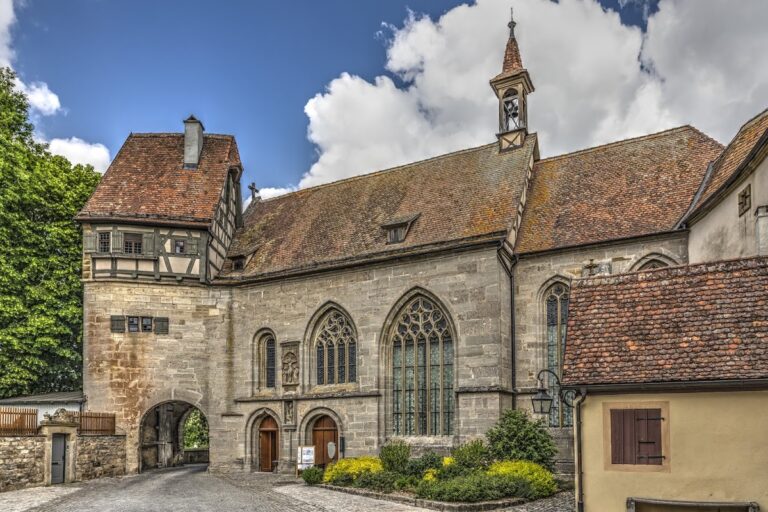
The surviving church is a three-aisled basilica with a flat-roofed nave and an elongated polygonal choir covered by a ribbed vault. A gabled roof, a small side tower, and a sacristy attached on the south complete the principal exterior form. The choir retains late Romanesque characteristics, while the building as a whole represents early High Gothic architecture. Its eastern wall meets the northern and southern walls at an oblique angle, allowing the church to follow an adjacent lane.
Church structure and interior
The church reflects the restrained architecture associated with the Franciscans. It has no freestanding tower, and vaulting is concentrated in the choir. The range of stained-glass motifs is limited. Projecting wall consoles remain visible, as does an upper level of the central nave that does not align perfectly with the building axes.
The church was built beside the cattle market on a site that contained a small chapel, a water source, and a lime tree. Construction began in 1282. The choir and high altar were consecrated on 29 May 1309 in the presence of Queen Margaret of Brabant by Bishop Philipp of Eichstätt, while a second choir consecration is recorded for 1333. The rest of the building was completed in 1337.
Rood screen and altars
Rood screen
A five-bay rood screen separates the nave from the choir. A rood screen is a substantial division between the clerical area and the space used by the congregation, often supporting preaching, readings, music, and devotional imagery. This screen extends across the full width of the nave and beyond the width of the choir. Fixed partitions divide it into screen chapels, and a doorway in the central bay provides access to the choir. The four side chapels each contained an altar or at least an altar table.
After the Reformation, the screen was retained as a gallery. Its wooden parapet carries imagery from a Passion cycle painted around 1370 to 1390, creating what was once described as a picture Bible. The Rothenburg Passion, added in 1494, is now preserved in the Reichsstadtmuseum, while copies occupy its former position. An image of the Last Supper from the early seventeenth century continued the screen’s devotional imagery. A small organ still stands on the gallery.
Altars and furnishings
Eight medieval altars are recorded. By the eighteenth century, five remained: the high altar dedicated to Mary and four altars in the screen chapels dedicated to Louis of Toulouse, Francis of Assisi, John, and Catherine. Fragments of the Louis and John altars were later transferred to St. James’s Church, while the other medieval altars were lost.
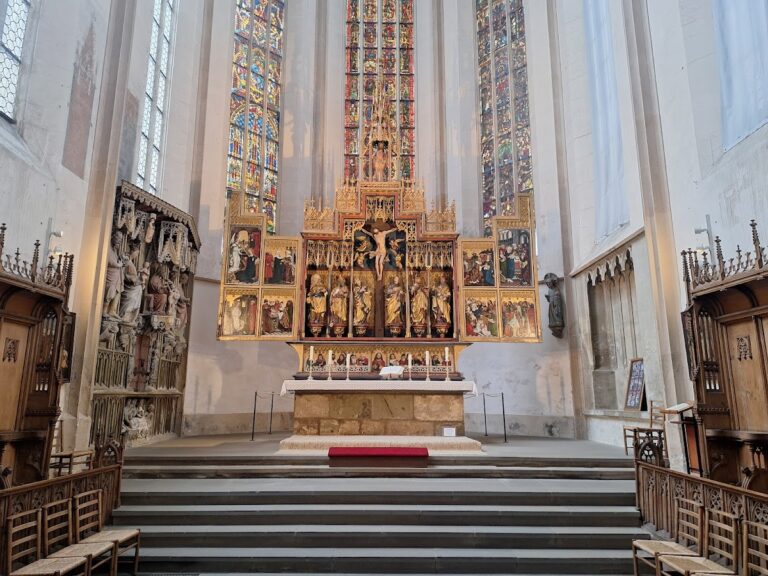
A late nineteenth-century high altar incorporates a late Gothic Trinity group from around 1500 and two reliefs dating from around 1560. It now stands beneath the arches of the rood screen as the second altar from the left. The church also contains a wooden choir bench from around 1380 and a pulpit dated 1560, both transferred from other churches in Rothenburg.
Francis Altar
Relief and attribution
The principal surviving artwork is the Francis Altar, made around 1480 to 1490 and restored in 1979. Its original position is uncertain, although it may have stood in a Francis chapel beside the cloister. During the twentieth century it was displayed in the nave in front of the centre of the rood screen before being moved to the former high-altar position.
The central relief shows the stigmatisation of Francis of Assisi, the miraculous appearance of marks corresponding to Christ’s wounds. Francis kneels while Brother Leo sits nearby, and the mountain landscape of La Verna, the Italian sanctuary associated with the event, appears behind them. The angel or seraph expected above Francis is missing. It may have belonged to a lost upper structure, been represented by a seraphic crucifix within the relief, or been supplied by a nearby crucifix.
The altar’s attribution remains disputed. Most art historians connect it with the workshop of Tilman Riemenschneider, a major German late Gothic sculptor active around Würzburg, or regard it as an early work by Riemenschneider himself.
Painted wings and predella
The painted wings and the relief’s coloured finish are attributed to Brother Martin Schwarz, an artist associated with the friary. The wings are mounted in reverse. Their inner sides, now facing outward, depict the beheading of the first Franciscan martyrs by the Sultan of Morocco. The better-preserved lower portions of the other sides show Pope Honorius III confirming the Franciscan Rule and Francis preaching to animals or birds.
A predella, the decorated base of an altarpiece, was probably attached to the altar in the early 1870s. It came from the John Altar and is attributed to Jakob Mülholzer. Its imagery shows the Holy Family and the donor family von Eyb adoring the Christ Child.
Burials, inscriptions, and organs
The church contains numerous burials. The first recorded burial took place in 1285, while construction was still underway, and the last dates from 1789. A double tomb for Hans von Peulendorf and his wife Margareta stands beside a pillar near the rood screen. Further burials are commemorated by numerous epitaphs on the walls. The interior walls were originally painted red and now display seventeenth- and eighteenth-century family coats of arms, fifteenth-century and later carved tomb slabs, epitaphs, and surviving sculptures of the Virgin Mary and Saint Liborius.
The first recorded organ stood south of the rood screen in the form of a swallow’s-nest organ and was moved to St. James’s Church at the end of the sixteenth century. A second organ, built in 1693, has not survived. The present organ was built in 1889 as Opus 12 by the Nuremberg organ builder Johannes Strebel. It has 14 stops, two manuals, and a pedal, and was restored by Orgelbau Sandtner in 1992.
Nearby sites