Klosterkirche St. Annen: Franciscan Convent Church and Sacred Art Museum in Kamenz


Site at a Glance
- Rating
- 4.8
- Popularity
- Very Low
- Country
- Germany
- Primary era
- Early Modern
- External website
- Open
- Eras represented
- Medieval, Early Modern, Modern
- Civilizations
- Holy Roman Empire, Kingdom of Bohemia
- Site type
- Religious
- Remains
- Church
On this page11 sections
History
Klosterkirche St. Annen is a former Franciscan convent church in Kamenz, Germany, founded in the late Gothic period for the Franciscans of the Strict Observance. Its foundation stone was laid on 20 May 1493, after the Kamenz council abandoned its long opposition to King Vladislav II of Bohemia’s plan to establish the reform branch of the Franciscan Order in the town. The foundation was the last Franciscan establishment in the lands of the Bohemian Crown, and its first friars came from Bechin in southern Bohemia.
Foundation and growth of the convent
The Upper Lusatian governor, or Landvogt, Sigismund von Wartenberg laid the monastery’s foundation stone. At his initiative, visitors received an indulgence valid for 1,200 days, while guilds and citizen families supported the convent by endowing numerous altars. This support helped the foundation develop despite the council’s initially hostile attitude.
The council assigned the friars a site beyond Kamenz’s northern walls. The convent consequently had to provide its own defenses and connect its buildings with the town’s fortifications. An outer wall was built around the monastery. In 1518, the friars acquired a house against the inner wall and replaced it with a monastery gate, creating a protected entrance into the town. The legal arrangements concerning the walls were settled in 1521.
The convent received relics of Saint Anne from Prague in 1512, and the church was placed under her patronage. In 1518, King Louis II, the successor of Vladislav II as king of Bohemia and Hungary, expanded the monastery’s privileges. The construction history of the church remains difficult to establish in detail. A shift in the building’s axis and a bend between the choir and nave indicate that these parts were not built at the same time. The date 1512 on the triumphal arch suggests that the nave may have been completed by then. On the basis of masons’ marks, Cornelius Gurlitt attributed the work to Wolf Rüdinger, while Georg Dehio assigned it to Wolff Hrabisch.
Reformation and municipal use
Johannes Ludwig delivered Kamenz’s first Protestant sermon in 1527, and the council ordered the definitive introduction of the Reformation in 1536. The Franciscan convent nevertheless remained a Catholic stronghold for some time. The friar Matthes Rudolph, later remembered in legend as the “clever monk,” was said to have won increasing numbers of people back to the older Catholic teaching. His activity led to complaints from the council.
The last Franciscan left in 1564. Johann Leisentrit, a Catholic church administrator and religious leader in Lusatia, then transferred the church and convent buildings to the city, despite the explicit opposition of the Bechin mother monastery. The agreement required Mass to be celebrated in the church according to a Wendish rite, a school to be established in the former convent buildings, and the altars, holy images, vestments, and chalices to be protected from secularization.
A municipal Latin school was subsequently established in the former convent buildings. It was later attended by Gotthold Ephraim Lessing, the eighteenth-century German Enlightenment writer and dramatist. The school library was kept in the former garden chapel. The church also became the setting for Sorbian-language Protestant worship, which had previously taken place in the Catechism Church, and it became known as the Wendish Church.
Fire, reconstruction, and renewed use
A gallery was installed in 1672. Fires in 1707 and 1842 destroyed large parts of Kamenz and the convent buildings, while leaving the church’s interior furnishings largely unharmed. The 1842 fire was followed by a complete redesign of the interior. Many furnishings were removed and were not returned until 1911. The rebuilding introduced new seating, a pulpit, a west gallery, and a new organ. The south-side windows were opened during the work, destroying a medieval wall painting. A bell structure was also erected above the west gable, with the architect and architectural theorist Gottfried Semper involved in its planning.
In the modern period, the church hosted worship, concerts, exhibitions, ecumenical services, and school services. Until the beginning of the twenty-first century, it functioned chiefly as a concert and exhibition venue while continuing to accommodate special services. In December 2009, the parish and the city of Kamenz concluded a 50-year cooperation agreement concerning the building’s use and transformation. The work was completed in August 2011.
Since August 2011, the building has served both as a church and as the Klosterkirche and St. Annen Sacred Art Museum. The museum presents religious artworks from Kamenz’s churches and interprets themes including the Franciscans, donors, the veneration of saints, and the Reformation. It also hosts exhibitions of art and cultural history, including contemporary art. A restrained modern extension accommodates the tourist information office and supports the church and museum. In 2014, the cooperation between parish and municipality, the relationship between historic and contemporary architecture, and the presentation of the late Gothic altarpieces and other furnishings received the first prize of the Foundation for the Preservation of Church Monuments in Germany.
Klosterkirche St. Annen, together with the late Gothic winged altarpieces of St. Mary and St. Just, forms a double station with the nearby St. Marienstern monastery on the Via Sacra. This cultural route connects historically important churches, monasteries, buildings, and works of art in Upper Lusatia, Lower Silesia, and northern Bohemia.
Remains
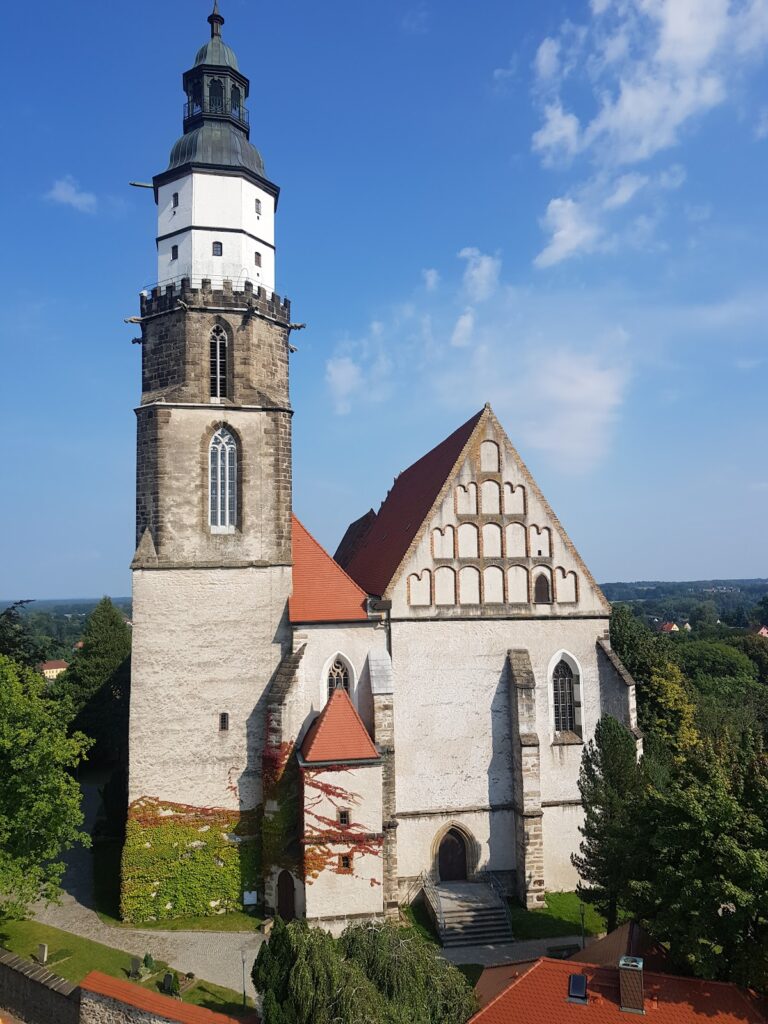
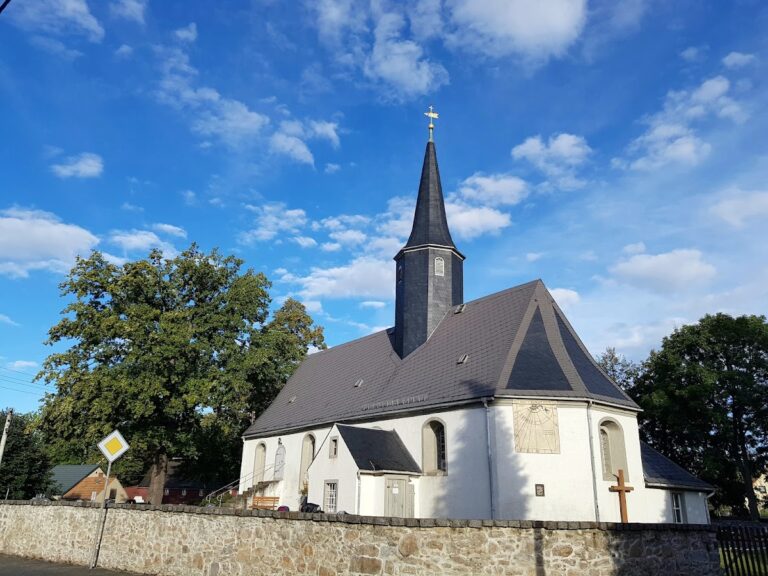
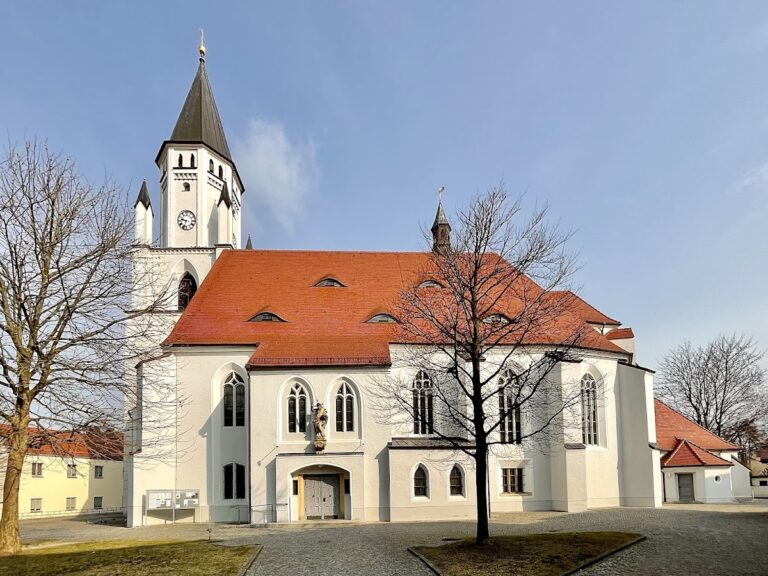
The former convent stood outside Kamenz’s medieval walls, but the convent buildings and outer fortifications no longer survive. The church now stands separately as a towerless hall church with a steep gabled roof. Built of rubble stone and covered with plaster, it has brickwork decoration on the east and west gables of the nave. Inside, the building forms a bright, spacious three-aisled hall of four bays. Six octagonal sandstone piers carry the regular parallel-ribbed vault. A triumphal arch leads to the three-bay choir, which ends in a three-eighths termination and is also vaulted.
Paintings and late Gothic furnishings
Altarpieces and religious artworks
Five late Gothic carved winged altarpieces dominate the interior, joined by figures from altars that no longer survive. Their presentation beneath the Gothic ribbed vault gives the church an unusually rich body of medieval furnishings for a building in a town of Kamenz’s size, particularly in view of its later Protestant use. The Marienkrönungsaltar, originally made for Klosterkirche St. Annen, now serves as the high altar of the funerary church of St. Just.
The church and museum also present a reliquary altarpiece dating from around 1400, a “Bornkindl” from the period of Martin Luther, and Wolfgang Krodel’s painted pair Law and Grace from 1542. Krodel was a pupil of Lucas Cranach the Elder, and the two paintings address the Crucifixion of Jesus.
Wall paintings
Areas of the original medieval decoration survive on the choral vault. Parts of these paintings were uncovered in 2003 and fully exposed during the interior renovation of 2009. Missing sections of the paint layers were selectively retouched. A depiction of Saint Anne with the Virgin Mary and the Christ Child at the triumphal arch dates from 1512. It is a secco painting, meaning that it was applied to dry plaster rather than fresh plaster, and it was renewed in 2010 after being discovered during restoration. The motif presents Saint Anne with Mary and the infant Christ, identifying her as Mary’s mother and Christ’s grandmother.
Organ and bell structure
Mende organ
The church received a 26-stop organ by Johann Gottlob Mende in 1849–1850. It was Mende’s final work; he died on 14 August 1850. The instrument was restored in 1994. In 1891, it received the Aeoline 8-foot stop, also called Fugara 8-foot, from the former Schurig organ of Kamenz’s principal church, St. Mary. The electoral Saxon coat of arms with two lions from the old organ case of St. Mary was moved to the organ gallery at St. Annen.
Bell installation
The bell installation consists of one bronze bell suspended from a wooden bell yoke in the bell gable above the west gable. Together with the historic vaults, paintings, altarpieces, and organ, it forms part of the church’s surviving material record, which is now presented alongside changing museum exhibitions in the historic interior.