St. Walburg Abbey: A Benedictine Nuns’ Monastery in Eichstätt


Site at a Glance
- Rating
- 4.7
- Popularity
- Low
- Country
- Germany
- Primary era
- Early Modern
- External website
- Open
- Eras represented
- Early Modern
- Civilizations
- Holy Roman Empire
- Site type
- Religious
- Remains
- Monastery
On this page17 sections
History
St. Walburg Abbey is a Benedictine nuns’ monastery in Eichstätt, Germany, dedicated to Saint Walburga, an eighth-century Christian missionary and abbess associated with Heidenheim. Its history began with the arrival of her relics between 870 and 879, and the present church emerged during the early Baroque period in the seventeenth century.
Relics and Early Religious Community
Saint Walburga died in 779. Between 870 and 879, during the episcopate of Bishop Otgar of Eichstätt, her relics were transferred from her monastery at Heidenheim am Hahnenkamm to Eichstätt. They were placed in a small Chapel of the Cross, which soon became known as the Chapel of Saint Walburga. Canonesses, women belonging to a religious community organized around shared worship and institutional life, later settled at the site.
On 24 June 1035, Liutger, also known as Leodegar, Count of Lechsgmünd and Graisbach, founded a Benedictine nuns’ monastery at the request of Bishop Heribert of Eichstätt. His niece Imma became its first abbess. The foundation endowment included properties in Böhmfeld, Pietenfeld, Dietfurt, Rehlingen, Langenaltheim, Sulzdorf, and Gempfing near Rain.
Reform and Noble Foundations
Under Bishop Johann III of Eych, who held office from 1445 to 1464, the monastery underwent reform after prolonged resistance. The changes followed the reforming debates associated with the Councils of Constance and Basel, major fifteenth-century church councils concerned with the regulation and renewal of religious institutions. By this period, St. Walburg had become a sought-after institution for the provision and care of noblewomen.
The monastery also developed a parish role. The origins of the parish of St. Walburg are uncertain, although the names of its priests have been recorded since the beginning of the thirteenth century. The Mariahilf Chapel was built near the monastery in 1465 as a subsidiary church, while the parish cemetery was moved westward to the Chapel of Saint Michael in 1534.
War, Reconstruction, and Secularization
Swedish forces burned almost all the buildings in the Walburg parish district in 1634 during the Thirty Years’ War, the European conflict fought from 1618 to 1648. The destruction included most of the monastery buildings and followed the plundering of the newly built church. The complex was rebuilt during the Baroque period, with work to complete and restore the church resuming in 1664 and continuing into the eighteenth century.
When the Prince-Bishopric of Eichstätt passed to Bavaria in 1806, the monastery was secularized. A prince-bishopric was a territory in which a bishop exercised both religious authority and secular rule. The nuns unanimously wished to remain together and continue their vows, and they received permission to maintain their monastic life at St. Walburg. The parish was reorganized in 1814, when financial provision was restored for a parish priest, two chaplains, and a sexton.
At the initiative of King Ludwig I of Bavaria, the monastery was renewed in 1835. The remaining community of 13 sisters was permitted to accept novices again on the condition that the nuns educate and teach Eichstätt’s girls. The schools later passed to the city. In 1914, King Ludwig III of Bavaria raised the monastery to abbey status. Its church had long served as a parish church as well as a monastic church, and Saint Walburga’s tomb made it an important pilgrimage destination.
Connections with North America
St. Walburg developed an important connection with North America through Benedicta Riepp, an Eichstätt religious sister born in 1825. In 1852 she travelled to North America with two fellow sisters as the first Benedictine prioress, beginning work among German immigrants at St. Mary in the Pennsylvania forests.
Conflict later arose between Benedicta Riepp and Boniface Wimmer after funds from the Bavarian Ludwig Mission Society were directed to other projects. In 1859, Pope Pius IX ruled that the competent bishops could authorize simple vows for the female members of the order. This decision sanctioned the separation of the female and male branches. The beginnings associated with Riepp led to three large, soon independent congregations of Benedictine nuns in the United States, with more than 50 priories.
Modern Community and Collections
Maria Anna Benedicta von Spiegel was an important abbess of the twentieth century. M. Franziska Salesia Kloos was elected abbess on 16 February 1985 and resigned on 27 December 2018. On 4 January 2019, Hildegard Dubnick, from the Abbey of Saint Walburga in Virginia Dale, Colorado, was elected the sixtieth abbess. She resigned on 24 March 2024. During her abbacy, renovation work at the abbey was completed in 2022 and the St. Anna guesthouse was inaugurated.
The nuns’ principal communal task is the solemn Liturgy of the Hours, the cycle of daily communal prayers central to Benedictine life. Their work has also included domestic duties, gardening, workshops, a nursery school, a primary school, care for pilgrims, a monastery shop, and a guesthouse.
The abbey preserves an archive with late-medieval manuscripts and music manuscripts, together with a library of approximately 20,000 volumes. Among these are 5,080 volumes dating from the sixteenth to the nineteenth centuries. Selected older holdings were filmed and published in the 1990s as the microfiche edition Edition St. Walburg; they are now accessible online through databases covering mysticism, asceticism, religion, and theology from the sixteenth to the nineteenth centuries. The library belongs to the Association of Catholic Theological Libraries.
On 1 January 2011, Bishop Gregor Maria Hanke dissolved the parish of St. Walburg after its incorporation into the cathedral parish. The church thereafter served as the abbey church and pilgrimage church.
Remains
The surviving complex centers on the early Baroque church, whose single nave, elongated representative façade, and south side dominate the view of Eichstätt. The church stands on the site of the earlier Chapel of the Cross and the Romanesque church built under Bishop Heribert. The Romanesque building was demolished during the Baroque period to make way for the present structure.
Church Exterior and Entrance
Present Church
The present church was built between 1629 and 1631 during the episcopate of Johann Christoph von Westerstetten and the abbacy of Eugenie Thürmeier. Martino I Barbieri was its architect. It is a single-nave building with an elongated façade and a prominent south side. Swedish forces plundered the church after its construction, and completion and restoration resumed from 1664. The crypt beneath the nave remained unchanged during this rebuilding.
Tower and Loggia
The tower received its present form in 1746. A dome crowns it, with a figure of Saint Walburga above. A raised platform staircase leads to the entrance and continues through a loggia. Beneath the loggia lies the Alexius Chapel, formerly called the Agnes Chapel.
Interior and Sacred Spaces
Baroque Nave
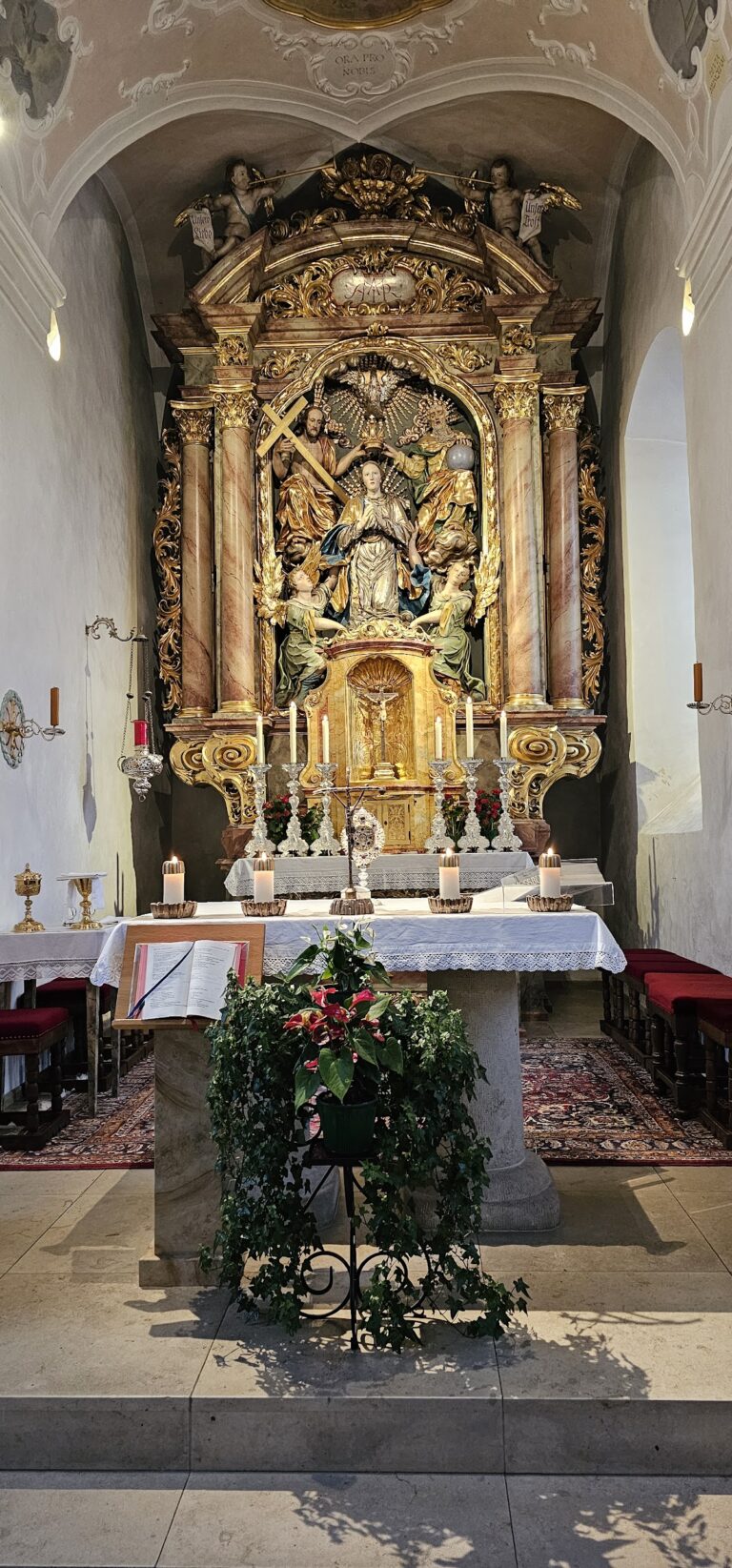
The church is an early Baroque wall-pier church, a design in which internal wall piers support arches or vaulting and divide the nave into architectural bays. Seven Baroque altars remain inside, along with finely worked filigree stucco from 1706. This delicate, finely modeled plaster ornament contributes to the interior decoration. Joachim von Sandrart painted the large high-altarpiece showing Saint Walburga, while Karl Engel designed the two large side altars.
Crypt of Saint Walburga
The crypt of Saint Walburga lies at the eastern end of the church. It has an upper and a lower level and can be reached from the choir and from outside. Numerous votive paintings are held there. Water gathers beneath the saint’s stone sarcophagus in winter, and the nuns have distributed it to believers as “Walburga’s Oil” since at least the eleventh century.
Nuns’ Choir and Organs
A separate nuns’ choir reflects the community’s longstanding provision of its own choir space. The west gallery contains an organ in a historical Rococo case dating from 1743. The present slider-chest instrument was built by Mathis Organ Builders in 1996. It has 27 stops across two manuals and a pedal, with mechanical key and stop actions.
A second Mathis organ stands in the nuns’ choir. Built in 1992, it has eleven stops, two manuals, and a pedal.
Associated Chapels and Cemetery Area
Mariahilf Chapel
The Mariahilf Chapel was built near the monastery in 1465. It served as a subsidiary church of St. Walburg and forms part of the complex’s late-medieval religious history.
Chapel of Saint Michael
The parish cemetery was moved in 1534 to the area of the Chapel of Saint Michael. This relocation shaped the relationship between the monastery’s parish functions and the nearby burial ground.
Nearby sites