Residenz Eichstätt: Baroque Residence of the Prince-Bishops


Site at a Glance
- Rating
- 4.5
- Popularity
- Very Low
- Country
- Germany
- Primary era
- Early Modern
- External website
- Open
- Eras represented
- Early Modern
- Civilizations
- Holy Roman Empire
- Site type
- Religious
- Remains
- Palace
On this page11 sections
History
Residenz Eichstätt is a Baroque palace in Germany that served as the residence of the prince-bishops of Eichstätt, bishops who also exercised secular territorial authority. Its history reaches back to an eleventh-century episcopal court complex known as the Old Court, established by Bishop Heribert immediately south of the recently built Romanesque Willibald Cathedral.
The Old Court and the Prince-Bishopric
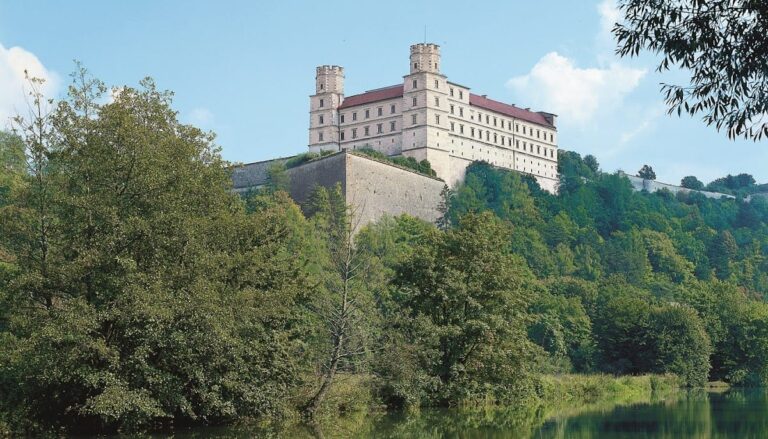
The Old Court was the urban residence of the bishops until the episcopal residence moved to Willibaldsburg castle above the city during the first half of the fourteenth century. After that relocation, the complex housed the cathedral chapter and functioned as an administrative center of the Prince-Bishopric of Eichstätt, the ecclesiastical principality governed by the bishops.
During the Thirty Years’ War, the major European conflict fought from 1618 to 1648 amid religious, dynastic, and political struggles, Swedish troops attempted to destroy Eichstätt. Two city fires, on 17 December 1633 and 12 February 1634, devastated the town and destroyed the Old Court. A provisional rebuilding of the complex was completed by 1684.
Construction of the Present Residence
Around 1700, court building director Jakob Engel began a new residence on the site at the instigation of Prince-Bishop Johann Martin von Eyb. The west wing was completed around 1702, followed by the east wing. After Engel’s death in 1714, Gabriel de Gabrieli completed the south wing and the palace complex, including the arrangement of Residenzplatz before the south wing.
Under Prince-Bishop Raymund Anton, Count of Strasoldo, court architect Maurizio Pedetti was responsible for the surviving Rococo interiors. Rococo developed from the Baroque and favored lighter, more delicate, and more intricate decoration. Pedetti also gave Residenzplatz its present form, with its Marian column and fountain.
Later Use and Protection
Prince-Bishop Johann Anton III, Baron von Zehmen, used the residence as his official seat, pursued an Enlightenment reform program, and enlarged the court garden. After the Napoleonic era, the end of the Prince-Bishopric of Eichstätt, and the territory’s incorporation into the Kingdom of Bavaria, the palace became the home of Eugène de Beauharnais and his family from 1817 to 1833. Eugène, Napoleon’s stepson and son-in-law of the Bavarian king Max I Joseph, was a French prince and military figure who later held the title Duke of Leuchtenberg.
Since 1976, the complex has housed the Eichstätt district administrative office. Some rooms have been restored, and a small gallery of works by the painter Carl Otto Müller is located within the residence. The palace is protected as a listed architectural monument of Eichstätt under register number D-1-76-123-210. Early modern remains in the area of the former residence and court garden are also recorded as an archaeological monument under number D-1-7133-0189.
Remains
Residenz Eichstätt survives as a three-winged Baroque palace. The south wing faces Residenzplatz, the square created during the completion of the complex. The palace’s surviving Rococo decoration, formal rooms, representative staircase, square, fountain, Marian column, and court garden together preserve the arrangement of the former residence complex.
Interior Decoration
Representative Staircase
The representative staircase has an elaborately forged iron railing and a ceiling fresco by Johann Michael Franz showing the fall of Phaethon. In Greek mythology, Phaethon attempted to drive the sun chariot, lost control of it, and fell. The fresco forms a principal figurative element of the staircase interior.
Mirror Hall
The Mirror Hall retains ceiling paintings of mythological scenes by Johann Michael Franz. The paintings were executed in glue paint, a medium made by mixing pigments with an adhesive binder. These interiors form part of the Rococo decoration that survives within the palace.
Square, Garden, and Archaeological Remains
Residenzplatz
Residenzplatz extends before the south wing and has the form given to it by Maurizio Pedetti. A Marian column stands at the center of a fountain surrounded by putti, providing the square with its central sculptural feature.
Court Garden and Earlier Remains
The court garden belongs to the former residence complex and was enlarged during the tenure of Johann Anton III, Baron von Zehmen. Archaeological remains associated with the former residence and court garden include early modern remains preserved in the area of the former complex.
Nearby sites