Church of St. Martin: A Roman Catholic Parish Church in Tŕnie, Slovakia
Site at a Glance
- Popularity
- Very Low
- Country
- Slovakia
- Primary era
- Medieval
- Eras represented
- Medieval, Early Modern, Modern
- Civilizations
- Austrian Empire, Habsburg, Hungarian
- Site type
- Religious
- Remains
- Church
On this page8 sections
History
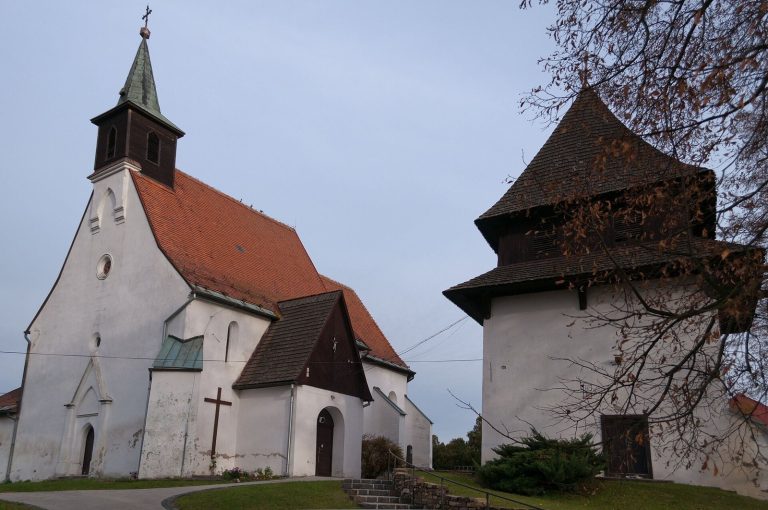
The Church of St. Martin is a Roman Catholic parish church in Tŕnie, Slovakia, dedicated to St. Martin of Tours, a fourth-century bishop widely venerated as a Christian saint. It serves the parish of Tŕnie within the Diocese of Banská Bystrica and the Western Slovak ecclesiastical province. The church’s existence is certain from the 14th century, and its architecture combines Gothic medieval vaulting, Renaissance design inspired by classical forms, and Baroque art associated with elaborate decoration and movement.
Origins and early records
Church tradition credits the foundation of the church in the first half of the 13th century to Beatrix d’Este, queen consort of Hungary and wife of King Andrew II. Historians consider its existence established only from the 14th century. In 1688, Ladislav Pyber recorded that the sanctuary had been painted in 1327.
A reference from 1648 identifies the building as belonging to Evangelicals, a term then used broadly for Protestants in Central Europe. Worshippers petitioned for repairs, and church inspections in 1688 and 1692 found the building in poor condition.
Repairs and enlargement
A Renaissance-style repair took place in 1696 but did not resolve the building’s problems. In the early 18th century, Protestant church superintendent Pilárik urged the Turiec regional church district to organize a collection for further work. Between 1721 and 1725, major repairs added a tower and exterior buttresses.
As Tŕnie’s population increased, pressure grew to enlarge the church. In 1855, parish priest Vojtech Sásik sought an expansion, but the work enlarged only the choir gallery.
Twentieth-century changes
An expansion undertaken in 1935 had to preserve the vaults and avoid a Gothic design. The altered church was consecrated on 4 October 1936 by Monsignor Andrej Hlinka, a Slovak Roman Catholic priest and political leader. The church was damaged during the Second World War, and repairs followed in 1946 and again from 1966 to 1973. Parishioners from Tŕnie and Železná Breznica helped with the later work. In 1970, the older altar was removed and new furnishings were installed in the presbytery.
Remains
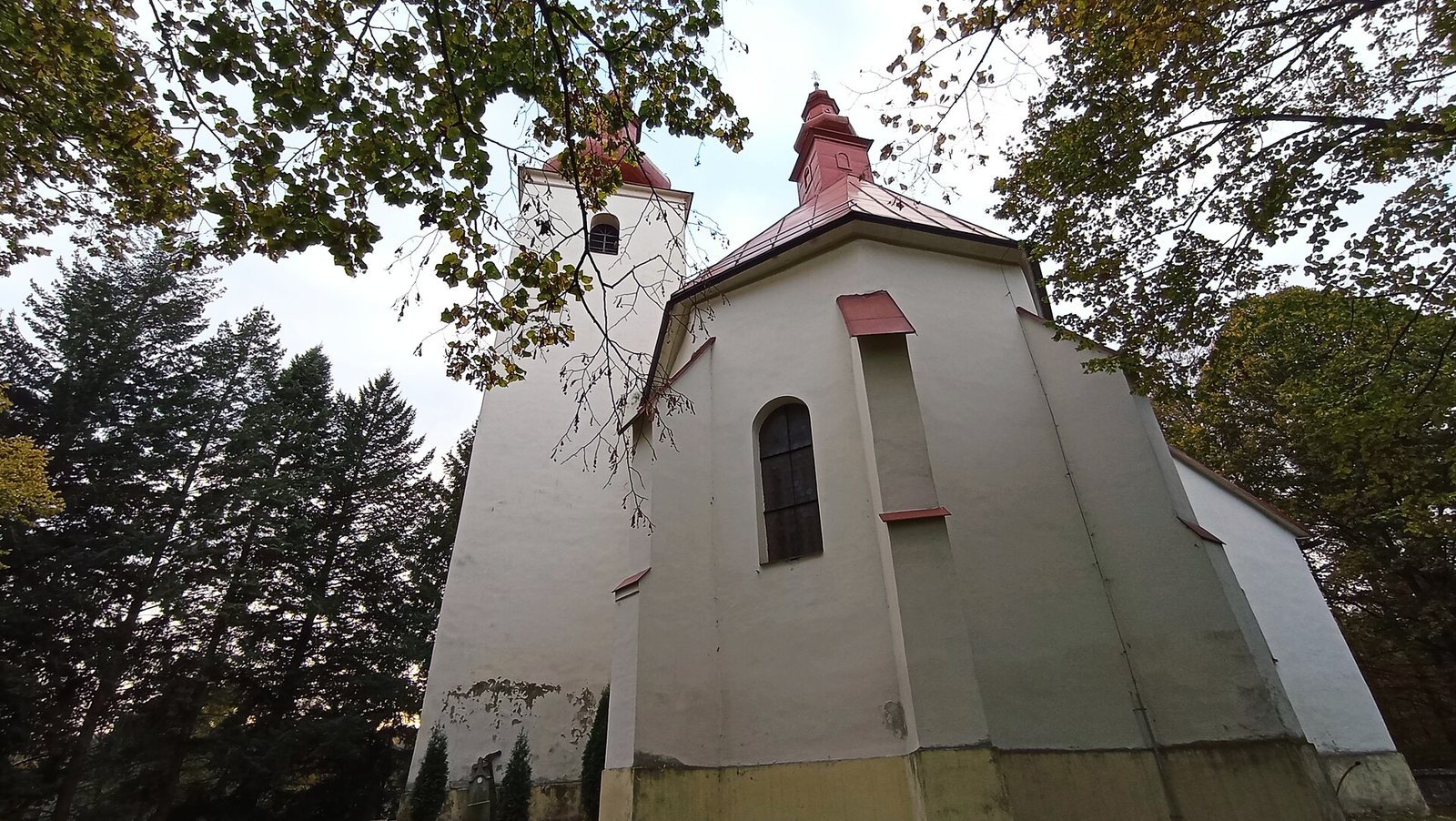
The church stands on a hill above Tŕnie and forms a prominent feature of the village. It is a hall church, meaning that its main interior spaces are of roughly equal height, with the altar facing east. Its polygonal presbytery is the area around the main altar. A modern extension occupies the west end and includes a pseudo-Gothic portal.
Plan and exterior
The older part has smooth façades reinforced by buttresses. Flat vertical strips frame its walls, and a richly decorated portal opens in the nave’s south wall. The roof, once covered with asbestos-cement sheets, now has corrugated sheet-metal covering.
Vaults and presbytery
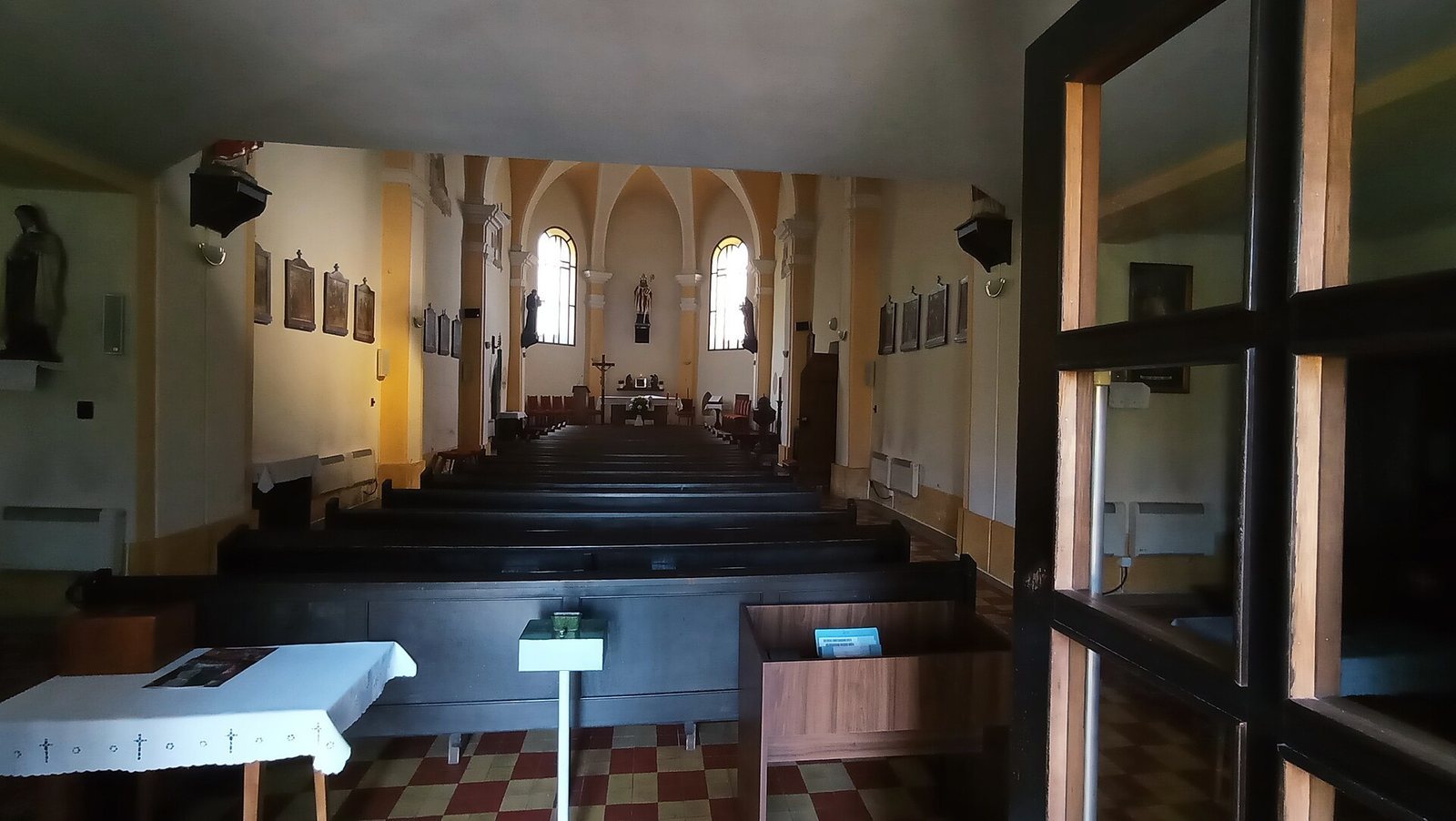
The nave has a Renaissance barrel vault, a continuous curved ceiling, with lunettes, the curved sections formed where openings meet a vault. The sacristy contains a Gothic ribbed cross vault, a ceiling structured by intersecting ribs. In the presbytery, a Gothic pastophorium, a built-in recess for sacred vessels or the Eucharist, is among the surviving features.
Furnishings and decoration
Most furnishings date from 1936. Czech painter Jiří Jelínek painted the church that year and repainted it in 1970. An 18th-century Baroque painting of the Baptism of Christ is attached to a wall-cabinet door, and a statue of St. Martin stands in the presbytery. Its tabernacle, altar table, and ambo, a stand for readings, were made by Pavel Kapusta of Tŕnie. Paintings of the Stations of the Cross hang on the north and south walls, while the choir loft contains an organ dating from 1936.