Kincaid Mounds State Historic Site: A Middle Mississippian Mound Center
Site at a Glance
- Rating
- 4.3
- Popularity
- Very Low
- Country
- United States
- Primary era
- Medieval
- External website
- Open
- Eras represented
- Stone Age, Classical, Medieval
- Civilizations
- Unclassified
- Site type
- City
On this page13 sections
History
Kincaid Mounds State Historic Site is a Middle Mississippian archaeological center on the Ohio River floodplain in southern Illinois, United States. Indigenous communities developed its principal Mississippian settlement around 1050 CE, creating a mound center and chiefdom that became one of the major Native American communities of the lower Ohio River valley.
Early occupation
People used the area for thousands of years before the Mississippian period. Archaeological evidence reaches back to the Archaic Period, approximately 8000 to 2000 BCE, represented locally by the pre-ceramic Faulkner Component. Occupation intensified during the Early and Middle Woodland periods, when the local Baumer phase developed as a relatively settled, semi-agricultural society. Its communities used semi-permanent housing and limestone-tempered pottery. Settlement continued during the Late Woodland period through the Lewis culture.
The Mississippian center
The Mississippian community grew from the local Lewis community around 1050 CE. Kincaid was influenced by Cahokia, the major cultural and political center near present-day St. Louis, which lay approximately 140 miles away. The settlement became part of the archaeological Kincaid focus, a group of lower Ohio River valley Mississippian towns that also includes Wickliffe, Tolu, and Angel Mounds. Similarities in pottery and town plans have led some specialists to associate these communities with the same society. Their shared 300- to 400-year tradition is known as the Angel phase.
Kincaid functioned as a major mound center, a chiefdom governed by a chiefly elite, and a prehistoric trading center along the Ohio River. At least 19 earthwork mounds were built during the Mississippian period, including at least 11 platform mounds and eight other monuments. Excavation of Pope Mound 2 provided evidence for a hierarchical social organization. Exchange connected the settlement with chert sources in Missouri, Tennessee, and other parts of Illinois, while nearby Mill Creek quarries supplied another important stone resource.
Abandonment and archaeological investigation
Mississippian occupation appears to have ended by approximately 1400 to 1450 CE. The settlement was probably abandoned after timber and game resources had been exhausted, and the site remained uninhabited for approximately three centuries before American settlement.
The University of Chicago carried out major excavations from 1934 to 1941 under Fay-Cooper Cole. The project trained archaeologists and anthropologists who later held notable careers and helped develop modern archaeological methods. Richard MacNeish was among those associated with the work. Southern Illinois University began renewed investigation and excavation in 2003, using newer technology, re-examining areas previously considered possible mounds, identifying an additional mound, and producing new information about the site.
The Illinois Historic Preservation Agency owns and operates the Massac County portion, while the Pope County portion is privately owned. Kincaid was designated a National Historic Landmark in 1964 for its importance as a major Native American mound center and prehistoric trading center along the Ohio River. It was added to the National Register of Historic Places in 1966 and is also an Illinois State Historic Site.
Remains
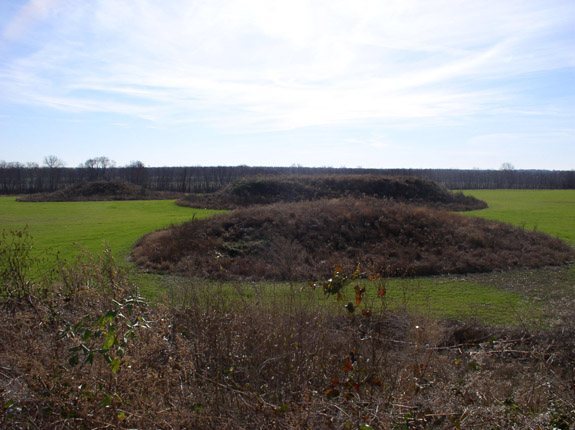
Kincaid was built on a floodplain beside the Ohio River and enclosed by a palisade, a defensive barrier made from upright wooden posts. The estimated enclosed area covers approximately 141 acres, with another occupation area extending westward. A large central plaza was formed by filling and leveling the ground at the center of the community. Major mounds surrounded this open space, which served as the settlement’s social center.
Mounds and central settlement
Platform mounds
The site contains at least 19 earthwork mounds, mainly flat-topped platform mounds that supported buildings or activity areas. One major mound extends nearly 500 feet, or approximately 150 meters, while the other platform mounds range from about 8 to 30 feet, or 2.4 to 9.1 meters, in height. Large buildings once stood on the principal mounds. Their remains appear to represent temples or council houses, although their precise functions are not established.
Pope Mound 2
Pope Mound 2 was a major burial mound excavated during the 1930s. It contained stone-box graves and log-lined tombs, burial forms also frequently found in the Middle Cumberland Valley of Tennessee. The mound’s contents provided evidence for differences in social rank within the Kincaid community.
Additional mound
In 2003, investigators identified a small mound near the present road, close to the county line and at the southeastern corner of the town plaza. A midden, or accumulation of discarded domestic material, had later covered the feature. Earlier excavations around the area had not classified it as a possible mound because its identity was unclear.
Earlier features and excavated materials
Baumer-phase features
Excavations conducted before construction of an informational kiosk and viewing platform in 2003 exposed six Baumer-phase pits dating from 250 BCE to 1 CE. One pit contained the intentionally buried remains of a small domestic dog, providing evidence of activity at the site long before the Mississippian settlement developed.
Pottery
Kincaid’s Mississippian pottery is characterized by negative-resist painting, a technique in which selected areas are protected from pigment so the design appears through a contrasting surface. Pottery associated with the wider Kincaid focus is shell-tempered and includes Angel Negative Painted, Kincaid Negative Painted, and Matthews Incised styles. Surfaces range from the smoother, coarser-tempered Mississippi Ware to the more polished, finer-tempered Bell Ware. Rare painted and incised Mississippian sherds make up less than one percent of the assemblage near Kincaid.
Baumer-phase pottery used cord and fabric marking rather than Havana Hopewell motifs. Its clay paste commonly contained limestone and grog, a crushed material added to clay as temper to improve its working and firing properties.
Figurines and stone resources
Excavated materials include carved figurines made from coal and fluorite. Their imagery connects the site with the Southeastern Ceremonial Complex, a broad tradition of religious symbols, ritual objects, and related imagery shared by several Mississippian societies. The archaeological assemblage also includes Mill Creek chert from nearby quarries and chert from more distant sources, reflecting the exchange networks that connected Kincaid with other parts of the region.