Grojec Hill Castle: A Destroyed Medieval Stronghold in Poland


Site at a Glance
- Rating
- 4.4
- Popularity
- Low
- Country
- Poland
- Primary era
- Medieval
- Eras represented
- Medieval
- Civilizations
- Unclassified
- Site type
- Military
- Remains
- Castle
On this page7 sections
History
Grojec Hill Castle is a destroyed medieval defensive site in Żywiec, Poland, built and occupied during the region’s medieval history. It stood on the summit of Grojec Hill, where an earlier medieval stronghold had already occupied the site. The ruins are entered in the register of immovable monuments of the Silesian Voivodeship, with entries dated 22 November 1968 and 29 December 1980.
Early settlement and stronghold
The earliest settlement traces on Grojec Hill belong to the Lusatian period, the later Bronze Age and early Iron Age culture of Central Europe associated with settled communities and fortified sites. A medieval stronghold later occupied the summit, although its precise date cannot be established. Much of the archaeological site was destroyed after the Second World War when a television relay station was constructed there. Nineteenth-century writings also mention a tradition that a hunting castle may have stood on the summit in the mid-thirteenth century, but this tradition remains distinct from the archaeological evidence for the earlier stronghold.
The Skrzyński and Komorowski castles
At the beginning of the fifteenth century, a castle arose on the summit under Bożywoj and Włodek Skrzyński, members of the Łabędź coat of arms family. They were notable robber knights and vassals of the Duchy of Oświęcim, and the castle is mentioned in written records. It later passed to the Komorowski family, who bore the Korczak coat of arms.
The Komorowskis supported Matthias Corvinus, the king of Hungary from 1458 to 1490, who had allied with the Teutonic Order against Poland. In response, King Casimir IV Jagiellon, who ruled Poland and Lithuania from 1447 to 1492, ordered military action against the family and the seizure of its castles. In 1477, royal forces commanded by Jakub of Dębno, the Kraków starost responsible for administering the Kraków district, captured three Komorowski-controlled strongholds, at Barwałd, Szaflary, and Żywiec. The chronicler Jan Długosz described the use of enormous guns during the sieges and stated that the castle at Żywiec was burned.
Modern archaeological interpretation identifies two defensive sites in the Żywiec area as victims of this campaign: the original castle within the town, on the site of the present Old Castle, and the castle on Grojec Hill. The hilltop castle was destroyed in 1477.
Archaeological investigations
Investigations took place in 1937 and 1983. The 1937 work was carried out by Tadeusz Reyman, Rudolf Jamka, and Tadeusz Sulimirski, and its results were compared with written evidence to reconstruct part of the castle’s history. Artefacts recovered during the excavations were held by the Municipal Museum in Żywiec but disappeared during the Second World War.
Remains
Summit enclosure and courtyard
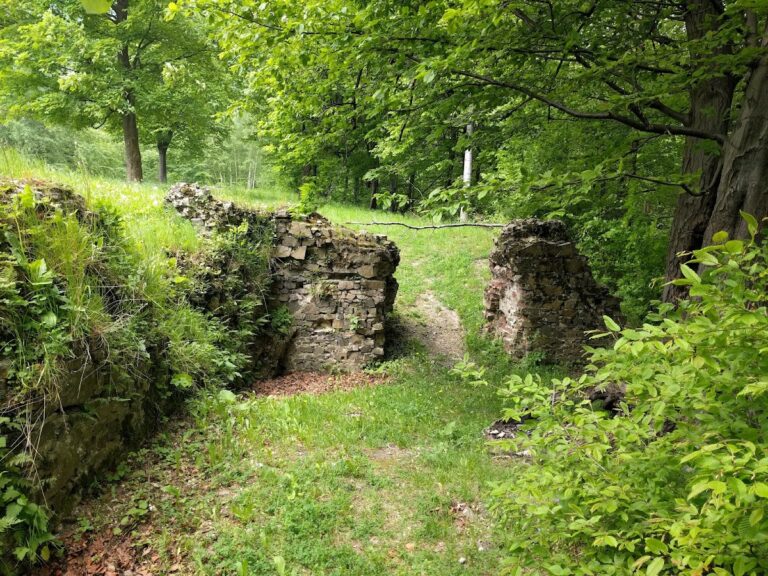
Grojec Hill rises to 612 metres above sea level between the Soła and Koszarawa Rivers. Its flattened summit contains a ridge of exposed rocks. The castle enclosure was protected by a dry moat and an elongated oval rampart measuring approximately 100 metres in length and 40 metres in width. Built from clay and large sandstone boulders, the rampart enclosed a courtyard where remains of wooden buildings were found.
Excavated objects
Metal artefacts from the courtyard included nails, a knife, a horse bit, and the head of a crossbow bolt. Excavators also found a silver denar of Władysław Jagiełło, a small medieval silver coin. Together, these objects provide material evidence for activity within the fortified enclosure during its medieval use.