Holy Cross Church in Żywiec: A Gothic Filial Church in Poland


Site at a Glance
- Rating
- 4.5
- Popularity
- Low
- Country
- Poland
- Primary era
- Early Modern
- Eras represented
- Medieval, Early Modern, Modern
- Civilizations
- Habsburg, Kingdom of Poland, Polish–Lithuanian Commonwealth
- Site type
- Religious
- Remains
- Church
On this page21 sections
History
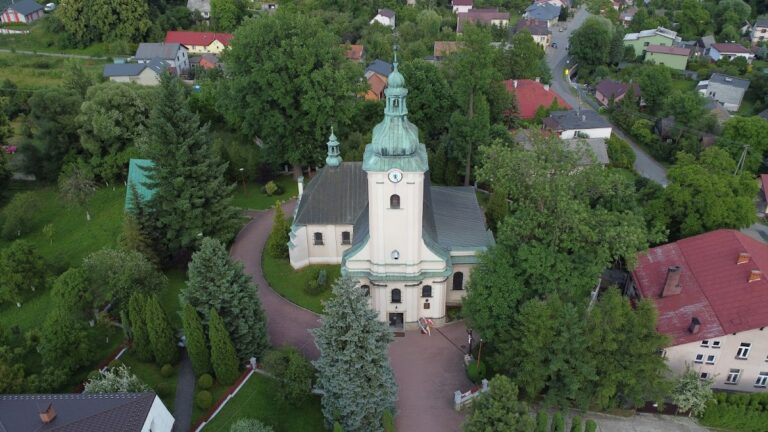
Holy Cross Church in Żywiec, Poland, is a Gothic Roman Catholic filial church, meaning that it belongs to a parish but is not its principal church. Dedicated to the Holy Cross, it originated around 1380, before Żywiec was established in its present area. Figures of the crucified Jesus and the two thieves on the apse exterior have given it the local name “Three Crosses” church.
Foundation and religious change
The church was completed in 1428 and reconsecrated by the Bishop of Krakow after returning to Catholic possession. Earlier in the fifteenth century it had become a Hussite church. The Hussites were a reform movement from Bohemia that challenged established Catholic ecclesiastical authority. The building belonged to the town parish, now the Parish of the Nativity of the Blessed Virgin Mary in Żywiec.
Expansion in the seventeenth century
In 1679 the original timber-framed nave was demolished and replaced by the much larger nave that survives. Father Wojciech Symellius, parish priest of the Żywiec town parish, subsequently promoted another enlargement. In 1690 the chancel was extended with the addition of a circular apse.
Closure, military reuse, and restoration of worship
A state order closed the church in 1790, and Elżbieta Wielopolska, then owner of Żywiec, acquired it at auction. Municipal authorities challenged the sale, and a second auction took place in 1801. Since only private individuals could bid, they appointed Marcin Rybarski to buy the church with public funds. The Austrian authorities nevertheless withheld permission for religious services for an extended period.
During the Napoleonic Wars, the building served successively as barracks for about 400 soldiers, a food store, and a military hospital. Father Franciszek Augustin began its conversion back to religious use in 1826. A Gethsemane Chapel was added in 1878, followed by a tower and vestibule in 1910. In 1916 the tower chapel, dedicated to the Sacred Heart of Jesus, received painted decoration by Jan Kazimierz Olpiński showing the Evangelists and four Polish saints.
Wartime parish administration
During the German occupation in the Second World War, the church was assigned to German-speaking worshippers. The occupying authorities promoted the theory that Żywiec’s inhabitants were of Germanic origin and intended to give the town’s oldest church to the German population. A German parish was established there on 7 July 1942, with Father Kurt Bensch appointed parish priest by Bishop Adam Stefan Sapieha. The Parish of the Nativity of the Blessed Virgin Mary formally transferred the church to it on 1 September 1942. The German-language parish continued until 1945, and its priest departed for Germany in January of that year.
Holy Cross Church is entered in the Silesian Voivodeship heritage register under registration A-180/77, dated 20 September 1977, and registration A/1355/24, dated 22 February 2024.
Remains
Building and roof structure
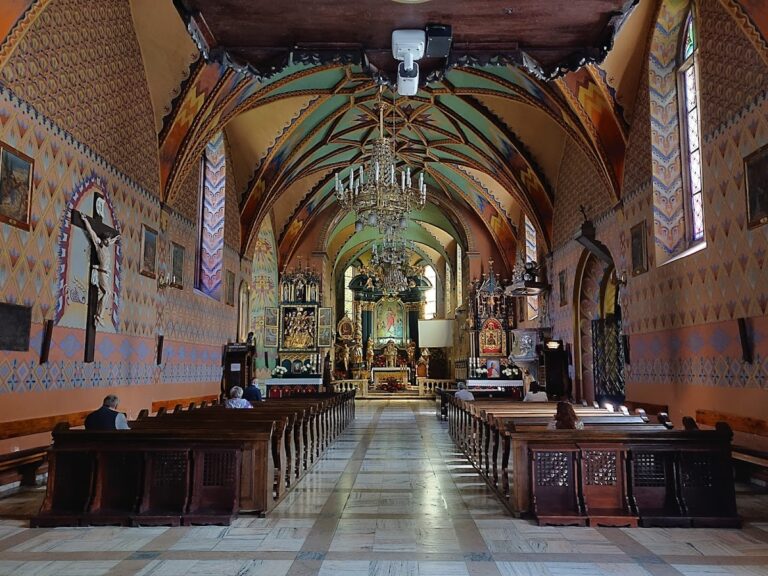
The church is an east-oriented stone building covered with plaster. Its principal body is an elongated rectangular nave, 20 metres long and 9 metres wide. To the east lie the chancel and apse, together measuring 18.6 metres in length and 7 metres in width. A tower is attached to the north side of the nave, while a vestibule stands at the west end. The northern side of the chancel has a sacristy, a room for vestments and liturgical furnishings, and the Gethsemane Chapel is attached to its south side.
The nave and chancel have flattened false vaults, ceilings that imitate masonry vaults without functioning as self-supporting masonry structures. The apse is covered by a wooden dome. High, steep roofs covered with wooden shingles rise above the building, and an octagonal shingled bell turret stands above them. The turret has a small dome, an octagonal lantern, and a shingled cap topped by an iron cross. Inside, a semicircular arch separates the nave from the chancel. Smooth interior walls contrast with exterior buttresses, which reinforce the walls.
Altars and crucifixes
Side altar paintings
Beside the entrance to the apse, the right side altar contains the Baroque oil painting Christ Carrying the Cross. Painted on canvas in the eighteenth century, it measures 67 by 115 centimetres. The same altar area holds Ecce Homo, an oil painting on wood dated 1826 and measuring 86 by 154 centimetres.
High altar crucifix
A late Baroque wooden crucifix forms part of the high altar. The figure of the crucified Jesus is 175 centimetres high and retains newer oil polychromy, or painted decorative colouring. The altar also includes later figures of Mary, John the Evangelist, and Mary Magdalene.
Gothic crucifix
The church also preserves a Gothic crucifix made after 1400. Christ wears a perizoma, the cloth traditionally shown around the waist of the crucified figure, with festoons of draped fabric falling on either side. The arms were replaced in 1637 by Jerzy Wiśnicki of Żywiec after the original arms had been destroyed.
Painted and sculpted works
Chancel and apse decoration
Painted decoration from around 1666 survives in the chancel window reveals. It was made by Florian Sobinowicz of Żywiec. The apse contains stained glass produced in 1910 from a design by Stefan Witold Matejko.
Gothic and Renaissance paintings
The Żywiec City Museum holds the former Gothic painting Descent from the Cross, made around 1450 in tempera on wood. Measuring 102.5 by 147.5 centimetres, it places the cross above a flower meadow with eight figures in two rows. Jesus, Mary, and two mourning women occupy the first row, while Mary Magdalene, John the Evangelist, Nicodemus, and Joseph of Arimathea appear behind them. Its restrained colours include dark red, olive green, and dark blue, set against a gold background with the instruments of the Passion. German occupiers took the painting to Bytom during the Second World War before it was returned to the museum.
Other works formerly in the church are also in the Żywiec City Museum. The Raising of Lazarus, a tempera painting on wood from the second half of the sixteenth century, measures 120 by 156 centimetres and presents the biblical scene within a landscape beneath a gilded arched frame with carved vegetal ornament. Christ and Saint Veronica, from the mid-sixteenth century, measures 71 by 109 centimetres and shows Jesus and Veronica in the foreground, with Mary and a soldier behind them. Its olive-grey palette is accented with dark red and emerald blue.
Triptych wing and Baroque works
A wooden wing from a former sixteenth-century triptych measures 37 by 122 centimetres. Its interior shows the Flagellation of Christ against a gold background with Renaissance vegetal interlace, while Pontius Pilate appears on the exterior. The badly damaged wing was transferred to the museum, lost during the Second World War, and returned after being found. The museum also received the former Baroque Fall of Christ under the Cross, an oil painting on wood measuring 114 by 77.5 centimetres, and Madonna with a Strawberry, a tempera painting on wood dated 1450–1475.
Saint Anne sculpture
A former Gothic wooden sculpture of Saint Anne with the Virgin Mary and Christ Child, known as Saint Anne Selbdritt, dates from around 1380. The hollow-backed figure was originally covered with tempera polychromy and later received another surface layer. Saint Anne sits enthroned, holding an apple in her left hand and embracing Mary with her right. The naked Christ Child sits on Mary’s lap with another apple, while Saint Anne’s mantle falls in funnel-shaped folds. The sculpture was taken to Bytom during the German occupation and returned to the Żywiec City Museum after the war.
Music gallery and organ
The music gallery contains a Neoclassical organ case raised on a high base. Seven pipe fields are arranged within three arched frames supported by columns on pedestals. Carved gilding decorates the capitals, and a shared cornice is surmounted by gilded Regency-style pinnacles and grilles.
The organ itself survives in fully original form. Rieger Orgelbau built it as a multiplex instrument, obtaining some stops through extensions of existing pipe ranks. It has 13 stops, including 10 real voices and 3 produced through extension. Opus number 1967 on the console indicates construction in 1913, while the later catalogue number 2080 and the style of the stops point to a later commissioning date and resemble the firm’s products of the 1920s. The detached console is set into the gallery balustrade and faces the chancel. It has two manuals and a pedal, with pneumatic action and registration, cone-valve windchests, reservoir bellows, and a lever for manual pumping. An electric blower stands in a separate room. Wooden tubes carry air to the windchests, a choice associated with wartime shortages of lead during the First World War.
Former churchyard and roadside monuments
Churchyard cross
The church originally stood within a cemetery where the municipal court ordered executions by beheading and where the bodies were buried nearby. From 1625 to 1684, those executed included Michał Gnidek for theft and disobedience toward his parents, Jakub Regula, son of Żywiec’s vogt, for theft, Mikołaj Kasprzykowicz for bigamy, Marcin Ociepka for stealing votive offerings and alms, and the tailor Wojciech Stokłosa for stealing horses. From 1689 to 1771, eleven women accused of killing their children were also executed there. The cemetery was abolished after 1784 following Emperor Joseph II’s prohibition of burials within urban settlements.
One stone cross from the former churchyard remains beside the church. Michał Gnidek’s parents erected it after his beheading in 1624. The massive, plain, equal-armed cross is 87 centimetres high and 22 to 25 centimetres thick.
Passion of Christ column
North of the church stands the stone column called the Passion of Christ. Zofia Kiełzak, a townswoman, financed it in 1618. Its Tuscan column supports a flower-bud-shaped top piece, from which rises a cross bearing a relief of the crucified Jesus. A second iron cross projects from the monument.
John of Nepomuk statue
A statue of John of Nepomuk, a fourteenth-century Bohemian Catholic saint associated with confession, martyrdom, and protection from drowning, stands beside the church enclosure. Dated 1717, it is mounted on a high pedestal and sheltered by a sheet-metal canopy. The statue was moved to its present position in 1864.