Zahrádky Castle: A Renaissance and Baroque Estate in Czechia


Site at a Glance
- Rating
- 4.2
- Popularity
- Low
- Country
- Czechia
- Primary era
- Modern
- Eras represented
- Modern
- Civilizations
- Habsburg, Holy Roman Empire, Kingdom of Bohemia
- Site type
- Domestic
- Remains
- Castle
On this page11 sections
History
Zahrádky Castle is a historic castle in Czechia, first recorded in 1376 as the fortified medieval complex of Nový Vítkovec and transformed into a Renaissance castle in 1547–1550. It was also known as Nový Zámek, Neuschloß, and Neuschloss. Built on a rocky spur above the Robitzer Brook, it was regarded in the sixteenth century as the largest and most magnificent castle in Bohemia.
Medieval origins and Renaissance rebuilding
The Lords of Mniechov held the medieval castle until they sold it after 1480 to the Lords of Wartenberg. The new owners rebuilt the complex between 1547 and 1550, replacing the earlier fortified residence with a substantial Renaissance castle. In 1547, the estate became a fief of the Bohemian Crown, meaning that it was held under a feudal relationship with the crown. It returned to free allodial ownership in 1575, when it was called Neuschloß. Allodial ownership meant that the property was held freely rather than as a feudal fief.
Wallenstein and the Kaunitz estate
After the Battle of White Mountain in 1620, Johann Georg von Wartenberg of the Tetschen line lost the estate. He had secured his claim in 1617 after a long dispute with other members of his family. In 1623, Albrecht von Wallenstein, a prominent Bohemian military commander and imperial prince during the Thirty Years’ War, became the owner. He introduced several Baroque alterations and established a straight lime-tree avenue through the pheasantry toward the Gründel Valley.
Following Wallenstein’s assassination in 1634, Neuschloß and the associated estate of Böhmisch Leipa were the only one of his confiscated possessions left to his widow, Isabella Katharina, Duchess of Friedland, as her dowager residence. Her daughter, Princess Maria Elisabeth of Friedland, married Reichsgraf Rudolph von Kaunitz in 1645. Later acquisitions brought Neuschloß, Böhmisch Leipa, and Houska together as a land-table estate, and the Neuschloß–Leipa fideicommissum was established. A fideicommissum was an inheritable estate arrangement intended to keep property within a designated family line.
Late eighteenth-century remodeling and scientific connections
The castle was remodeled in the Baroque style at the end of the eighteenth century and retained this appearance until its expropriation in 1945. Under Michael Karl Josef, Count of Kaunitz, his son Vinzenz encouraged the natural sciences. The astronomer Alois Martin David stayed at the castle several times as a guest.
Changing ownership in the nineteenth and twentieth centuries
After the death of Reichsgraf Albrecht von Kaunitz in 1897, the castle passed to his eldest daughter Marie, who was married to Egon Karl, Prince of Hohenlohe-Waldenburg-Schillingsfürst. Marie later became widowed and faced financial difficulties, leading her to sell Neuschloß to Géza, Count Andrássy of Csíkszentkirály and Krasznahorka, the husband of her sister Eleonore, Countess Kaunitz.
Géza Andrássy gave the castle to his daughter Marizza Andrássy, who was married to Prince Johannes of Liechtenstein. In 1936, Marizza von Liechtenstein transferred Neuschloß in equal shares to her sons Emanuel and Johannes Liechtenstein. In 1945, after the Second World War, the House of Liechtenstein was expropriated without compensation and the entire castle complex became the property of Czechoslovakia.
During the Communist period, the castle’s economic court was converted into a state farm. Charles University in Prague, one of Central Europe’s historic universities, used the castle for institutional training and further education, and public access was consequently limited. A hotel was established in the castle in 1992.
Fire and later securing works
On 30 January 2003, a fire began in the roof structure and spread across the entire roof area. Falling debris and firefighting water almost completely destroyed the castle building, while some floor slabs collapsed as far as the ground floor. Damage was estimated at more than 100 million Czech korunas, approximately 3.5 million euros. Work since then has focused on securing the structure. An emergency roof was installed in 2003, and the municipality of Zahrádky launched a public collection to support reconstruction.
Remains
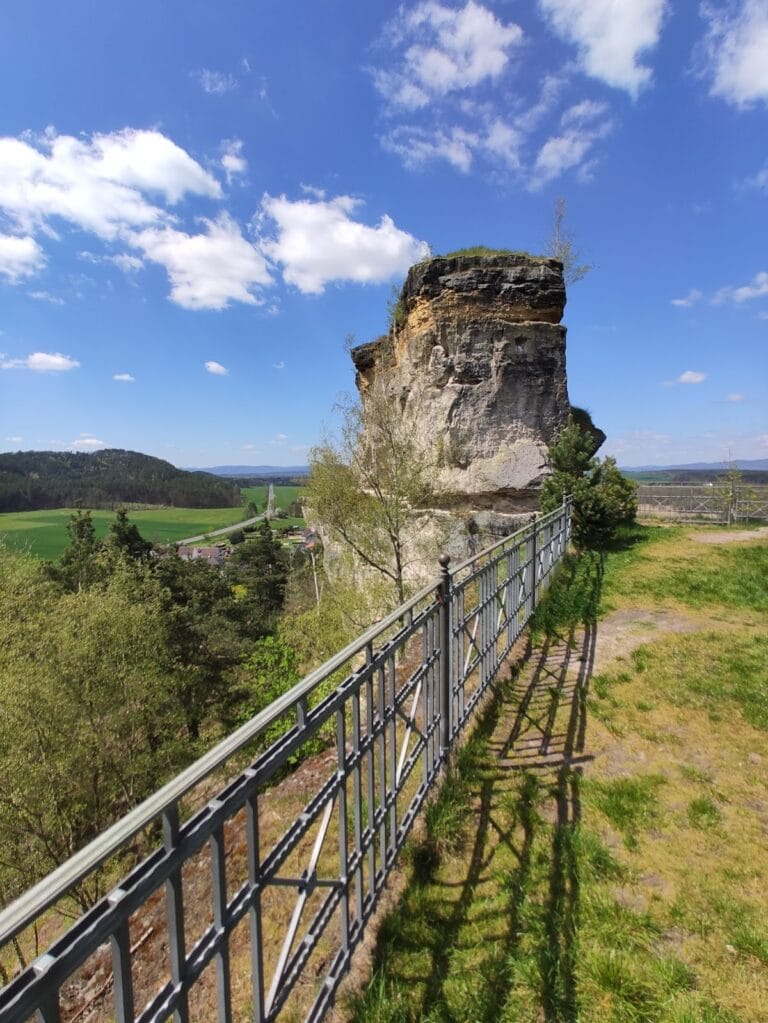
The site combines the heavily damaged castle building with an extensive designed landscape. The main residence developed from a fortified medieval complex into Renaissance and Baroque forms, while the surrounding grounds include an English landscape park, avenues, paths through a rocky gorge, and picturesque structures. The park contains 20 species of coniferous trees and 17 species of deciduous trees.
Castle building
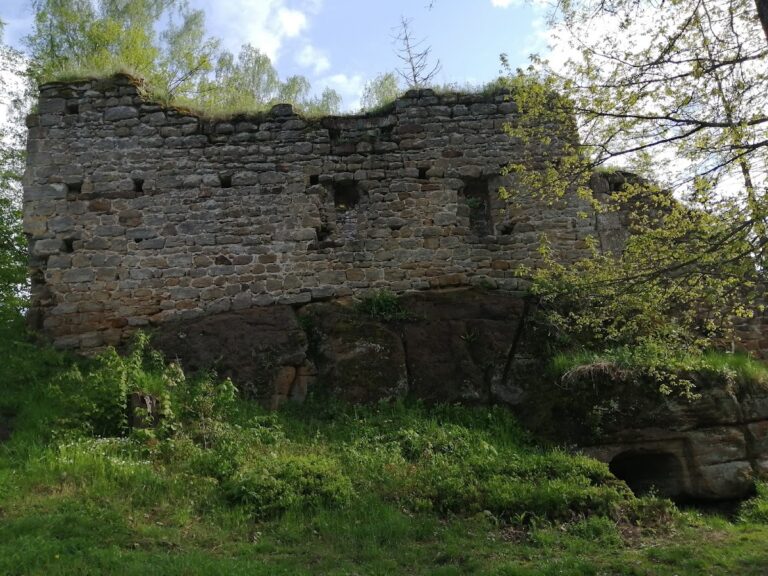
The castle stands on a rocky spur above the Robitzer Brook. Its earliest form was the fortified Nový Vítkovec, while the rebuilding of 1547–1550 created the substantial Renaissance residence later altered in the Baroque period. The 2003 fire destroyed almost the entire roof and severely damaged the interior through falling material and water used in firefighting. Some floor structures gave way to the ground floor. The principal post-fire intervention has been an emergency roof, installed in 2003 as part of the securing works.
Landscape park and avenue
The grounds include an English landscape park, a designed landscape intended to resemble an informal natural setting through trees, lawns, paths, water features, and picturesque structures. During the nineteenth century, parts of the landscape were redesigned in the Romantic manner. A straight lime-tree avenue runs through the former pheasantry toward the Gründel Valley. After 1945, the western half of the park became part of the state farm, and a tall iron fence divided the grounds into eastern and western sections. The western section later became overgrown and its designed character was altered.
Höllengrund and Jiljov
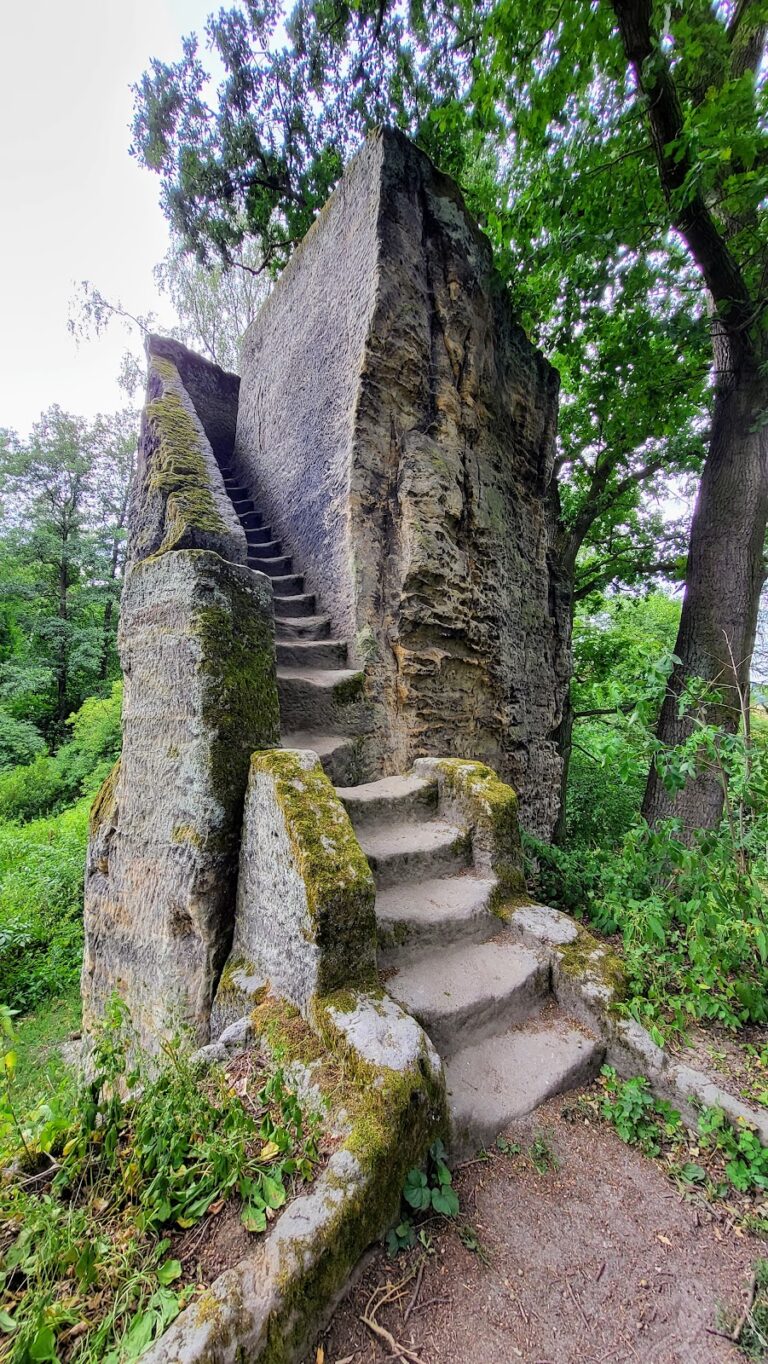
The nineteenth-century landscape also included the artificial rock castle of Jiljov, known as Veilchenburg. Paths were laid through the nearby rocky gorge of Höllengrund, and a boating route was introduced through the gorge. These features formed part of the Romantic treatment of the landscape around the castle.
Orangery
An orangery on the northern side of the park was being reconstructed from 2002. The work was not completed after the castle fire.
Nearby sites