Koganeyama Shrine (Ishinomaki): A Sacred Shinto Shrine on Mount Kinka


Site at a Glance
- Rating
- 4.5
- Popularity
- Low
- Country
- Japan
- Primary era
- Modern
- External website
- Open
- Eras represented
- Modern
- Civilizations
- Japanese
- Site type
- Religious
- Remains
- Sanctuary
On this page18 sections
History
Koganeyama Shrine is a Shinto shrine on Mount Kinka in Ishinomaki, Japan, traditionally founded in 750 during the Nara period to honor the deities Kanayamahiko and Kanayamahime, who were associated with gold production. The shrine stands on an isolated Pacific island opposite the southeastern end of the Oshika Peninsula, and the whole island is regarded as sacred. It is also known as Kinkazan Shrine and Kinkazan Koganeyama Shrine.
Gold, foundation, and sacred origins
The shrine’s traditional foundation is connected with the discovery of gold in Mutsu Province. In 749, the Yamato court received news of Japan’s first gold production while seeking gold to gild the Vairocana Buddha at Todaiji. The following year, Oshika no Muraji Miyamaro and others are said to have asked the provincial governor to establish a shrine on Mount Kinka for Kanayamahiko and Kanayamahime, the deities responsible for gold production.
The names Koganeyama and Kinkazan are traditionally associated with the “golden flowers” celebrated in a poem by Otomo no Yakamochi about the discovery of gold. Other traditions describe a celestial maiden who came ashore on the Pacific coast of Mount Kinka. She was enshrined at both the foot and summit of the mountain, with Benzaiten-do, identified with Daikin-ji, at the foot and Ryuzo Gongen, now called Owatatsumi Shrine, at the summit. A further legend links the area with the Baekje royal Kudara no Kyo Kyofuku, who was said either to have been shipwrecked near Onagawa or to have lived there after presenting gold to the imperial court.
Daikin-ji and the sacred mountain
The early shrine was later transformed into Daikin-ji, a Shingon Buddhist temple whose principal object of worship was Benzaiten. Shingon is an esoteric school of Japanese Buddhism founded by Kukai, also known as Kobo Daishi. Benzaiten, a Buddhist and Shinto-associated deity connected with water, music, eloquence, fortune, and prosperity, remained central to the religious identity of Mount Kinka.
Before the Meiji period, Daikin-ji was a women-prohibited institution combining Shingon practice with Shugendo, a Japanese mountain religion that brings together ascetic practices and elements of Buddhism, Shinto, and esoteric ritual. The complex was counted among Japan’s five great Benzaiten sanctuaries and the three sacred places of Tohoku. From the Heian period onward, ascetics associated with Daikin-ji and the Shingon tradition are thought to have developed Mount Kinka as a sacred mountain.
The island’s position in the eastern sea encouraged comparisons with Penglai and Tokoyo, ideal lands associated with the ocean to the east. Its steep five-peaked profile and the tradition of “sixty-eight peaks and forty-eight valleys” supported its development as a Shugendo landscape. The memory of Tenpyo-period gold production was joined to Benzaiten’s association with prosperity and good fortune, even though the island itself is composed almost entirely of granite and has no gold veins.
The Sendai-domain geography Fuchinai Fudoki preserves an older creation account in which Miwa Myojin formed Kinkazan Island from gold and enshrined the true spirit of Amaterasu there, later identified with Benzaiten. The author, Tanabe Nozomu, rejected this account as fabricated. Other interpretations have connected Mount Kinka with the ancient Oshima Shrine and Keisenma Shrine.
Medieval development and decline
Shrine tradition attributes the construction of 48 halls and pagodas, including Daikin-ji, and the donation of 1,000 koku of temple lands to Fujiwara no Hidehira in the mid-twelfth century. A koku was a historical measure of rice used to assess land and income. After the Fujiwara family fell, Kasai Kiyoshige reduced the complex to 18 religious establishments and 500 koku of land while continuing to protect it. Daikin-ji remained at the center of an independent mountain-temple organization.
Ascetics who had served as military forces or accompanying monks during the Former Nine Years’ War and the Later Three Years’ War are thought to have gathered at Mount Kinka for mountain practice and ritual prayer. The Fujiwara family valued them for prayers for peace and for their possible military role. Similar relationships with territorial lords probably continued during the Kamakura period, although repeated fires destroyed early records and leave the medieval history uncertain.
The complex declined during the Sengoku wars, a period of prolonged conflict among competing military powers. Its buildings were reportedly destroyed by fire in the late sixteenth century. In 1593, the Shugendo monk Choshun restored them. Choshun was associated with Iwakura in Shimotsuke Province and was also said to have held high office at Nikko-san.
Date protection and early modern devotion
During the Edo period, the Date family, lords of the Sendai domain, revered Mount Kinka. The island was treated as exempt temple land, and its buildings were rebuilt. Under the honmatsu system, which organized temples under principal and branch institutions, Daikin-ji belonged to the Tozan branch of Shugendo under Daigo Sanbo-in, with Ryuho-ji in Sendai serving as its principal temple.
In 1703, Date Tsunamura, the fourth lord of the Sendai domain, ordered retainers to make proxy visits to Daikin-ji for three consecutive months and offer gold dust. Although direct financial support from the domain lord was limited, Daikin-ji survived as the sole remaining temple of the former complex. Its religious influence expanded through preaching and fundraising journeys among villages.
Devotion to Daikin-ji and Benzaiten increased from the middle of the Edo period as religious associations and pilgrimages spread beyond the Sendai domain. In 1813, a fire reportedly reduced the mountain complex to ashes. The buildings were rebuilt with assistance from the Date family, while the surviving old records were lost.
The 1813 reinterpretation of Mount Kinka also changed the emphasis placed on its origins. The Kokugaku scholar Okin Yasumi identified the historical Tenpyo gold-mining site at present-day Wakuya and restored the small Kogane Shrine there. Mount Kinka was consequently understood more strongly as a natural sacred object, its form rising from the sea and revered by coastal communities. The gold tradition continued through local songs into the late Taisho period, which described gold boxes, golden flowers, and a golden mountain.
Meiji transformation and later history
The Meiji government’s policy separating Shinto and Buddhism abolished Daikin-ji in 1869 and established Koganeyama Shrine. The new shrine enshrined Kanayamahiko and Kanayamahime together with the deities of heaven and earth. The former temple superior returned to secular life and became a Shinto priest under the Okumi name. The shrine was classified as a prefectural shrine in 1874.
Rebuilding began in 1877 but was interrupted by a fire in 1897 that destroyed the shrine buildings and surrounding trees. The sacred object and portable shrine survived. Reconstruction continued in stages for approximately 30 years, with the worship hall completed in 1916, producing the shrine buildings seen today. The earlier buildings, constructed or extensively rebuilt during the 1870s, had been renowned for elaborate architecture and sculpture and were known as the “Nikko of the Eastern Frontier.”
After the Second World War, Koganeyama Shrine joined the Association of Shinto Shrines and became a Beppyo shrine in 1952. Beppyo is the association’s category for shrines regarded as having particular importance and long historical standing. The shrine is also regarded as a possible candidate for the small shrine listed in the Engishiki, an early tenth-century compilation of court regulations and shrine listings.
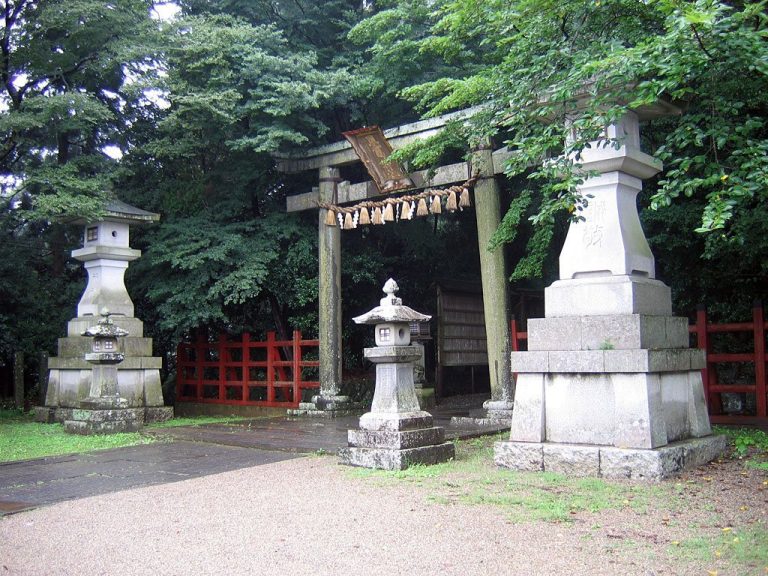
The Great East Japan Earthquake of 2011 caused one injury but did not collapse the shrine buildings. A stone torii and permanent lanterns were damaged, while the pier and other island facilities suffered major earthquake and tsunami damage. The shrine priests temporarily evacuated on March 25, returned in April, and held the May Hatsumi Grand Festival as restoration work continued. The entire island became part of Minamisanriku Kinkazan Quasi-National Park in 1979 and Sanriku Fukko National Park in 2015.
Coastal worship and pilgrimage
Coastal communities, particularly fishermen, revered Mount Kinka as a guardian of fishing and safety at sea. Offshore fishermen used the island’s diminishing silhouette as a distance marker. About 20 nautical miles offshore was called “San no Gote,” about 45 nautical miles was called “Nioboshi,” and the point where the island disappeared below the horizon was called “Yamanashi.” Fishermen offered lamps toward the unseen mountain at sunset, prayed before fishing, scattered rice from passing vessels, and reportedly offered seven Pacific saury during saury fishing for safety and a good catch.
Sailors likewise treated the mountain as a deity of safe navigation. During the 1858 voyage of the Sendai-domain warship Kaisei Maru, the crew chanted “Oyama Oyama.” When Daikin-ji came into view, they washed their hands, rinsed their mouths, scattered white rice on the sea, and prayed.
From antiquity through the medieval period, Shugendo practitioners are thought to have undertaken rigorous mountain asceticism on the island. The Womb Passage ritual expressed the idea of the mountain as a mother’s womb. Participants crawled through a narrow opening beneath a large rock, symbolically experiencing death and rebirth in order to gain new spiritual power. The northeast coast was associated with Sai no Kawara, where visitors were said to hear the voices of deceased relatives.
Early modern devotion also connected older water and serpent beliefs with Benzaiten and with Miroku, the future Buddha expected to appear in a transformed and prosperous age. A 1583 manuscript-box lid preserved at the shrine carries a mandala, a diagram of the Buddhist cosmos formed by an ordered arrangement of deities, with Benzaiten at the center and other deities of good fortune around her. This imagery shows the depth of Benzaiten devotion before the early modern period.
Pilgrims traveled from Sendai through Ishinomaki toward Mount Kinka, using land and sea routes along the Oshika Peninsula. The customary approach led to Yamadori, its first torii, and the Yamadori Strait, also called the Kinka Strait. Pilgrims changed into new straw sandals before landing, stayed overnight at Daikin-ji, and then undertook the ascent. The sandals were left at the pier because the sacred island was treated as a place from which nothing, including ore, plants, or even a grain of sand, should be removed.
Women were traditionally forbidden to cross to the island and worshipped from the first torii at Yamadori. Even deceased Daikin-ji monks were reportedly not buried on Mount Kinka; their remains were carried to Yamadori. Koganeyama associations developed in many regions, sometimes by adapting older serpent-day associations. Membership was restricted to men, principally household heads, who gathered several times each year around a hanging scroll of Mount Kinka, offered sacred sake and lamps, prayed, and ate vegetarian meals.
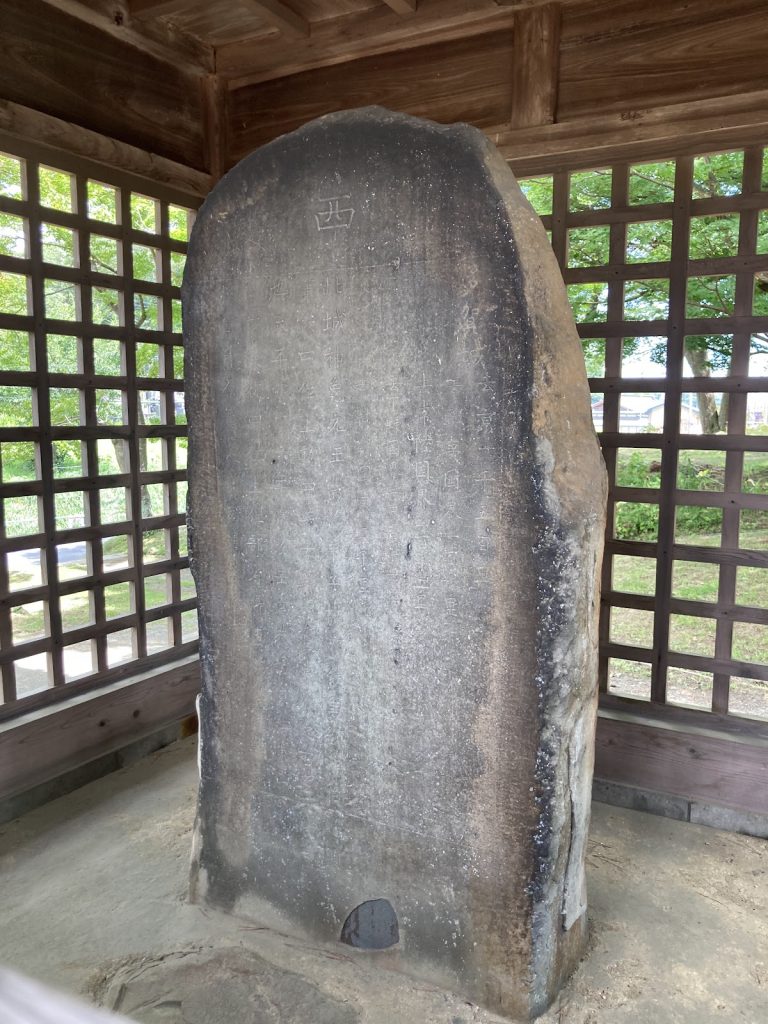
When travel was difficult, two representatives usually made the pilgrimage for the group and distributed sacred talismans after returning. Pilgrimages led to stone monuments at village entrances, crossroads, and local shrine precincts, as well as Benzaiten shrines in compounds and homes. In the modern period, about 500 Koganeyama associations existed across Tohoku, especially Miyagi, and also in Hokkaido and Chiba. In 1921, the shrine reorganized existing associations into the Eitaiko organization to revive the shrine and extend its sphere of worship.
The annual festival takes place on September 25, while the Hatsumi Grand Festival is held in May. Devotion also includes the island ascent pilgrimage, known as Oyama-gake, and continuing prayers for prosperity, good fortune, fishing, and safe travel.
Remains
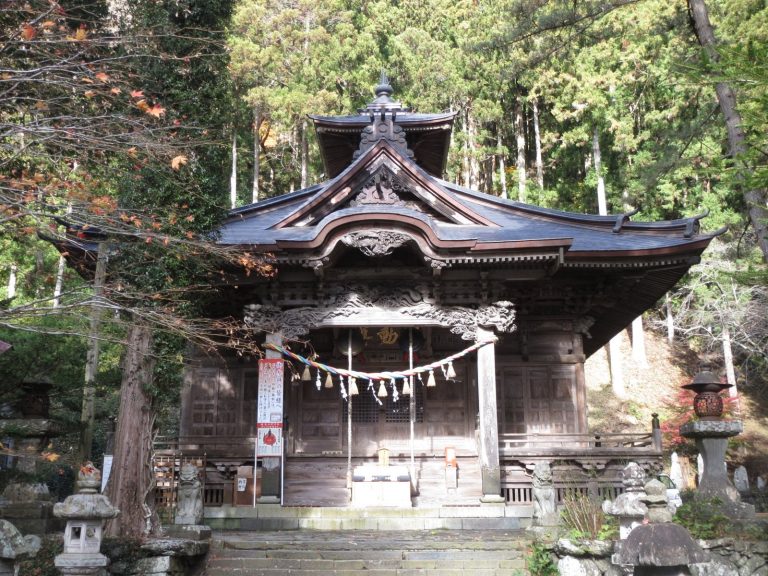
Koganeyama Shrine occupies the western slope of Mount Kinka, facing west at approximately mid-slope. The precinct is treated as part of the sacred island as a whole. The present complex was rebuilt in stages during the approximately 30 years after the 1897 fire, and its principal buildings combine copper-sheet roofing with traditional Japanese forms.
Main shrine buildings
Sanctuary and worship hall
The honden, or main sanctuary, is a three-bay building in the nagare-zukuri style, with a copper-sheet roof. The haiden, or worship hall, is five bays wide and three bays deep. It has an irimoya roof, a form combining gabled and hipped sections, and a three-bay projecting worship porch with a central one-bay karahafu gable. Its roof is also covered with copper sheets.
Prayer hall and gate
Other buildings include a prayer hall and the Zuishinmon gate. The prayer hall retains a practice associated with the former Shugendo tradition, in which petitioners’ prayers are conducted while goma wood is burned. The former site of Daikin-ji lies west of the main sanctuary, linking the present Shinto precinct with the earlier mountain-temple complex.
Bronze permanent lanterns
A pair of bronze permanent lanterns stands before the worship hall. Devotees from Yamagata City donated them separately in 1892 and 1894, and they were cast in Domachi in that city. Each is approximately 4.8 metres high. Together with the lanterns at Kotohira-gu and Yamadera Risshaku-ji, they are counted among Japan’s “three great lanterns.”
Summit sanctuaries and pilgrimage landscape
Owatatsumi Shrine and the summit
During the early modern period, Ryuzo Gongen was enshrined at the summit as the inner sanctuary, with Benzaiten as the central deity. The former summit shrine of Ryuzo Gongen is now Owatatsumi Shrine. A goma altar beside it provides a physical feature associated with the fire-offering rituals of Shugendo. Other points on the island contain shrines and halls dedicated to Atago Gongen, Shinmeigu, and Fudo.
Ascent circuits
The island ascent pilgrimage has front and rear circuits. The front circuit begins at Nameraishi Shrine behind the main sanctuary, passes unusual rocks and stones, reaches Shobudaira, and climbs to Muso Peak and Owatatsumi Shrine. The rear circuit descends from Muso Peak through the Womb Passage, passes Kaizan Shonin’s Meditation Rock and Yamagata Rock, reaches the east coast, and continues around Senjojiki, Senninzawa, Ohakozaki, and Sai no Kawara before crossing Amida Pass back to the main sanctuary.
Other features associated with the ascetic landscape include the former place-names Diamond Realm and Womb Realm, Soji Pass, the Tengu Sumo Ground, Kaizan Shonin’s Meditation Rock, Yamagata Rock, Senjojiki, Senninzawa, Ohakozaki, Sai no Kawara, and Amida Pass. Together they form the physical setting for the island’s mountain practices and ascent pilgrimage.
Shrines, wildlife, and religious objects
Nameraishi Shrine and the island’s deer
Nameraishi Shrine enshrines Takemikazuchi no Mikoto, identified as a branch deity of Kashima Jingu, whose traditions are closely associated with deer. Approximately 530 wild deer were recorded on the island in 2007, and they are protected as divine messengers.
The 1583 sutra box
The shrine preserves a 1583 Great Prajnaparamita Sutra storage box. Inside its lid is an ink mandala with Benzaiten at the center, surrounded by other deities associated with good fortune. The box provides direct material evidence for the religious imagery connected with Daikin-ji and the shrine community during the medieval period.