Yama-dera Temple: A Tendai Buddhist Mountain Temple in Japan


Site at a Glance
- Rating
- 4.5
- Popularity
- Medium
- Country
- Japan
- Primary era
- Medieval
- External website
- Open
- Eras represented
- Medieval, Early Modern
- Civilizations
- Ashikaga shogunate
- Site type
- Religious
- Remains
- Monastery
On this page17 sections
History
Yama-dera Temple, formally Risshaku-ji, is a Tendai Buddhist temple in Japan, located in Yamagata, whose traditional foundation dates to 860 during the Heian period. Emperor Seiwa is said to have ordered the monk Ennin, later known as Jikaku Daishi, to establish it in Dewa Province. Tendai is a major Japanese Buddhist school centered historically on Enryaku-ji on Mount Hiei and grounded in the Lotus Sutra. Yama-dera was founded as a branch temple of Enryaku-ji and became closely associated with Ennin, with Yakushi Nyorai, the Buddha of healing and medicine, as its principal image.
Foundation and association with Ennin
Temple tradition names Ennin as the founder, although the temple record gives him the more specific title of “opening mountain founder” and identifies An’e as the founding ancestor. An’e succeeded Ennin as chief priest of the Tendai school and served as a lecturer in Dewa from 844 to 849. This has led to interpretations that An’e was the temple’s substantive founder. Another tradition holds that, after Ennin’s eastern journey from 829 to 832, he left his disciples Shinno and Jitsugen in the region to begin establishing the temple.
A document dated December 860 and attributed to Ennin survives at Yama-dera, but its later origin has been questioned, so the date does not by itself settle the circumstances of the foundation. Ennin died on Mount Hiei in 864. By the twelfth century, a tradition had developed that he entered final meditation at Yama-dera, and the temple was widely recognized as a sacred place connected with him. A stone inscription dated 1144, positioned above the meditation cave, records the deposition of a copy of the Lotus Sutra under the protection of the great master. An inscription preserved in a statue at another temple and dated 1158 also links sacred wood with Risshaku-ji and Ennin.
Medieval protection and rebuilding
During the Kamakura period, the shogunate assumed the temple’s protection and supervision. Yama-dera became a designated prayer temple for the Kanto region and expanded its religious influence. After a fire in the mid-thirteenth century, its buildings were rebuilt, and the institution was temporarily converted to Zen Buddhism.
In 1356, Shiba Kaneyori, the lord of Yamagata Castle, rebuilt Yama-dera and restored it to the Tendai school. The artist Sesshū Tōyō visited the precincts in 1482 and made sketches of the temple. These medieval developments helped maintain the connection between the mountain complex, Tendai practice, and the regional political authorities.
Destruction, restoration, and regional patronage
The temple was drawn into the wars of the Sengoku period, an era of prolonged conflict among regional military powers. After Yama-dera supported Date Tanemune during his conflict with Tendo Yorinaga in 1520, Tendo attacked the temple in 1521. The entire mountain complex was destroyed by fire, including the ritual fire that had been transmitted from Enryaku-ji.
In 1543, the Tendai monk Enkai climbed Mount Hiei and obtained a new transmission of the ritual fire with financial assistance from Shungen Hokuko-ni. When Enryaku-ji itself was burned in 1571, the fire was transmitted in the opposite direction, from Yama-dera to Enryaku-ji during its rebuilding. The exchange connected the two temples through a religious practice in which ritual flames were preserved and passed between important Tendai institutions.
Yama-dera maintained a close relationship with the Mogami family, the rulers of Yamagata, who protected the temple after its destruction. Shungen Hokuko-ni, the mother of Mogami Yoshimori, helped revive its ruined buildings, and her grandson Mogami Yoshiaki continued that protection. A sixteenth-century estate register assigns the temple 1,300 koku, a historical measure of agricultural production and estate income. Mogami patronage continued until the family was dispossessed in 1622.
Edo-period prosperity and literary memory
After the loss of its principal political patron, Yama-dera drew worshippers from a wider area. At the height of its prosperity in the early Edo period, it was said to hold 2,800 koku in lands supported by shogunal vermilion-seal grants, with 100 subsidiary monastic residences and more than 300 monks. Its Edo-period maintenance endowment is also given as 1,420 koku>.
Matsuo Bashō visited Yama-dera in 1689 while travelling through northern Japan. He composed the celebrated haiku about silence and cicadas sinking into the rocks, linking the temple’s mountain setting with one of the best-known poetic responses to the site. A monument and a cicada mound along the approach preserve the memory of the poem.
Modern investigation and heritage status
Investigation of the meditation cave took place from 1948 to 1949. It recovered a wooden coffin covered with gold leaf, the remains of five people, and the head of a wooden statue believed to represent Ennin. The temple was designated a National Historic Site and Place of Scenic Beauty in 1932. Important cultural-property designations later included the Main Hall in 1908, the 1144 Lotus Sutra stele in 1915, the miniature three-storied pagoda in 1952, the Yakushi statue in 1966, and the wooden head of Ennin with its associated coffin and objects in 2006.
Yama-dera forms part of the Four-Temple Pilgrimage associated with Ennin, together with Chūson-ji, Mōtsū-ji, and Zuigan-ji. It also belongs to a pilgrimage circuit involving three celebrated temples of Dewa and lies within Zaō Quasi-National Park.
Remains
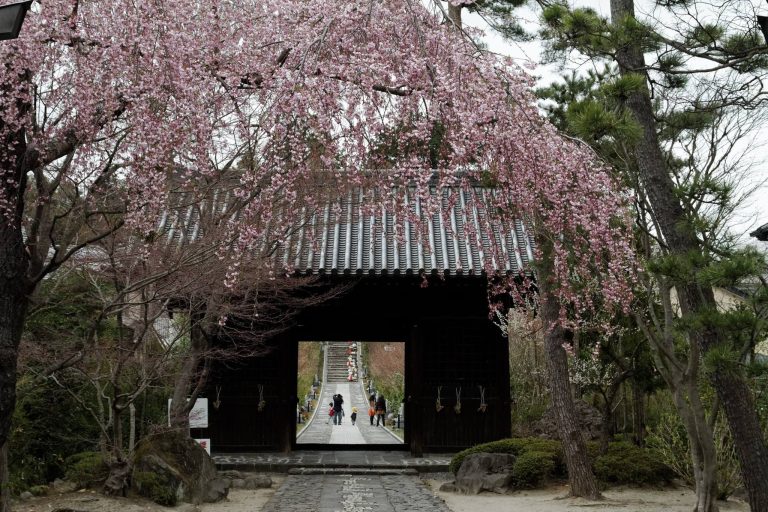
Yama-dera occupies steep, forested, rocky hillsides, with buildings set along the mountain slopes. A stone stairway cut into the rock leads through the precincts toward the upper temple and contains 1,015 steps. East of the temple, a mountain route passes Senju-in Kannon and the Tarumi archaeological site, a former training area for mountain ascetics. This area is known as the “back Yama-dera” or Mine-no-Ura.
Main religious buildings
Konpon-chūdō, or Main Hall
The Konpon-chūdō, or Main Hall, is the principal building of the temple. It is regarded as a medieval structure traditionally rebuilt between 1346 and 1370, with Shiba Kaneyori’s rebuilding in 1356 forming part of that history. Several repairs followed, including a major intervention in 1608, and the hall now preserves the appearance associated with that repair. Local red oak was used in its construction. The hall’s terrace overlooks the surrounding mountain valley.
Yakushi Nyorai
The principal image is a seated wooden statue of Yakushi Nyorai made from a single block of katsura wood. It is considered a work of the Heian period and carries an inscription recording repairs in 1205. The statue is a hidden image, or hibutsu, meaning a sacred figure kept concealed and shown only on restricted occasions. It is not normally displayed. The altar also preserves the ritual fire transmitted from Enryaku-ji, which burns in two lamps on either side of the image. Temple attendants maintain the fire, and the altar doors are opened once every fifty years.
Meditation cave and inscriptions
Ennin-associated meditation cave
A meditation cave traditionally associated with Ennin’s burial lies within the temple grounds. The investigation carried out from 1948 to 1949 recovered a gold-leaf-covered wooden coffin, five sets of human remains, and the head of a wooden image associated with Ennin. The image is considered a Heian-period work on stylistic grounds. Its eyes, nose, and other facial features have led to its recognition as a portrait. The coffin is accompanied by a wooden five-ringed pagoda and wooden tablets dated 1618 and 1687.
Lotus Sutra stele
The 1144 Lotus Sutra stele stands above the meditation cave. A Lotus Sutra stele is a stone monument that records the copying or ritual deposition of the Buddhist scripture. Its inscription states that a monk and others copied the eight-volume Lotus Sutra and deposited it beside the sacred cave on August 18, 1144. The stele is not open to ordinary viewing.
Cliff chamber and other precinct features
Miniature three-storied pagoda
A wooden miniature three-storied pagoda, 2.5 metres high, stands inside a rock chamber cut into a cliff on the right side of the grounds of Kezō-in. It faces south. An inscription on its finial gives the date 1519, indicating that the tower was probably erected around that time.
Precinct structures and Bashō memorials
Other identified components of the precincts include the sutra repository, Founder’s Hall, Niomon gate, Oku-no-In, lanterns, and the Taimenseki meeting stone. Ennin is traditionally said to have met Banji Banzaburō at the meeting stone. In the lower grounds, a statue of Bashō and a stone engraved with lines from his haiku stand near the approach, which also contains the poem’s monument and the cicada mound.
Housed cultural assets
The temple’s treasure house contains standing wooden images of Shaka Nyorai, Yakushi Nyorai, and Amida Nyorai, as well as a seated wooden image of Dengyō Daishi. It also houses a hanging wooden mandala depicting the Buddha. Together with the principal image, the Ennin-associated objects, and the surviving inscriptions, these works preserve the religious and historical associations of the mountain temple.