Aterazawa Tateyama Castle: A Medieval Mountain Fortress in Japan
Site at a Glance
- Rating
- 4.2
- Popularity
- Low
- Country
- Japan
- Primary era
- Medieval
- External website
- Open
- Eras represented
- Medieval, Early Modern
- Civilizations
- Ashikaga shogunate
- Site type
- Military
- Remains
- Castle
On this page13 sections
History
Aterazawa Tateyama Castle is a Japanese mountain castle in Aterazawa, Ōe, Yamagata Prefecture, Japan. Established by the Aterazawa clan in the fourteenth century, during the Northern and Southern Courts period, it occupied a strategic position above the Mogami River and the Imokawa Gorge. The gorge connected the Yonezawa and Murayama regions, while the river linked the Yonezawa and Yamagata basins with the Sakata Plain and the Sea of Japan coast. The castle therefore controlled river traffic and the junction between water and land transport. During the medieval period, this point was the furthest inland location that large ships could reach.
Foundation and the Northern and Southern Courts
The castle’s first fortification was established by Aterazawa Mototoki, the second son of Ōe Tokishige. The Ōe clan placed relatives at several fortified locations as it prepared for the Northern and Southern Courts conflict, a fourteenth-century struggle between rival imperial courts in Japan. Mototoki was assigned to Aterazawa, where the mountain stronghold developed as a base for the clan.
The Aterazawa clan supported the Southern Court against the Ashikaga shogunate, Japan’s medieval military government. In 1368, Mogami forces defeated the Aterazawa at the Battle of Urushikawa. Mototoki and more than sixty members of his clan then committed suicide. Other members of the family continued to protect Aterazawa Tateyama Castle for generations. After the defeat, the Aterazawa submitted to Shiba Kaneyori, a medieval military leader whose family later adopted the name Mogami.
Expansion and Sengoku conflicts
The castle was later expanded in response to pressure from the Date clan advancing from the south. The Sengoku period, an era of competing regional warlords before Japan’s political unification, brought further changes to the local balance of power. The recorded succession of Aterazawa lords includes Mototoki, Ujimasa, Mitsuhiro, Tokitaka, Yorihiro, Masakatsu, Mitsumasa, a second Ujimasa, and Masachika.
Mitsumasa helped the Shiraiwa and Dewa Kikkawa families repel a Mogami invasion mounted in support of the Sagae clan. Aterazawa Masachika, who had been adopted into the main Kikkawa family, was killed in 1514 during a conflict involving the Mogami and Date clans. The Aterazawa genealogy becomes unclear after his death, although the clan supported the Date side during the Mogami Disturbance of 1574. A tradition also associates the later Ujimasa with the Dajoji family, which served as his ceremonial sponsor.
Mogami rule and abandonment
When the Sagae clan was destroyed by the Mogami in 1584, Aterazawa came under Mogami rule. Aterazawa Tateyama Castle then served as a local administrative center of the Mogami domain. During the Keichō Dewa Campaign of 1600, a military operation in Dewa Province connected with the wider conflict surrounding the establishment of Tokugawa rule, the castle was apparently attacked by a detachment under Naoe Kanetsugu.
After the Mogami clan was dispossessed in 1622, the castle passed to Sakai Naotsugu, lord of Aterazawa Domain. It remained in use until a new castle was built at Ko-Urushikawa during the Kan’ei period, approximately 1624 to 1645. The former mountain castle was then abandoned.
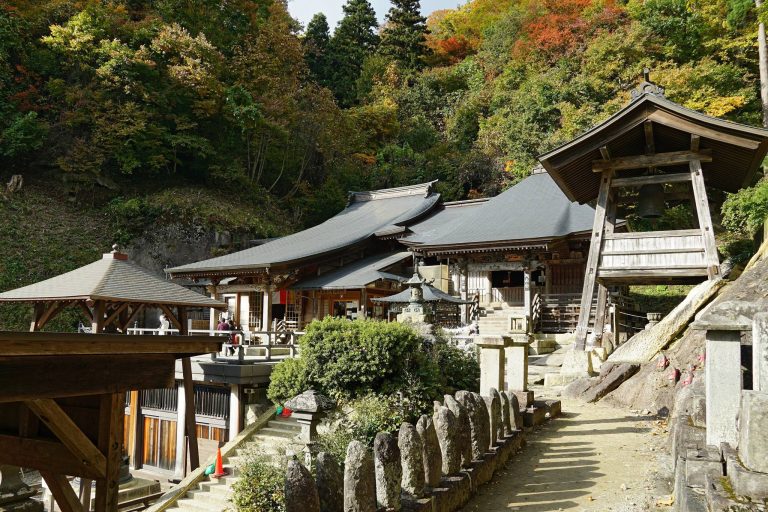
Koka-in, originally located north of Rakui in the Sagae Estate near the former Daimon of Terayama, was probably transferred into the castle when Mototoki established it. During Sakai Naotsugu’s construction of the new castle, the temple was moved to its present location. Its gate was transferred from the new castle in 1648.
Protection and later interpretation
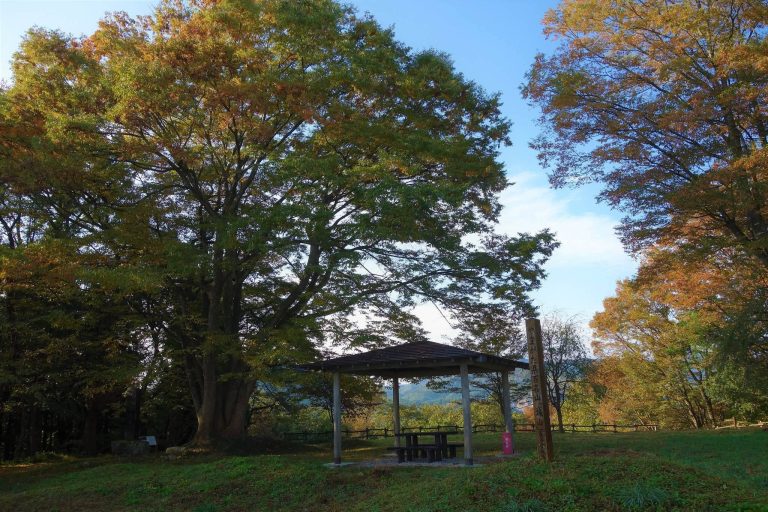
The castle ruins were designated a National Historic Site of Japan on February 12, 2009. The area is now associated with Tateyama Park. The view of the Mogami River from the park was selected as a Mogami River viewpoint in 1997 and as one of Japan’s 100 Best Walking Routes in 2002.
Remains
Aterazawa Tateyama Castle occupied a long, U-shaped plateau on a hill about 100 meters above a bend in the Mogami River, near its confluence with the Sagae River. The eastern side overlooked the Sagae Plain. The recorded complex extended approximately 1,300 meters from east to west and 600 meters from north to south, while the principal U-shaped hilltop position measured about 500 meters long and up to 400 meters wide. Its defenses relied mainly on earthen terraces, clay walls, and dry moats, meaning ditches without water.
Hilltop enclosures
Main bailey
The main bailey contained the castle residence and a Hachiman shrine. Hachiman is a Japanese deity associated especially with warfare and the protection of warriors and communities. The shrine was established through the transfer of the Hachiman cult from Sagae Hachimangu. Koka-in occupied the northeastern sector, traditionally regarded as the castle’s demon gate. No castle buildings survive, but scattered fragments of earthen ramparts and terraces preserve parts of the former enclosure system.
Second bailey
The summit of the second bailey formed a level area called Senjoshiki. Its elevated position provided extensive views across the surrounding landscape. The second bailey formed part of the connected hilltop defenses, whose small terraces were separated by earthen or clay walls.
Third bailey
The third bailey was separated from the second by a dry-cut moat. This cut also carried the main road from Aterazawa toward Sagae, Yachi, and Oishida. A northern elevated area belonged to the third bailey, while the slopes south of the enclosure and its western end contained temples and shrines. Traces of these religious installations remain among the surviving archaeological features.
Slopes and entrances
River-facing defenses
On the slopes facing the river, vertical dry moats hindered attackers attempting to climb from ships anchored below the castle. These ditches formed part of the defenses of the steep riverward side and survive as scattered earthworks within the larger ruin.
Rear terraces and gate
The rear side of the hill was strengthened with terraces. The entrance included a small masugata-style gate, a bent or enclosed arrangement intended to restrict attackers and expose them as they entered. Together with the ramparts, dry moats, and numerous smaller terraces, these remains show how the castle adapted the long hilltop and its slopes for defense. The surviving site consists of fragmentary earthen works and traces of the former religious installations rather than standing castle buildings.