Świnoujście Fortress: A Prussian Coastal Fortification Complex in Poland


Site at a Glance
- Rating
- 4.6
- Popularity
- Very Low
- Country
- Poland
- Primary era
- Modern
- Eras represented
- Modern
- Civilizations
- German
- Site type
- Military
- Remains
- Fort
On this page17 sections
History
Świnoujście Fortress is a Prussian fortification complex at the mouth of the Swina River in Poland, built chiefly in the nineteenth century according to the new Prussian fortification system to protect the waterway and the port of Świnoujście. Its principal nineteenth-century design is attributed to Johann Leopold Ludwig Brese. The complex occupies positions on both sides of the river and reflects the strategic importance of the Oder and Swina approaches to the Baltic Sea.
The Thirty Years’ War
The first fortified position at the Swina developed during the Thirty Years’ War, the major European conflict of 1618 to 1648. Imperial forces occupied Pomerania in 1628, and Colonel Hebron ordered a defensive earthwork known as the Swine Sconce near the river. Its purpose was to prevent hostile landings. Nearby settlements were compelled to provide labor for its construction.
Danish troops under King Christian IV captured the position after several days of assault. They withdrew, however, after the Danish defeat at Wolgast. On 26 June 1630, the Swedish army under King Gustav II Adolf landed at Peenemünde. Imperial forces on Usedom could not hold both the Peenemünde and Swina positions. In 1634, Swedish Major General Alexander Leslie ordered the Swine Sconce rebuilt, again using compulsory local labor. Timber for its palisades came from the Kaseburg forest.
After the Peace of Westphalia, western Pomerania and the approaches to the Oder through the Peene, Swina, and Dievenow belonged to Swedish Pomerania. Control of the fortified river positions continued to change during the conflicts that followed.
Swedish and Brandenburgian campaigns
During the Second Northern War, imperial forces under Generalfeldwachtmeister von Starhemberg advanced from Wolin toward the Swina in 1659. Swedish troops abandoned the fortifications on the Wolin bank but reinforced those on Usedom, after which imperial forces occupied the island. Swedish troops commanded by Carl Gustav Wrangel recaptured Usedom on 4 November 1659.
The Swine Sconce changed hands again during the Swedish-Brandenburg War. Brandenburgian troops under Bogislaw von Schwerin captured it in October 1675. Swedish troops under General Conrad Mardefelt retook the Swina and Peenemünde positions after a siege in December. Brandenburgian forces later crossed the ice-covered Szczecin Lagoon near Kamminke and attacked the Swine Sconce on 22 May 1676, but the assault failed. Sweden regained Usedom under the Peace of Saint-Germain in 1679. An inspection in 1692 found the Swina fortifications in disrepair.
Prussian control and the eighteenth-century defenses
During the Great Northern War, Usedom and Wolin came under Prussian sequestration in 1713. Prussia strengthened the defenses on Usedom, using 600 peasants from the surrounding administrative district and 82 citizens from Wolin as laborers. Swedish troops captured the Peenemünde, Wolgaster Fähre, and Swina positions between 20 and 24 April 1715. Prussian forces under General von Arnim recaptured the island in the following weeks. Sweden ceded Usedom and Wolin, together with Old Pomerania, to Prussia in the Peace of Stockholm in 1720.
Construction of the port town of Swinemünde began in 1746 on the orders of Frederick II, also known as Frederick the Great, the eighteenth-century king of Prussia. During the Seven Years’ War, Swedish troops captured the Swine Sconce in 1757 after its small Prussian militia garrison withdrew to Wolin. Prussian forces returned in early 1758, repaired the position, and added defenses on the Wolin side.
Swedish troops under Major General von Hessenstein occupied Usedom again in July 1758, but were driven back before the end of the year. Swedish forces under Fredrik Axel von Fersen captured the West Redoubt after bombardment from land and sea. The Mövenhaken Sconce was abandoned after being set on fire, while the Blockhouse Sconce held out and forced Swedish warships to withdraw. After a Prussian flotilla was defeated by the Swedish archipelago fleet on 10 September, Prussia abandoned the Wolin side. Sweden later demolished the fortifications before leaving the island in 1761.
Rebuilding and the nineteenth-century fortress
During the Coalition Wars, the Swinemünde Sconce was rebuilt in 1812 and armed with fortress artillery. Prussia also expanded coastal defenses around Swinemünde that year against possible Russian or British fleets. The position again deteriorated after the wars, leading to a more substantial nineteenth-century reconstruction.
Construction of the modern fortress was ordered and carried out from 1848 to protect the mouth of the Swina. Franz von Kleist directed the fortress works from 1852 to 1857 and organized them according to the new Prussian fortification system. Work began on Werk I, on the eastern bank of the Swina, in 1848. The Engelsburg, later designated Werk III, was built on the western bank from 1854 to 1858. The project’s design is attributed to Johann Leopold Ludwig Brese.
A permanent garrison was required from 1856. A company of the 2nd Jäger Battalion served until 1859, followed by a battalion of the 2nd Grenadier Regiment from 1860 to 1864. Swinemünde became an independent third-class fortress in 1863. During the German-Danish War, part of the Prussian fleet took refuge at Swinemünde and was blockaded there by Danish ships.
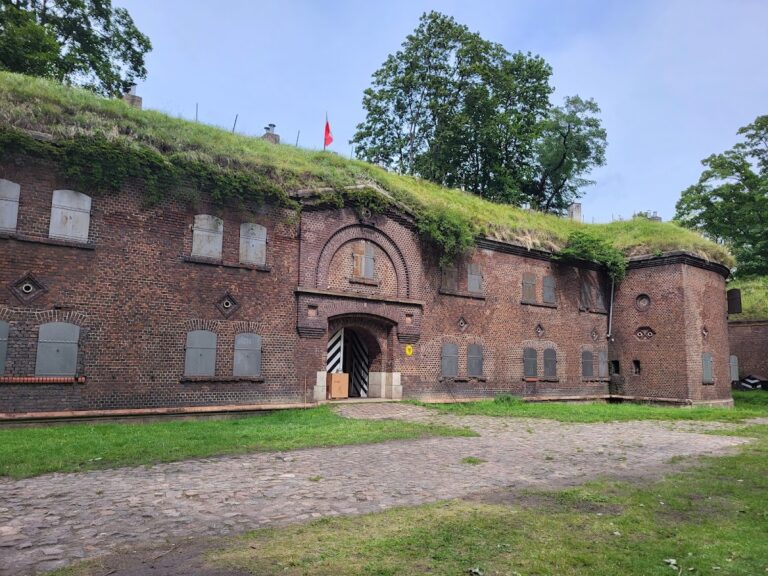
The fortifications and artillery positions were modernized around 1870 to 1880 as artillery technology advanced. Werk II, also called Fort Gerhard, had been completed in 1859 and was extensively expanded in 1877. The work added covered ammunition bunkers, barracks, a headquarters building, and renewed gun positions.
Construction of Werk IV began in 1856, followed by major expansion in 1861 and 1863. The work was successively known as Werk IV, Battery A, the West Battery, and Battery Henningsen. Its latter name commemorated Lieutenant Wilhelm Henningsen, commander of a naval assault troop company who died at Westerplatte in 1939. After the Second World War, the Soviet forces called it the 485th Soviet Coastal Battery. It is now known as Fort Zachodni.
Wartime transformation and the end of military use
During the Second World War, the fortress’s purpose changed substantially. Its main artillery was reorganized for long-range fire toward the sea and for anti-aircraft defense. A radar tower was added to the Engelsburg, and a concrete observation and command tower was built at the western end of Werk IV in 1941. As an Allied landing became less likely, artillery was transferred away from the fortress in favor of the Atlantic Wall, Germany’s extensive Second World War coastal-defense system.
Świnoujście was heavily bombed because it contained an important German naval base. On 12 March 1945, 200 B-17 and B-24 bombers of the Eighth Air Force attacked the city, which was crowded with refugees. Estimates of the dead range from 3,000 to 4,000 and from 4,500, while the frequently circulated figure of 23,000 is considered untenable. Most victims were buried in mass graves on nearby Golm. Approximately 55 percent of the city was destroyed, while the fortress suffered little wartime damage.
In April 1945, the Royal Air Force’s 617 Squadron attacked the heavy cruiser Lützow three times in the Kaiserfahrt south of Swinemünde. Eighteen Avro Lancaster bombers sank the ship on 16 April using Tallboy and 500-kilogram bombs. A British bomber crashed in a forest on Kaseburg, now called Karsibór, and a monument on the island commemorates the British pilots killed in the attack.
The Red Army, the armed force of the Soviet Union, captured Swinemünde on 5 May 1945 after fighting German forces that included a unit of the Tenth SS Corps. Troops of the 2nd Shock Army under General Ivan Fedyuninsky and the 19th Army under General Vladimir Romanovsky took part in the capture. Soviet authorities then made the harbor, spa park, and fortifications a restricted zone until 1961.
The Potsdam settlement placed Swinemünde under Polish administration. The formal transfer to Polish authorities took place on 6 October 1945, followed by the expulsion of the remaining and returning German population. The last local German technical personnel employed by the Soviet Baltic Fleet were expelled in January 1951. The Engelsburg, parts of the war harbor, and barracks on the western edge of Świnoujście remained occupied by the Soviet Army until 1992. Soviet naval units and offices withdrew at the end of that year, ending military use of the fortress complex.
After the fortifications became largely unused, vegetation overgrew them and the sites were neglected. Clearance and opening began after 2000. Werk II, Werk III, and Werk IV were cleared, made accessible, and equipped with exhibition material. They now function as museums and gastronomic facilities. Werk I, the fourth original fort, was demolished in the 1970s during expansion of the Świnoujście harbor.
Remains
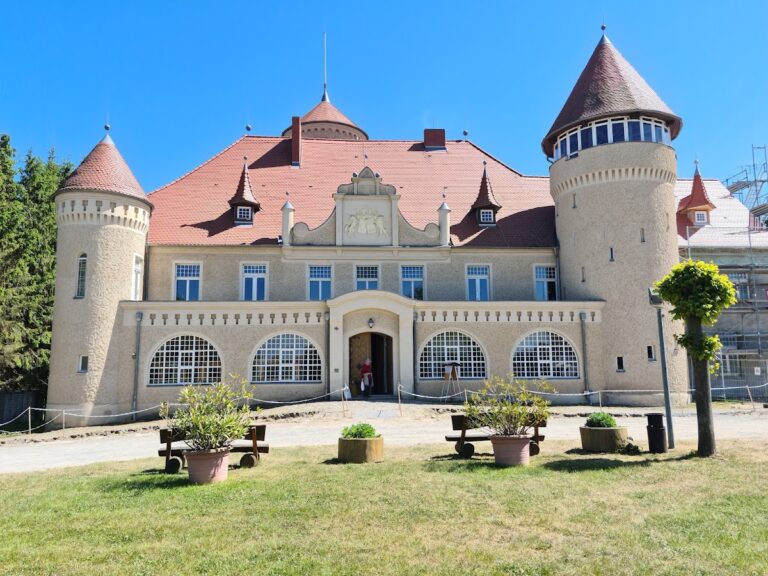
The fortress was arranged on the islands of Usedom and Wolin, northeast of present-day Świnoujście, around the mouth of the Swina. Its principal works stood on both sides of the waterway, combining artillery positions, ramparts, ditches, enclosed rooms, and supporting buildings. Three of the original four forts survive: Fort Gerhard, Fort Anioła or Engelsburg, and Fort Zachodni. The works are generally maintained and adapted for museum and public use.
Early earthworks and river defenses
Swine Sconce and eighteenth-century positions
The original Swine Sconce was an earthwork strengthened with palisades. Later defenses included the rectangular West Redoubt on Usedom and the Blockhouse, East Swina, and Mövenhaken sconces on the Wolin side. These positions were constructed from dune sand held in place by fascines, bundles of branches used to stabilize military earthworks. The redoubt was a detached fortification, while the sconces were smaller fortified works, often formed mainly as earthworks.
Eastern bank works
Werk I
Werk I stood on the eastern side of the Swina in a semicircular plan oriented toward the east. Ramparts and advanced ditches protected the position. At the river, a central two- or three-storey brick artillery building secured the sea entrance. A large trapezoidal central structure contained gun traverses, raised masses of earth or masonry that shielded artillery and defenders from fire. Casemates, vaulted or enclosed fortified spaces used for troops and artillery equipment, lay beneath the outer ramparts. The fort was demolished in the 1970s during harbor expansion.
Werk II, Fort Gerhard
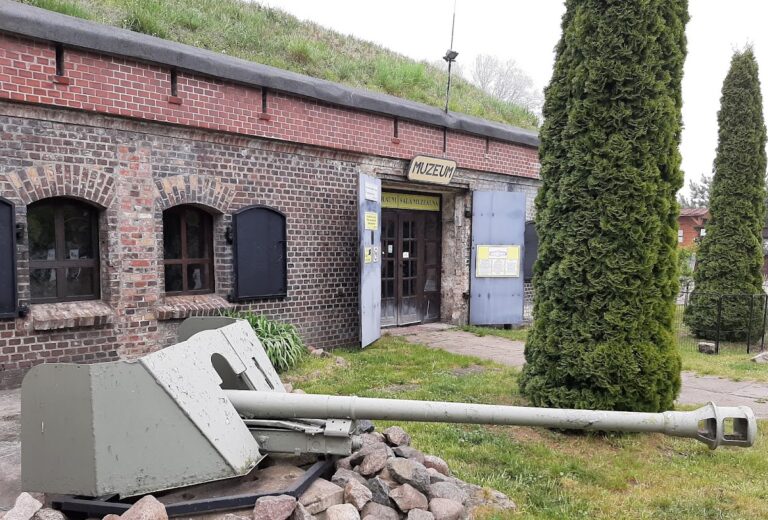
Werk II, now known as Fort Gerhard, was initially designed to allow fire in all directions. Additional defenses later faced the Swina. The fort protected the river entrance and the coast against landings. Its major expansion in 1877 added large covered ammunition bunkers, barracks, a headquarters building, and renewed gun positions on the traverses. The surviving fort is maintained for museum use, with exhibitions installed in accessible buildings and other spaces adapted for public facilities.
Western bank works
Werk III, the Engelsburg
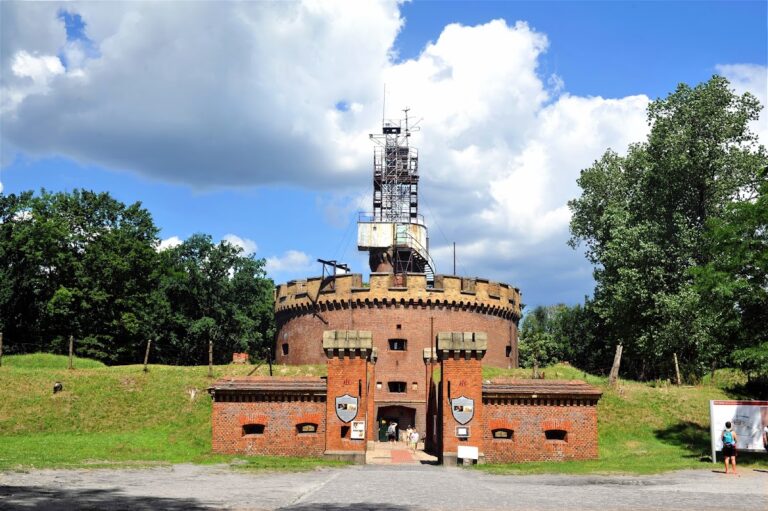
Werk III, known as the Engelsburg or Fort Anioła, has a pentagonal plan enclosed by ditches and ramparts. A stepped brick tower stood at its center, resembling the Papal Fortress in Rome and giving the work its name. The upper storey contained an observation and command post for the entire fortress. Gun positions occupied the ramparts and tower terraces, while casemates for troops and ammunition were built into the ramparts. The tower also contained the fortress commander’s residence. A radar tower was added during the Second World War. The Engelsburg survives and is used as a museum and public facility.
Werk IV, Fort Zachodni
Werk IV, now Fort Zachodni, was originally called the Redoubt and later Battery A. Its seaward-facing gun positions stood on traverses behind water-filled ditches and ramparts. Casemates formed part of the defensive structure. Between 1878 and 1887, the north rampart was extensively fitted with large casemates, and a covered alarm courtyard was added.
The armament changed repeatedly. Light field artillery was used from 1856 to 1878, followed by four 21-centimeter Krupp guns from 1878 to 1919. Two 8.8-centimeter anti-aircraft guns served from 1919 to 1935, and four 15-centimeter S.K.L/45 guns from 1935 to 1942. Four 15-centimeter S.K.C/28 guns were installed from 1942 to 1945, while three 127-millimeter Mk.30 guns were used during the Soviet period from 1946 to 1961.
A concrete observation and command tower was built at the western end of Werk IV in 1941. The fortifications remained largely intact during the Second World War, although their masonry suffered greater damage from material shortages in the 1960s. Fort Zachodni is now maintained for museum and public use, with exhibition areas and other spaces adapted for gastronomic functions.
Connecting defenses
Work between the Engelsburg and Werk IV
A connecting work between the Engelsburg and the Redoubt began in 1863. It consisted of ramparts and water-filled ditches, with casemates for troops and ammunition. A gate with a drawbridge faced the town. This gate provided a landward connection because the route south along the Swina was blocked by the Westernothafen.
Nearby sites