Fort Gerharda: A Prussian Coastal Artillery Fort in Poland


Site at a Glance
- Rating
- 4.7
- Popularity
- Medium
- Country
- Poland
- Primary era
- Modern
- External website
- Open
- Eras represented
- Modern
- Civilizations
- German, Kingdom of Prussia
- Site type
- Military
- Remains
- Fort
On this page12 sections
History
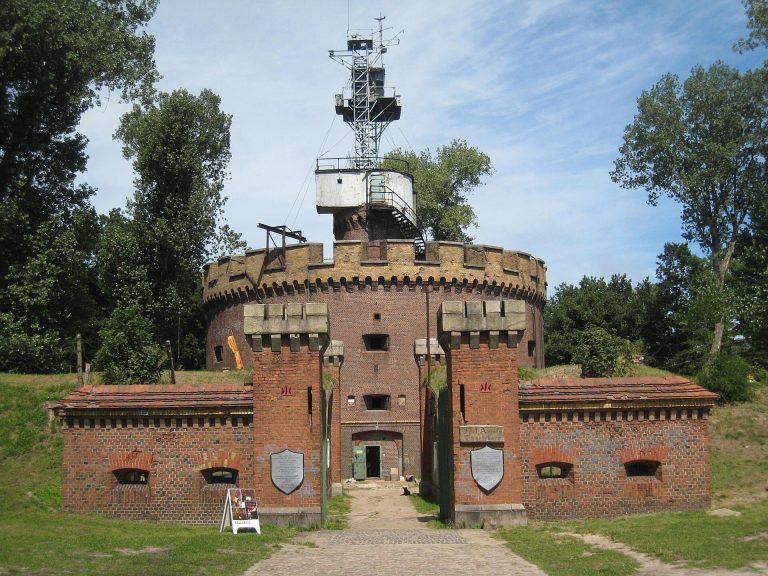
Fort Gerharda is a Prussian coastal artillery fort in Poland, located in Świnoujście on Wolin Island. Built between 1848 and 1859, it formed part of the Świnoujście Fortress, a defensive system created to protect the port and the Świna Strait from an enemy fleet. The fort is regarded as one of the best-preserved Prussian coastal artillery forts in Europe.
Origins and Prussian defense
The fortifications at Świnoujście followed a Danish naval blockade during the First Prussian-Danish War in 1848. A Danish frigate blocked the Świna for several months, interrupting trade and causing major losses. In response, the Prussian army developed defenses for the waterway, which led toward the Szczecin Lagoon and the port of Szczecin.
Fort Gerharda, also known as the Eastern Fort or Werk II, originally had two separate parts: a fortified work and an artillery battery. The battery was intended to fire on ships trying to close the entrance to the strategically important strait. Its first garrison consisted of about 300 infantry and artillery troops.
Reconstruction after 1871
Following Prussia’s victory in the Franco-Prussian War of 1870–1871, the fort was rebuilt in 1876 and 1877. French reparations from that conflict financed the work. The earlier division between the fortified work and the battery was removed, producing a unified fortification with a new defensive arrangement.
During the reconstruction, the redoubt, a fortified defensive building, was stripped of its guns and converted into barracks. New artillery terraces, ammunition magazines, and positions for field artillery were added, followed later by machine-gun positions. The fort’s defenses were increasingly directed toward the north. Further alterations took place in 1900 and 1901, after the fort had been linked to the telegraph network and a narrow-gauge railway around the turn of the twentieth century.
Twentieth-century military use and preservation
After the First World War, the German navy administered the fort, which continued to serve in an auxiliary capacity until the end of the Second World War. The Soviet military then used the site. In 1962, the fort was transferred to the city. After the Soviet army departed, it served for several years as storage space before being abandoned.
In 2001, the fort was leased to enthusiasts who established a living-history initiative there. Living history recreates military life, clothing, and practices through interpretation and demonstrations. The site presents a historical commandant of the fortress, while costumed students conduct tours in Prussian uniforms. Since 2010, the Museum of Coastal Defence has been based at Fort Gerharda and is its current owner.
Remains
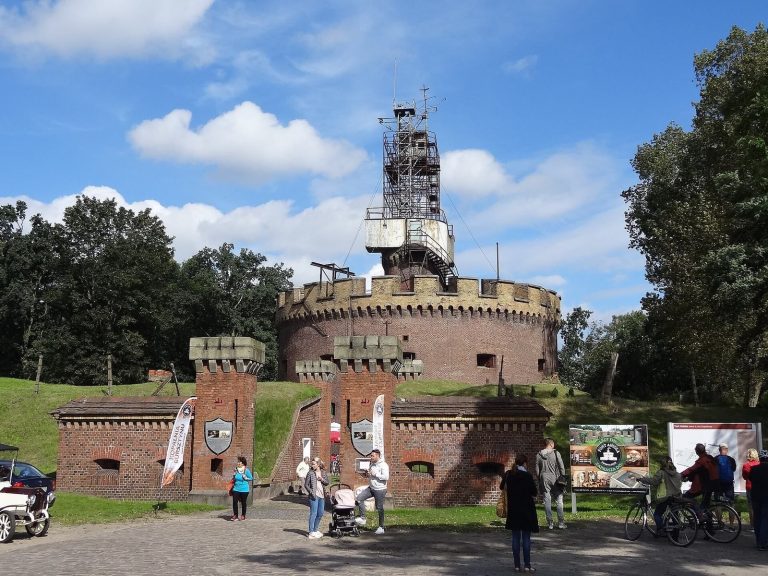
Fort Gerharda preserves a unified coastal fortification organized around a two-storey redoubt, artillery positions, a parade ground, defensive structures, and underground passages. The original work was surrounded by a wet moat, a water-filled defensive ditch, while the reconstructed fort received a new moat more than 800 metres long. Stone, brick, earth embankments, protected chambers, and surviving gun positions together reveal the changes made to the fort during the nineteenth century.
Redoubt and artillery defenses
The redoubt
The two-storey redoubt originally contained 25 twelve-pounder guns in artillery casemates on both floors. A casemate is a vaulted or protected chamber used for artillery, ammunition, or shelter. Rifle loopholes faced the parade ground, but during the 1876–1877 reconstruction they were widened and fitted with windows when the building became the fort’s barracks. Two granite stones above the entrance carry the date of completion. Near the entrance, two lift shafts in the ceiling were used to move guns to the upper floor, and a smaller lift served ammunition.
Artillery terraces and bench
The original northern battery was protected by earth embankments and carried Prussian muzzle-loading guns, which were loaded through the front of the barrel. The reconstructed fort preserves an artillery bench, a linear platform formed by a series of gun positions. Its stone-and-brick positions were designed for 150 mm and 210 mm coastal guns, and remains of several types of gun mountings survive.
The lower artillery terrace held four Krupp 15 cm Ring Kanone C/72 guns on fortress carriages. Seven 21 cm guns stood on the upper terrace. An artillery terrace is a raised area that provides guns with firing positions and a suitable field of view. Together, these terraces preserve the arrangement created when the separate battery and fortified work were combined.
Moat structures and underground passages
Caponiers and shooting shelters
The fort’s original defenses included a half-caponier and two caponiers. A caponier is a projecting fortified structure designed to defend a moat, while a half-caponier projects only partly into it. The northern and southern caponiers are connected with the fort by underground tunnels.
Two shooting shelters were built in the southern and northern sections of the moat. Underground tunnels connect both shelters with the fort’s courtyard, creating protected links between the moat defenses and the central enclosure.
Magazines and casemates
Additional ammunition magazines were built during the nineteenth-century reconstruction. The surviving complex includes the main powder magazine and casemates, as well as the north-eastern caponier. These protected spaces formed part of the fort’s system for storing ammunition and supporting its artillery positions.
Museum collections and surviving objects
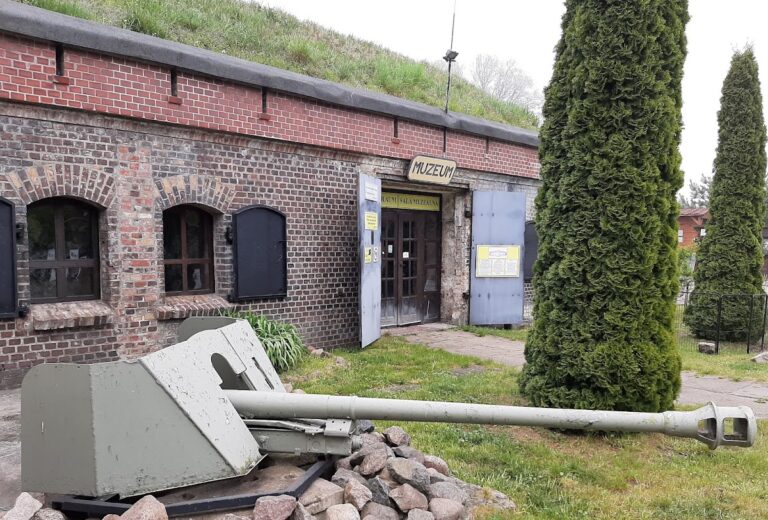
The redoubt now contains the largest private museum in Poland, with more than 3,000 exhibits arranged in five exhibitions: “God of War, Artillery,” “History of Świnoujście,” “Fort Kitchen,” “Armoury,” and “Kalashnikov-System Weapons, 1947–2019.” The museum interiors occupy rooms within the redoubt and present the fort’s military and local historical themes.
A wrecked Sd.Kfz. 7/2 vehicle stands on the parade ground. It was recovered from the sea near Dziwnów in 2006. Alongside the surviving structures, this vehicle forms part of the material collection preserved within the fort.