White Pyramid: Amenemhat II’s Royal Burial Complex at Dahshur, Egypt
Site at a Glance
- Rating
- 4.4
- Popularity
- Medium
- Country
- Egypt
- Primary era
- Bronze Age
- Eras represented
- Bronze Age
- Civilizations
- Egyptian
- Site type
- Burial
- Remains
- Pyramid
On this page14 sections
History
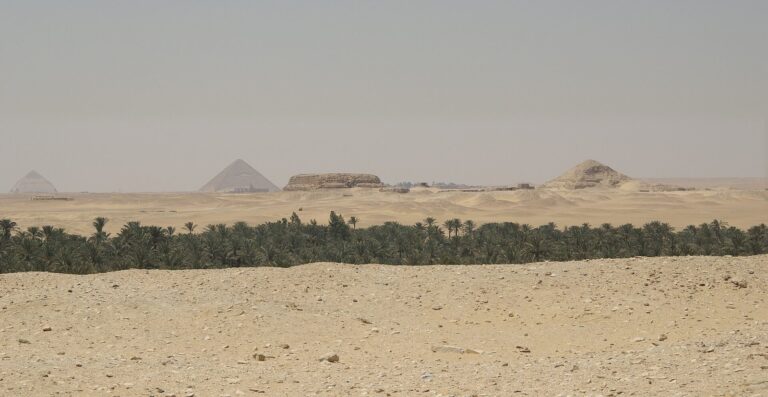
The White Pyramid is the royal burial complex of Amenemhat II in Egypt’s Al Giza Desert, within the Dahshur pyramid field. Built during the reign of this 12th-Dynasty king (1929–1895 BCE), in the Middle Kingdom, it marked a return to Dahshur after Snefru, a 4th-Dynasty king of the early Old Kingdom, built the Bent Pyramid and the Red Pyramid there. Amenemhat II also restored the area’s ancient burial ground.
Amenemhat II’s building program
Work began in Amenemhat II’s fifth regnal year, counted from his accession, during the fourth month of Akhet, one of the seasons in the ancient Egyptian calendar. Asian prisoners of war were also involved in the project. The complex was notably modest in scale given the prosperity and length of the king’s reign.
The pyramid’s ancient name is uncertain. Ba-Imen-em-hat is considered the likeliest reading, while Ach-Imen-em-hat and Djefa-Imen-em-hat are other proposed readings. The last name, meaning “Amenemhat is provided for,” may instead have referred to the cult facilities, mortuary temple, or wider precinct. The associated pyramid town, a settlement serving the complex’s worship and administration, was called Sechem-Imen-em-hat, or Sechem-Imeni for short. Amenemhat III, Amenemhat II’s great-grandson, later incorporated a town of that name into his own pyramid complex.
Quarrying and archaeological study
Stone quarrying left the pyramid largely demolished. The removal of stone may have begun as early as the Middle Kingdom, perhaps by people from nearby villages, and structural failure or collapse may also have contributed to the destruction.
Jacques de Morgan excavated at the complex in 1894–1895, concentrating on the surrounding royal tombs, particularly those of princesses. Much of the rest of the precinct received only limited examination. A comprehensive investigation remains outstanding, and the valley temple has not been examined. Excavations in November 2018 found eight mummies in the pyramid, three reportedly well preserved. Amenemhat II’s burial there remains unconfirmed.
Remains
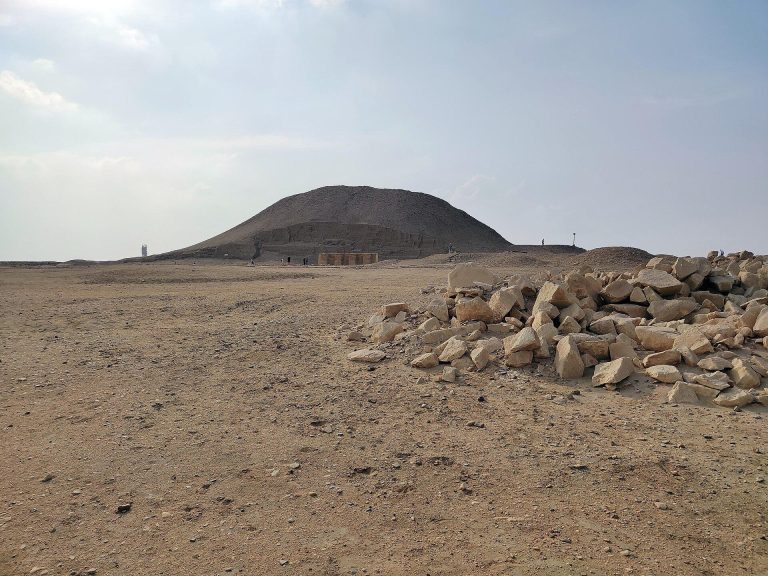
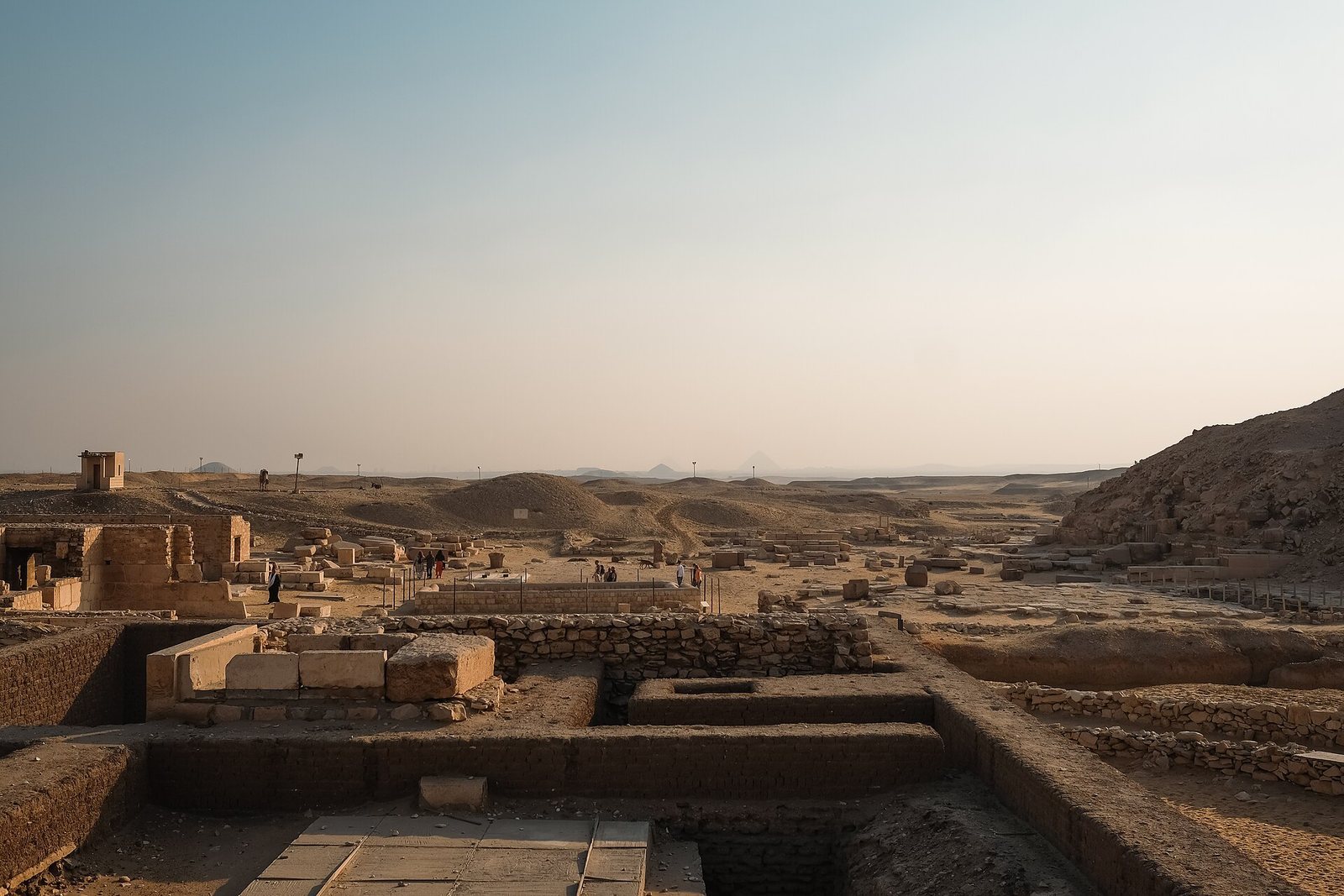
The complex was arranged within an east–west rectangular enclosure about 220 metres long and 100 metres wide. Its outer wall alternated projections and recesses in a pattern resembling a palace façade. The pyramid stood at the centre, dividing the enclosure into two unequal courts.
Enclosure and ceremonial approach
Eastern entrance
At the eastern entrance, two massive mud-brick structures faced with stone flanked the approach. They have been described as early precursors of temple pylons, monumental gateways formed by paired towers.
Causeway and temple remains
A processional causeway, a ceremonial route linking parts of a temple complex, extended east from the precinct toward a valley temple. About 20 metres wide and 800 metres long, it had side walls and stone paving. The valley temple has not been investigated. Traces and rubble mark the mortuary temple, whose plan cannot be reconstructed. Fragments of stone, an offering table, and broken friezes in the eastern court point to a cult temple there.
Pyramid and burial chambers
Pyramid and core
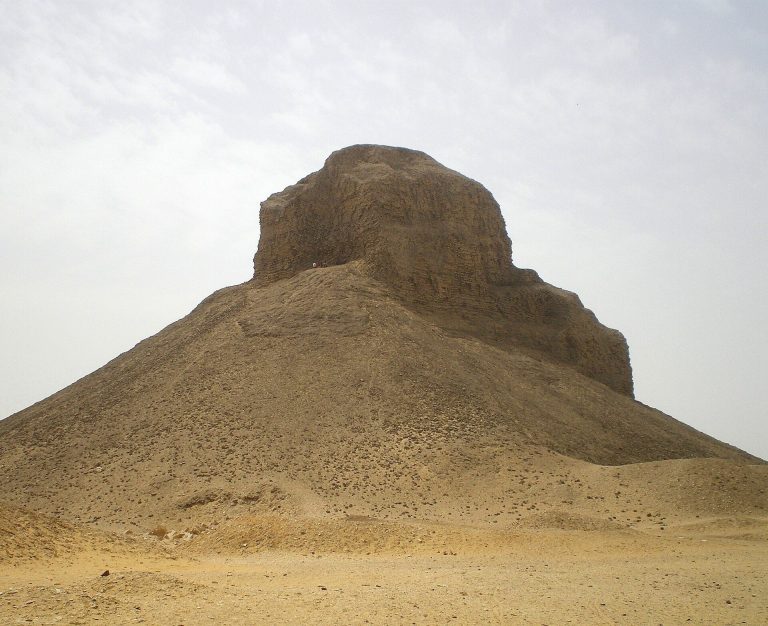
The pyramid had a square base estimated at about 50 metres on each side. It now survives chiefly as a mound of rubble, with a small amount of limestone casing still in place. The remaining limestone debris gave rise to the modern name White Pyramid. Inside, radial limestone support walls divided the core into eight sectors. The compartments were filled with sand and debris, and the structure also incorporated successive courses of brick.
Entrance and burial chamber
The entrance lay midway along the pyramid’s north face. A descending passage about 40 metres long, sloping at roughly 15 degrees, had an inverted-V ceiling and led to a horizontal corridor. Two granite portcullises, heavy barriers that block a passage, guarded the corridor. Each was about 60 centimetres thick; one moved sideways and the other vertically.
Beneath the pyramid’s centre, the north–south burial chamber had a flat ceiling supported by twelve limestone beams. Four concealed niches were arranged in its walls, with two in the south wall and one each in the east and west walls. A plastered blocking wall survives in the western niche.
Lower chamber and sarcophagus
A shaft about two metres deep descended from the burial chamber to a short northward passage and a lower chamber. The lower chamber’s ceiling also formed the paving at the end of the passage. Near the portcullises, partly embedded diorite corbels, projecting stone supports, held the paving. A square opening at the end of the lower chamber may have held canopic jars, containers for organs removed during mummification.
The sandstone sarcophagus was set into the floor. It measured about two metres by one metre and stood one metre high. It has been described as a built-in chamber rather than a conventional sarcophagus.
Royal tombs and surrounding burials
Western-court double tombs
Three double tombs in the western court are associated with members of the royal family. Their rectangular interiors had limestone partition slabs, and large, finely worked stone sarcophagi held decorated wooden coffins. The burials included mummies, jewelry, and ritual objects; separate chambers served for offerings and canopic jars. Alabaster perfume jars and canopic chests were also among the finds. The northern tomb, belonging to the princesses Ita and Khnumet, was found intact, and their jewelry is now in the Cairo Museum. Another tomb is associated with the princesses Itaweret and Sithathormeret. A tomb of Queen Keminub and the official Amenhotep may date to the 13th Dynasty, which followed the 12th, and may have been reused. Amenhotep may have been Keminub’s son. The tomb was built less carefully and in haste, perhaps because Amenemhat II had already died.
Other burials
Four other burials in the western court date to the Old Kingdom. A cemetery of high officials associated with Amenemhat II lay south of the complex, beside the valley. Other burials around the enclosure date to the 3rd or 4th Dynasties, or to periods after Amenemhat II’s reign.