West Mebon: A Hindu Temple on Cambodia’s West Baray
Site at a Glance
- Rating
- 4.4
- Popularity
- Low
- Country
- Cambodia
- Primary era
- Medieval
- Eras represented
- Medieval
- Civilizations
- Khmer
- Site type
- Religious
- Remains
- Temple
On this page13 sections
History
West Mebon is a Hindu temple in Angkor, Cambodia, built by the Khmer civilization on an artificial island in the West Baray during the eleventh century. It is generally associated with the Baphuon style, an eleventh-century Khmer architectural and sculptural tradition, and was probably completed around the middle of that century, during the reign of Suryavarman I or under his successor Udayadityavarman II. Dedicated to Vishnu, the temple occupied the centre of the largest reservoir in the Angkor area, giving physical form to the Hindu image of the primordial ocean surrounding the world of the gods.
Construction and religious purpose
The precise date of West Mebon remains uncertain, but its architecture places it in the eleventh century. The temple’s setting within the West Baray was central to its meaning. Vishnu is a major Hindu deity associated with preservation and cosmic order. In his reclining form, he rests upon Ananta, the cosmic serpent, while the universe is renewed. A lotus traditionally grows from Vishnu’s navel and gives birth to Brahma, the creator deity. The temple’s position within an immense body of water connected this cosmological image with the physical landscape of Angkor.
A late-thirteenth-century description by the Chinese diplomat Zhou Daguan refers to a large figure, apparently understood as a Buddha, from whose navel water emerged. The account probably confused the reclining Vishnu at West Mebon with a Buddhist image and may also have confused West Mebon with East Mebon. Its reference to water emerging from the deity nevertheless accords with the temple’s ritual water arrangements and the symbolism of Vishnu reclining on the primordial ocean.
Decline and local tradition
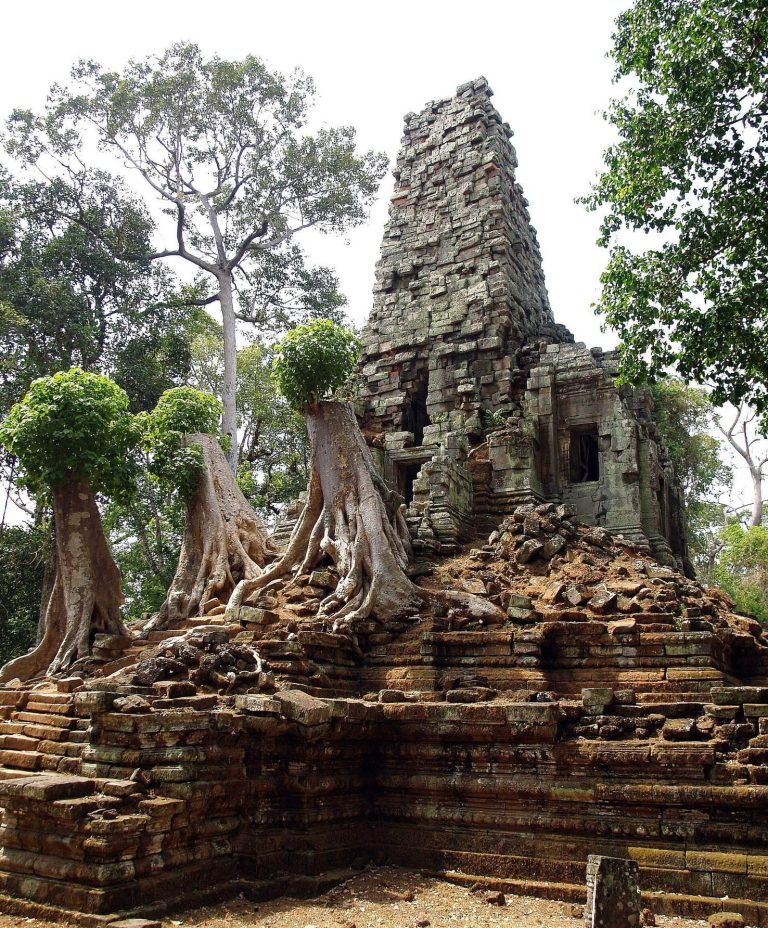
After the centre of the Khmer kingdom shifted south to Phnom Penh in the fifteenth century, Angkor lost much of its former importance. The West Baray and many monuments around Angkor then ceased to be used, while West Mebon deteriorated beneath tropical vegetation.
A local tradition recorded by Maurice Glaize links the temple to a giant crocodile that swallowed the daughter of an Angkorian king. The crocodile escaped through a hole it made in the West Baray’s enclosing embankment. After it was captured and killed, the princess was found alive inside its stomach.
Excavation and restoration
In 1936, Maurice Glaize, working for the École française d’Extrême-Orient, excavated within the temple after a villager dreamed that a buried Buddha wanted to be released. The work uncovered fragments of the large bronze Vishnu and a network of bronze pipes. Glaize cleared the monument of vegetation between 1942 and 1944 and carried out partial anastylosis, a conservation method that reassembles a ruined structure from its original pieces. The work concentrated especially on the two surviving gopuras, or monumental tower gateways.
The poor condition of the walls was probably connected with the combination of stone masonry and wooden structural elements, a building practice used at Angkor in the mid-eleventh century. Initial restoration in the 1940s was followed by decades of routine maintenance by the APSARA Authority. In 2012, after work at the Baphuon, the École française d’Extrême-Orient began a major restoration campaign under Pascal Royère. Cambodian and French conservators, sculptors, engineers, and architects worked to reconstruct the monument while dealing with dispersed sandstone blocks and uncertainty over their original arrangement. A temporary cofferdam, boat transport, and detailed three-dimensional models allowed the project to continue during the monsoon. The major restoration phase reached an initial stage in 2018, while the broader program continued. West Mebon forms part of the Angkor UNESCO World Heritage property.
Remains
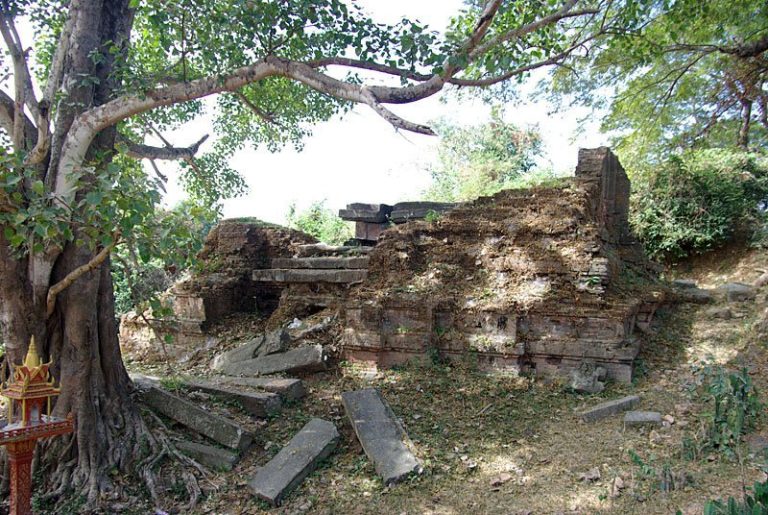
West Mebon occupied a square plan of about 100 metres per side on a square artificial elevation approximately 10 metres above the floor of the West Baray. A sandstone enclosure surrounded an interior basin. The principal surviving remains are the central platform, its causeway, much of the eastern wall, and several tower gateways. In the dry season the temple can be reached by land, while during the rainy season the rising waters of the roughly 7,800-metre-long reservoir surround the higher ground and turn it into an island.
Enclosure and gateways
Sandstone walls
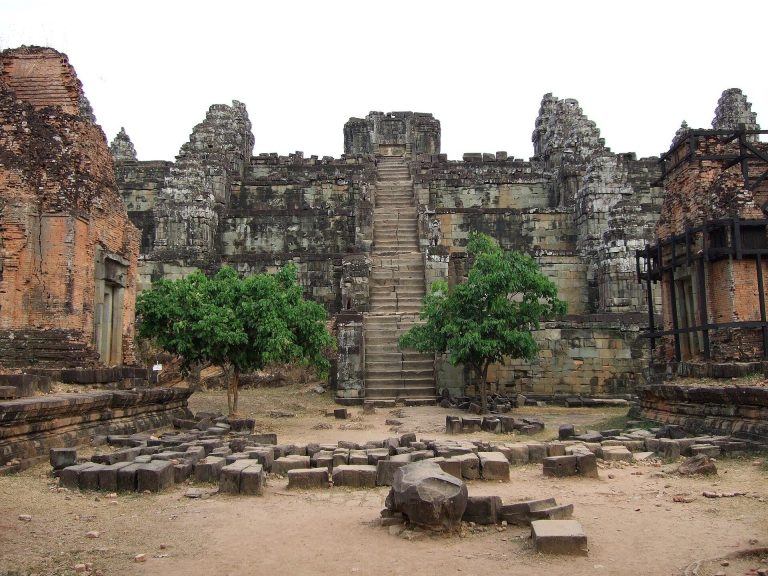
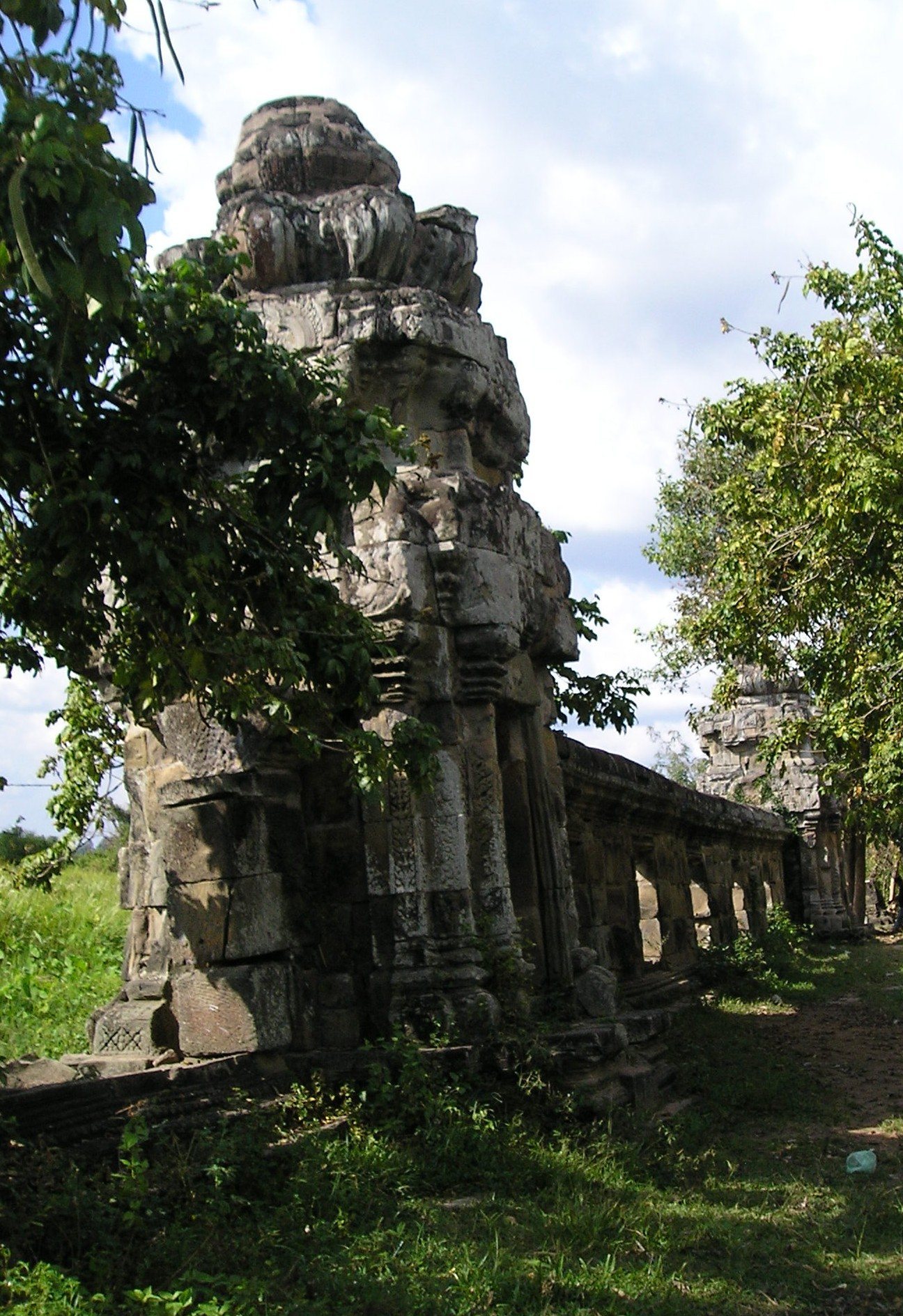
Each side of the enclosure had three monumental sandstone gopuras, arranged roughly 25 to 28 metres apart, giving the enclosure 16 towers in total. The walls ended in broad, corbel-like cornices decorated with lotus blossoms. Gopura pediments were framed by naga forms, serpent beings used in South and Southeast Asian religious art as architectural and protective motifs. Their tympana contained realistic animals set within small squares. Vertical reinforcements on the walls used a fish-bone pattern, while bands around the corner pillars carried volute scrolls and small animals.
Surviving gopuras
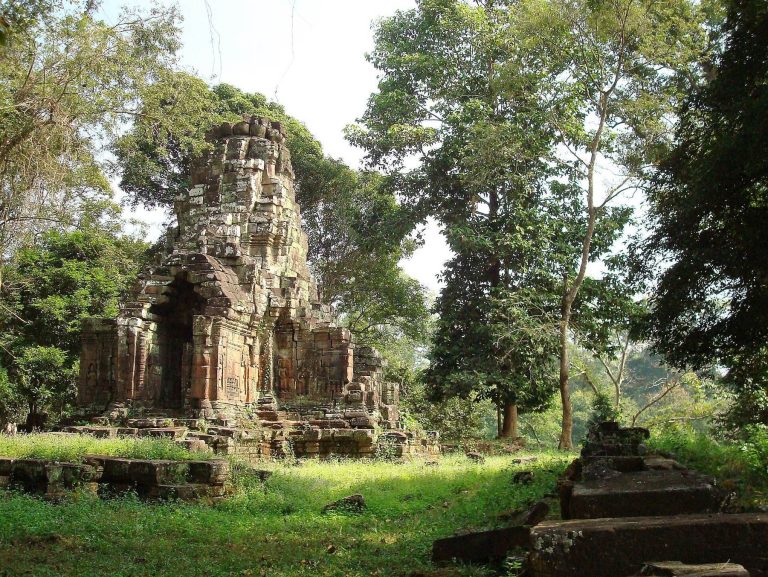
The surviving gopuras have square bases about 2.4 metres wide and interior passages approximately 1.3 metres across. Their upper forms were worked as eight-petalled lotus flowers. Most of the relief decoration has been destroyed, but the ornamental front pediment of the eastern tower on the north wall survives in relatively good condition. Another preserved relief on the eastern lintel of the central eastern gopura shows three figures reaching towards branches. The door frames use angle-bisecting mitred joints, and remains of narrow colonnettes beside the doorways preserve an uncommon design form.
Central basin and platform
Interior basin
A large basin filled the interior of the enclosure. Within it lay a U-shaped pond, with a 12-metre-square sandstone terrace standing between its arms. The terrace probably supported a pavilion made from perishable materials. This arrangement placed the central ritual space within water while retaining a raised stone platform at its centre.
Causeway and terrace
A 43-metre causeway of laterite and sandstone connected the central terrace to the embankment in front of the eastern outer wall. Laterite is a hard, iron-rich material widely used in Khmer foundations, embankments, and structural elements. The surviving terrace and causeway form the principal physical remains of the monument. The other elevations have largely disappeared, although their stone outlines become visible when the level of the West Baray falls.
Well and regulating pond
At the centre of the terrace was a 2.7-metre-deep well shaped like an inverted linga, a representation associated with the Hindu god Shiva. Spiral steps surrounded the well. Its plan began as an octagon measuring 0.55 metres between opposite sides before widening into a circular form approximately 1 metre in diameter. To the east, a square pond measuring 2 metres on each side received water from the well through a bronze pipe, probably helping to regulate the level of water in the basin.
Bronze Vishnu
Excavations in 1936 recovered fragments of a colossal bronze image of Vishnu with four arms, reclining on the serpent Ananta. The statue was originally about 5 to 6 metres long and is the largest known ancient Khmer bronze sculpture of this type. Its iconography represented Vishnu asleep upon the primordial ocean while meditating the creation of the world. A golden lotus was intended to emerge from his navel and give birth to Brahma. The associated bronze pipes and water arrangements have been interpreted as a ritual installation through which water emerged from the deity’s body.
The image survives in fragments, including a well-preserved 2.2-metre-long bust with the head, upper torso, and right arms, approximately 40 large elements, and several hundred smaller pieces. Together, these remains represent about 25 to 30 percent of the original work. The fragments are held by the National Museum of Cambodia in Phnom Penh and have also been exhibited abroad, including in Washington, DC.
In 2024 and 2025, the surviving fragments underwent a major program of study and restoration involving the National Museum of Cambodia, the Guimet Museum, the Centre de recherche et de restauration des musées de France, and the École française d’Extrême-Orient. The restored and studied image was presented at the Guimet Museum in the 2025 exhibition Royal Bronzes of Angkor: Art of the Divine, alongside 126 Cambodian bronze objects dating from the ninth century to the present.