Weitra Palace: A Renaissance Palace in Austria


Site at a Glance
- Rating
- 4.6
- Popularity
- Medium
- Country
- Austria
- Primary era
- Early Modern
- External website
- Open
- Eras represented
- Medieval, Early Modern
- Civilizations
- Habsburg, Holy Roman Empire
- Site type
- Domestic
- Remains
- Palace
On this page8 sections
History
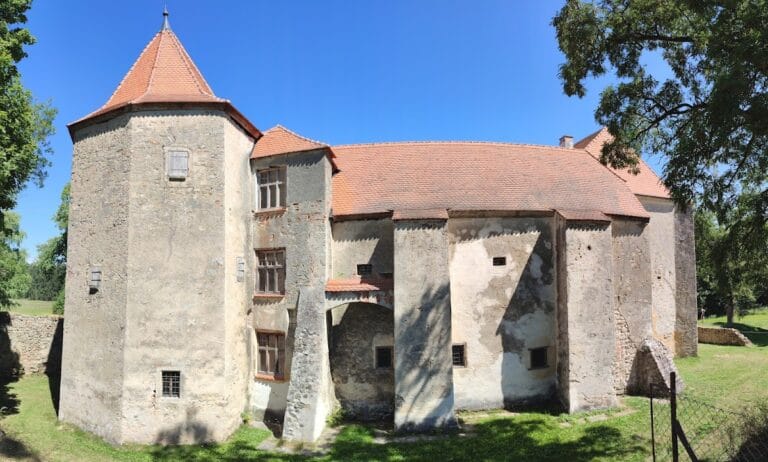
Weitra Palace is a Renaissance palace in Austria, created in the late sixteenth century by transforming a medieval castle founded with the town of Weitra between 1201 and 1208. Hadmar II of Kuenring established the castle and town, beginning Weitra’s development as a seat of noble authority in the Waldviertel.
The Kuenring lordship
The Kuenring family controlled Weitra during the Middle Ages. Heinrich IV of Kuenring-Weitra, marshal of Austria from 1274, fled to Weitra after rebelling against Rudolf I, a medieval ruler whose confiscation of the lordship ended Kuenring control. Following the Battle of Dürnkrut and Jedenspeigen, Stephan von Maissau besieged Weitra. Rudolf I then seized the lordship, although his sons briefly returned it to Leuthold of Kuenring.
Weitra continued to face military pressure in later centuries. Hussite forces, followers of the Bohemian religious reformer Jan Hus, besieged it in 1426 and 1431, while Hungarian forces attacked in 1486. In 1508, the lordship was pledged to Laslav von Prag, Baron of Windhag.
Conversion into a Renaissance palace
In 1582, Rudolf II, a later Habsburg emperor, gave Weitra Castle and the town to his chamberlain Wolf Rumpf, a senior court official, who held the title Baron of Wullroß. Wolf Rumpf’s widow, Maria, née Countess of Arco, later married Count Friedrich of Fürstenberg-Heiligenberg. She bequeathed the castle and town to him after the medieval fortress had been converted into a Renaissance palace.
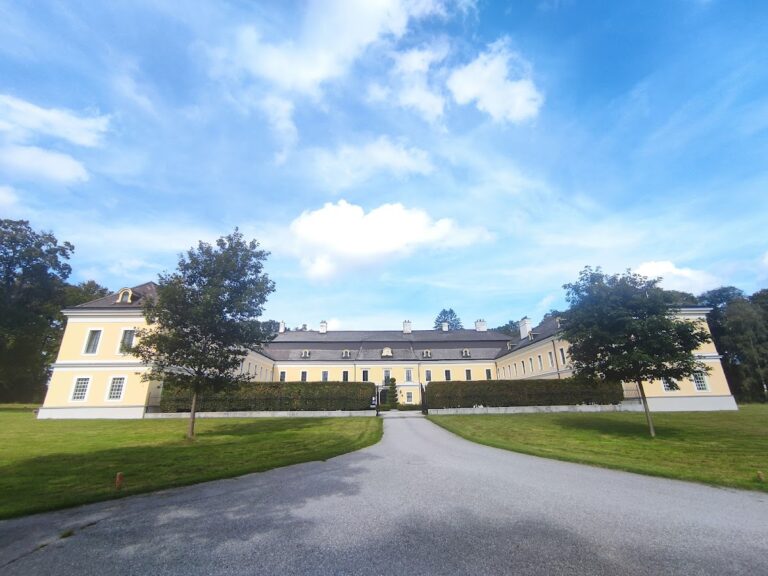
The new palace was built above the original castle complex according to plans drawn by Pietro Ferrabosco in 1588. Fires later brought Baroque and Rococo additions, reflecting the influence of these successive European architectural styles.
The Fürstenberg period
From 1606, Weitra belonged to the princes and landgraves of Fürstenberg, a princely and landgravial aristocratic family. When the Fürstenberg-Heiligenberg line died out in 1716, the palace passed in 1744 to Landgrave Ludwig, the younger brother of Prince Joseph Wilhelm Ernst of Fürstenberg-Stühlingen. Ludwig founded the Fürstenberg-Weitra line, which divided after his death in 1759 into the Weitra and Taikowitz branches. Cardinal Friedrich Egon von Fürstenberg, a senior Roman Catholic cleric, emerged from the Weitra branch.
War damage and renewal
Soviet occupation troops severely damaged the palace ensemble during the Second World War. Its deterioration continued because it stood near the Iron Curtain, the Cold War division between Soviet-aligned Eastern Europe and Western Europe, and because the surrounding region was structurally weak.
Before the 1994 Lower Austrian Provincial Exhibition, Johannes Prince of Fürstenberg renovated the palace and opened it to the public. Since 2006, the covered and heated courtyard has hosted the Weitra Palace Festival, founded by Felix Dvorak. The palace also houses a brewery museum and a permanent exhibition on the Iron Curtain.
Remains
Weitra Palace stands in an elevated position south of Weitra’s old town. Its Renaissance form occupies the site of the earlier medieval castle, so the present ensemble combines the foundations of a fortified predecessor with the later appearance of a noble residence. Fires brought Baroque and Rococo elements to the Renaissance structure, and the palace is currently renovated.
Palace and courtyard
The palace was constructed directly above the original castle complex during the late sixteenth century. Its design followed plans drawn by Pietro Ferrabosco in 1588, while later Baroque and Rococo changes altered the building’s architectural character. The courtyard is covered by large umbrellas and heated, enabling its use as an event venue during unfavorable weather.
Museums and exhibitions
The palace contains a brewery museum and a permanent exhibition devoted to the Iron Curtain. These uses form part of the building’s present cultural function alongside the festival held in its covered courtyard.
Nearby sites