Warcino Palace: A Pomeranian Estate of the von Bismarck Family


Site at a Glance
- Rating
- 4.6
- Popularity
- Very Low
- Country
- Poland
- Primary era
- Early Modern
- External website
- Open
- Eras represented
- Early Modern, Modern
- Civilizations
- German, Holy Roman Empire
- Site type
- Domestic
- Remains
- Elite Residence
On this page11 sections
History
Warcino Palace is a historic estate palace in Poland whose central building developed from a Baroque manor house. The property passed through several Pomeranian noble families before Otto von Bismarck, the nineteenth-century German statesman and first chancellor of the German Empire, acquired it for the von Bismarck family. It remained in the family until the Red Army occupied Pomerania in 1945.
From the Zitzewitz family to the von Blumenthals
In 1485, the estate was held as a fief by the von Zitzewitz family. After the Thirty Years’ War, a major European conflict fought from 1618 to 1648, part of the property was sold to the Pomeranian noble family of Massow. During the eighteenth century, ownership passed to the von Podewils family.
The estate entered the von Blumenthal family through the marriage in 1805 of Auguste, Countess Podewils-Varzin (1784–1859), to Werner Konstantin, Count von Blumenthal (1773–1844). Adalbert von Blumenthal (1821–1882), their younger son, sold the estate in 1867 because of alleged over-indebtedness. Werner von Blumenthal-Suckow was born at Warcino Palace.
The von Bismarck estate
Otto von Bismarck later acquired Warcino for his family. His wife, Johanna von Puttkamer, had grown up on a neighboring estate and was eventually buried at Warcino. Bismarck paid particular attention to the estate’s forests, which provided him with a place for rest and recreation.
Klaus, also known as Nikolaus, Count von Bismarck (1896–1940), came from the Warcino estate and became a politician and large landowner known beyond the region during the 1920s. Around 1914, the estate covered 565 hectares, excluding subsidiary properties in the surrounding area. Its owner was Klaus Count von Bismarck, while senior estate official Dr. Gräbke served as administrator. The estate employed some of the most modern technology available at the time.
In 1939, Nikolaus Count von Bismarck remained the owner. Count Theodor von Medem, an agricultural specialist born in Alexandria, was the tenant, and Mr. Lemke served as chief inspector. Warcino itself covered 2,317 hectares, alongside forests and estates at Misdow A, Puddiger, Seelitz, Wussow, and Chorow, which covered 397, 613, 1,023, 987, and 950 hectares respectively.
War, occupation, and later use
The palace stayed under von Bismarck ownership until the Red Army occupied Pomerania in 1945. Countess Sybille von Bismarck, née von Arnim-Kröchlendorff, was the family’s last resident. She was the widow of Otto von Bismarck’s son Wilhelm, known as “Bill” von Bismarck. Refusing to flee as the Red Army approached, she died by suicide in March 1945 at the age of 81 and was buried in the family mausoleum on the estate.
Count Rule von Bismarck (1920–1991) was regarded as the legal heir. He had served as a reserve officer and later lived in Chile, where he worked as a qualified agriculturalist. From 1946, the palace was used as a training center, and a forestry school was established there in 1951. The Bismarck family mausoleum was destroyed in 1957.
Remains
The surviving estate is organized around a palace that grew through successive additions, with associated service buildings, a landscape park, and other features connected with the von Bismarck family’s occupation of the property.
Palace and associated buildings
The main palace
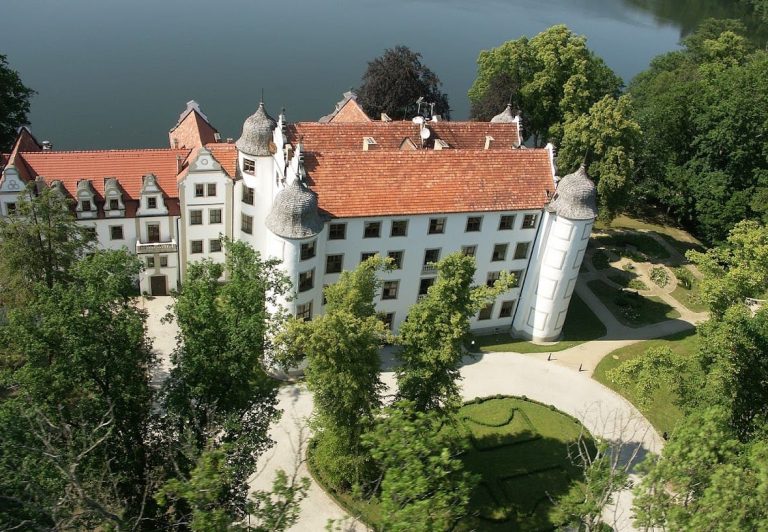
The central palace developed from a Baroque manor house, an early-modern style known for formal composition, strong ornament, and monumental design. The von Podewils family added two side wings. Otto von Bismarck later commissioned a square, flat-roofed extension designed by Ende and Böckelmann, and Wilhelm von Bismarck enlarged the complex again with a Neo-Baroque wing, a later revival of Baroque architectural forms.
Inside the palace, Otto von Bismarck’s study retains its original furniture and a large Silesian tiled stove. The room preserves a direct interior connection with the period of Bismarck family ownership.
The carriage house
A carriage house opposite the palace now contains an educational center, giving the former service building a postwar institutional use within the estate complex.
Park and family features
Landscape park
The extensive landscape park was arranged as a designed estate setting with a naturalistic composition of lawns, trees, water, and garden features. It formerly included Johanna von Bismarck’s rose garden.
Family mausoleum and dog graves
The estate contained the Bismarck family mausoleum, where Countess Sybille von Bismarck was buried in 1945. The grounds also include the graves of Bismarck’s dogs.