Wallenstein Castle: A High-Medieval Hill Castle in Germany


Site at a Glance
- Rating
- 4.4
- Popularity
- Low
- Country
- Germany
- Primary era
- Medieval
- External website
- Open
- Eras represented
- Medieval
- Civilizations
- Holy Roman Empire
- Site type
- Military
- Remains
- Castle
On this page9 sections
History
Wallenstein Castle is a high-medieval hill castle in Germany, probably built by Hersfeld Abbey in the twelfth century to control the western part of the abbey’s territory. Hersfeld Abbey was an ecclesiastical foundation whose abbots also governed surrounding lands and possessions. The castle was established after the Thuringian landgrave had secured a position at Homberg and threatened Hersfeld’s rights and territory.
The Wallenstein family and the two castles
In the early thirteenth century, Count Albert V of Schauenburg held the castle, then called Waldinsteyn, as a pledge. A pledged castle was held temporarily as security for a debt or agreement. From 1223, Albert styled himself Albert of Wallenstein. In 1250 he sold half of the castle and its associated possessions back to Hersfeld Abbey, while developing the more favourably located Neuwallenstein, now Neuenstein Castle, as the family’s principal seat.
In 1267 Albert’s son, Albert II of Wallenstein, made an exchange agreement with Abbot Heinrich III of Hersfeld concerning estates around the two castles. This agreement provides the first recorded mention of Neuenstein Castle. After Albert II died without heirs in 1284, the estate passed to Conrad of Wallenstein, probably a brother of Albert I. Conrad referred to Wallenstein Castle as his own castle in 1290 and founded a new Wallenstein line.
Conrad no longer used a comital title, probably because his Schauenburg predecessors had sold the Obergericht of Ditmelle to the Archbishopric of Mainz during the first half of the thirteenth century. An archbishopric was an ecclesiastical territory governed by an archbishop, and the title was connected with that jurisdiction.
Pledges, fiefs, and changing lordship
The castle was repeatedly pledged during the following centuries. Simon of Homberg held it in 1332 and returned half to the Wallenstein family six years later. By the end of the fourteenth century, the entire castle was again in Wallenstein possession. In the fifteenth century, the Lords of Elben held a share.
In 1438 Archbishop Dietrich of Mainz had to surrender the castle to Landgrave Ludwig I of Hesse. The landgraves were the ruling territorial princes of Hesse, and Ludwig had acquired the protectorate of Hersfeld Abbey in 1432. In 1456, Hans of Wallenstein received half of the castle as a fief from Hersfeld Abbey. A castle fief was a fortified property or estate granted by a superior authority in return for service or allegiance.
The local Wallenstein line became extinct in the male line in 1521 with Konrad II of Wallenstein, a former senior Hessian administrative official and chief court steward. His share passed to the Lords of Reckrodt and, in 1529, as a Hersfeld castle fief, to their heirs, the Hund family. At the same time, Hersfeld Abbey continued granting another Wallenstein branch a castle fief at Wallenstein, a practice that lasted until 1730. The Hund family held its Hersfeld fief at least until 1594.
In 1559, the Lords of Schachten, as co-heirs of the Reckrodt family, received one quarter of the castle as a hereditary Hessian castle fief. They sold this share to the Wallensteins in 1616. The castle and its associated administrative district had already passed to the Hessian landgraves in 1588.
Destruction and later ownership
Croatian troops serving the emperor destroyed Wallenstein Castle in 1637 during the Thirty Years’ War, the major European conflict fought mainly between 1618 and 1648. Because the ruined castle was no longer useful to the landgraves, it was not rebuilt. After the war, in 1648, the entire territory of Hersfeld passed to Hesse.
The Hund family became extinct in 1660, and its share passed to the Lords of Buttlar. They transferred it in 1695 to Landgrave Philipp of Hesse-Philippsthal. Philipp sold the share to his brother Karl, Landgrave of Hesse-Kassel, in 1700. The landgraves then pledged this portion to the last Wallensteins until that line became extinct in 1745, after which the fief reverted to the landgraves.
The former district of Fritzlar-Homberg acquired the ruins from the state of Hesse in 1957. Later repairs stabilised the surviving remains and protected them from further deterioration.
Remains
Inner castle defenses
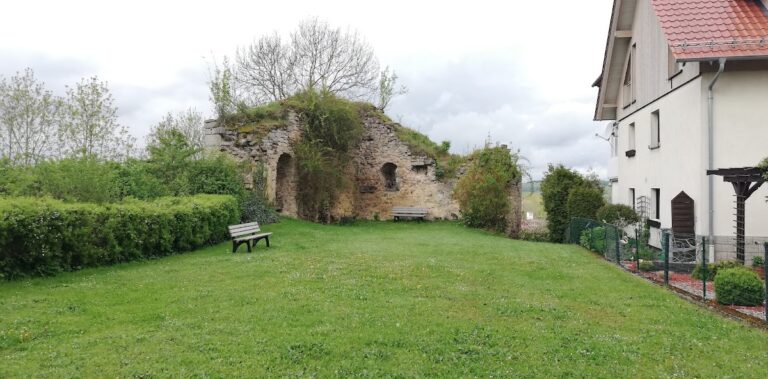
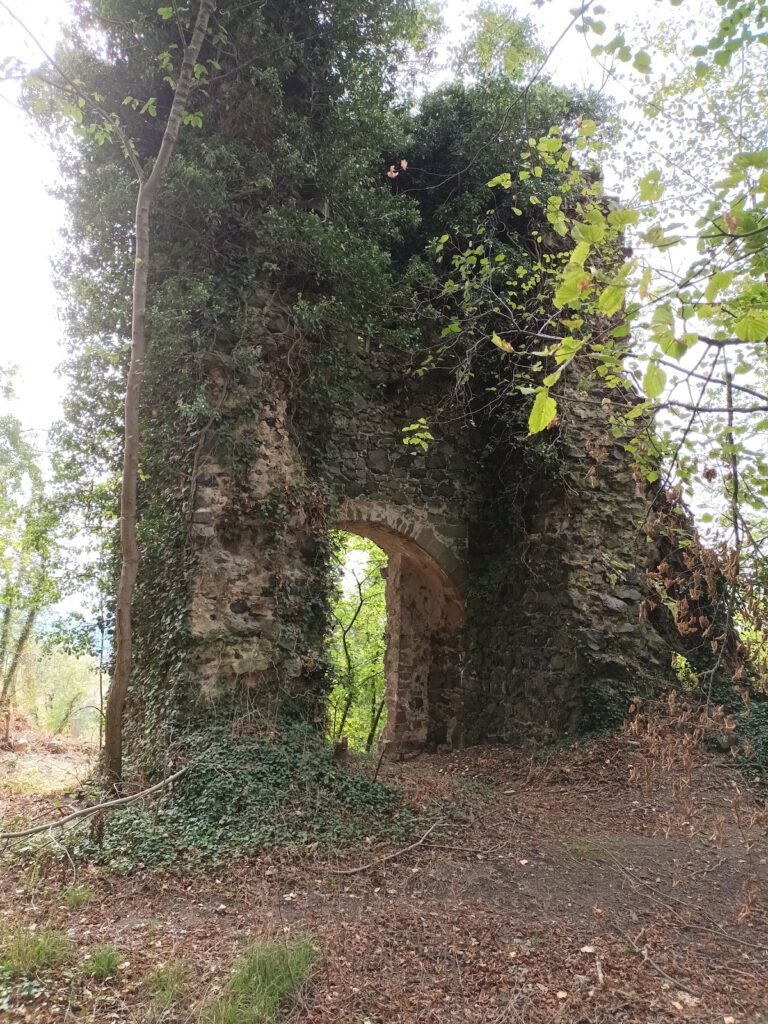
Wallenstein Castle occupies a west-descending mountain spur in a small side valley of the Efze in the Knüll Mountains, at an elevation of 354 metres above sea level. The nearly square inner castle was enclosed by a particularly strong shield wall, known as the High Mantle. A shield wall protected the most exposed side of a castle, and large sections of the High Mantle survive.
Keep
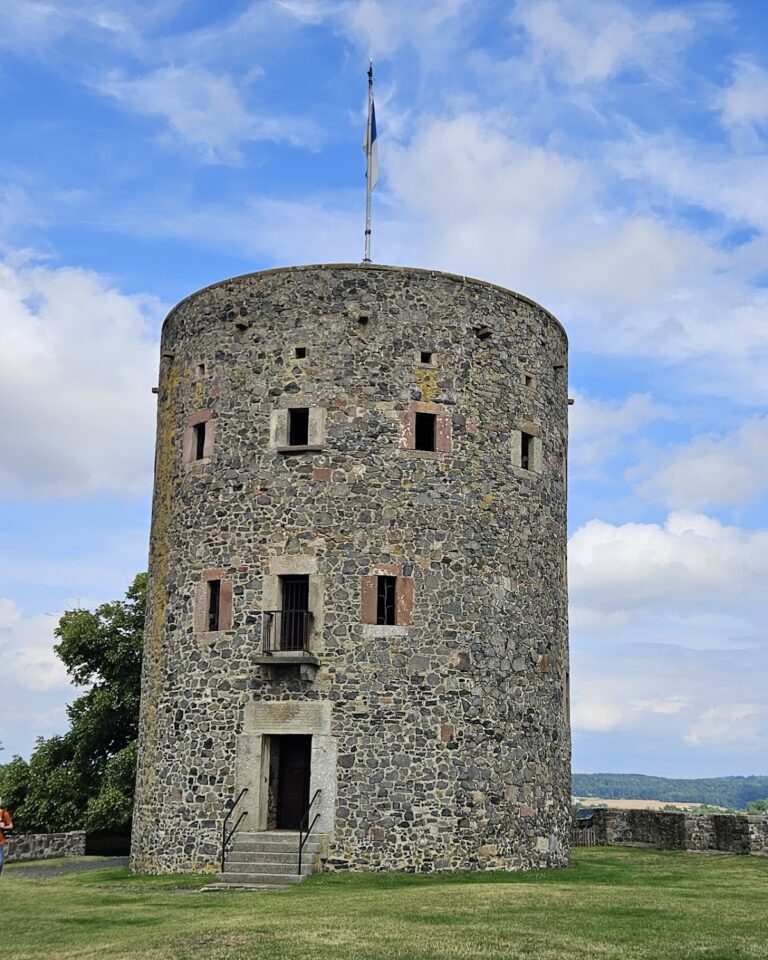
The castle keep is recorded as 12 metres high. It formed part of the inner castle’s defensive complex, whose surviving walls convey the scale of the principal fortified enclosure.
Stair tower
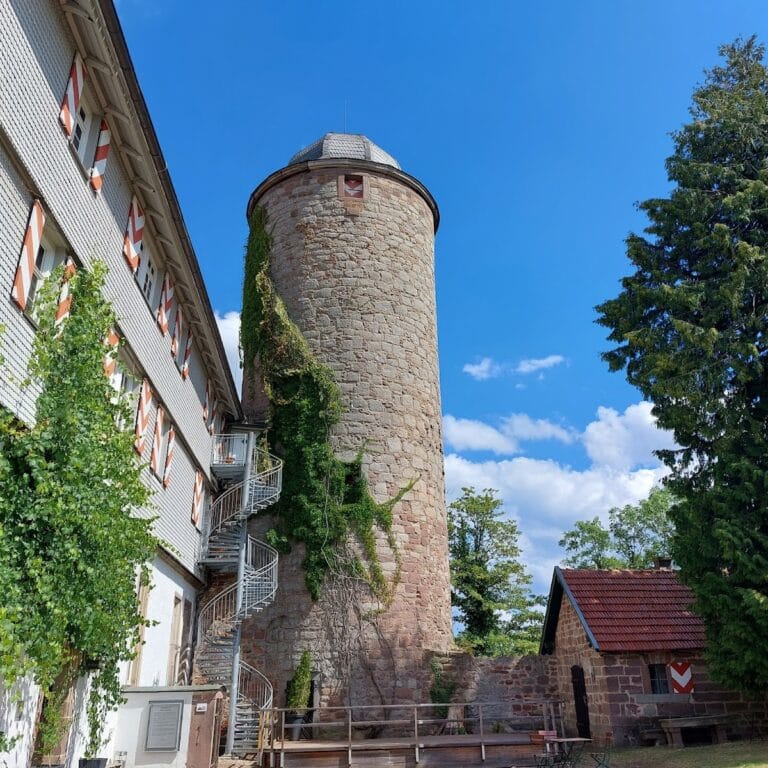
A round stair tower also survives. In modern times, it was converted into a lookout tower by the installation of a spiral staircase.
Outer bailey and surrounding landscape
Only several wall remnants survive from the extensive outer bailey, the subsidiary enclosed area outside the inner castle. The former neck ditch, a ditch cut across the narrow connection between a castle spur and the adjoining terrain, has been filled in. Many other castle buildings were demolished to obtain construction materials.
The 474-metre Babloh rises above the castle. Wallenstein Castle and Neuenstein Castle, the later principal seat of the Wallenstein family, were both situated along an old road running from Hersfeld through Homberg and Fritzlar toward the Kassel area. Neuenstein lies approximately six kilometres southeast on a hilltop above Saasen.
Nearby sites