Waidhaus: Görlitz’s Oldest Surviving Secular Building
Site at a Glance
- Rating
- 4.7
- Popularity
- Low
- Country
- Germany
- Primary era
- Early Modern
- Eras represented
- Early Modern
- Civilizations
- Habsburg, Habsburg Austria, Holy Roman Empire, Kingdom of Bohemia
- Site type
- Economic
- Remains
- Warehouse
On this page7 sections
History
Waidhaus, also known as the Renthaus, is a secular building in Görlitz, Germany, with origins in the 12th century. It is the oldest surviving secular building in the city.
Estate courtyard and municipal ownership
In the first half of the 12th century, an estate courtyard on the property served the territorial lord’s castle and was probably managed by Bohemian retainers. It may also have contained a noble family’s residence. The courtyard had its own tower and was probably close to, or part of, a larger estate courtyard overseen by a Bohemian official.
By the late 14th century, the property was used as a brewery yard. Its owners changed frequently in the early 15th century, though Görlitz mayor Bartholomäus Eberhard owned it for a time, and the site was long associated with his name. The city acquired the property from his heirs in 1425. A spacious tower known as the Eberhard Tower was demolished there in 1426 during the Hussite Wars, early-15th-century conflicts linked to the Hussite religious movement in Bohemia. Erfurt’s auxiliary force, led by Tiezmann von Weberstedt, moved into the courtyard from late April to mid-June 1428. In 1432, it housed the Bohemian nobleman Johann von Michelsberg for more than three months.
School, dye storage, and revenue warehouse
Waidhaus served as a school from 1447 to 1529. A lightning strike caused a severe fire that destroyed the building in 1479. In 1530, the school moved to Krebsgasse 7, and the building began to be used for storing woad, a plant formerly used to make blue dye. Before this change, woad had been stored and sold in private houses. The name Waidhaus comes from this storage use.
The building also served as a warehouse for the territorial governor’s revenues, including grain kept there until 1732. The name Renthaus arose from this function; here it refers to a revenue storehouse.
Fire brigade and later uses
Görlitz’s professional fire brigade was based at Waidhaus from its establishment in 1897 until 1907, when it moved to new premises. In 1992, the German Foundation for Monument Protection began using the building’s interior as a training center. The craft-based center, founded in 1991 as the first of its kind in the eastern German states, trained craftspeople in monument preservation. In 2008, the Council of Europe recognized it, alongside three other European centers, as an exemplary place for training craftspeople to preserve Europe’s architectural heritage. Courses ended in 2016 because of insufficient funding and demand. The building was unused as of March 2021.
Remains
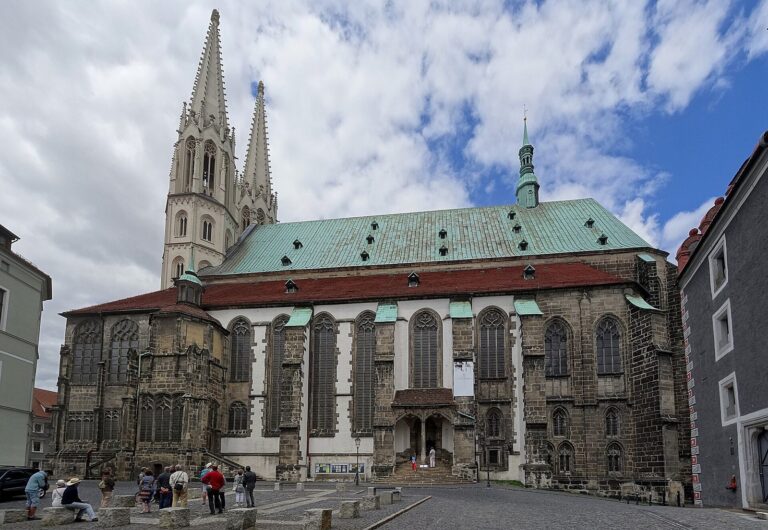
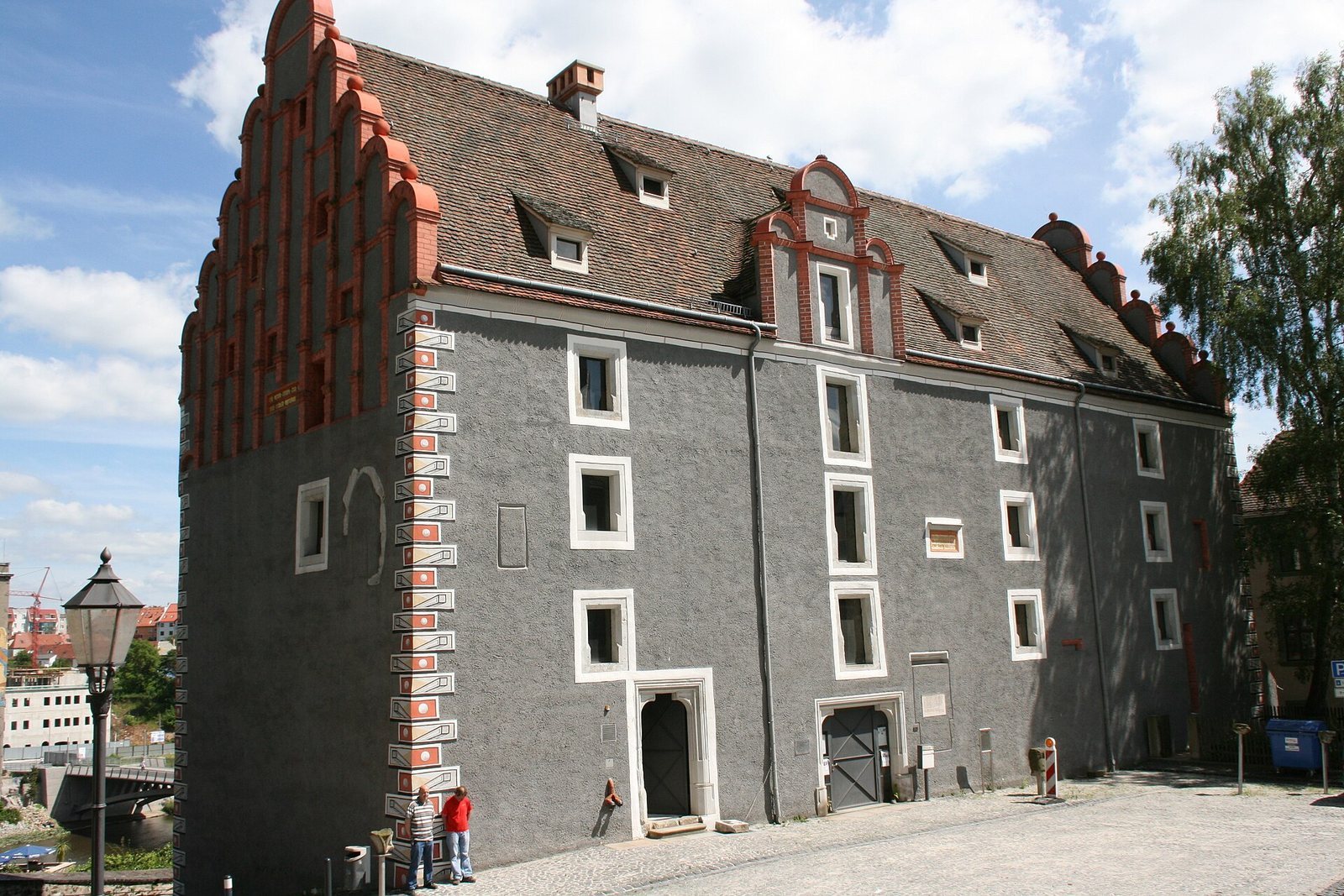
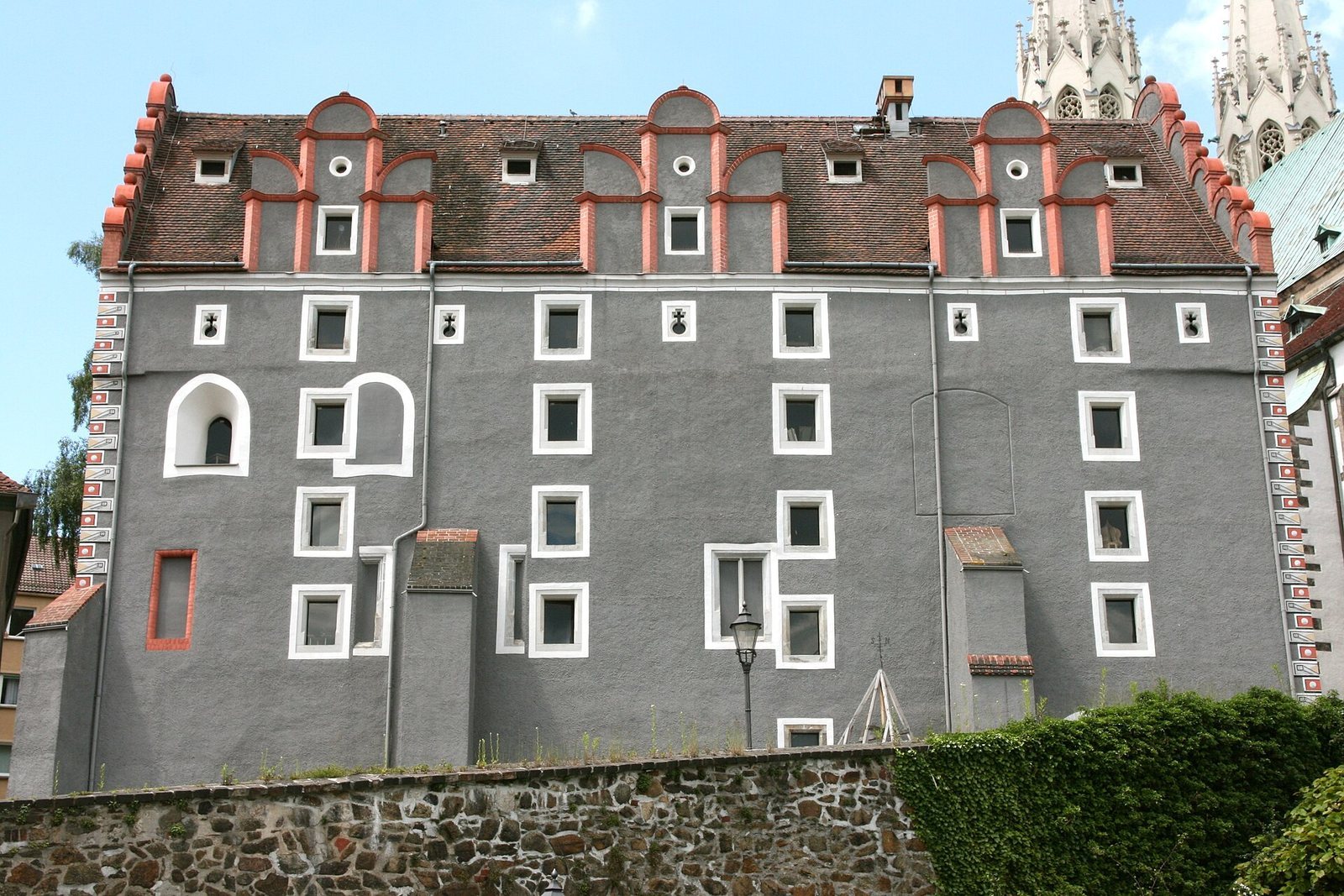
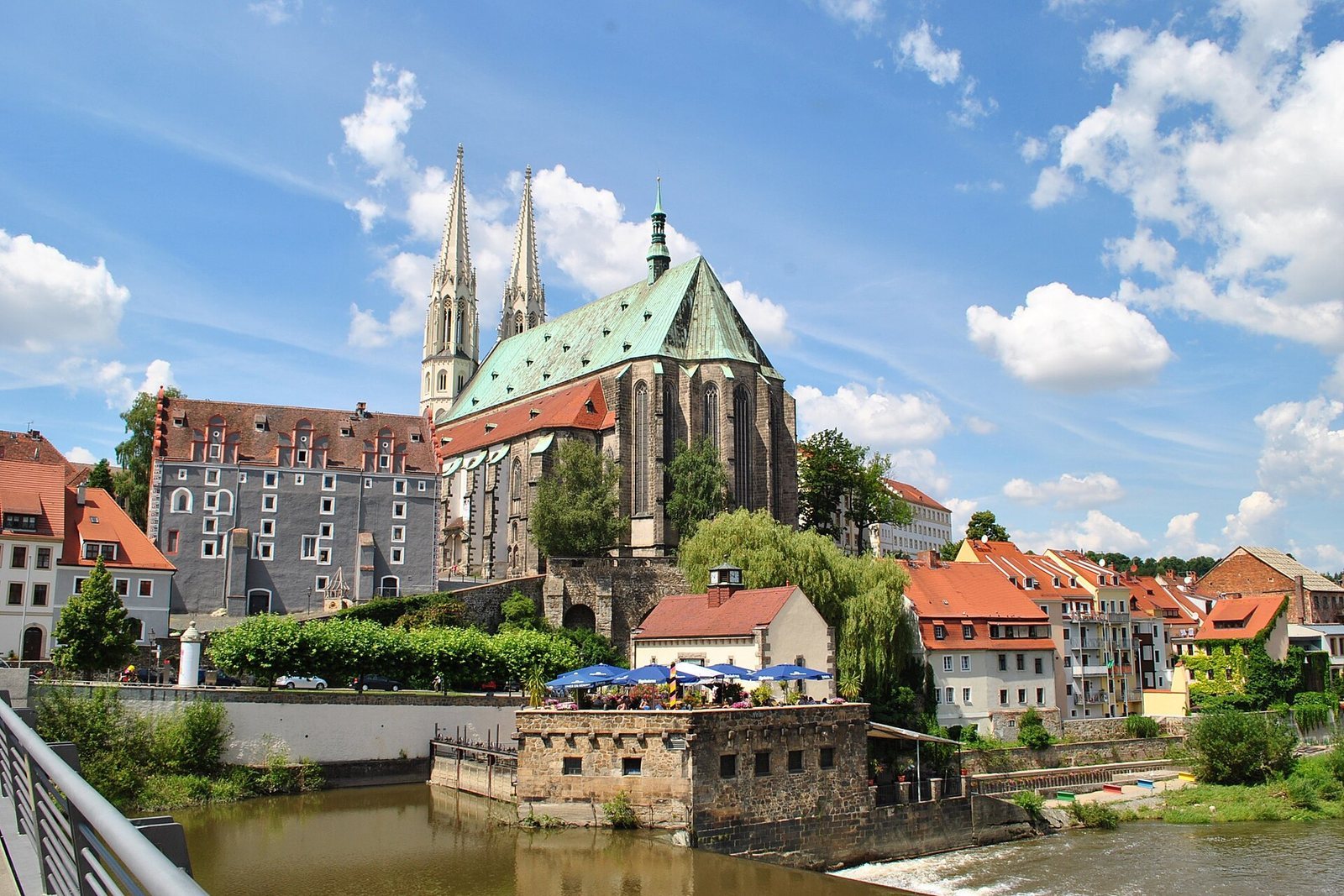
Waidhaus stands on the Kirchberg plateau, between the parish church of St. Peter and Paul to the north and the buildings of Hainwald to the south, separated from them by a small lane. The plateau drops steeply eastward toward the Lusatian Neisse. A footpath links the riverbank with the plateau and the church forecourt, while the square Bei der Peterskirche adjoins the building on the west. Waidhaus probably reached its present height when three floors were added during its conversion for woad storage, creating larger storage rooms.
Gables, inscriptions, and roof
An inscription on the north gable commemorates the fire of 1479 and was probably placed there in 1529. A separate inscription, dated 1529, appears on the west façade. It states that nothing in human affairs is nobler than serving the commonwealth well. In 1578, wall dormers on the east side, facing the Neisse, were removed and the roof was flattened. The gables were restored in 1936 using a 1565 woodcut as a guide. After German reunification, the building was refurbished in 1993–94, and the eastern roof dormers were reconstructed with reference to the same woodcut.
Stonecutters’ marks
Work in 1908 revealed about 50 stonecutters’ marks, drawn in red chalk in an interior room. Their presence suggests that Waidhaus may also have served as a work hut for stoneworkers engaged on the parish church of St. Peter and Paul.